
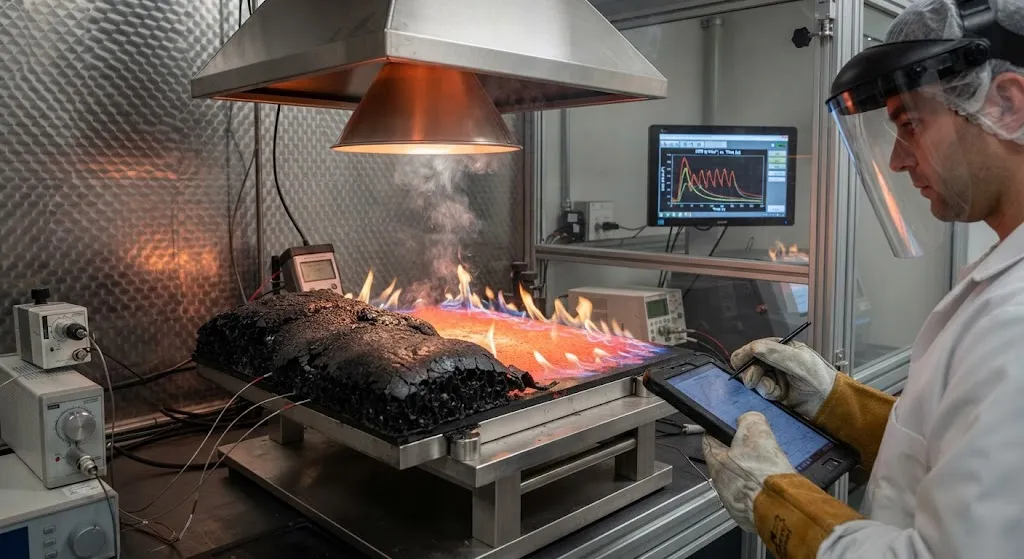
Carbon fiber reinforced polymer (CFRP) composites are inherently combustible — the organic polymer matrix (typically epoxy, polyester, or vinyl ester) ignites and burns when exposed to sufficient heat flux, releasing heat and toxic gases. This combustibility is the primary barrier to broader adoptio
Introduction
Carbon fiber reinforced polymer (CFRP) composites are inherently combustible — the organic polymer matrix (typically epoxy, polyester, or vinyl ester) ignites and burns when exposed to sufficient heat flux, releasing heat and toxic gases. This combustibility is the primary barrier to broader adoption of carbon fiber composites in fire-safety-critical applications such as aircraft interiors, building facades, railway vehicles, and marine structures. Fire resistance in composite structures is not a material property of the carbon fiber itself — which is thermally stable to approximately 500 degrees C in air — but rather a system-level performance that depends on the resin system, protective coatings, and structural design.
This article explains the fire behavior of polymer matrix composites, reviews the intumescent coatings and fire-barrier solutions that protect composite structures, examines the fire test standards that govern regulatory compliance, and provides guidance for engineers balancing fire resistance requirements against mechanical performance and weight constraints.
Fire Behavior of Polymer Matrix Composites
When a carbon fiber composite is exposed to fire, the material passes through four distinct phases:
- Heating and decomposition: As the surface temperature rises above 200-300 degrees C, the polymer matrix begins to decompose (pyrolysis), releasing volatile gases. The decomposition rate depends on the resin chemistry — epoxy resins decompose at 300-400 degrees C, while phenolic resins are stable to 400-500 degrees C.
- Ignition: When the concentration of pyrolysis gases at the surface exceeds the lower flammable limit and is in contact with an ignition source (flame, spark, or sufficient radiant heat), the composite ignites. The critical heat flux for ignition of typical epoxy-carbon fiber composites is 20-40 kW/m2.
- Burning and heat release: Once ignited, the composite burns with a heat release rate (HRR) that depends on the resin content, fiber architecture, and whether fire-retardant additives are present. Unprotected epoxy CFRP has a peak HRR of 150-300 kW/m2 — comparable to wood and significantly lower than liquids like gasoline (3,000+ kW/m2) but still sufficient to sustain fire spread.
- Char formation and structural residual: After the resin is consumed, a carbonaceous char residue remains on the carbon fiber reinforcement. The char layer provides some insulation, slowing heat transfer to the unburned composite beneath. Phenolic resins form the most effective char, retaining 50-60% of original mass, while epoxies retain only 15-25%.
Intumescent Coatings for Composite Fire Protection
Intumescent coatings are the most widely used passive fire protection method for composite structures. When exposed to fire, these coatings膨胀 (swell) to 10-50 times their original thickness, forming an insulating carbonaceous char foam that shields the underlying composite from heat.
| Coating Type | Expansion Ratio | Fire Rating Achieved | Dry Film Thickness | Weight Penalty |
|---|---|---|---|---|
| Water-based intumescent | 10-25x | 30-60 minutes | 0.5-2.0 mm | 1-4 kg/m2 |
| Solvent-based intumescent | 20-40x | 60-120 minutes | 1.0-3.0 mm | 2-6 kg/m2 |
| Epoxy intumescent (2K) | 15-30x | 60-90 minutes | 1.5-4.0 mm | 3-8 kg/m2 |
| Ceramic-filled intumescent | 5-15x | 90-180 minutes | 2.0-6.0 mm | 5-12 kg/m2 |
The intumescent mechanism involves three chemical reactions occurring simultaneously at fire temperatures (250-500 degrees C): (1) acid source decomposition releasing phosphoric acid, (2) carbon source dehydration forming the carbonaceous char backbone, and (3) blowing agent decomposition releasing gases that膨胀 the char into a low-density foam. The quality of the intumescent char — its density, thermal conductivity (typically 0.1-0.2 W/mK, compared to 0.3-0.5 W/mK for solid char), and mechanical integrity — determines the fire protection performance.
Fire-Barrier Solutions for Composite Structures
Beyond intumescent coatings, several fire-barrier approaches are used to protect composite structures:
- Fire-resistant prepreg systems: Phenolic-based prepregs offer inherent fire resistance with char yields of 50-60%, peak HRR below 50 kW/m2, and low smoke density. Phenolic CFRP is the standard material for aircraft interior panels, floor panels, and cargo liners, meeting FAR 25.853 fire requirements without additional coatings.
- Ceramic fiber blankets and mats: Alumina-silica fiber blankets (2-10 mm thick) are applied between composite layers or over composite surfaces, providing thermal insulation up to 1,260 degrees C. These barriers are used in marine engine rooms, building facades, and industrial equipment enclosures.
- Endothermic fire barriers: Hydrated mineral fillers (aluminum trihydrate, magnesium hydroxide) incorporated into the resin matrix absorb heat through endothermic decomposition, releasing water vapor that dilutes flammable gases. Loading levels of 40-60% by weight reduce peak HRR by 50-70% but significantly increase density and reduce mechanical properties.
- Multi-layer protective systems: Aerospace fire protection often combines an intumescent base coat with a topcoat for mechanical protection, or integrates fire-barrier films between composite plies during layup. The Boeing 787 uses a combination of phenolic resin matrices and intumescent edge coatings for cargo compartment fire protection.
Fire Test Standards for Composite Structures
Fire performance requirements for composite structures vary by application sector, with distinct test standards governing each:
| Standard | Application | Key Requirements | Test Method |
|---|---|---|---|
| FAR 25.853 | Aircraft interior | Self-extinguishing, low heat release, low smoke/toxicity | Vertical Bunsen burner, OSU calorimeter |
| ASTM E119 / EN 1363 | Building construction | Fire resistance rating (30-120 min load-bearing) | Furnace test with standardized time-temperature curve |
| EN 45545 | Railway vehicles | Reaction to fire (HL1-HL3), smoke density, toxicity | Cone calorimeter, smoke density chamber |
| FTP Code (IMO) | Marine structures | Fire integrity, smoke generation, toxicity | Surface flame spread, non-combustibility |
| UL 94 | Electronics enclosures | Flame classification (V-0, V-1, V-2, HB) | Vertical burning test |
Compliance with these standards often requires system-level testing of the complete composite assembly — including core material, adhesives, coatings, and edge seals — rather than material-level testing of the bare composite laminate.
Engineering Trade-Offs: Fire Resistance vs Mechanical Performance
Every fire protection measure imposes penalties on the composite structure that must be balanced against the fire safety requirement:
- Weight: Intumescent coatings add 1-12 kg/m2 depending on the required fire rating. For a commercial aircraft with 500 m2 of interior composite panels, this translates to 500-6,000 kg of additional coating weight — directly reducing payload capacity.
- Mechanical properties: Flame-retardant resin additives (halogenated compounds, phosphorus-based FRs) can reduce interlaminar shear strength by 10-20% and impact resistance by 15-30% due to interference with the epoxy crosslinking network.
- Manufacturing complexity: Fire-barrier coatings require additional application steps (spray, brush, or film placement), cure cycles, and quality inspection, increasing part cost by 15-30%.
- Repair and maintenance: Intumescent coatings damaged by impact or abrasion must be repaired to maintain fire rating, adding lifecycle maintenance costs.
Frequently Asked Questions
Can carbon fiber composite structures achieve the same fire ratings as steel or concrete?
With appropriate fire protection systems, yes. Phenolic CFRP panels with intumescent edge coatings can achieve 60-90 minute fire resistance ratings under ASTM E119 criteria, comparable to light-gauge steel assemblies. However, the composite structure must be designed with fire protection as an integral part of the structural system, not as an afterthought. The key difference from steel is that CFRP loses mechanical properties above 200-300 degrees C (glass transition temperature), while steel retains strength to approximately 500-600 degrees C. This means composite fire protection must maintain lower substrate temperatures than steel fire protection.
What are the most effective fire-retardant additives for epoxy resin systems?
Phosphorus-based flame retardants (ammonium polyphosphate, resorcinol bis(diphenyl phosphate)) are the most widely used non-halogenated options, reducing peak HRR by 30-50% at 15-25% loading by weight. Aluminum trihydrate (ATH) is the lowest-cost option at 40-60% loading but significantly increases density. Nitrogen-based FRs (melamine compounds) offer synergistic effects when combined with phosphorus systems. Halogenated FRs (brominated epoxies) provide the highest fire performance but face increasing regulatory restrictions due to toxic smoke generation.
How do intumescent coatings perform under dynamic fire conditions such as jet engine fires?
Standard intumescent coatings are designed for static fire exposure following a prescribed time-temperature curve. Under dynamic conditions such as jet engine fires (where heat flux can exceed 200 kW/m2 with turbulent flame impingement), standard intumescent coatings may fail to develop properly or may be blown off by the flame dynamics. For these applications, ceramic-filled intumescent systems or multi-layer fire barriers with mechanical retention features are required. Aerospace fire testing includes dynamic fire scenarios (FAA 12-second torch test, radiant panel tests) that validate coating performance under realistic fire conditions.
Conclusion
Fire resistance in carbon fiber polymer matrix composite structures is a system-level engineering challenge that requires coordinated solutions across resin chemistry, surface protection, and structural design. Intumescent coatings, fire-barrier materials, and flame-retardant resin systems each offer distinct advantages and trade-offs in the balance between fire protection and mechanical performance. The applicable fire test standards — FAR 25.853 for aircraft, EN 45545 for railways, FTP Code for marine — define the performance targets, but achieving these targets requires careful integration of fire protection into the composite structure from the design phase.
For engineers specifying fire-resistant composite solutions, the selection of fire protection approach must be driven by the specific regulatory requirements, the fire exposure scenario, and the allowable weight and performance penalties. Explore our carbon fiber fabrics and fire-resistant resin systems, or contact our engineering team to discuss fire protection solutions for your composite structure application.
Related Articles
- Carbon Fiber HP-RTM Cycle Time Optimization: High-Pressure Resin Transfer Molding for Automotive
- Continuous Fiber Reinforced Thermoplastics: CFRT vs Thermoset Processing and Applications
- Carbon Fiber Nanostitching and Interleaving: Toughness Enhancement for Delamination Resistance
- Bio-Based Carbon Fiber Precursors: Lignin and Polyethylene for Low-Cost Production
- Large-Tow Carbon Fiber Cost Analysis: 48K vs 60K Price-Performance Comparison
- Carbon Fiber-Resin Interface Bonding: Surface Treatment and Coupling Agent Optimization
Interested in Our Products?
Contact our team for competitive pricing and technical specifications.
Get a QuoteRelated Products
Carbon Fiber Fishing Rod Blank
High-quality carbon fiber fishing rod blank manufactured from multiple grades of Toray carbon fiber cloth. Available in a wide range of lengths, powers, and actions for freshwater and saltwater applications. Suitable for OEM rod building.

Carbon Fiber Plate — 3K Twill T700 1.5mm
Thin 1.5mm carbon fiber plate with 3K twill weave surface. Lightweight and stiff, commonly used for covers, panels, drone bodies, and applications requiring a premium aesthetic appearance.

Carbon Fiber Plate — 3K Twill T700 3.0mm
Medium-thickness 3.0mm carbon fiber plate offering significantly higher load capacity while maintaining attractive 3K twill finish. Suitable for structural brackets, reinforcement plates, and load-bearing panels.

Carbon Fiber Trekking Pole
Lightweight carbon fiber trekking pole manufactured from high-grade carbon fiber tube. Weighs only 160g per pole while providing superior shock absorption and durability for hiking, trail running, and backpacking.

Square Carbon Fiber Tube — 3K Twill T700
Square cross-section carbon fiber tube manufactured with 3K twill weave for torsional strength. Preferred for structural frames, trusses, and support columns where rectangular geometry offers design flexibility.