
Motorcycle chassis design is a constant fight between stiffness and mass, because the frame sits directly in the load path between the front and rear wheels and dictates how precisely the bike changes direction. For decades the two dominant solutions were the steel tube trellis, refined
Introduction
Motorcycle chassis design is a constant fight between stiffness and mass, because the frame sits directly in the load path between the front and rear wheels and dictates how precisely the bike changes direction. For decades the two dominant solutions were the steel tube trellis, refined by Ducati and its imitators, and the aluminum twin-spar beam used by almost every Japanese superbike. Carbon fiber introduced a third architecture in the 1990s through race prototypes such as the MotoCzysz C1, the first MotoGP machine built around a full carbon monocoque, and it moved into showrooms with limited-edition machines like the BMW HP4 Race, whose complete carbon frame weighs about 7.8 kilograms.
This article examines why the carbon monocoque is fundamentally different from welded metal frames, where it outperforms them, and where it still loses. The comparison matters less for a track special and more for a serious question facing every performance bike program: how far can composites push the power-to-weight and agility envelope before certification, crash, and cost constraints pull them back?
Why Frame Mass Matters on a Motorcycle
Suspension and rider weight dominate any motorcycle, but the frame has an outsized effect because of where it sits. It is the largest unsprung-adjacent moving mass in the load path, and its polar moment of inertia governs how quickly the bike can flip from one lean angle to another. Saving mass in the frame is worth more than saving the same mass in bodywork because chassis inertia is multiplied by the square of the distance from the steering axis. A frame that drops from 12 kilograms to 7 kilograms changes the steering response measurably even on a 200 kilogram machine.
The second reason is total weight itself. A superbike aiming at the 170-180 kilogram wet weight class finds that reducing chassis mass is one of the few legal ways to gain acceleration and braking performance without touching engine power. Every kilogram removed from the frame also lowers the center of gravity when the savings come from the upper structure, which improves cornering clearance and front-end feel under braking.
Steel Trellis vs Aluminum Twin-Spar vs Carbon Monocoque
Each architecture represents a different answer to the same problem: carry bending and torsional loads while connecting the steering head, swingarm pivot, and engine mounts. The table below summarizes the typical trade-offs for a 1000-class performance bike.
| Architecture | Typical frame mass | Torsional stiffness | Production cost | Typical users |
|---|---|---|---|---|
| Steel tube trellis | 10-13 kg | Moderate, tunable | Low-moderate | Ducati tradition, naked bikes, customs |
| Aluminum twin-spar | 8-10 kg | High, stiff by design | Moderate | Japanese superbikes (R1, GSX-R, ZX-10R) |
| Carbon monocoque | 6-9 kg | Very high, laminate-tunable | Very high | Track specials, limited editions, racing |
The aluminum twin-spar won the production wars because it is stiff, cheap to cast and weld, and easy to tune through cross-section changes. The steel trellis survives because thin-wall tubes fail gracefully and the open structure allows easy engine access. Carbon monocoques produce the highest stiffness per unit mass of the three, but the cost of tooling and autoclave cycles keeps them out of mass production.
Monocoque Engineering: Load Paths and Structure
A carbon monocoque is not a set of beams connected by joints; it is a single continuous shell that combines the roles of frame, airbox, and part of the fuel tank. Removing bolted connections is the main structural advantage, because every bolted joint in a trellis or twin-spar frame is a local flexibility and a stress concentration. The monocoque transfers loads directly through the skin, with the fiber orientation tailored region by region: hoop layers around the steering head handle the radial loads, axial layers along the top and bottom surfaces carry the bending moment, and plus/minus 45 degree layers carry shear.
Because the laminate can be oriented per load case, a monocoque achieves its twist and bending targets with less material than an isotropic metal structure. Engineers exploit this by co-curing hard points, such as aluminum inserts for the swingarm pivot and steering bearings, directly into the layup. The wall thickness of a typical superbike monocoque varies from about 2 millimeters in lightly loaded skin areas to 8-12 millimeters in the head and pivot zones, much of it in high-strength intermediate-modulus tow at fiber volume fractions above 60%.
How Carbon Frames Are Manufactured
Every serious carbon frame program uses a combination of prepreg layup and autoclave cure, because motorcycle frames demand the void control and fiber volume fraction that only pressure consolidation delivers. The typical sequence is:
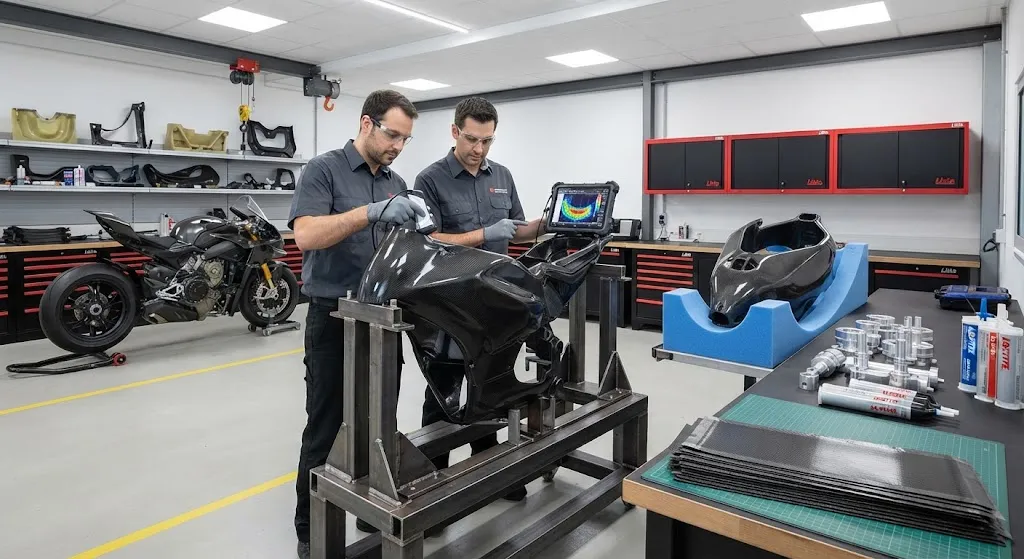
- Master buck and tooling: a male master is machined to the final envelope, then female carbon tooling is laid up on it so that the production shell has class-A surfaces on both sides.
- Programmed layup: prepreg plies are cut by automated nesting, draped into the female tool, and inspected ply by ply before consolidation.
- Autoclave cure: the closed tool goes through a 130-180 degree Celsius cure cycle at 6-10 bar, which compacts the laminate to under 1% void content.
- Post-machining: bearing bores are drilled with diamond tooling, inserts bonded with structural adhesive, and the shell trimmed and edge-sealed.
- Non-destructive testing: ultrasonic scanning of the head and pivot zones verifies that no delamination was introduced during handling or machining.
The price of this route is time and tooling. A monocoque shell spends 6-10 hours in the autoclave plus hours of hand layup, which is why the technique appears only on machines sold in hundreds, not tens of thousands.
Certification, Crash and Repairability
Road homologation treats the frame as a safety-critical part, so carbon frames must pass fatigue and load proof tests defined by regional type approval. The European framework requires the frame to demonstrate finite-life behavior under repeated maximum load cases, which composites manage well because their fatigue curves are flatter than steel's when the laminate is properly designed. The greater concern is crash behavior: a metal frame bends and can sometimes be straightened, while a carbon shell that has absorbed a hard impact may carry invisible delamination. Manufacturers therefore use sacrificial structures, replaceable lower body sections, and stringent post-crash inspection protocols rather than repairing the main shell.
Repairability also shapes the cost argument. A scuffed aluminum frame might be re-machined for a few hundred dollars; a damaged carbon monocoque is typically declared beyond economical repair and replaced, at a cost that can exceed the resale value of the motorcycle. That asymmetry is the single largest reason carbon frames remain a niche within performance bikes rather than the default, even where the performance case is clear.
Frequently Asked Questions
How much does a carbon fiber motorcycle frame weigh compared with steel?
A steel trellis frame for a 1000-class bike typically weighs 10-13 kilograms, while a comparable carbon monocoque comes in around 6-9 kilograms including the bonded metal inserts. The realized saving on an actual motorcycle is usually 3-5 kilograms, because the monocoque also integrates airbox and tank structures that are separate components on a steel bike. The HP4 Race demonstrated about 7.8 kilograms for its complete carbon frame, roughly 35% lighter than an equivalent steel structure.
Why are production motorcycles not built with carbon frames?
Cost and repairability are the blockers, not performance. A carbon monocoque requires female tooling, hand layup, an autoclave cycle, and ultrasonic inspection per unit, which lands the frame cost in the range of a small car while steel and aluminum frames are cast or welded in minutes for a few hundred dollars. Crash behavior is the second reason: a hidden delamination from an impact cannot be assessed by eye, so insurers and owners treat a damaged composite frame as a write-off far more quickly than a damaged metal one.
Is a carbon monocoque stiffer than an aluminum twin-spar frame?
At equal mass, yes, and by a wide margin. A unidirectional carbon laminate offers roughly 130-150 GPa of modulus at a density near 1.6 grams per cubic centimeter, giving a specific stiffness three to four times that of aluminum. The practical result is that a monocoque can exceed the torsional stiffness of a twin-spar at about 70% of its mass. The caveat is that stiffness is laminate-direction dependent, so the designer must orient fibers down the load paths, which is why monocoque development is a few years of finite element iteration rather than a simple casting redesign.
Conclusion
Carbon fiber motorcycle frames win decisively on stiffness-to-mass ratio, and the monocoque architecture compounds the advantage by eliminating bolted joints and integrating the airbox and tank structure. Those gains are real enough to have driven racing prototypes for three decades and to justify limited production runs such as the HP4 Race. But the same properties that make the monocoque brilliant in bending make it expensive to build and unforgiving to crash, which is why it will not displace welded metal frames in volume production until tooling and repairability costs fall by an order of magnitude.
For teams and OEMs evaluating a composite frame program, the decision starts with a laminate design study against your actual load cases, followed by prototype fatigue proof, not by assuming the racing results transfer directly. Explore our carbon fiber sheet, tube, and prepreg range for structural prototyping, or contact our engineering team to discuss laminate design and supply for your chassis program.
Part of topic
Related Articles
- Carbon Fiber Sheets for Sale: A Buyer Checklist for Thickness, Weave and Finish
- Carbon Fiber Plate Running Shoes: Manufacturing Process and Material Specifications
- Carbon Fiber Tubes for Sale: Spec Sheet Fields That Actually Matter
- Carbon Fiber Sheets Near Me: Local Dealers and Quick Turnaround Procurement
- Carbon Fiber Tubes Near Me: Local Stock Availability and Same-Day Delivery Options
- Carbon Fiber Plate Orthotic: Lightweight Prosthetic and Medical Device Applications
Interested in Our Products?
Contact our team for competitive pricing and technical specifications.
Get a QuoteRelated Products

Carbon Fiber Plate — 3K Twill T700 1.5mm
Thin 1.5mm carbon fiber plate with 3K twill weave surface. Lightweight and stiff, commonly used for covers, panels, drone bodies, and applications requiring a premium aesthetic appearance.

Carbon Fiber Plate — 3K Twill T700 3.0mm
Medium-thickness 3.0mm carbon fiber plate offering significantly higher load capacity while maintaining attractive 3K twill finish. Suitable for structural brackets, reinforcement plates, and load-bearing panels.

Square Carbon Fiber Tube — 3K Twill T700
Square cross-section carbon fiber tube manufactured with 3K twill weave for torsional strength. Preferred for structural frames, trusses, and support columns where rectangular geometry offers design flexibility.
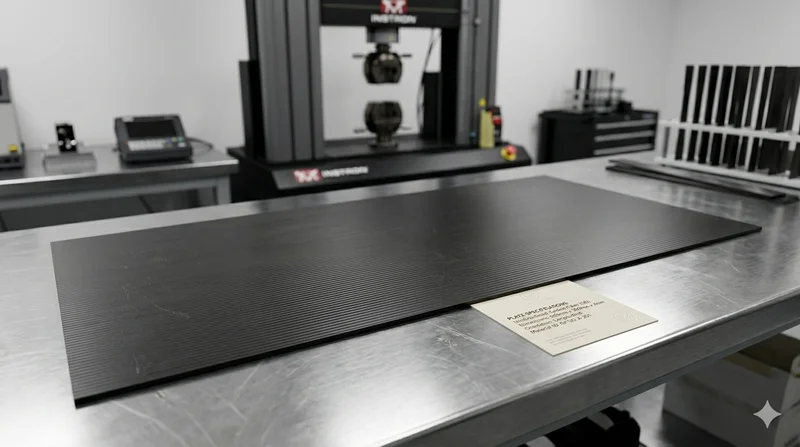
Carbon Fiber Plate — UD Unidirectional T700
Unidirectional carbon fiber plate with all fibers oriented in a single direction for maximum strength along the fiber axis. Essential for structural reinforcements, splints, and applications where load direction is predictable.
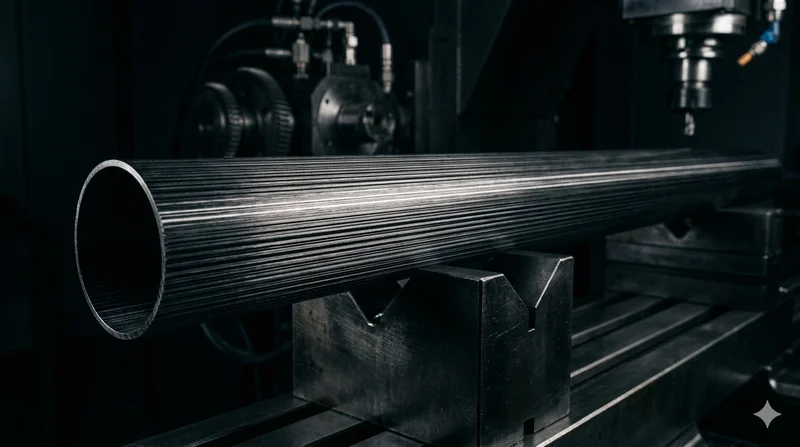
Round Carbon Fiber Tube — UD Unidirectional T700
Unidirectional (UD) round tube with all fibers aligned axially for maximum longitudinal stiffness. Ideal for applications requiring high bending rigidity with minimal weight, such as shafts, struts, and structural reinforcements.