
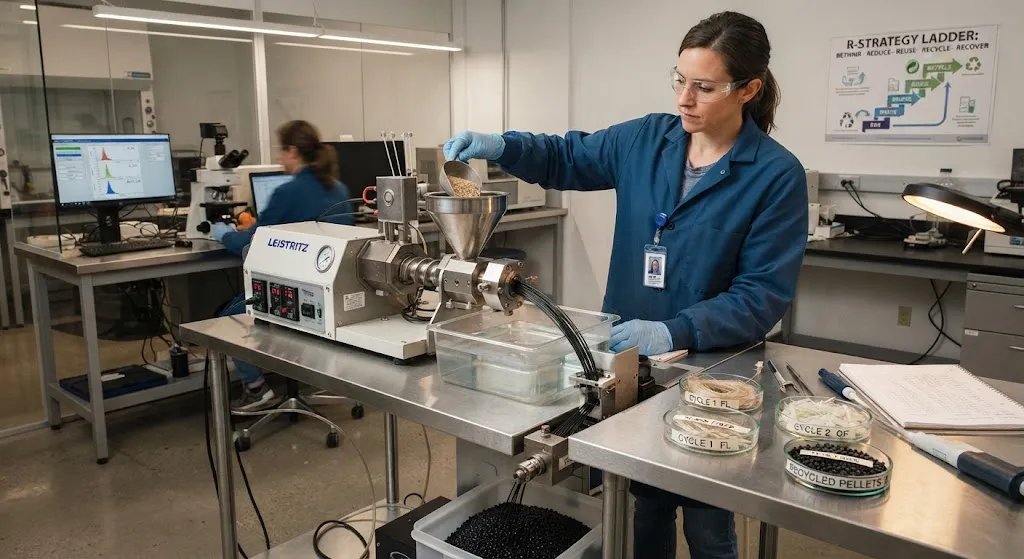
Mechanical recycling is the workhorse of composite recycling: scrap parts are shredded, granulated and re-compounded into new materials. The process has a fundamental side effect — every pass shortens the reinforcing fibers. A fiber that is too short cannot transfer load effectively, so
Introduction
Mechanical recycling is the workhorse of composite recycling: scrap parts are shredded, granulated and re-compounded into new materials. The process has a fundamental side effect — every pass shortens the reinforcing fibers. A fiber that is too short cannot transfer load effectively, so the reinforcing value of the material decays with each recycling loop. The decisive question is not whether fibers shorten, but how they shorten. Research at Fraunhofer IWU concludes that natural fiber reinforced thermoplastics (NFRTP) respond far more gracefully to this challenge than glass fiber systems, because natural fibers lose strength progressively while glass fibers fracture abruptly and degrade into contaminants.
How Mechanical Recycling Shortens Fiber
Fiber shortening happens at every mechanical stage. Shredding and granulation impose shear and impact loads that break fibers at their weakest points; melt compounding in a twin-screw extruder adds further mechanical and thermal degradation; and injection molding imparts additional shear as the melt flows through narrow gates. The result is a steadily decreasing fiber length distribution.
- Aspect ratio loss: Reinforcement efficiency depends on fiber length relative to the critical length for load transfer. As fibers fall below a few fiber diameters in length, they are pulled out rather than loaded to failure.
- Critical length: The critical length scales with fiber diameter, strength and matrix strength. Carbon and glass fibers, with their small diameters and high stiffness, are more sensitive to length loss than sturdier natural fiber bundles.
- Cumulative damage: Every reprocessing cycle adds new breakage. After several cycles, most fibers sit well below the critical length and behave like filler rather than reinforcement.
Fiber length distribution is therefore the first thing a recycler measures, because it predicts the mechanical ceiling of the recycled compound.
Why Glass Fibers Degrade Abruptly
Glass fibers are inherently brittle. A 10-17 micrometer glass filament has no mechanism to absorb strain beyond its elastic limit; it fails by catastrophic fracture, splitting into sharp fragments that are typically 50-300 micrometers long. Those fragments are far below the critical length, so they contribute almost no reinforcement. Worse, the fragments behave as stress concentrators and hard inclusions in the recycled matrix, and the fiber-matrix interface, already damaged by the loss of silane coupling agents during reprocessing, promotes microcracking around every fragment.
The industry consequence is well documented in comparative studies: after two or three mechanical recycling loops, glass fiber reinforced thermoplastics lose a substantial share of their tensile and impact strength, and the compound visibly shifts from a reinforced material to a filled — and sometimes weakened — plastic. The fibers have effectively become impurities.
Why Natural Fibers Stay Functional
Natural fibers such as flax and hemp fail differently. Their lignocellulosic architecture is not a monolithic brittle solid but a bundle of microfibrils, which gives them a progressive damage mode: loading damages individual microfibrils while the bundle as a whole continues to carry load. Shear during recycling peels and fibrillates the fiber rather than shattering it, so the retained lengths remain usable for load transfer.
| Fiber type | Elastic modulus | Typical diameter | Failure mode | Approx. tensile retention after 3 loops |
|---|---|---|---|---|
| E-glass | 72-78 GPa | 10-17 µm | Brittle fracture | 40-60% (length-limited) |
| Flax | 50-70 GPa | 10-25 µm (bundles) | Progressive / fibrillar | 70-85% |
| Carbon | 230-400 GPa | 5-7 µm | Brittle fracture | 50-70% (fragmentation) |
Fraunhofer IWU's conclusion follows directly: through repeated use, repair and recycling cycles, NFRTP retains reinforcing performance much better than glass systems because the fiber shortening mechanism itself is more forgiving. Add the density advantage of natural fibers — roughly 1.4-1.5 g/cm³ against 2.5-2.6 g/cm³ for glass — and the recycled NFRTP actually keeps a better specific stiffness than its glass counterpart.
R-Strategies and the Material Loop
The R-strategy ladder applies differently to the two systems. Reuse and repair keep the fiber architecture intact for both, but once the loop enters remanufacturing and mechanical recycling, the fiber shortening penalty separates them.
| R-strategy | Loop type | Fiber shortening severity | NFRTP outcome | Glass-fiber TP outcome |
|---|---|---|---|---|
| Reuse | Part-level | None | Full performance retained | Full performance retained |
| Repair | Part-level | Low | Good; local damage only | Moderate; brittle edge cracks spread |
| Remanufacture | Reforming | Medium | Good; fiber keeps working | Moderate; length margin shrinks |
| Mechanical recycling | Regrind and recompound | High | Reinforcement retained | Fiber becomes filler / impurity |
For designers this changes the goalposts: a component made from NFRTP can be designed for multiple end-of-life loops, which is a direct contribution to circular economy targets. The same part in glass fiber thermoplastic needs to plan for downcycling from loop one onward.
Design Implications for Circular Products
The practical design rules follow from the mechanism. First, choose the matrix wisely: polypropylene and polylactic acid are the workhorses of NFRTP, and compatibilizers such as maleic anhydride grafted polypropylene improve interface retention through reprocessing. Second, control initial fiber length: long fibers give the recycled material more length budget to lose. Third, manage the regrind ratio — compounds with 20-30% recycled content typically retain most of their properties. Fourth, adjust screw and mold design to limit shear on the natural fibers. None of these rules are exotic; they are simply the design-for-recycling measures that glass systems need in far more aggressive form.
There is a parallel with carbon fiber recycling. Carbon fibers are also brittle, and their recovery relies on thermal or solvolytic routes that preserve fiber length, precisely because mechanical routes would fragment them into low-value powder. The natural fiber advantage is that mechanical recycling — the cheapest route — remains viable for several loops.
Frequently Asked Questions
Is natural fiber ever as strong as glass fiber in a thermoplastic?
Not in absolute terms: flax and hemp are less stiff and less strong than E-glass in a single, first-life part. But composite performance is a product of fiber properties, fiber length and interface quality, and the gap narrows substantially in recycled systems. After several mechanical recycling loops, a glass fiber compound has lost so much fiber length that its reinforcement value collapses, while the natural fiber compound still transfers load reasonably well. Because natural fibers are also roughly 45% lighter than glass, the recycled NFRTP can match or exceed the specific stiffness of the recycled glass compound. The honest summary is: glass wins the first life, natural fiber wins the loop.
Can NFRTP be recycled indefinitely?
No material survives an infinite number of loops, but NFRTP degrades far more gracefully. Each cycle shortens the fibers and thermally degrades the matrix and interface somewhat. In practice, studies show usable reinforcement retained through three to five loops for natural fiber systems, versus typically one to two for glass systems before the fibers behave as filler. The sustainable strategy is a cascade: high-performance recycled NFRTP in structural or semi-structural parts, then progressively lower-value applications, and energy recovery at the very end of the cascade.
How does this compare with carbon fiber mechanical recycling?
Carbon fibers are brittle like glass, so mechanical recycling fragments them into short, high-modulus powder that retains only a fraction of the original reinforcement value. The industry therefore avoids mechanical routes for carbon and uses pyrolysis or solvolysis, which strip the matrix while keeping fiber lengths close to the original. Those thermal and chemical routes are more expensive than the shred-and-recompound machinery used for thermoplastics. The practical hierarchy: mechanical recycling for NFRTP and glass systems where it is economically viable, thermal and solvolytic recovery for carbon fiber, and cement co-processing or energy recovery for mixed, contaminated or non-recoverable feedstock.
Conclusion
Fiber shortening is not a bug of mechanical recycling; it is the physical reality that every recycled composite must be designed around. Fraunhofer IWU's finding that natural fiber thermoplastics outperform glass systems through reuse, repair and recycling loops rests on a clear mechanism: natural fibers degrade progressively while glass fibers fracture into impurities. For product designers, the consequence is a practical ranking of materials by their ability to survive R-strategies, and NFRTP occupies the top tier.
If you are evaluating thermoplastic compounds, recycled fiber materials or natural fiber reinforcements for your products, review our material range or contact our engineering team to discuss the right fiber system and recycling strategy for your application.
Part of topic
Related Articles
- Bio-Based Carbon Fiber Precursors: Lignin and Polyethylene for Low-Cost Production
- Large-Tow Carbon Fiber Cost Analysis: 48K vs 60K Price-Performance Comparison
- Carbon Fiber-Resin Interface Bonding: Surface Treatment and Coupling Agent Optimization
- Digital Twin for Carbon Fiber Manufacturing: Real-Time Process Monitoring and Defect Prevention
- Thermoplastic Carbon Fiber Welding for Automotive: Ultrasonic and Induction Welding Process Windows
- Large-Tow Carbon Fiber Wet Spinning: Process Optimization for 48K/60K Production Efficiency
Interested in Our Products?
Contact our team for competitive pricing and technical specifications.
Get a QuoteRelated Products

Carbon Fiber Fishing Rod Blank
High-quality carbon fiber fishing rod blank manufactured from multiple grades of Toray carbon fiber cloth. Available in a wide range of lengths, powers, and actions for freshwater and saltwater applications. Suitable for OEM rod building.
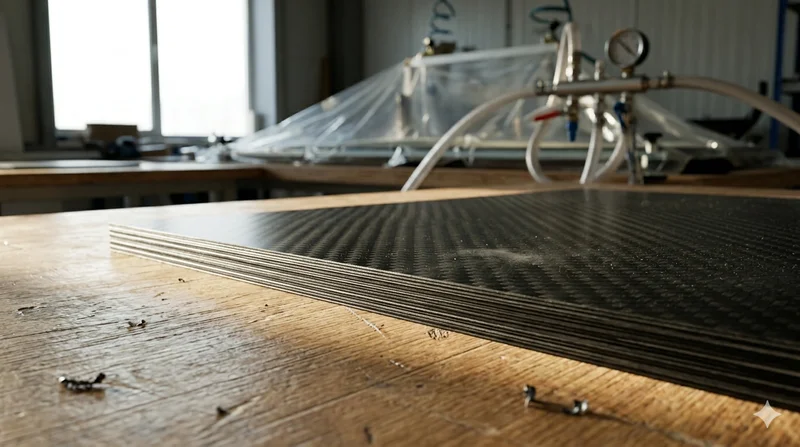
Carbon Fiber Plate — 3K Twill T700 3.0mm
Medium-thickness 3.0mm carbon fiber plate offering significantly higher load capacity while maintaining attractive 3K twill finish. Suitable for structural brackets, reinforcement plates, and load-bearing panels.
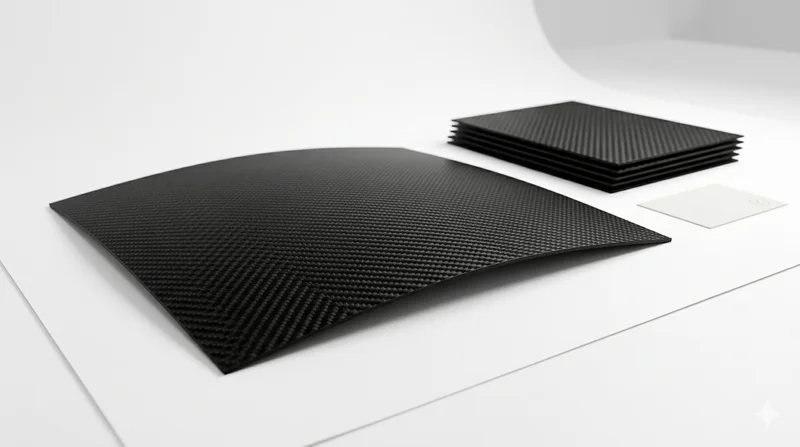
Carbon Fiber Plate — 3K Twill T700 1.5mm
Thin 1.5mm carbon fiber plate with 3K twill weave surface. Lightweight and stiff, commonly used for covers, panels, drone bodies, and applications requiring a premium aesthetic appearance.
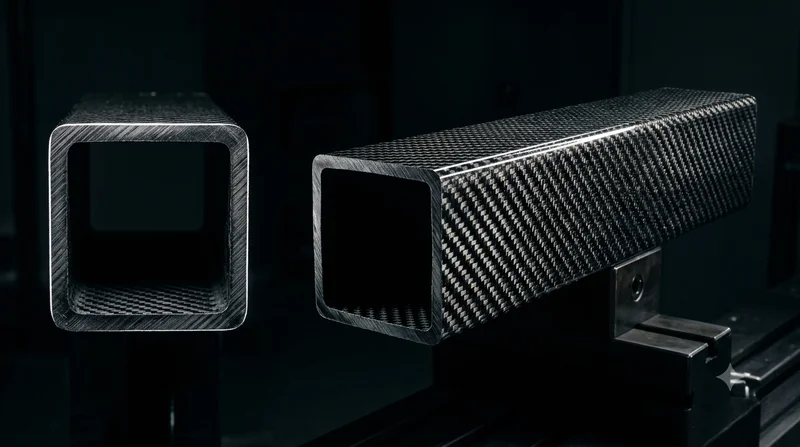
Square Carbon Fiber Tube — 3K Twill T700
Square cross-section carbon fiber tube manufactured with 3K twill weave for torsional strength. Preferred for structural frames, trusses, and support columns where rectangular geometry offers design flexibility.
Carbon Fiber Pickleball Paddle
High-performance pickleball paddle with Toray T700 carbon fiber face and polypropylene honeycomb core. Delivers excellent power-to-weight ratio, spin generation, and vibration dampening for competitive play.