
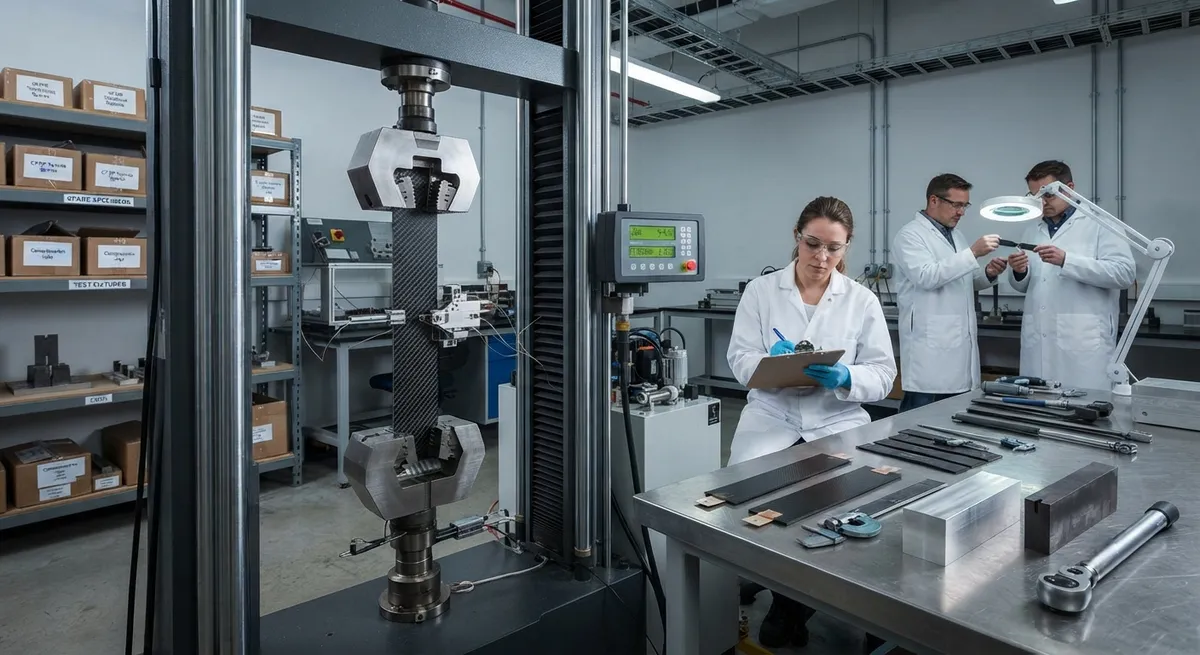
Every lightweighting project begins with the same question: which material should carry this load? The answer is rarely a single winner. Carbon fiber, aluminum, and high-strength steel each dominate a different corner of the design space, and the correct choice depends on geometry, load
Introduction
Every lightweighting project begins with the same question: which material should carry this load? The answer is rarely a single winner. Carbon fiber, aluminum, and high-strength steel each dominate a different corner of the design space, and the correct choice depends on geometry, load path, production volume, corrosion environment, and — most decisively — the total cost of the finished part, not just the raw material price.
B2B buyers often default to one material because a competitor uses it, or because a single number (like "carbon fiber is 5x stronger than steel") gives a false sense of certainty. The reality is more nuanced: at the system level, a kilogram saved in a rotating component is worth far more than in a bracket, and the processing cost of carbon fiber can outweigh its weight advantage in high-volume parts. This article puts all three materials on a comparable basis and walks through a repeatable selection workflow tied to specific stiffness, total cost per part, and manufacturing route.
Mechanical Properties on a Like-for-Like Basis
The table below shows representative mechanical values for the three materials across the properties that matter most in lightweight structural design. These are typical ranges for structural grades (T700 carbon fiber, 7075-T6 aluminum, high-strength steel at 1000 MPa) presented as a first-pass comparison;
| Property | Carbon Fiber Laminate | Aluminum 7075-T6 | High-Strength Steel (1000 MPa) |
|---|---|---|---|
| Density (g/cm³) | 1.60 | 2.81 | 7.85 |
| Tensile strength (MPa) | 3,500 (fiber) / 600-700 (laminate) | 570 | 1,000 |
| Specific tensile strength (kN·m/kg) | 1,500-2,300 (laminate) | ~200 | ~130 |
| Modulus (GPa) | 230-370 | 71 | 210 |
| Specific stiffness (MN·m/kg) | 100-230 | ~25 | ~27 |
| Fatigue behavior | Near-infinite, no endurance limit issues if well designed | Good, below endurance limit | Finite life when near yield |
| Corrosion resistance | Excellent (galvanic needs insulation) | Good, anodizable | Requires coating and protection |
| Operating temperature (°C) | Depends on matrix: 120-250 W/ prepreg | up to ~250 short-term | Up to ~600 |
What the comparison reveals is that the advantage of carbon fiber appears most clearly in specific stiffness and specific strength, i.e., performance divided by density. But it also shows that for pure compression or temperature-critical applications, steel retains real structural advantages, and aluminum offers the best balance of cost, corrosion, and energy absorption for many everyday products.
Cost: Raw Material vs Total Part Cost
Raw material cost per kilogram tells an incomplete story because it ignores processing. The table below breaks down typical full costing in low-to-mid volume manufacturing (a production run of 100-1,000 parts/year), which is the comparison region most relevant to B2B bespoke parts:
| Cost driver | Carbon Fiber | Aluminum | High-Strength Steel |
|---|---|---|---|
| Raw material ($/kg) | 10-60 (prepreg/fabric) | 3-6 | 1-2 |
| Tooling cost | High (mold, consumables, autoclave/oven) | Medium (machining or casting) | Low-Medium (stamping/welding) |
| Labor intensity | High (layup, cure) | Medium (machining) | Low-Medium (automated stamping) |
| Cycle time | Hours-days (cure) | Minutes (CNC) | Seconds-Minutes (stamping) |
| Total cost per part (low volume) | High-Medium | Medium | Low |
| Cost per part (high volume) | Drops slowly, tooling amortized | Drops steadily | Lowest (best for scale) |
The key takeaway is that carbon fiber is fundamentally a low-to-mid volume, high-performance material because of the mold and curation costs; steel is the opposite — its cheapest at the highest volume because stamping and welding are in seconds. Loss of cost can only be which one of the application weight the weight requirements.
Decision Framework by Application
The following rules of thumb are the practical starting grid that B2B teams use when selecting between the three materials:
- Credit for rotating or dynamic components: When the part rotates, flexes, or experiences high-frequency cycling, weight savings have their highest leverage — carbon fiber wins (drive shafts, drone arms, motorsports suspension links). A small mass reduction on a rotating element can produce an outsized system benefit.
- Space frames & structural brackets in moderate volume: Aluminum is the default because it combines good specific strength, corrosion resistance, extruded shapes, and CNC repeatability at a moderate cost with fast cycle time.
- Crash and collision energy absorption: High-strength steel, in selected thickness, offers the best controlled, stable energy absorption and weldable fabrication — critical for automotive chassis, roll cages, and crash-structures that must deform in a predetermined manner.
- Temperature-exposed parts: Above 150 °C resin degrades and lobes the composite; steel or aluminum becomes preferred at elevated service temperatures.
- Thermal expansion-sensitive instrument frames: Ultra-low CTE of carbon fiber suits metrology and precision alignment structures where dimensional stability matters more than raw strength.
Fatigue, Corrosion, and Long-Term Service
Long service life often decides the choice far more than initial cost. Carbon fiber does not show a classical endurance limit like metals; it is nearly "infinite fatigue life" for laminated composites under in-plane loads when designed correctly (that is, no B-basis issues), but it is sensitive to impact damage that can be invisible. Aluminum 7075-T6 has a well-characterized fatigue limit but is susceptible to stress corrosion cracking and pitting if not protected. High-strength steel achieves high strength by stress margin, but in that same margin it becomes sensitive to fatigue and corrosion, and the protective addition (galvanizing or coating) is a real cost argument. For critical parts that must be inspected, aluminum and steel have well-established non-destructive methods (eddy current, ultrasonic, dye-penetrant) that are cheap and simple, while carbon fiber requires more advanced NDT to catch inner flaws.
Frequently Asked Questions
Is carbon fiber always lighter than aluminum for the same stiffness?
Often yes, but not always by the naive 2/3 factor. For bending stiffness under equal load, carbon fiber is about 2-3 times stiffer than aluminum per unit mass "specific modulus". That means a carbon-fiber part can be a similar size and weigh 40-60% less than an equivalent aluminum design for stiffness-limited beams. For strength-limited designs, the weight saving can be as high as 70% if the part is not buckling limited. The catches: for low-cycle, high-stability or impact-limited applications, aluminum sometimes survives as design because thickness must be large enough to resist buckling or a hard impact even though stiffness is lower. Also galvanic corrosion with metal attachments must be designed for, and carbon costs more than aluminum by the factor of 3-10. The right rule is always "lighter for load/stiffness", but the total-scheme must be balanced with tooling, dimensional tolerance, and budget.
When should I choose steel over carbon fiber even though steel is heavier?
Choose steel when any of these is true: the part operates over 200 °C; the design is dominated by crash/energy absorption rather than stiffness; the production volume is in the range of tens of thousands where steel stamping cost per part becomes the lowest; the part requires weld-ability or repair-ability in the field; or the loading leads to impact and cannot be protected as highly (as in a roll cage you want the structure to yield predictably). Carbon gives a higher specific strength, but if the failure mode favors energy density of a metal (blast/impact), steel remains the winning material even substantial weight.
Which material gives the best fatigue life for a part vibrating at high frequency?
Carbon fiber resin dominates that domain as well as high cycle life with a shallow S-N for a properly designed laminate horizontally. In cycling in-plane loads below the delamination threshold, a well-designed carbon layup shows virtually no progressive degradation, which is what drives high-frequency robotics and aerospace rotating structures to carbon. Aluminum has a strict endurance limit below which it never fails under constant amplitude; it is highly predictable but the strength is low so the design often ends thicker. High-strength steel has the fatigue margin biggest, but you are higher cyclic near its static margin, it degrades faster and is corrosion sensitive. For fatigue under the high ratio of 10^8 cycles, carbon intrusive wins; use it served with a test.
Conclusion
There is no single "best" material. Carbon fiber wins for specific stiffness and strength in low-volume, rotating-complexity or metrology-critical applications; aluminum is the balanced middle for cost and process; high-strength steel is irreplaceable at high volume, high temperature, and crash/corrosion-resistant. The selecting function is provided by the load path, duty cycle, temperature, production volume, and the real total cost — not the per-kilo price.
The best project starts with a material decision informed by real data for your exact application. Explore our carbon fiber fabrics, prepregs, and tubes configured for specific stiffness-critical designs, or contact our engineering team for a material trade study tailored to your part, production volume, and environment.
Part of topic
Related Articles
- Carbon Fiber Drone Blades and Propellers: Stiffness, Balance and Noise Reduction
- Fiberglass Filament Wound Tubes: Cost-Effective Alternative to Carbon Fiber
- Filament Wound Epoxy Tube Design: Wall Thickness, Fiber Angle and Load Optimization
- Filament Wound Epoxy Tubes: Testing Standards and Quality Assurance
- Filament Wound Epoxy Tubes Manufacturing: Process and Quality Control
- Filament Wound Fiberglass Tube: Process Parameters and Performance vs Carbon Fiber
Interested in Our Products?
Contact our team for competitive pricing and technical specifications.
Get a QuoteRelated Products
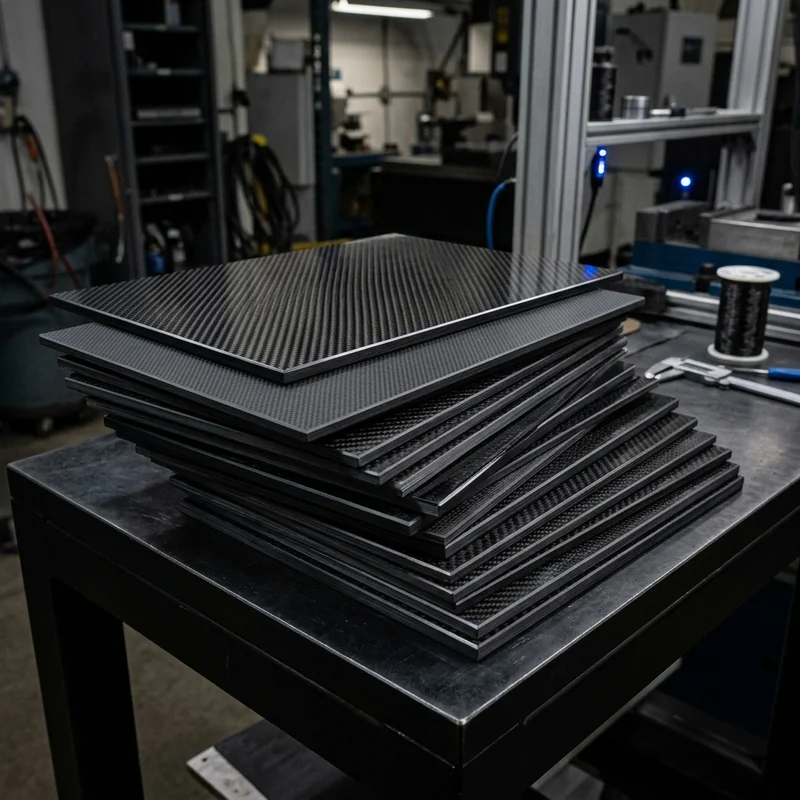
Carbon fiber standard plate-3k stripe
Lightweight, ultra-rigid standard sheets for drone fuselages, robot housings, facades and structural applications.

Carbon Fiber Plate — 3K Twill T700 3.0mm
Medium-thickness 3.0mm carbon fiber plate offering significantly higher load capacity while maintaining attractive 3K twill finish. Suitable for structural brackets, reinforcement plates, and load-bearing panels.

Carbon Fiber Plate — 3K Twill T700 1.5mm
Thin 1.5mm carbon fiber plate with 3K twill weave surface. Lightweight and stiff, commonly used for covers, panels, drone bodies, and applications requiring a premium aesthetic appearance.
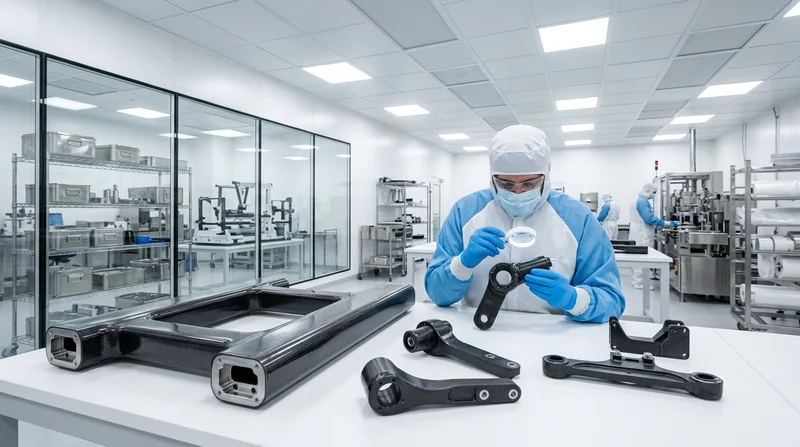
Custom Carbon Fiber Medical Device Components
Medical-grade carbon fiber components manufactured for imaging equipment, surgical instruments, and patient support systems. Carbon fiber's radiolucency (X-ray transparency) and high strength-to-weight ratio make it ideal for CT scanner beds, wheelchair frames, surgical robot arms, and MRI-compatible accessories. Biocompatible resin systems available.

Square Carbon Fiber Tube — 3K Twill T700
Square cross-section carbon fiber tube manufactured with 3K twill weave for torsional strength. Preferred for structural frames, trusses, and support columns where rectangular geometry offers design flexibility.