
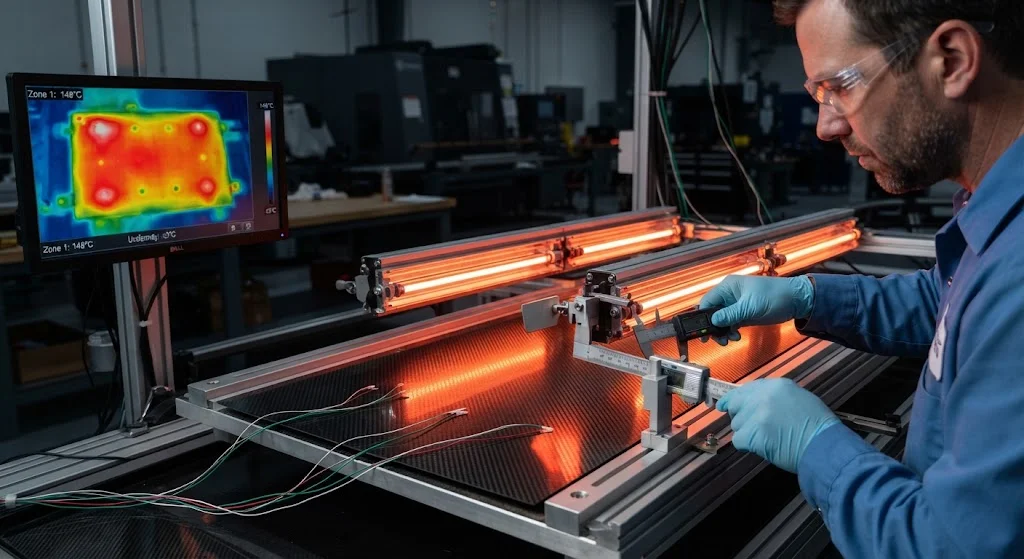
Infrared heating for carbon fiber cure represents a fundamental shift in how composite parts are processed. Traditional convection ovens heat the air around a part, which then transfers heat to the composite surface through convection — a process that is inherently slow because air is a poor heat co
Introduction
Infrared heating for carbon fiber cure represents a fundamental shift in how composite parts are processed. Traditional convection ovens heat the air around a part, which then transfers heat to the composite surface through convection — a process that is inherently slow because air is a poor heat conductor. Infrared heating bypasses this limitation by delivering electromagnetic radiation directly to the composite surface, where it is absorbed and converted to heat within the material itself. The result is faster, more uniform, and more energy-efficient curing.
For carbon fiber manufacturers facing pressure to reduce cycle times, energy costs, and carbon emissions, infrared cure optimization offers a practical path to improvement. The technology is particularly compelling for out-of-autoclave (OoA) processing, where oven cure time often represents the bottleneck in production throughput. This article examines the physics of infrared heating in carbon fiber cure, process optimization strategies, and the real-world benefits that manufacturers are achieving in production environments.
Physics of Infrared Heating in Carbon Fiber Composites
Infrared heating relies on radiative heat transfer — the emission and absorption of electromagnetic radiation in the 0.7-1000 μm wavelength range. Carbon fiber composites are excellent absorbers of infrared radiation, with absorptivity values of 0.85-0.95 across the near-infrared and mid-infrared spectrum. This high absorptivity means that infrared energy is efficiently converted to heat at the composite surface, rather than being reflected or transmitted.
- Wavelength selection: Near-infrared (NIR, 0.7-2.5 μm) radiation penetrates the composite surface 0.5-2 mm, providing volumetric heating of the resin-rich surface layer. Mid-infrared (MIR, 2.5-25 μm) radiation is absorbed at the surface, creating a temperature gradient that drives heat into the laminate. Optimal cure heating uses a combination of NIR and MIR to balance surface and through-thickness heating.
- Emissivity matching: Carbon fiber/epoxy composites have emissivity values of 0.85-0.92, making them well-suited to infrared heating. The high emissivity ensures efficient energy absorption and minimal reflection losses, typically less than 10% of incident radiation.
- Penetration depth: Infrared penetration depth depends on wavelength and resin system. For typical epoxy/carbon fiber laminates, NIR penetrates 0.5-2 mm, while MIR is absorbed within the first 0.1-0.5 mm. This surface-weighted heating is advantageous for thin laminates (< 3 mm) but requires careful process design for thick sections (> 6 mm) to avoid thermal gradients.
- Heat flux distribution: Infrared heaters can be arranged in zones to control heat flux across the part surface, enabling uniform heating even on complex geometries. Multi-zone control compensates for edge effects, thickness variations, and tool thermal mass.
The key advantage of infrared heating is speed: because energy is delivered directly to the composite rather than through an air medium, surface temperature rise rates of 5-15°C per minute are achievable, compared with 1-3°C per minute in convection ovens. This translates directly into shorter cure cycles and higher production throughput.
Infrared vs Convection Heating: Performance Comparison
| Parameter | Infrared Heating | Convection Oven | Improvement |
|---|---|---|---|
| Heat transfer mechanism | Radiation (direct absorption) | Convection (air medium) | Faster response |
| Temperature rise rate | 5-15°C/min | 1-3°C/min | 3-5× faster |
| Cure cycle time | 30-60 minutes | 90-180 minutes | 30-50% reduction |
| Energy consumption | 2-4 kWh/kg composite | 4-7 kWh/kg composite | 20-40% reduction |
| Heating uniformity | ±3°C (multi-zone) | ±8-12°C | Better uniformity |
| Capital cost | Moderate ($50-200K) | Low ($30-100K) | Higher initial cost |
| Floor space | Compact (inline) | Bulkier (batch) | 50-70% less space |
| Startup time | Instant on/off | 30-60 min warm-up | Significant savings |
The economic case for infrared heating is strongest in high-rate production environments where cycle time reduction directly translates to throughput gains. A carbon fiber manufacturer producing 500 parts per month can achieve payback periods of 12-18 months with infrared cure systems, depending on part geometry and existing equipment efficiency.
Process Optimization Strategies
Optimizing infrared heating for carbon fiber cure requires attention to several interrelated parameters:
- Heater distance and angle: The distance between the infrared emitter and the composite surface determines heat flux intensity. Typical standoff distances are 100-300 mm, with closer spacing for thin laminates and wider spacing for thick sections. Angled heaters improve uniformity on curved surfaces.
- Multi-zone control: Dividing the infrared array into independently controlled zones allows compensation for edge cooling, thickness variations, and tool thermal mass. Each zone is controlled by a thermocouple feedback loop that adjusts emitter power to maintain target temperature.
- Ramp rate optimization: Fast ramp rates (10-15°C/min) are suitable for thin laminates with low exotherm risk, while thick laminates require slower ramps (3-5°C/min) to prevent thermal runaway from the exothermic cure reaction. Adaptive ramp control adjusts the rate based on real-time temperature measurement.
- Dwell and hold strategy: Intermediate temperature holds (80-120°C) allow resin to flow and volatiles to escape before the final cure hold (150-180°C). Infrared heating enables precise temperature control during these critical transitions, reducing void content and improving laminate quality.
- Hybrid heating: Combining infrared with convection — using infrared for rapid surface heating and convection for through-thickness equalization — provides the best of both approaches. This hybrid approach is increasingly common in production environments.
Process simulation software (e.g., PAM-RTM, Moldex3D) can model the thermal response of the composite under infrared heating, predicting temperature distribution, cure degree, and residual stress. Simulation-guided process design reduces the number of physical trials required to optimize the cure cycle.
Manufacturing Applications and Case Studies
Infrared heating for carbon fiber cure is being adopted across multiple industries:
- Aerospace secondary structures: Radomes, fairings, and access panels are well-suited to infrared cure because of their thin cross-sections and high production volumes. Several aerospace tier-one suppliers have reported 35-45% cycle time reductions with infrared cure systems.
- Automotive production: Carbon fiber structural components for electric vehicles — battery enclosures, crash structures, and suspension arms — benefit from infrared cure's ability to achieve 2-4 minute cycle times for thin-walled parts, meeting automotive takt time requirements.
- Sports equipment: High-performance bicycle frames, tennis rackets, and golf club shafts use infrared cure to achieve rapid prototyping and production ramp-up, with cycle times reduced from 4 hours to 90 minutes.
- Wind energy: Large composite structures such as root sections and trailing edge panels can benefit from zone-controlled infrared heating that addresses the thermal mass of large tooling while maintaining cure uniformity.
The common theme across these applications is the need for faster, more energy-efficient processing without sacrificing laminate quality. Infrared heating delivers on both counts, making it a key enabling technology for the next generation of carbon fiber manufacturing.
Energy Efficiency and Sustainability Benefits
The energy efficiency advantages of infrared heating extend beyond direct cost savings. Carbon fiber manufacturers are under increasing pressure to reduce their carbon footprint, and infrared cure contributes to this goal through several mechanisms:
- Direct energy conversion: Infrared heaters convert 60-80% of electrical energy to radiant heat, compared with 30-50% for convection ovens that lose energy through exhaust and duct losses.
- No warm-up energy: Infrared emitters reach operating temperature in seconds, eliminating the 30-60 minute warm-up period required for convection ovens — a significant energy saving in batch production environments.
- Reduced thermal mass: Infrared systems heat the composite directly, not the oven structure, reducing the energy required to heat thermal mass by 40-60%.
- Shorter cycle times: Faster cure cycles mean less energy consumed per part, with typical savings of 20-40% in total energy consumption per kilogram of composite processed.
For manufacturers pursuing ISO 14001 certification or carbon neutrality targets, infrared cure optimization represents a measurable, achievable improvement in environmental performance.
Frequently Asked Questions
How much faster is infrared heating compared to convection ovens for carbon fiber cure?
Infrared heating typically reduces carbon fiber cure cycle times by 30-50% compared with convection ovens. The improvement comes from the direct absorption of electromagnetic radiation by the composite surface, eliminating the slow convective heat transfer through air. For a typical aerospace composite part, this means cure times of 30-60 minutes instead of 90-180 minutes, with temperature rise rates of 5-15°C per minute versus 1-3°C per minute in convection heating.
Can infrared heating cure thick carbon fiber laminates without thermal gradients?
Infrared heating is most effective on thin laminates (< 3 mm) where surface-weighted heating produces uniform through-thickness temperature. For thick laminates (> 6 mm), hybrid approaches combining infrared for rapid surface heating with convection for through-thickness equalization are recommended. Multi-zone infrared control and adaptive ramp rates can also mitigate thermal gradients in thick sections, but careful process design and thermal simulation are essential.
What is the energy savings of infrared heating versus convection ovens?
Infrared heating typically saves 20-40% of energy compared with convection ovens, measured in kWh per kilogram of composite processed. The savings come from higher heating efficiency (60-80% vs 30-50%), elimination of warm-up energy, reduced thermal mass heating, and shorter cycle times. For a manufacturer processing 10 tonnes of carbon fiber per year, this translates to energy savings of 20,000-40,000 kWh annually.
Conclusion
Infrared heating for carbon fiber cure is a proven technology that delivers measurable improvements in cycle time, energy efficiency, and production throughput. By delivering electromagnetic radiation directly to the composite surface, infrared heating achieves 30-50% faster cure cycles and 20-40% energy savings compared with conventional convection ovens. The technology is particularly compelling for out-of-autoclave processing and high-rate production environments where cycle time is the primary constraint.
For carbon fiber manufacturers seeking to optimize their cure processes, infrared heating offers a practical, scalable path to improvement — one that reduces cost, improves quality, and supports sustainability goals. YongXian supplies carbon fiber fabrics and materials compatible with infrared cure processing. Explore our carbon fiber product range or contact our engineering team to discuss infrared cure optimization for your manufacturing operations.
Part of topic
Related Articles
- Carbon Fiber Bio-Composites: Natural Fiber Hybrid Reinforcement for Sustainable Applications
- RFID Tracking for Carbon Fiber Supply Chain: Traceability and Quality Assurance
- Out-of-Autoclave Carbon Fiber Processing: OoA Certification and Aerospace Qualification
- Carbon Fiber Polymer Matrix Composite Fire Resistance: Intumescent Coatings and Fire-Barrier Solutions
- Carbon Fiber HP-RTM Cycle Time Optimization: High-Pressure Resin Transfer Molding for Automotive
- Continuous Fiber Reinforced Thermoplastics: CFRT vs Thermoset Processing and Applications
Interested in Our Products?
Contact our team for competitive pricing and technical specifications.
Get a QuoteRelated Products
Carbon Fiber Fishing Rod Blank
High-quality carbon fiber fishing rod blank manufactured from multiple grades of Toray carbon fiber cloth. Available in a wide range of lengths, powers, and actions for freshwater and saltwater applications. Suitable for OEM rod building.
Carbon Fiber Plate — 3K Twill T700 1.5mm
Thin 1.5mm carbon fiber plate with 3K twill weave surface. Lightweight and stiff, commonly used for covers, panels, drone bodies, and applications requiring a premium aesthetic appearance.
Carbon Fiber Plate — 3K Twill T700 3.0mm
Medium-thickness 3.0mm carbon fiber plate offering significantly higher load capacity while maintaining attractive 3K twill finish. Suitable for structural brackets, reinforcement plates, and load-bearing panels.
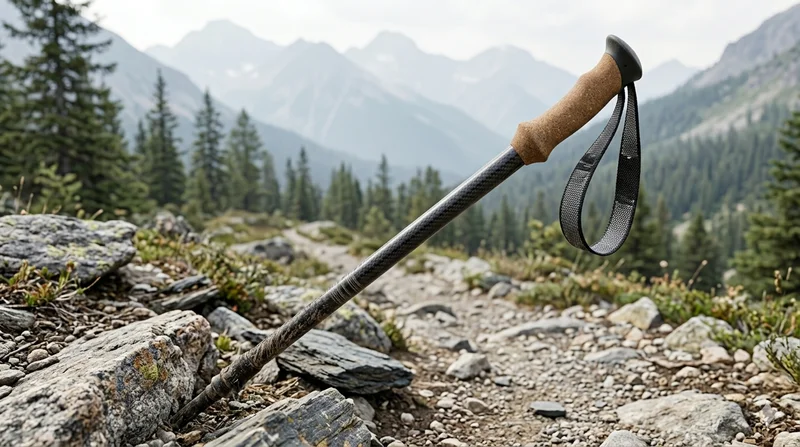
Carbon Fiber Trekking Pole
Lightweight carbon fiber trekking pole manufactured from high-grade carbon fiber tube. Weighs only 160g per pole while providing superior shock absorption and durability for hiking, trail running, and backpacking.
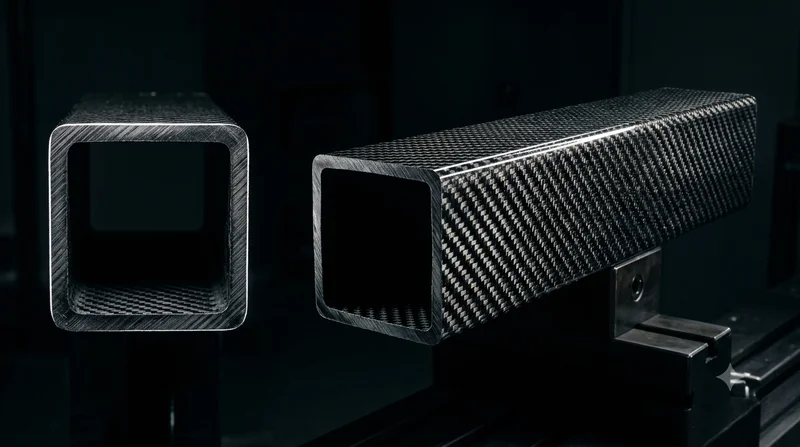
Square Carbon Fiber Tube — 3K Twill T700
Square cross-section carbon fiber tube manufactured with 3K twill weave for torsional strength. Preferred for structural frames, trusses, and support columns where rectangular geometry offers design flexibility.