
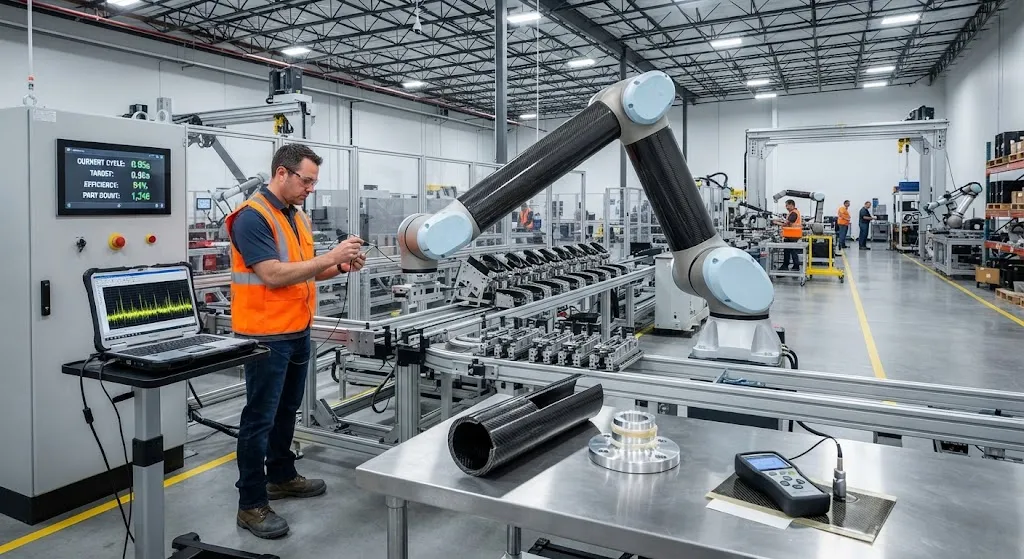
An industrial robot arm is a cantilever that must be stiff in two senses: statically, to hold a tool and payload within repeatability tolerances measured in hundredths of a millimeter, and dynamically, to stop oscillations quickly after every move. These requirements pull against each o
Introduction
An industrial robot arm is a cantilever that must be stiff in two senses: statically, to hold a tool and payload within repeatability tolerances measured in hundredths of a millimeter, and dynamically, to stop oscillations quickly after every move. These requirements pull against each other in metal. To make a steel or aluminum arm stiffer, engineers add material, which adds mass, which forces bigger motors and heavier bases, which in turn increases the total dynamic load and limits speed. Carbon fiber breaks the loop because it delivers stiffness per unit mass that no structural metal approaches.
The stakes are economic. In high-speed automation, cycle time is revenue: a pick-and-place cell running 30 cycles per minute instead of 20 produces 50% more parts per shift with the same floor space. Carbon fiber arms are a proven route to that gain, which is why robot builders and system integrators for electronics assembly, packaging, and machine tending increasingly specify composite links. This article explains the design logic, the material data, and the practical engineering of bonded and bolted construction in a production robot arm.
Why Stiffness-to-Weight Ratio Dictates Cycle Time
The limiting artifact of any moving machine is the first vibration mode of its structure. Every time the wrist accelerates, the arm deflects and then rings at its natural frequency; the controller cannot declare the move complete until oscillation has decayed below the repeatability band. Natural frequency scales with the square root of stiffness divided by mass, so doubling the stiffness-to-weight ratio cuts settling time substantially and raises the practical speed limit of the motion profile.
This is where carbon works its magic. The specific stiffness of a unidirectional carbon/epoxy laminate is roughly 90-110 GPa per unit density at typical fiber volume fractions, compared with about 26 for aluminum and 26-27 for steel. A composite link can therefore be designed with higher bending and torsional stiffness than an aluminum link while weighing as little as 55-60% of it. The lighter link also reduces the load on downstream joints, letting the designer choose smaller servos on axes two and three, a compounding saving that is worth more than the arm weight itself.
Material Comparison: Carbon vs Aluminum vs Steel
| Property | Carbon/epoxy laminate | Aluminum 6061 | Steel |
|---|---|---|---|
| Density (g/cm³) | 1.55-1.60 | 2.70 | 7.85 |
| Axial modulus (GPa) | 120-160 | 69 | 200-210 |
| Specific stiffness (GPa per g/cm³) | 75-100 | 26 | 26-27 |
| Damping ratio (relative) | High, 3-5x aluminum | Low | Low |
| Fatigue endurance | Excellent, flat S-N curve | Endurance limit ~40% UTS | Good if detailed |
The table shows why aluminum established the robot industry baseline: it is easy to cast, machine, and weld, and its specific stiffness for an equivalent link design is sufficient for most robots. Carbon's advantage must be engineered deliberately through fiber orientation. An arm link is a beam bending in the vertical plane and twisting about its axis, so the laminate stacks unidirectional layers along the length for bending stiffness plus plus/minus 45 degree layers for torsional stiffness, usually with a woven outer ply for impact and handling resistance.
Where Carbon Goes in a Robot Arm
Not every link benefits equally, and the engineering rule is simple: the farther the link is from the robot base, the more valuable carbon becomes. The end-effector-to-payload distance multiplies the effect of mass because inertia increases with the square of distance from the rotation axis. Typical applications include:
- Wrist housings and flange plates: the most distal mass, directly on the tool center point; a lighter wrist allows faster wrist rotation and higher payload-to-robot-weight ratio.
- Forearm and upper arm links: the main structural members, where bending stiffness and mass reduction combine to raise natural frequency.
- Linear and gantry booms: long unsupported spans where deflection, not strength, sets the design, and where carbon tubes cut mass by 30-40% at equal stiffness.
- End-of-arm tooling and gripper structures: custom carbon assemblies that reduce the tool weight the robot must carry, useful for multi-tool turrets on machine tending cells.
Sinofibers, one of the leading carbon fiber producers, has explicitly targeted industrial robot arms as a growth application for its high-strength fibers, reflecting the industry's shift toward lightweight structural components as robots move faster, carry heavier payloads, and are deployed in ever more dynamic processes.
Joints, Bonding, and the Structural Interface
A carbon arm cannot be welded, so the joint interfaces are machined aluminum fittings bonded and bolted to the composite. The design rule is to keep the composite tubes and shells continuous and put every fastener load into a metallic insert or flange. Adhesive joints, typically with epoxy structural adhesives giving 20-30 MPa of lap shear, transfer axial loads over the bonded area, while bolts clamp the insert against laminate with soft shims to avoid crushing the composite. The joint detail determines whether the arm behaves as designed, because a flexible joint turns a stiff link into a floppy assembly.
Two failure modes dominate if joints are mismanaged: fretting at the bolt hole edge, addressed with bushings and careful torque control, and galvanic coupling between carbon and aluminum in humid environments, addressed with primer and insulating layers at the interface. In clean, dry factory air these concerns are manageable, which is why robot arms, unlike marine structures, rarely need elaborate corrosion protection schemes.
Damping, Payload, and Total Cost of Ownership
Carbon's internal damping, typically three to five times that of aluminum, means arm oscillations decay faster after each move. For edge-settling applications such as precise placement of components or inspection passes, this directly reduces per-cycle settling time. It also lowers the vibration transmitted to the payload and to the base, which can improve the quality of downstream processes such as gluing, dispensing, and in-line measurement.
The economic case depends on volume and duty cycle. A carbon arm is materially more expensive to source than a cast aluminum one, so the payback comes from higher cycles per minute, a longer life in high-duty service, or a lower payload robot doing the job of a larger one. For a high-volume packaging line running three shifts, the cycle time gain typically pays for the premium within months; for an occasional-use cell, aluminum remains the rational choice.
Frequently Asked Questions
How much faster can a carbon fiber robot arm cycle than an aluminum one?
There is no single multiplier, because cycle time depends on payload, reach, and the motion profile, but the mechanism is well understood: natural frequency scales with the square root of stiffness-to-mass, and settling time scales with frequency and damping. In practice, integrators report 10-25% cycle time reductions on pick-and-place and machine tending applications after replacing distal aluminum structure with carbon, with the largest gains on long-reach or high-payload configurations where mass dominates. The correct way to predict the gain is a modal analysis of the proposed arm against the current one, not a rule of thumb.
Is a carbon fiber robot arm stiff enough for precision placement?
Yes, when the laminate and joints are designed for the duty. The same specific stiffness that makes carbon competitive in aerospace primary structure applies to robot arms, and repeatability is ultimately set by the encoder, controller, and backlash in joints rather than by the link material alone. The practical requirement is that the joint interfaces are rigid aluminum fittings well bonded to the composite, because the stiffness of the assembly is the sum of link and joint stiffness, and a soft joint will dominate no matter how stiff the carbon is.
Why is carbon fiber not used in all industrial robot arms?
Cost and system-level simplification. Cast and machined aluminum is cheap, well understood, and stiff enough for the majority of robots on standard pick-and-place and welding duties, and moving to carbon adds qualification, bonding inspection, and supply chain complexity that integrators avoid unless the cycle time or reach requirement demands it. Carbon becomes the right answer when the robot must be lighter to be faster, longer to reach deeper, or when payload-to-self-weight ratio is a selling point, as in collaborative and high-speed automation markets.
Conclusion
Carbon fiber is the material that lets a robot arm be both stiff and fast, because it converts the stiffness-to-weight ratio that constrains every metal design into an engineered advantage. The gains show up as shorter settle times, lighter distal structures, smaller joint motors, and cycle time improvements that compound into production capacity. The engineering discipline is in the joints and laminate orientation, not in the raw material, which is why the successful carbon robot programs are those that treat the arm as a composite assembly problem from the start.
For robot builders and automation integrators evaluating composite arms, the right first step is a stiffness and modal analysis of your highest-cycle link, followed by a prototype with instrumented joints. Explore our carbon fiber tubes, sheets, and structural profiles for robot arm construction, or contact our engineering team to discuss laminate design and supply for your automation program.
Part of topic
Related Articles
- Carbon Fiber Sheets for Sale: A Buyer Checklist for Thickness, Weave and Finish
- Carbon Fiber Plate Running Shoes: Manufacturing Process and Material Specifications
- Carbon Fiber Tubes for Sale: Spec Sheet Fields That Actually Matter
- Carbon Fiber Sheets Near Me: Local Dealers and Quick Turnaround Procurement
- Carbon Fiber Tubes Near Me: Local Stock Availability and Same-Day Delivery Options
- Carbon Fiber Plate Orthotic: Lightweight Prosthetic and Medical Device Applications
Interested in Our Products?
Contact our team for competitive pricing and technical specifications.
Get a QuoteRelated Products

Carbon Fiber Plate — 3K Twill T700 1.5mm
Thin 1.5mm carbon fiber plate with 3K twill weave surface. Lightweight and stiff, commonly used for covers, panels, drone bodies, and applications requiring a premium aesthetic appearance.

Carbon Fiber Plate — 3K Twill T700 3.0mm
Medium-thickness 3.0mm carbon fiber plate offering significantly higher load capacity while maintaining attractive 3K twill finish. Suitable for structural brackets, reinforcement plates, and load-bearing panels.

Square Carbon Fiber Tube — 3K Twill T700
Square cross-section carbon fiber tube manufactured with 3K twill weave for torsional strength. Preferred for structural frames, trusses, and support columns where rectangular geometry offers design flexibility.
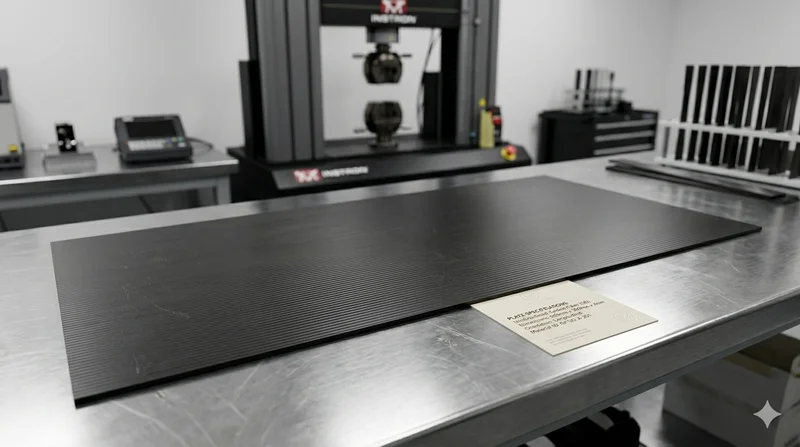
Carbon Fiber Plate — UD Unidirectional T700
Unidirectional carbon fiber plate with all fibers oriented in a single direction for maximum strength along the fiber axis. Essential for structural reinforcements, splints, and applications where load direction is predictable.
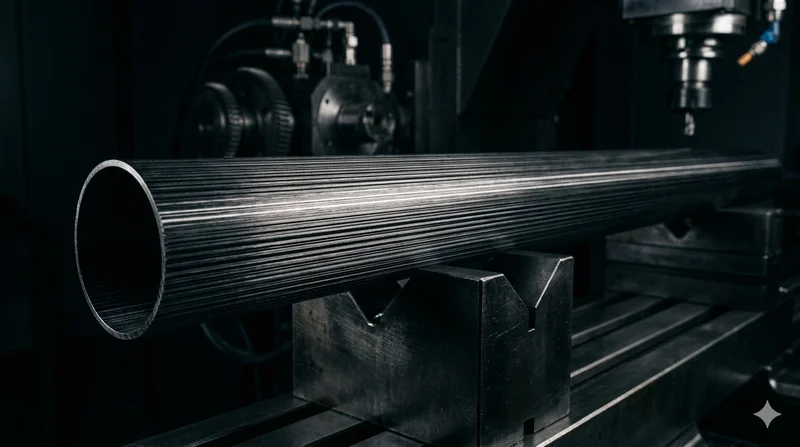
Round Carbon Fiber Tube — UD Unidirectional T700
Unidirectional (UD) round tube with all fibers aligned axially for maximum longitudinal stiffness. Ideal for applications requiring high bending rigidity with minimal weight, such as shafts, struts, and structural reinforcements.