
Thermoplastic carbon fiber composites bring a fundamental advantage over thermosets: they can be reheated and reshaped. A consolidated flat laminate is not a finished part — it is stock material that can be formed into complex, doubly curved geometries in seconds or minutes, without the
Introduction
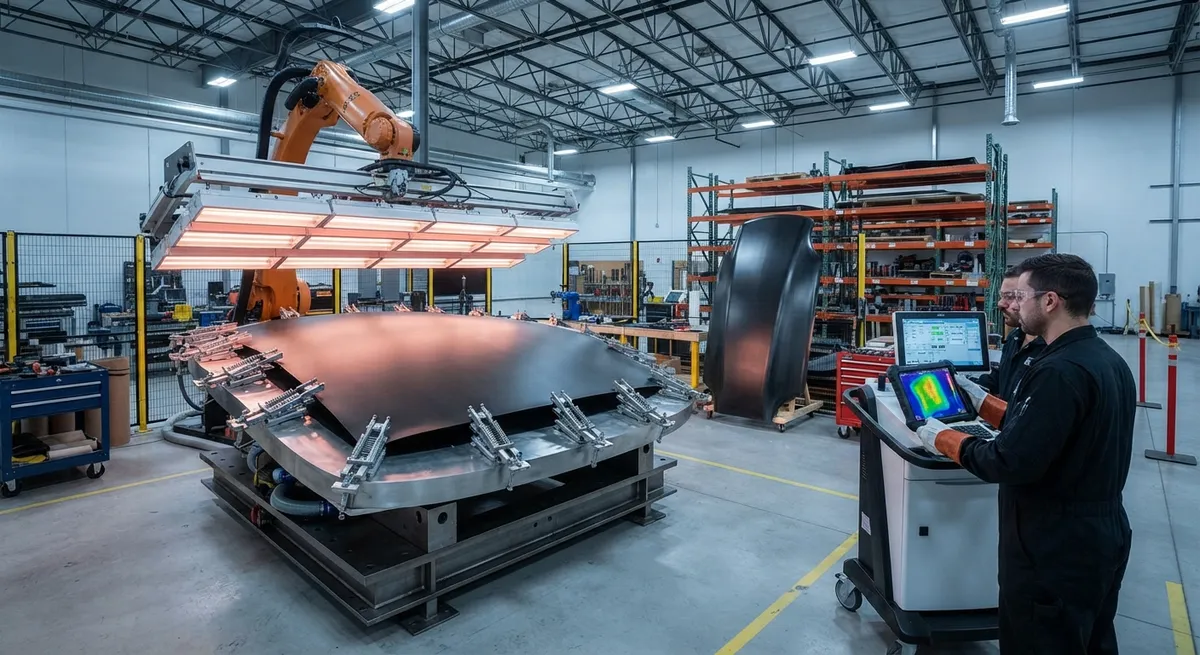
Thermoplastic carbon fiber composites bring a fundamental advantage over thermosets: they can be reheated and reshaped. A consolidated flat laminate is not a finished part — it is stock material that can be formed into complex, doubly curved geometries in seconds or minutes, without the hours-long autoclave cure that thermoset parts require. Hot drape forming is the simplest production form of this idea. A flat laminate is heated above the matrix melt temperature and pressed against a single-sided tool under vacuum or gentle pressure, draping the material onto the tool surface. Because only one tool face is required, hot drape forming is the lowest-cost way to make curved thermoplastic parts, and it is the process of choice for aerospace skins, fuselage panels, and interior components.
The engineering challenge is that forming quality is governed by a narrow set of process windows. Form too hot and the laminate sags and wrinkles; too cold and it springs back; too fast and the fibers buckle under compression. This article defines those windows — forming temperature, heat-up and dwell time, applied pressure, and blank restraint — and explains how they interact on doubly curved geometries, where in-plane shear and fiber compression compete.
How Hot Drape Forming Differs from Other Thermoplastic Processes
Hot drape forming occupies a specific niche in the thermoplastic forming landscape, distinct from the alternatives by tooling cost and cycle time:
- Hot drape forming vs. autoclave forming: In autoclave forming, the laminate is heated and pressed against the tool inside an autoclave under full pressure. The autoclave provides high consolidation pressure but caps the part size to the vessel and costs far more per cycle. Hot drape forming uses only vacuum or low pressure (1-3 bar) and infrared heaters, trading some consolidation quality for dramatically lower capital and cycle cost.
- Hot drape forming vs. stamp forming: Stamp forming uses matched metal dies in a press, applying high pressure (10-50 bar) for full consolidation and net-shape geometry in cycles under one minute. It is the fastest process but the dies cost tens to hundreds of thousands of dollars. Hot drape forming suits lower volumes and larger, more lightly loaded parts.
- Hot drape forming vs. roll forming / continuous forming: Continuous processes form long constant-cross-section profiles; hot drape forming handles large, non-prismatic, doubly curved panels that cannot be rolled.
The result is a process positioned between low-cost tooling and high-rate pressing — ideal for aerospace parts that are too large or too low-volume to justify matched dies, but need true doubly curved geometry.
The Four Process Windows That Control Quality
Quality in hot drape forming comes down to four controllable parameters, each with a defined operating window:
| Parameter | Typical Window | Effect When Too Low | Effect When Too High |
|---|---|---|---|
| Forming temperature (matrix melt region) | Tm to Tm+40°C (PEEK: 343-380°C) | Insufficient drapability, high springback, residual stress | Resin degradation, laminate sag, fiber wash |
| Heat-up rate | 2-10°C/s infrared | Long cycle, temperature gradient across part | Surface overheating, non-uniform melt |
| Dwell time at forming temperature | 30-120 s | Incomplete melting, poor interlaminar strength | Matrix degradation, voids from volatiles |
| Applied pressure | 1-3 bar vacuum/low pressure | Poor tool conformity, wrinkles at features | Laminate thinning, fiber slippage |
Forming temperature is the master variable. For polyether ether ketone (PEEK), the forming window sits roughly 20-40°C above the melt temperature of 343°C, where the semicrystalline matrix is fully molten and the laminate can shear freely in-plane. For polyphenylene sulfide (PPS), the window is 300-330°C. Below the window the material behaves like a rubbery solid — it resists draping and returns toward its flat shape after the tool is removed. Above the window, oxidative degradation begins, and thin sections can sag under their own weight.
Controlling Wrinkling on Doubly Curved Surfaces
Doubly curved geometries create the central problem of hot drape forming: the flat blank has too much material to fit a surface that curves in two directions. The excess material must go somewhere, and without careful control it forms wrinkles. Three mechanisms distribute the excess:
- Intra-ply shear (trellis effect): In a fabric or a laminate with off-axis plies, the fibers can rotate relative to each other, allowing the ply to shear like a trellis. This is the dominant mechanism for woven reinforcement and handles most of the double curvature.
- Inter-ply slip: Adjacent plies slide over each other when the matrix is molten. This accommodates curvature gradients through the thickness and is essential for thick laminates.
- Fiber compression: When shear and slip are exhausted, the excess material forces fibers to buckle out of plane — this is wrinkling, and it must be avoided by design, since it is not recoverable once formed.
The practical controls are blank restraint and local heating. Blank holders clamp the flat laminate around its perimeter and release material gradually as forming proceeds, so the shear strain is distributed rather than concentrated. Zone heating lets the operator soften the high-strain regions while keeping the rest of the laminate stiff enough to resist premature buckling. For severe curvature, slitting the blank along the edges or selecting a higher-shear reinforcement architecture shifts the balance from fiber compression toward intra-ply shear.
Springback and Dimensional Control
Springback is the second quality risk. When a formed thermoplastic part cools below the melt temperature, the crystalline regions contract more than the amorphous ones, and the through-thickness residual stress distribution relaxes the part toward its flat shape. The amount of springback depends primarily on the cooling conditions and the tool surface temperature:
| Condition | Springback Behavior | Recommended Practice |
|---|---|---|
| Slow cooling in tool (0.5-2°C/s) | Less springback, higher crystallinity (35-40% for PEEK) | Preferred for dimension-critical aerospace parts |
| Fast cooling (quench) | More springback, lower crystallinity (20-30%) | Only when lower crystallinity is acceptable |
| Cold tool (below Tg) during release | Highest springback | Hold part in tool until below Tg (~143°C for PEEK) |
The rule of thumb is to keep the part in the tool until it cools below the glass transition temperature of the matrix — roughly 143°C for PEEK and 90°C for PPS — so the part geometry is locked before release. Compensation is then applied to the tool surface for the residual springback, which is typically 0.5-2 degrees on shallow angles and up to 5 degrees on severe bends. First-article measurement with a coordinate measuring machine or laser scanner closes the loop, feeding the compensation back into the tool design.
Consolidation Quality and Defect Control
Hot drape forming starts from a pre-consolidated laminate, so the forming step itself must not degrade consolidation. The main risks are voids at the tool surface, fiber wash at sharp features, and delamination at high-strain regions. Vacuum integrity is the first line of defense: the vacuum bag must hold throughout the heat-up, because any leak draws air into the hot laminate. Second, the tool surface temperature must be high enough to keep the contact face molten during the entire forming stroke — a cold tool freezes the surface skin before the laminate has fully draped. Third, the pressure must be applied progressively, not as a slam, so that the laminate slides and shears into place rather than folding.
Non-destructive verification follows the same practice as other thermoplastic processes: ultrasonic inspection for voids and delamination, and physical or optical measurement of the formed geometry. Parts that hold the required consolidation and dimension are then ready for post-forming steps — welding, drilling, or trimming — that convert the formed skin into an assembly-ready component.
Frequently Asked Questions
What is the difference between hot drape forming and stamp forming?
The essential difference is the tooling and pressure. Hot drape forming uses a single-sided tool (a mold surface with vacuum bagging) and low pressure of 1-3 bar, so tooling costs are low — suitable for large parts and moderate volumes. Stamp forming uses matched metal dies and high pressure of 10-50 bar, achieving full consolidation and net shape in cycles under one minute, but the dies cost tens to hundreds of thousands of dollars. Choose hot drape forming when part size or low volume makes matched tooling uneconomical; choose stamp forming when cycle time and consolidation pressure justify the die investment.
Which thermoplastic matrices can be hot drape formed?
Any thermoplastic matrix can in principle be drape formed, but the practical candidates are the semicrystalline aerospace matrices: PEEK (forming window roughly 343-380°C), PPS (300-330°C), and PEKK (similar to PEEK). Polyetherimide (PEI) and polycarbonate can also be formed but are amorphous, so they offer less crystallinity-dependent stiffness and are used in lower-performance applications. The forming temperature window, the melt viscosity, and the cooling behavior all depend on the specific matrix, and the process must be qualified for each resin system.
Is hot drape forming suitable for large aerospace parts?
Yes — it is one of the few processes that scales to fuselage-size panels. Because the pressure source is vacuum, the tool can be a large single-sided former, and the part size is limited mainly by the infrared heater array and handling equipment rather than by a press bed or autoclave vessel. Fuselage skin panels several meters in length have been demonstrated with this process. The trade-off is consolidation pressure: 1-3 bar is lower than autoclave or stamp forming, so the starting laminate must be well consolidated, and through-thickness porosity requirements must be validated on first articles.
Conclusion
Hot drape forming gives aerospace manufacturers a low-investment route to doubly curved thermoplastic carbon fiber parts. The process windows that decide success are forming temperature (Tm to Tm+40°C), heat-up rate, dwell time, and applied pressure — with temperature as the master variable. Doubly curved quality hinges on distributing excess material through intra-ply shear and inter-ply slip rather than fiber compression, and dimensional control depends on cooling the part below the matrix glass transition before release and compensating the tool for residual springback.
For manufacturers choosing a thermoplastic forming route, hot drape forming is the natural first step before committing to matched-metal stamping. Explore our thermoplastic carbon fiber tape, laminate, and fabric range, or contact our engineering team to discuss forming windows and material selection for your curved composite parts.
Part of topic
Related Articles
- Carbon Fiber Drone Blades and Propellers: Stiffness, Balance and Noise Reduction
- Fiberglass Filament Wound Tubes: Cost-Effective Alternative to Carbon Fiber
- Filament Wound Epoxy Tube Design: Wall Thickness, Fiber Angle and Load Optimization
- Filament Wound Epoxy Tubes: Testing Standards and Quality Assurance
- Filament Wound Epoxy Tubes Manufacturing: Process and Quality Control
- Filament Wound Fiberglass Tube: Process Parameters and Performance vs Carbon Fiber
Interested in Our Products?
Contact our team for competitive pricing and technical specifications.
Get a QuoteRelated Products
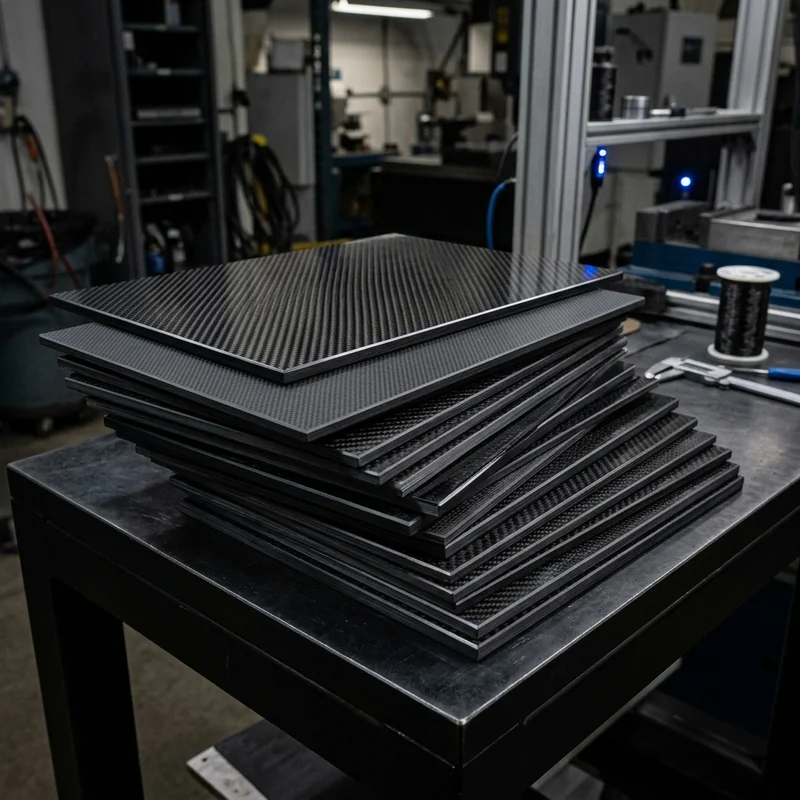
Carbon fiber standard plate-3k stripe
Lightweight, ultra-rigid standard sheets for drone fuselages, robot housings, facades and structural applications.

Carbon Fiber Plate — 3K Twill T700 3.0mm
Medium-thickness 3.0mm carbon fiber plate offering significantly higher load capacity while maintaining attractive 3K twill finish. Suitable for structural brackets, reinforcement plates, and load-bearing panels.

Carbon Fiber Plate — 3K Twill T700 1.5mm
Thin 1.5mm carbon fiber plate with 3K twill weave surface. Lightweight and stiff, commonly used for covers, panels, drone bodies, and applications requiring a premium aesthetic appearance.
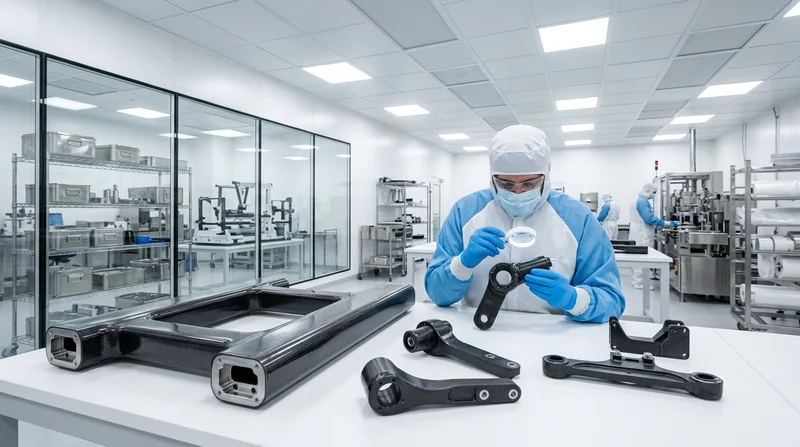
Custom Carbon Fiber Medical Device Components
Medical-grade carbon fiber components manufactured for imaging equipment, surgical instruments, and patient support systems. Carbon fiber's radiolucency (X-ray transparency) and high strength-to-weight ratio make it ideal for CT scanner beds, wheelchair frames, surgical robot arms, and MRI-compatible accessories. Biocompatible resin systems available.

Square Carbon Fiber Tube — 3K Twill T700
Square cross-section carbon fiber tube manufactured with 3K twill weave for torsional strength. Preferred for structural frames, trusses, and support columns where rectangular geometry offers design flexibility.