
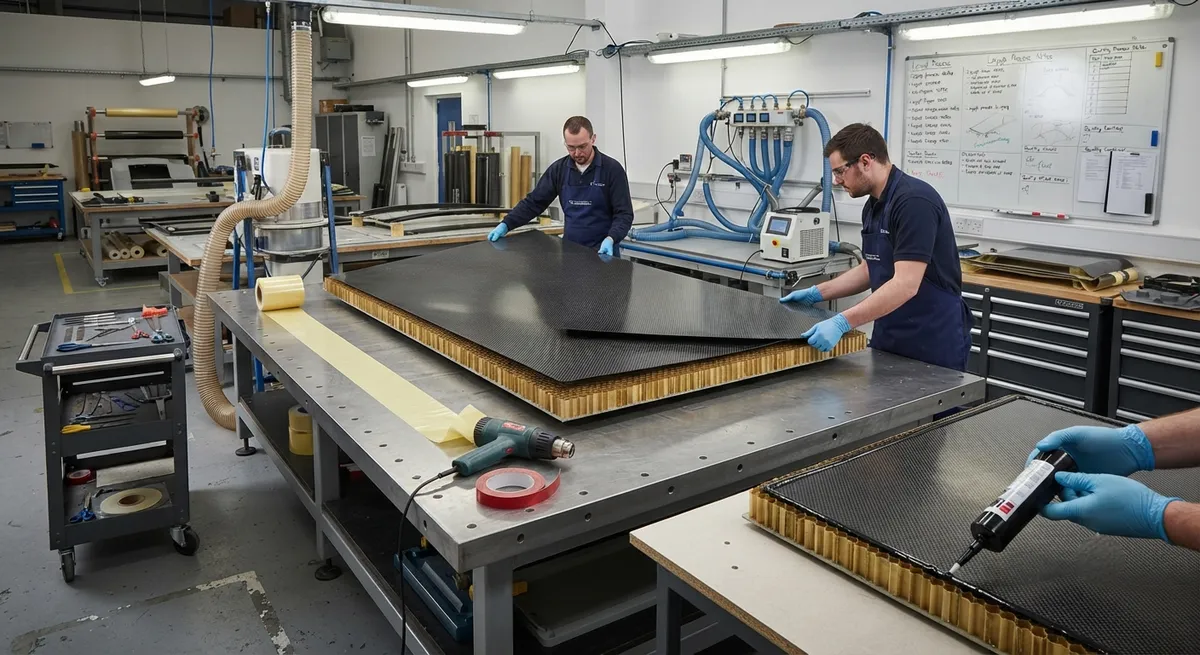
Carbon fiber honeycomb sandwich panel manufacturing is one of the most efficient ways to build large, flat, and torsionally stiff structures at a fraction of the weight of solid laminates. A sandwich panel works by separating two thin carbon fiber face skins with a lightweight core, dra
Introduction
Carbon fiber honeycomb sandwich panel manufacturing is one of the most efficient ways to build large, flat, and torsionally stiff structures at a fraction of the weight of solid laminates. A sandwich panel works by separating two thin carbon fiber face skins with a lightweight core, dramatically increasing the section's bending stiffness because stiffness scales with the cube of the distance between the faces. For the same bending performance, a sandwich panel can be 70-80% lighter than an equivalent solid aluminum or carbon fiber laminate, which is why aerospace interiors, aircraft flooring, railcar walls, marine bulkheads, and lightweight shelters all specify honeycomb sandwich construction.
But the concept is simple while the execution is demanding. Panel quality depends on three linked decisions: the honeycomb core material and density, the film adhesive system and its cure cycle, and the edge closeout method that seals and loads the panel perimeter. This article walks through each of these in the order a manufacturer actually makes them, with the process parameters and quality checks that separate a structural-grade panel from a cosmetic failure.
Honeycomb Core Selection: Material and Cell Geometry
The core provides shear resistance and through-thickness stability, and it carries roughly 90% of the panel's shear load. The three commercially dominant honeycomb materials behave very differently under load, in moisture, and in price:
| Core Material | Density Range (kg/m³) | Cell Size (mm) | Shear Strength (MPa) | Moisture Resistance | Typical Application |
|---|---|---|---|---|---|
| Nomex (aramid paper) | 32-96 | 3.2-4.8 | 0.9-2.4 | Moderate | Aerospace interiors, flooring, ducting |
| Aluminum 5056 | 32-130 | 3.2-9.5 | 1.1-3.5 | Corrodes if unprotected | Ground transport, shelters, tooling |
| Thermoplastic (PET, PP) | 60-110 | 4.8-12.7 | 0.4-1.2 | Excellent | Rail, marine interiors, cost-sensitive parts |
| Glass/phenolic | 64-144 | 3.2-6.4 | 1.0-3.0 | Good | High-temperature ducts, radomes |
Cell size and foil gauge set the core's density, and density sets both stiffness and price. A 3.2 mm cell Nomex core at 48 kg/m³ is the aerospace interior workhorse; larger 9.5 mm cells trade some bearing strength for lower cost in non-structural panels. For outdoor or marine exposure, aluminum honeycomb requires corrosion protection where it meets the carbon skins — a galvanic couple that must be isolated with a glass scrim or corrosion-inhibiting primer, a step many manufacturers skip to their regret.
Film Adhesive Bonding: Chemistry and Cure Cycle
The skin-to-core bond is made with a supported film adhesive — an epoxy film carrying a light carrier scrim that controls bondline thickness and prevents the adhesive from starving the core cell walls. Bondline thickness of 0.1-0.2 mm is typical, and the adhesive must wet the carbon face skin, bridge the core ribbon, and form an adhesive fillet that runs up the cell walls. That fillet, typically 1.5-3 mm tall, is what actually carries peel loads and provides the "tie" between skin and core.
The cure cycle is where most manufacturing defects are born. A typical 120°C-curing film adhesive is cured under vacuum bag pressure plus 0.2-0.4 MPa autoclave pressure, with a ramp rate of 1-3°C/min and a 60-90 minute dwell. Overly fast ramps cause outgassing and porosity in the bondline; undercure leaves a tacky, low-Tg bond that creeps in service. Manufacturers verify cure with a small test coupon or dielectric sensors, and confirm degree of cure with differential scanning calorimetry (DSC) before panels leave the tool.
- Surface preparation: Carbon face skins must be clean and lightly abraded; peel-ply removal just before layup maximizes bond strength.
- Adhesive handling: Film adhesive has a limited out-time at room temperature — typically 10-21 days — after which tack and flow degrade.
- Core splice and stabilization: Core splices use adhesive-expanded foam or additional film, and panels with cells larger than 6.4 mm often need edge stabilization to prevent skin dimpling.
- Bagging and bleed control: A perforated release film plus breather controls resin bleed so the face skins stay at the designed fiber volume fraction.
Edge Closeout: Sealing the Perimeter
Raw honeycomb edge cells are a liability: they crush under point loads, wick moisture, and produce a visually ragged edge. Every production panel needs an edge closeout, and the choice depends on the loads the edge will carry:
- Adhesive potting: A thixotropic paste or syntactic foam is injected into the edge cells before cure, sealing the core and carrying modest bearing loads. Cheapest option; adequate for decorative and lightly loaded edges.
- Ramped edge: The outer cells are machined to a slope so the top skin can be wrapped down and co-cured onto the bottom skin, producing a solid laminate edge band. Strong and aerodynamic, but costs panel surface area.
- Edge band or closeout channel: A solid carbon or aluminum profile is bonded onto the machined edge, providing a fastener-able surface and high bearing strength. Standard for flooring and structural panels that must accept inserts and bolts.
- Insert potting: Localized potting around fastener locations transfers loads into the core and prevents the classic "pulled insert" failure mode.
The edge closeout is also the panel's moisture entry point. Unsealed honeycomb that ingresses water gains weight, delaminates under freeze-thaw, and can burst cell walls during cure or in service. Sealing edges — and any drilled hole — is not optional cosmetic work; it is the primary long-term durability control.
Quality Control and Testing
Structural-grade panels are verified before they ship. The core checks are flatwise tension (per ASTM C297), which measures skin-to-core bond strength and typically must exceed 2.5 MPa for aerospace interior grades; climbing drum peel (ASTM D1781) for peel resistance; and non-destructive ultrasonic or tap testing to find disbonds and crushed cells. Dimensional checks on flatness and panel thickness complete the inspection set, because a panel that is structurally sound but bowed by 3 mm will not fit its assembly envelope.
Frequently Asked Questions
What is the difference between Nomex and aluminum honeycomb for carbon fiber sandwich panels?
Nomex honeycomb is an aramid paper honeycomb coated with phenolic resin. It offers the best stiffness-to-weight ratio for interior applications, resists corrosion, and has low thermal conductivity, making it the default for aerospace cabin interiors, flooring, and lightweight panels. Aluminum honeycomb is stronger in shear per unit density in many sizes and is cheaper, but it is heavier, conducts heat, and forms a galvanic couple with carbon fiber that requires corrosion protection in humid or marine environments. The choice is a trade-off between weight budget, environmental exposure, and cost: interiors favor Nomex, while ground transport and tooling often specify aluminum.
Why does edge sealing matter so much in honeycomb sandwich panels?
An unsealed honeycomb edge is an open capillary network. It wicks moisture into the cells, which adds weight, promotes skin-to-core disbond under freeze-thaw cycling, and can even burst cell walls when trapped water expands. It also crushes easily under point loads and looks unprofessional. Edge closeout — potting, ramped edges, or bonded edge bands — seals the core, provides a load-bearing perimeter for fasteners, and protects the panel for its full service life. For marine and outdoor panels, edge sealing is the single most important durability decision.
How thick should the adhesive fillet be for a good skin-to-core bond?
A well-formed fillet typically extends 1.5-3 mm up the honeycomb cell walls. If the fillet is too small, the bond area is insufficient and peel strength collapses; if too large, you are adding weight and wasting adhesive. Fillet formation is controlled by adhesive viscosity at cure temperature, the amount of adhesive in the film, and the cure pressure. Manufacturers validate fillet quality by sectioning test coupons or through flatwise tension and peel testing, since fillet geometry is not directly visible in a finished panel.
Conclusion
Carbon fiber honeycomb sandwich panel manufacturing rewards discipline. The core material and density must match the load case and environment, the film adhesive must be cured with a controlled cycle that produces a proper fillet, and every edge and hole must be sealed to protect the core for decades of service. When these fundamentals are right, sandwich panels deliver the stiffness-to-weight performance that no other construction method matches — which is why they remain the backbone of aircraft interiors, railcar structures, and lightweight industrial panels.
Whether you are designing a panel system or sourcing finished sandwich panels, working with a manufacturer that controls the full process — core selection, film bonding, and edge closeout — makes the difference between a prototype and a production-grade part. Explore our carbon fiber sandwich panel and laminate products to match core and skin options to your load case, or contact our engineering team for core selection and edge closeout support on your next project.
Part of topic
Related Articles
- Carbon Fiber Drone Blades and Propellers: Stiffness, Balance and Noise Reduction
- Fiberglass Filament Wound Tubes: Cost-Effective Alternative to Carbon Fiber
- Filament Wound Epoxy Tube Design: Wall Thickness, Fiber Angle and Load Optimization
- Filament Wound Epoxy Tubes: Testing Standards and Quality Assurance
- Filament Wound Epoxy Tubes Manufacturing: Process and Quality Control
- Filament Wound Fiberglass Tube: Process Parameters and Performance vs Carbon Fiber
Interested in Our Products?
Contact our team for competitive pricing and technical specifications.
Get a QuoteRelated Products
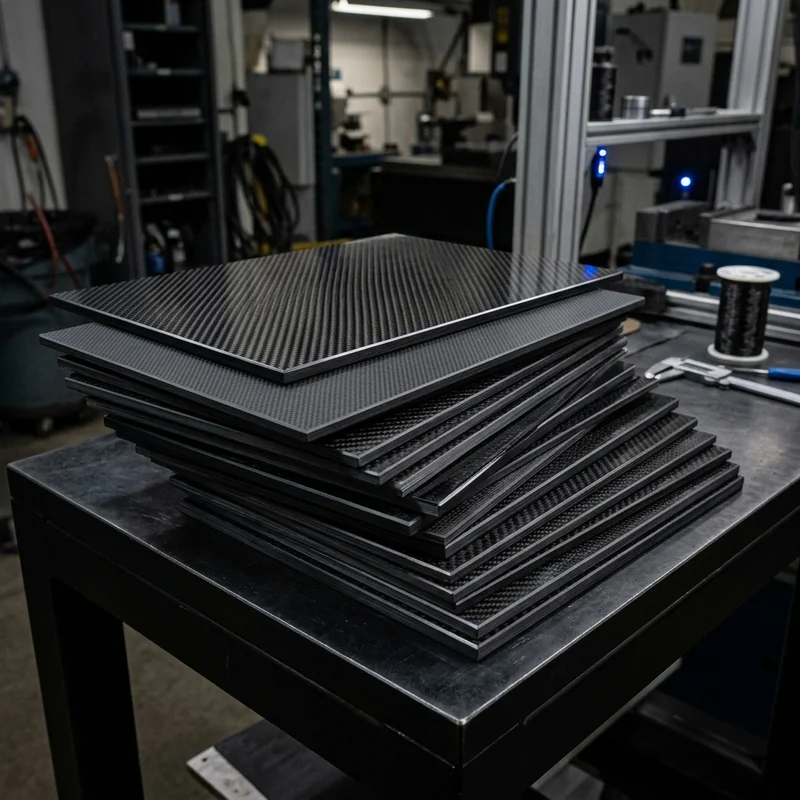
Carbon fiber standard plate-3k stripe
Lightweight, ultra-rigid standard sheets for drone fuselages, robot housings, facades and structural applications.

Carbon Fiber Plate — 3K Twill T700 3.0mm
Medium-thickness 3.0mm carbon fiber plate offering significantly higher load capacity while maintaining attractive 3K twill finish. Suitable for structural brackets, reinforcement plates, and load-bearing panels.

Carbon Fiber Plate — 3K Twill T700 1.5mm
Thin 1.5mm carbon fiber plate with 3K twill weave surface. Lightweight and stiff, commonly used for covers, panels, drone bodies, and applications requiring a premium aesthetic appearance.
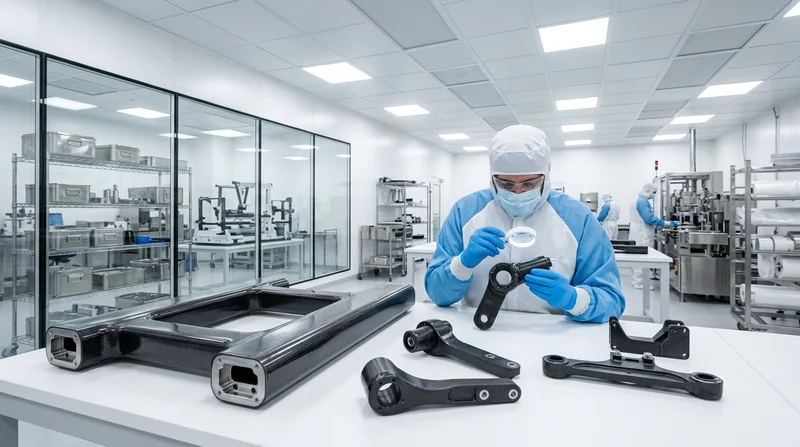
Custom Carbon Fiber Medical Device Components
Medical-grade carbon fiber components manufactured for imaging equipment, surgical instruments, and patient support systems. Carbon fiber's radiolucency (X-ray transparency) and high strength-to-weight ratio make it ideal for CT scanner beds, wheelchair frames, surgical robot arms, and MRI-compatible accessories. Biocompatible resin systems available.

Square Carbon Fiber Tube — 3K Twill T700
Square cross-section carbon fiber tube manufactured with 3K twill weave for torsional strength. Preferred for structural frames, trusses, and support columns where rectangular geometry offers design flexibility.