
Carbon fiber golf shafts have become the default specification for premium drivers, fairway woods, and irons because no other material matches their combination of low weight, high stiffness, and tunable feel. A modern graphite shaft weighing only 50-75 grams replaces a steel shaft of 1
Introduction
Carbon fiber golf shafts have become the default specification for premium drivers, fairway woods, and irons because no other material matches their combination of low weight, high stiffness, and tunable feel. A modern graphite shaft weighing only 50-75 grams replaces a steel shaft of 110-130 grams, yet delivers lower torque, reduced vibration, and a stiffness distribution that can be engineered to fit a player's swing tempo and release timing. For golf club OEMs and component buyers, understanding how these shafts are manufactured — specifically the winding patterns and sheet assembly methods that create each stiffness profile — is essential for specifying consistent, high-performance products.
This article examines the two dominant manufacturing routes for carbon fiber golf shafts — sheet rolling and filament winding — explains how layup architecture produces different flex and torque characteristics, and reviews the quality parameters that determine whether a shaft performs on the course or fails during impact.
Sheet Rolling: The Industry Standard Process
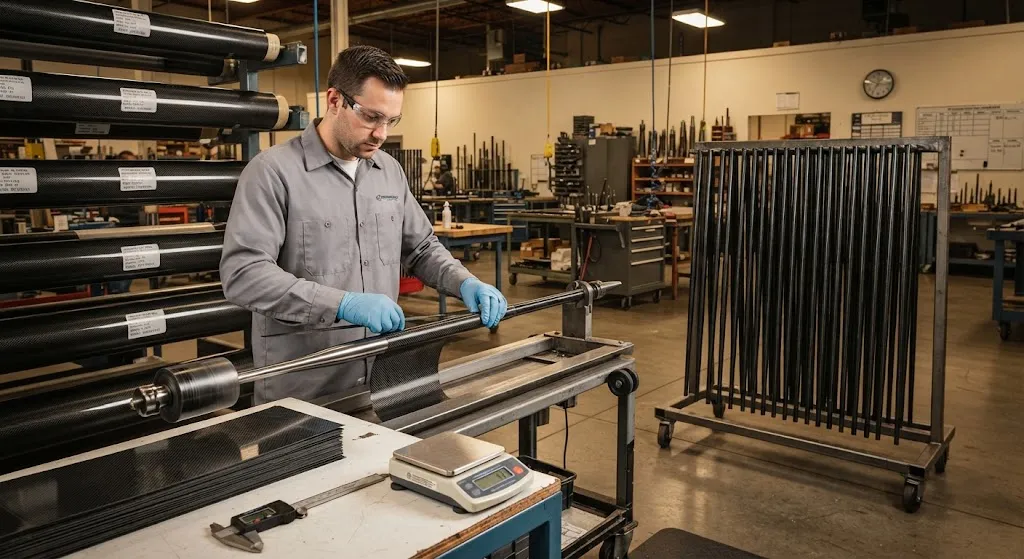
Sheet rolling, also called prepreg rolling, is the most widely used process for carbon fiber golf shafts. A flat prepreg sheet — unidirectional carbon fiber pre-impregnated with epoxy resin — is cut into a trapezoidal pattern, rolled around a tapered steel mandrel, wrapped with compression tape, and cured under heat and pressure.
- Bias sheets: Plies oriented at 45 degrees to the shaft axis provide torque resistance and torsional stability; they govern how much the shaft twists during the downswing.
- 0-degree sheets: Plies aligned with the shaft axis carry the bending load and define flex and kick point; they control how the shaft bows and how energy is released at impact.
- 90-degree hoop plies: Circumferential reinforcement adds crush resistance and improves the shaft's resistance to ovalization under load.
- Flag and tip wraps: Localized reinforcement at the butt and tip sections tunes stiffness where players feel it most during the swing.
The designer specifies the sheet widths, fiber angles, and layup sequence for each shaft model. Because the prepreg plies overlap and step down along the mandrel, the effective wall thickness and stiffness taper smoothly from butt to tip — this is what creates the distinctive bend profile of each shaft model.
Filament Winding for Golf Shafts
Filament winding is used by several leading shaft manufacturers as an alternative or complement to sheet rolling. Continuous carbon fiber tows are pulled through a resin bath and wound onto a rotating mandrel at controlled angles, building the wall thickness in helical and hoop layers. The process offers two advantages: automated, repeatable fiber placement, and the ability to tailor fiber angle continuously along the shaft length by varying the winding speed and carriage traverse.
Wound shafts typically combine helical layers (at low angles such as 5-20 degrees for bending stiffness) with hoop layers (at 80-90 degrees for torque and crush resistance). An optimized winding schedule can produce a shaft with 30-50% higher torsional stiffness than an equivalent rolled construction, which is why the approach is advancing in premium models aimed at faster-swinging players.
Stiffness Profiles: Flex, Kick Point, and Torque
The performance identity of a golf shaft is captured in three engineering characteristics: flex rating, kick point, and torque. These arise directly from the layup architecture and taper geometry.
| Shaft Type | Flex | Kick Point | Torque (°) | Target Player |
|---|---|---|---|---|
| L-flex (ladies) | Soft | Low-mid | 5.5-7.0 | Slow swing speeds below 70 mph |
| A-flex (senior) | Soft-medium | Mid | 4.5-5.5 | Swing speeds 70-80 mph |
| R-flex (regular) | Medium | Mid | 3.5-4.5 | Swing speeds 80-90 mph |
| S-flex (stiff) | Stiff | Mid-high | 2.5-3.5 | Swing speeds 90-100 mph |
| X-flex (extra stiff) | Very stiff | High | 1.5-2.5 | Swing speeds above 100 mph |
- Kick point is the location along the shaft where bending is greatest; high-kick shafts feel stiffer in the hands and launch lower, while low-kick shafts load closer to the tip, launch higher, and feel softer through impact.
- Torque measures the shaft's resistance to twisting. Lower torque (below 3 degrees) provides a stable feel for aggressive swingers; higher torque increases shaft rotation and can help slower swingers square the face.
- Weight is governed by fiber tow count, wall thickness, and resin content; premium shafts in the 45-65 gram range for drivers require careful vouchering of both fiber density and prepreg weight.
Manufacturing Process Steps
A complete carbon fiber golf shaft production run follows a tightly controlled sequence:
- Mandrel preparation: Tapered steel mandrels are cleaned, coated with release agent, and inspected for surface defects; the taper angle defines the shaft profile geometry.
- Sheet cutting and layup: Prepreg is cut to the designed trapezoidal shapes on a computerized cutting table, with the fiber angle and sheet size verified per model.
- Rolling: The sheets are rolled onto the mandrel under controlled tension to avoid wrinkles; rolling tension affects fiber straightness and final modulus efficiency.
- Tape wrapping: Heat-shrink or polypropylene tape is spiral-wrapped over the assembly to consolidate the plies and apply uniform pressure during cure.
- Curing: The wrapped mandrels are cured in an oven at 130-180 degrees Celsius for 20-60 minutes, or in an autoclave where higher consolidation pressure is required.
- Demolding and finishing: After cooling, the tape is stripped, the mandrel is extracted, and the shaft is trimmed, sanded, painted, and fitted with the hosel and grip end.
- 100% inspection: Each shaft is checked for weight, flex, torque, straightness, and wall thickness; premium lines add frequency testing and X-ray or ultrasonic checks for voids.
Material Selection and Quality Control
Golf shaft manufacturers specify carbon fiber in the intermediate-modulus range, typically T700-class fiber with 230-240 GPa modulus and 4,900 MPa tensile strength, or higher-modulus T800 material for stiff, low-torque models. Prepreg resin content is typically controlled at 30-36% with a high-temperature epoxy that survives the cure cycle and provides the toughness needed for repeated impact. Key quality parameters include fiber straightness (wavy fibers reduce compressive strength and cause early breakage), void content below 1-2%, and consistent prepreg weight per unit area within 2%.
Because a golf shaft is a slim, highly stressed beam that must survive hundreds of impacts, variable-void or undulating-fiber shafts fail prematurely at the tip or butt. Reputable manufacturers perform bend testing on every batch, frequency testing to confirm consistency, and fatigue testing on sample shafts to validate durability across flex classes.
Frequently Asked Questions
Why do premium golf shafts use carbon fiber instead of steel or titanium?
Carbon fiber offers the highest stiffness-to-weight ratio of any golf shaft material: a 55-gram graphite shaft can be two to three times stiffer in bending than a steel shaft of the same weight, while generating far less torsional twist. Steel shafts are heavier and transmit more vibration, while titanium shafts, though light, offer limited ability to tune stiffness distribution. Carbon fiber's layered architecture lets designers control flex, torque, and kick point independently, which is why virtually all premium drivers on tour use graphite shafts.
What is the difference between sheet rolling and filament winding for golf shafts?
Sheet rolling builds the shaft from flat prepreg sheets cut at precise angles and rolled around a mandrel; it is flexible for creating complex ply schedules and is the industry default. Filament winding deposits continuous fiber tows at controlled angles directly onto the mandrel, offering automated consistency and continuous angle control along the length, which can yield higher torsional stiffness. Sheet rolling dominates for cost and design flexibility; winding is favored for high-end models needing exceptional torque stability and repeatability.
How does shaft torque affect swing performance?
Torque describes how much the shaft twists under the forces of the downswing. A low-torque shaft (1.5-3 degrees) stays stable and square, suiting fast, aggressive swingers who deliver the clubhead accurately; a higher-torque shaft (4-6 degrees) allows the face to rotate more, which can help moderate-speed players square the club at impact and feel more shaft action. Choosing the wrong torque makes a shaft feel "loose" or "boardy," so OEMs match torque to swing tempo and release characteristics rather than flex alone.
What causes carbon fiber golf shafts to break?
Shaft fracture almost always traces to one of three causes: impact with the ground or a tree root (a stress concentrator at the impact point, especially in the tip section), a manufacturing defect such as voids, wrinkles, or wavy fibers that weaken the laminate, or shaft-to-hosel assembly issues that pinch or score the composite. Fatigue is rarely the cause in the tip section because design lifetimes exceed actual use; but over-aggressive trimming or re-shafting can damage the butt area. Proper manufacture, correct flex selection, and careful handling prevent nearly all failures.
Conclusion
Carbon fiber golf shaft manufacturing is a precision composite discipline that combines sheet rolling and filament winding with carefully engineered stiffness profiles. The winding pattern and ply angles determine flex, torque, and kick point — the three properties that dictate feel and performance for every player category from ladies flex to extra stiff tour models. For OEMs, consistent material supply, tight prepreg vouchers, and documented process control separate premium shafts from commodity products. As 3D-printed mandrels, automated winding, and AI-assisted layup optimization advance, shaft customization is moving toward individually tailored stiffness profiles — but the fundamentals of bias, 0-degree, and hoop reinforcement remain the core of every shaft.
Browse YongXian's carbon fiber tow and prepreg options for golf shaft production, or contact our engineering team for material grade selection, vouchers, and supply programs for sporting goods manufacturers.
Part of topic
Related Articles
Interested in Our Products?
Contact our team for competitive pricing and technical specifications.
Get a QuoteRelated Products

Carbon Fiber Plate — 3K Twill T700 3.0mm
Medium-thickness 3.0mm carbon fiber plate offering significantly higher load capacity while maintaining attractive 3K twill finish. Suitable for structural brackets, reinforcement plates, and load-bearing panels.

Carbon Fiber Plate — 3K Twill T700 1.5mm
Thin 1.5mm carbon fiber plate with 3K twill weave surface. Lightweight and stiff, commonly used for covers, panels, drone bodies, and applications requiring a premium aesthetic appearance.

Square Carbon Fiber Tube — 3K Twill T700
Square cross-section carbon fiber tube manufactured with 3K twill weave for torsional strength. Preferred for structural frames, trusses, and support columns where rectangular geometry offers design flexibility.
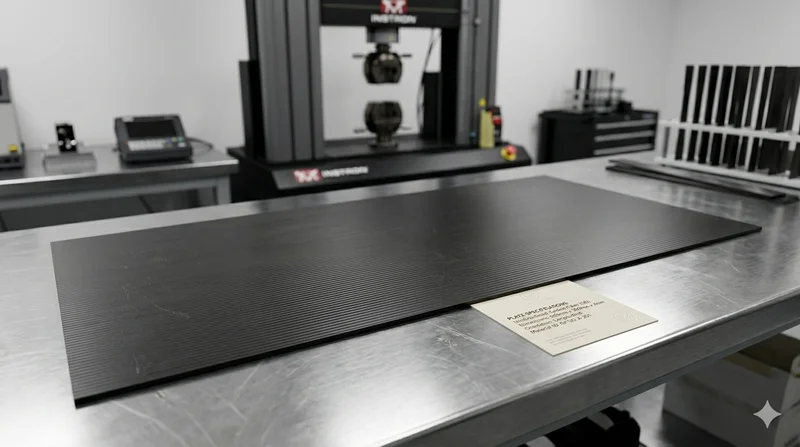
Carbon Fiber Plate — UD Unidirectional T700
Unidirectional carbon fiber plate with all fibers oriented in a single direction for maximum strength along the fiber axis. Essential for structural reinforcements, splints, and applications where load direction is predictable.
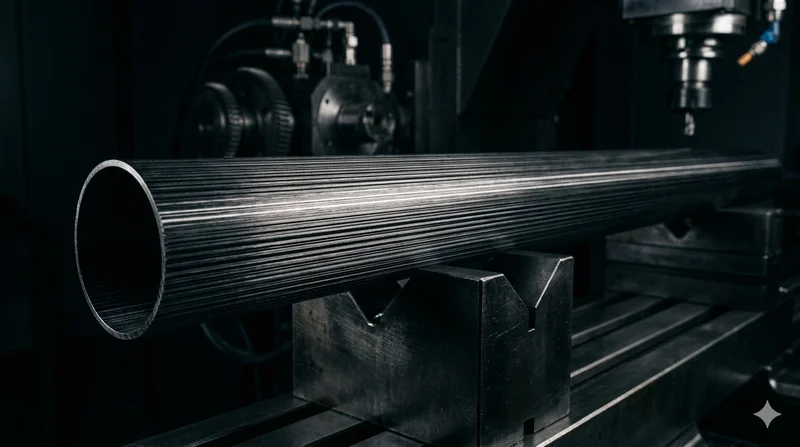
Round Carbon Fiber Tube — UD Unidirectional T700
Unidirectional (UD) round tube with all fibers aligned axially for maximum longitudinal stiffness. Ideal for applications requiring high bending rigidity with minimal weight, such as shafts, struts, and structural reinforcements.