
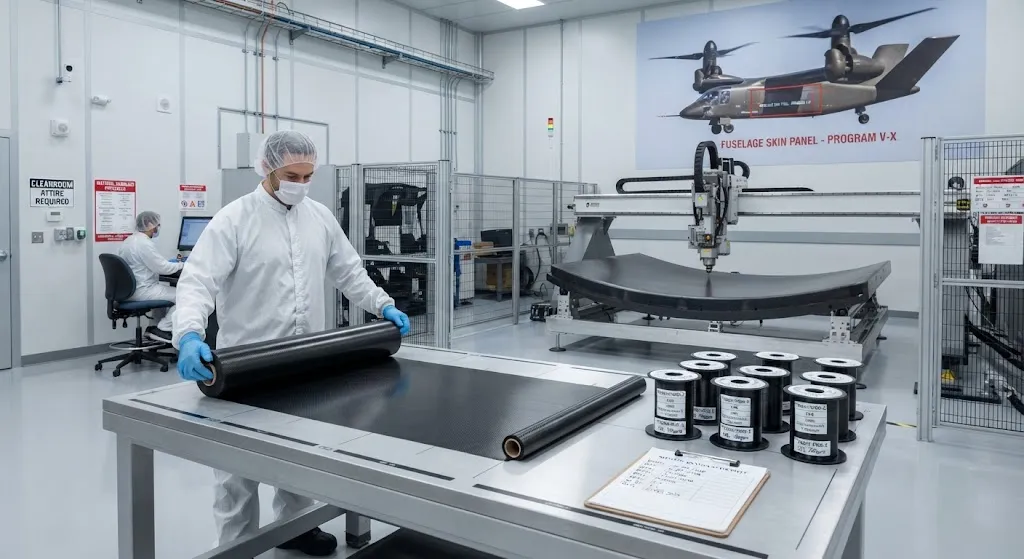
In December 2022 the US Army selected Bell's V-280 Valor as its Future Long-Range Assault Aircraft, the program that will replace the aging UH-60 Black Hawk fleet with a tiltrotor designed to fly twice as far and twice as fast. Behind the airframe award sits a materials decision with it
Introduction
In December 2022 the US Army selected Bell's V-280 Valor as its Future Long-Range Assault Aircraft, the program that will replace the aging UH-60 Black Hawk fleet with a tiltrotor designed to fly twice as far and twice as fast. Behind the airframe award sits a materials decision with its own strategic weight: in June 2025 the program confirmed that the V-280 fuselage will be built with Toray's T1100/3960 prepreg system, combining Toray's T1100G intermediate-modulus carbon fiber with the company's 3960 toughened epoxy resin.
The choice is a study in how defense programs buy materials. T1100G delivers a strength-modulus combination that was effectively impossible to certify a decade ago, and the 3960 resin system brings the impact tolerance that military rotorcraft need after decades of lessons from battlefield damage. But the T1100/3960 selection is also a Japanese fiber sitting inside a flagship American program, and that geopolitical fact is reshaping procurement behavior across the defense supply chain. This article examines the engineering rationale, the export-control politics, and the shift toward a supply-security-over-performance buying model that the FLRAA precedent is accelerating.
The Technical Rationale Behind T1100/3960
The V-280 is a heavy-load, high-speed platform: the fuselage carries cargo, resists the vibration of a large proprotor system, and faces hard landing and battle damage conditions that a commercial airframe never sees. The material system has to be strong enough to save weight, stiff enough to hold dynamic stability at 280 knots, and tough enough to survive impact damage without catastrophic delamination growth. The table below positions T1100G against the grades the defense supply chain has historically relied on:
| Property | T1100G | T800S | T700S |
|---|---|---|---|
| Tensile strength | 7,000 MPa | 5,880 MPa | 4,900 MPa |
| Tensile modulus | 324 GPa | 294 GPa | 230 GPa |
| Grade class | Intermediate modulus, ultra-high strength | Intermediate modulus | Standard modulus |
| Typical use | Next-gen rotorcraft and fighter structures | Primary aerospace structures | General aerospace and industrial |
Two engineering properties drive the selection. The first is the strength-modulus balance: at 7,000 MPa tensile strength and 324 GPa modulus, T1100G lets designers cut laminate thickness where stiffness is driven by dynamic loads, saving weight in the fuselage skin and frames. The second is the 3960 resin, a toughened epoxy whose high strain-to-failure gives damage tolerance through the resin-rich interlaminar regions, which is exactly where impact events in rotorcraft initiate delamination. Together the system certifies to the point-load and impact requirements that a tiltrotor fuselage demands.
Supply Security Versus Performance in Defense Procurement
The engineering case for T1100/3960 is strong, but it is not the whole story of the selection. The FLRAA decision placed a Japanese-produced fiber system inside a program the US Army calls its top aviation modernization priority, and that choice has put the broader question of supply security on the table. Defense buyers are now asking a question that rarely surfaced in the commercial composites market: what happens to a strategic program if the fiber source becomes politically or commercially unavailable?
The answer shaping new programs is a shift in procurement logic. Where past defense contracts optimized primarily for cost and technical performance, the current generation adds a third criterion — supply security — that can outweigh both. For carbon fiber in defense structures this means:
- Dual sourcing: requiring at least two qualified fiber suppliers per platform so a single export-control decision or factory fire cannot ground a fleet.
- Domestic capability investment: government and prime-contractor funding for home-grown high-performance fiber capacity, including intermediate-modulus grades previously bought only from Japan.
- Export control awareness: evaluating fiber supply chains against export-control regimes in the country of origin, including restrictions that could apply to defense-relevant grades.
- Material qualification portability: designing qualification programs so an alternative fiber can be substituted with limited re-testing rather than a full re-certification.
- Long-horizon supply agreements: locking multi-year fiber allocations with suppliers that have stable, documented production capacity.
How Export Control Politics Is Reshaping Sourcing
The political layer of the T1100/3960 selection is real. Japan controls the export of carbon fiber through its own regulations, and its regimes have historically been permissive for commercial grades while receiving close scrutiny for defense-relevant technology. The FLRAA program, as a flagship US Army platform, sits precisely at that intersection, and the optics of a Japanese fiber inside an American strategic rotorcraft have pushed parts of the procurement community toward a domestic-first posture regardless of the technical merits of the incumbent material.
This is not hypothetical pressure. Several Western defense and aerospace buyers have already signaled that they will evaluate non-Japanese intermediate-modulus sources for future programs, even where the incumbent Japanese grade meets every specification. The commercial consequence is a wave of qualification work: fiber producers outside Japan are investing in intermediate-modulus capacity with the explicit aim of becoming the second-source option in defense programs, and the qualification pipelines that used to take years are being compressed by the urgency of the supply-security argument. For buyers, the practical implication is that material decisions now carry a geopolitical component that must be documented alongside the mechanical test data.
What the FLRAA Precedent Means for Material Qualification
The FLRAA materials decision demonstrates a new qualification reality in defense composites. First, the threshold for entry is no longer just mechanical performance: a fiber system must show supply-chain resilience, including documented production capacity, export-control exposure and the ability to support dual sourcing. Second, qualification programs are being restructured for portability, so that substituting a qualified alternative fiber does not trigger a full re-certification of the airframe. Third, the commercial market is being pulled along: the same intermediate-modulus grades being qualified for defense are increasingly specified in commercial aircraft and rotorcraft spares, because defense supply decisions de-risk the grades and build qualification data that civil programs can reuse.
Suppliers that respond to this environment — by expanding intermediate-modulus capability, by documenting their own supply chains, and by structuring their qualification data for portability — position themselves for a defense market that is growing more demanding on exactly these dimensions. Suppliers that treat defense programs as pure performance competitions will find the procurement community has moved the goalposts.
Frequently Asked Questions
What is the T1100/3960 prepreg system selected for the FLRAA fuselage?
T1100/3960 is a Toray prepreg system combining T1100G intermediate-modulus carbon fiber with the 3960 toughened epoxy resin. T1100G offers 7,000 MPa tensile strength and 324 GPa modulus, and the 3960 resin provides damage tolerance through high strain-to-failure in interlaminar regions. The system was confirmed in June 2025 for the Bell V-280 fuselage under the US Army's Future Long-Range Assault Aircraft program, chosen for its weight-saving strength, dynamic stiffness and impact tolerance.
Why does the FLRAA selection raise supply-security concerns?
The selection places a Japanese-produced fiber system inside a flagship US Army program, which has intensified the debate over foreign dependency in strategic defense supply chains. Buyers are adding supply security as a procurement criterion alongside cost and performance, which is driving dual-source requirements, investment in domestic intermediate-modulus capacity, export-control evaluations and qualification programs designed for fiber substitution. The concern is not about the T1100G material itself, which is qualified and proven, but about the resilience of relying on a single foreign source for a strategic platform.
How does supply-security thinking change carbon fiber qualification for defense?
Qualification programs are being restructured in three ways: dual sourcing is becoming a program requirement rather than an option, qualification data is being organized for portability so an alternative fiber can be substituted with limited re-testing, and material decisions now include documented supply-chain resilience — production capacity, export-control exposure and sourcing independence — alongside mechanical test data. Fiber producers outside Japan are investing in intermediate-modulus capacity to become second-source options, and the qualification pipelines are being compressed by the urgency of the supply-security argument.
Conclusion
The T1100/3960 selection for the FLRAA fuselage is a materials milestone wrapped in a supply-chain politics story. Technically, it puts an ultra-high-strength intermediate-modulus grade and a toughened resin system in the center of the Army's flagship rotorcraft program. Strategically, it has accelerated a procurement shift where supply security can outweigh both cost and performance, pushing dual sourcing, domestic capability investment and export-control awareness to the center of defense material decisions. Any supplier in the defense composites chain must now treat documented supply resilience as a core qualification requirement.
For programs evaluating high-performance fiber systems — whether for rotorcraft, fixed-wing or emerging platforms — the qualification conversation now includes both the test data and the supply-chain evidence behind it. Explore our carbon fiber product range and contact our engineering team to discuss material qualification, dual-source strategy and supply documentation for defense and aerospace programs.
Part of topic
Related Articles
- Recycled Carbon Fiber Market Forecast 2030: Technology Maturity and Commercialization Path
- South Korea Carbon Fiber Market 2026: Hydrogen Economy and Shipbuilding Innovation
- Wind Turbine Blade Leading Edge Protection 2026: Polyurethane, Tape, and Metallic Shield Solutions
- China Carbon Fiber Overcapacity 2026: Price War Impact and Industry Consolidation
- India Carbon Fiber Market 2026: Wind Energy, Aerospace, and Defense Expansion
- PAN Precursor Market 2026: Acrylonitrile Supply and Carbon Fiber Cost Structure
Interested in Our Products?
Contact our team for competitive pricing and technical specifications.
Get a QuoteRelated Products
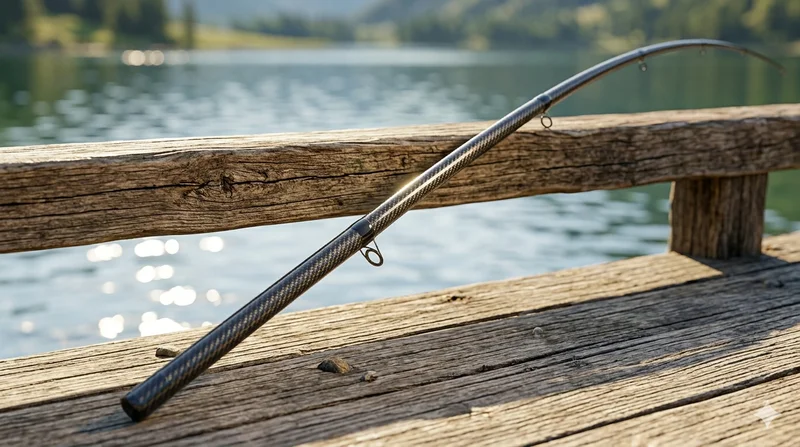
Carbon Fiber Fishing Rod Blank
High-quality carbon fiber fishing rod blank manufactured from multiple grades of Toray carbon fiber cloth. Available in a wide range of lengths, powers, and actions for freshwater and saltwater applications. Suitable for OEM rod building.
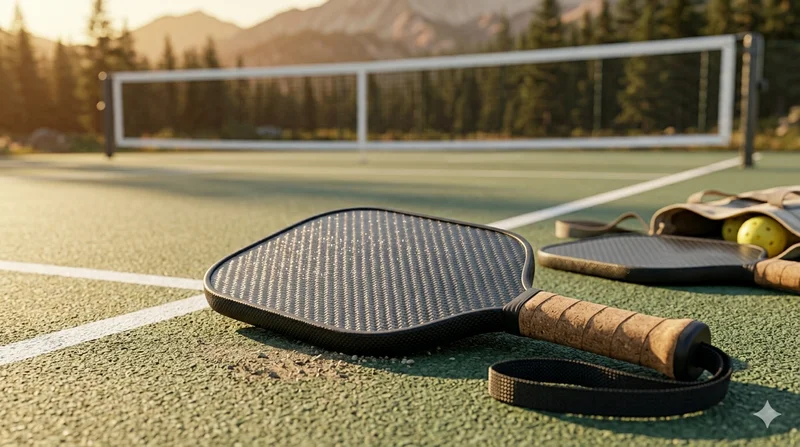
Carbon Fiber Pickleball Paddle
High-performance pickleball paddle with Toray T700 carbon fiber face and polypropylene honeycomb core. Delivers excellent power-to-weight ratio, spin generation, and vibration dampening for competitive play.
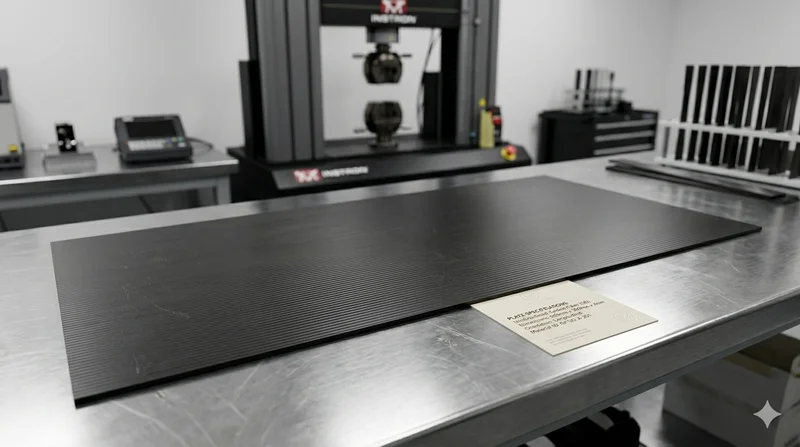
Carbon Fiber Plate — UD Unidirectional T700
Unidirectional carbon fiber plate with all fibers oriented in a single direction for maximum strength along the fiber axis. Essential for structural reinforcements, splints, and applications where load direction is predictable.
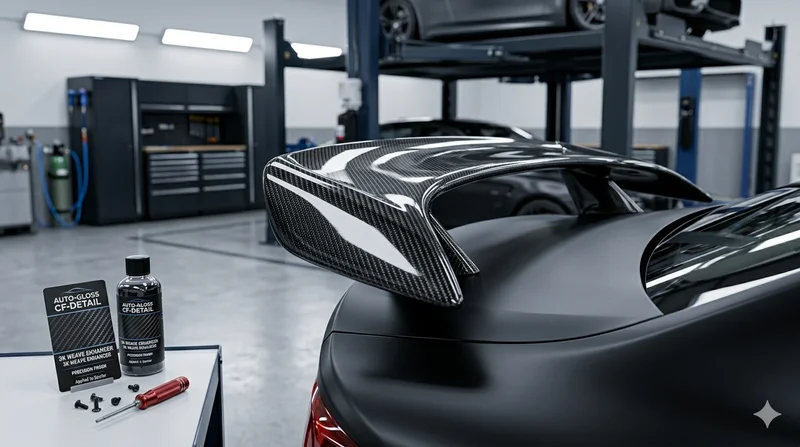
Carbon Fiber Automotive Spoiler
Automotive-grade carbon fiber spoiler manufactured using autoclave-cured pre-preg technology. Each spoiler is vacuum-bagged and oven-cured for optimal fiber-to-resin ratio, strength, and a flawless cosmetic finish.
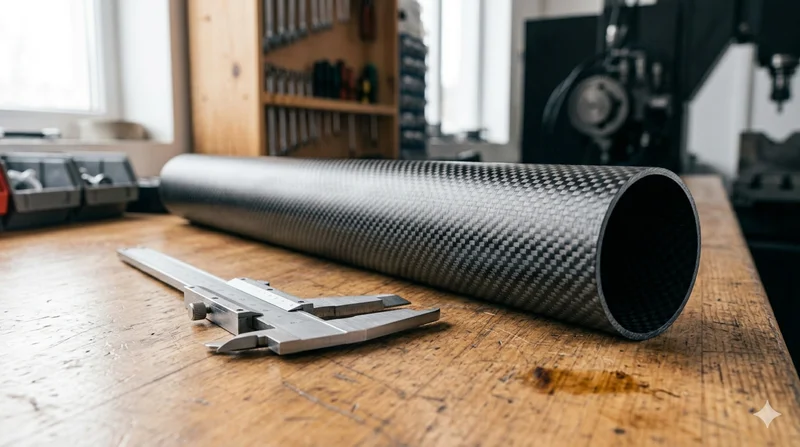
Round Carbon Fiber Tube — 3K Plain Weave T700
Standard round carbon fiber tube manufactured from Toray T700 grade fiber with 3K plain weave. Offers balanced strength and stiffness for general industrial applications including robotics, automation, sports equipment, and aerospace structures.