
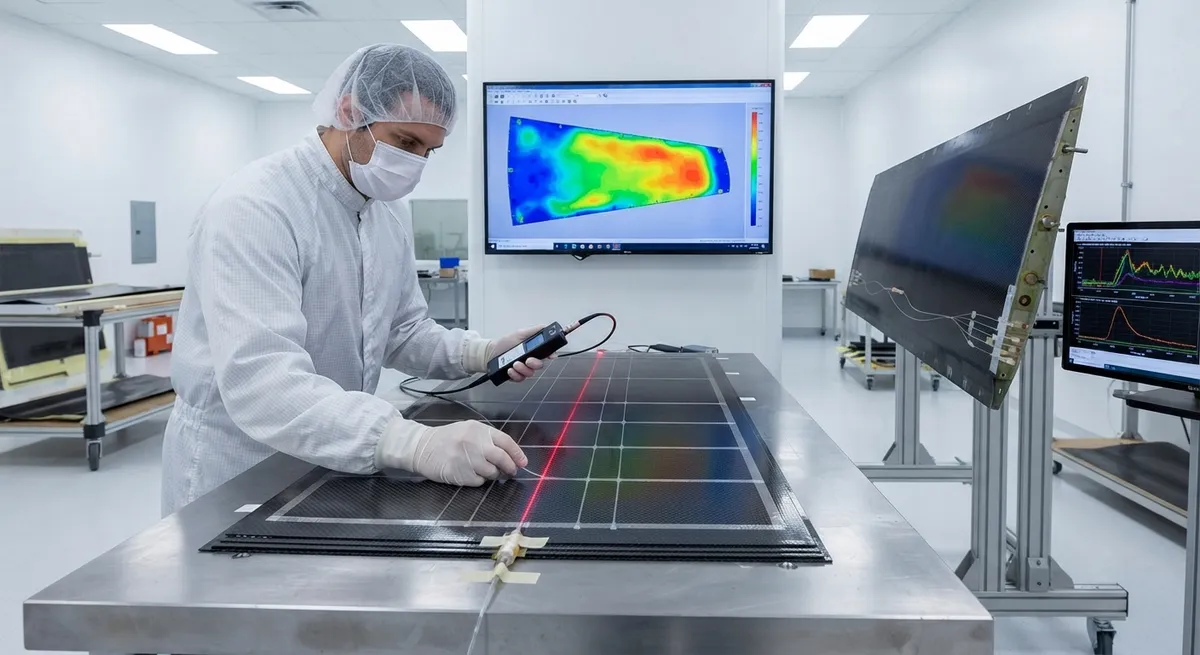
Composite structures hide their damage. A barely visible impact on a carbon fiber skin can delaminate internal plies without leaving a mark, and the repair decision then depends on scheduled inspections rather than on what the structure actually knows about itself. Embedded fiber optic
Introduction
Composite structures hide their damage. A barely visible impact on a carbon fiber skin can delaminate internal plies without leaving a mark, and the repair decision then depends on scheduled inspections rather than on what the structure actually knows about itself. Embedded fiber optic sensing changes this relationship: a network of fiber Bragg grating (FBG) sensors laid inside the laminate measures strain and temperature at every ply interface, and the structure begins to report its own health continuously — during cure, in the factory, and through decades of in-service loading.
For aerospace and wind energy buyers, structural health monitoring (SHM) is moving from research demonstration to production requirement. Certification authorities are accepting validated monitoring data as part of inspection programs, and the economics favor sensors that are added at layup for a few dollars of fiber rather than retrofitted at a cost of access and downtime. This article explains how embedded fiber optic sensing works, what the SHM data actually looks like, and where in-service monitoring is being adopted today.
How Embedded FBG Sensing Works
A fiber Bragg grating is a periodic modulation of the refractive index written into a short segment of an optical fiber. When broadband light passes through the grating, a narrow wavelength band is reflected, and the reflected wavelength shifts in proportion to the strain and temperature applied to that segment. The measurement is absolute, self-referencing, and immune to electromagnetic interference — properties that suit composite structures in lightning-prone and high-voltage environments.
Embedding changes how the sensor is applied. During layup, the optical fiber is placed between plies along with the reinforcement, either co-laminated directly or bonded in a thin protective carrier. The fiber is small — typically 155-250 microns with its acrylate coating — so it disturbs the laminate minimally, and it is routed to a termination at the part edge where a connector couples it to an interrogator. Because several gratings can be written along a single fiber at different wavelengths, one embedded fiber line returns strain and temperature from ten or more distributed points, which is the basis of low-cost, high-coverage SHM.
What SHM Data Produces in Practice
The value of embedded sensing is the type of data it produces at different stages of the part life cycle. The table below summarizes the main measurement modes and their use:
| Measurement mode | What is detected | Typical application |
|---|---|---|
| Cure monitoring | Residual strain buildup during cure; temperature profile through the laminate | Process validation, spring-in prediction, autoclave cycle optimization |
| Assembly and proof load | Load path distribution; peak strain under test load | Acceptance testing, load calibration, validating analysis models |
| Operational strain monitoring | Cyclic strain at hot spots; load spectra | Fatigue life tracking, usage-based maintenance intervals |
| Damage detection | Local strain anomalies from delamination or fiber breakage | Impact detection, repair justification, residual strength assessment |
| Structural temperature mapping | Temperature distribution across the structure | Thermal load cases, de-icing, fire detection near composite parts |
The strain resolution of a typical FBG interrogator is in the range of 1-10 microstrain, with acquisition rates from 1 Hz to kilohertz for dynamic events. A network of 10-50 sensors per structure is common for production aircraft and wind turbine components, returning a continuous map of how the structure is loaded and whether that loading has changed.
Data Interpretation: From Raw Wavelength to Maintenance Decision
The raw output of an FBG system is a wavelength shift, not a maintenance decision. Converting it into actionable information requires a processing chain that is now well established:
- Strain-temperature separation: Because gratings respond to both strain and temperature, production systems place at least one unstrained reference grating to measure temperature alone, allowing the strain component to be extracted from every other grating.
- Baseline and load-path mapping: The structure is interrogated through known test loads at commissioning, producing a baseline strain map. In-service readings are compared against this baseline, and a deviation beyond a defined threshold flags the region for inspection.
- Damage localization: A delamination or crack changes the local load path, which appears as a strain anomaly at a specific grating or between adjacent gratings. With sufficient sensor density, the damage zone can be localized to within centimeters.
- Trend analysis for fatigue: Accumulated strain cycles are counted at each sensor, feeding a usage-based fatigue model that can extend or shorten inspection intervals based on actual load history rather than conservative assumptions.
This chain matters commercially: the sensor hardware is the small part of the cost, while the validated data interpretation is what earns certification credit and operator trust.
Adoption in Aerospace and Wind Energy
Two industries are furthest along in embedding fiber optic sensing into composite structures:
- Aerospace: Several production and near-production programs use embedded FBG networks for load monitoring on wings, horizontal stabilizers, and fuselage panels. The strongest driver is inspection reduction: continuous monitoring can replace some scheduled ultrasonic inspections, and the data supports life-extension decisions for structures approaching their design life. Blade-out and impact events are detected and localized immediately, reducing downtime for assessment.
- Wind energy: Turbine blades are the highest-volume composite structure in the world, and embedded sensing is used on offshore blades for blade root and trailing edge monitoring, load measurement for pitch control, and ice and lightning event detection. Offshore inspection access is expensive and weather-limited, which makes the economics of embedded monitoring unusually favorable — the sensor is installed once at manufacture and returns data for the 20-25 year life of the blade.
Both industries converge on the same technical conclusion: the embedded sensor network is cost-effective when it is designed in from the start, because the incremental material cost at layup is a few dollars per meter of fiber while the alternative — access, inspection labor, and unscheduled downtime — costs orders of magnitude more.
Integration and Qualification Considerations
Embedding a sensor into a load-bearing laminate raises questions that a production engineer must answer before committing a part design:
- Impact on laminate integrity: Fiber optic cables reduce local strength only slightly when aligned with the reinforcement direction; studies typically show losses of 1-3% in tensile and fatigue properties, negligible for most structures when the fiber is routed in low-stress regions.
- Connector and termination robustness: The part edge termination is the most failure-prone point of an embedded system. Ruggedized connectors, strain-relieved routing, and protective covers are required for aircraft and blade environments.
- Certification and qualification: Monitoring data earns credit only when the sensor system itself is qualified — temperature and strain calibration, installation process control, and demonstrated long-term stability. Aerospace programs document this through the same materials and processes qualification framework as the composite itself.
- Interrogator selection: Wavelength-division multiplexed (WDM) systems interrogate many gratings per fiber, while fiber-optic distributed sensing (OFDR or Rayleigh) measures strain continuously along the fiber at the cost of more complex interrogators and shorter usable lengths.
Frequently Asked Questions
How much does embedded FBG sensing add to the cost of a composite part?
The incremental cost at manufacture is modest: optical fiber suitable for embedding costs roughly $1-5 per meter, connectors and terminations add tens of dollars per channel, and the interrogator — the expensive component — is shared across an entire aircraft or wind turbine and amortized over many structures. A production-scale system typically adds well under 1% to the cost of a large composite component, and it can pay for itself if it reduces even a small number of scheduled inspections or unscheduled groundings over the life of the asset. The dominant cost is not hardware but the engineering effort to validate data interpretation and qualify the system.
Can embedded fiber optic sensors detect impact damage before it becomes visible?
Yes, and this is one of the primary value cases. A barely visible impact that produces internal delamination changes the local load path, which appears as a strain anomaly at the affected grating before any surface mark is visible. Detection sensitivity depends on sensor density and distance from the impact site: a sensor directly under or adjacent to the impact zone reliably detects the event and localizes it within centimeters, while a sparse network may only register that something changed in a region. Because the fiber can be routed through the exact zones where impact damage is most likely — under fastener rows, at blade roots, on leading edges — the network is typically designed to cover the risk areas with adequate density.
What is the difference between FBG point sensing and distributed fiber optic sensing?
FBG sensing reads discrete gratings written at specific points along the fiber, typically 10-50 per fiber line. It offers high accuracy, established interrogators, and a proven certification record, and it is the mainstream choice for embedded composite monitoring. Distributed sensing (optical frequency domain reflectometry, or OFDR, and Rayleigh-scattering systems) measures strain continuously along the entire fiber, so one embedded fiber acts like a dense array of thousands of virtual sensors — ideal for mapping damage over large areas. The trade-offs are cost and complexity: distributed interrogators are substantially more expensive, data volumes are large, and practical measurement lengths are shorter in embedded applications. Many programs use FBG networks for production monitoring and distributed sensing for development testing and damage mapping on selected high-value parts.
Conclusion
Embedded fiber optic sensing turns a composite structure into an instrumented asset that reports its own strain, temperature, and damage state throughout its life. The FBG technology is mature, the data chain from wavelength shift to maintenance decision is established, and aerospace and wind programs are moving from demonstration to production adoption because the economics favor sensors designed in at layup over inspections scheduled forever after. For buyers of composite structures, the question is shifting from whether to instrument to how much monitoring a given asset should carry.
For engineers specifying SHM on a new composite program, the practical decisions are sensor architecture, placement, termination design, and qualification scope. Explore our carbon fiber materials for instrumented and standard structures, or contact our engineering team to discuss sensor integration, fiber selection, and monitoring strategy for your application.
Part of topic
Related Articles
- Carbon Fiber Drone Blades and Propellers: Stiffness, Balance and Noise Reduction
- Fiberglass Filament Wound Tubes: Cost-Effective Alternative to Carbon Fiber
- Filament Wound Epoxy Tube Design: Wall Thickness, Fiber Angle and Load Optimization
- Filament Wound Epoxy Tubes: Testing Standards and Quality Assurance
- Filament Wound Epoxy Tubes Manufacturing: Process and Quality Control
- Filament Wound Fiberglass Tube: Process Parameters and Performance vs Carbon Fiber
Interested in Our Products?
Contact our team for competitive pricing and technical specifications.
Get a QuoteRelated Products

Carbon Fiber Fishing Rod Blank
High-quality carbon fiber fishing rod blank manufactured from multiple grades of Toray carbon fiber cloth. Available in a wide range of lengths, powers, and actions for freshwater and saltwater applications. Suitable for OEM rod building.

Carbon Fiber Plate — 3K Twill T700 1.5mm
Thin 1.5mm carbon fiber plate with 3K twill weave surface. Lightweight and stiff, commonly used for covers, panels, drone bodies, and applications requiring a premium aesthetic appearance.

Carbon Fiber Plate — 3K Twill T700 3.0mm
Medium-thickness 3.0mm carbon fiber plate offering significantly higher load capacity while maintaining attractive 3K twill finish. Suitable for structural brackets, reinforcement plates, and load-bearing panels.
Custom Carbon Fiber Medical Device Components
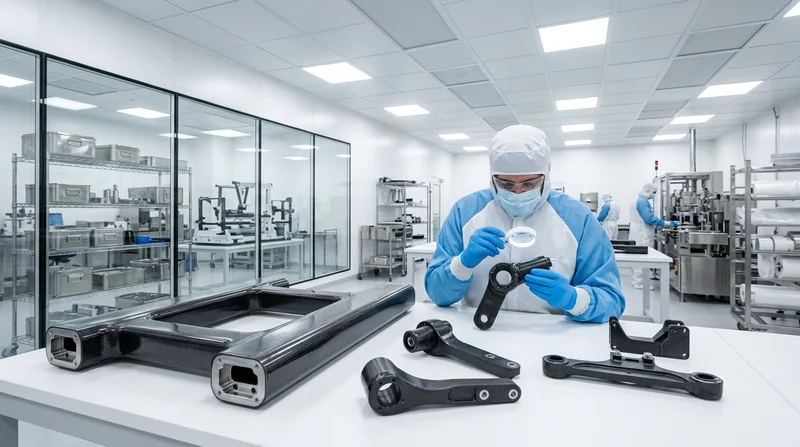
Medical-grade carbon fiber components manufactured for imaging equipment, surgical instruments, and patient support systems. Carbon fiber's radiolucency (X-ray transparency) and high strength-to-weight ratio make it ideal for CT scanner beds, wheelchair frames, surgical robot arms, and MRI-compatible accessories. Biocompatible resin systems available.

Square Carbon Fiber Tube — 3K Twill T700
Square cross-section carbon fiber tube manufactured with 3K twill weave for torsional strength. Preferred for structural frames, trusses, and support columns where rectangular geometry offers design flexibility.