
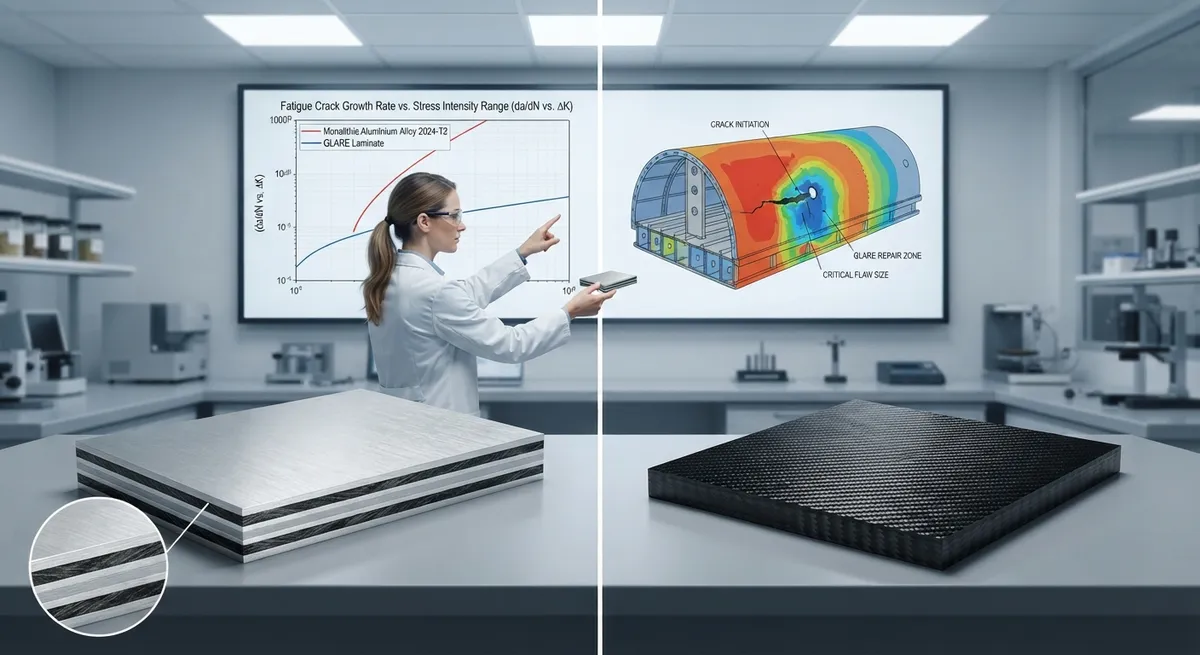
Two materials dominate the modern airframe material conversation. The first is the fiber metal laminate (FML) family, led by GLARE — alternating layers of thin aluminum sheet and unidirectional glass-fiber prepreg — proven since 2007 as the upper fuselage skin of the Airbus A380. The se
Introduction
Two materials dominate the modern airframe material conversation. The first is the fiber metal laminate (FML) family, led by GLARE — alternating layers of thin aluminum sheet and unidirectional glass-fiber prepreg — proven since 2007 as the upper fuselage skin of the Airbus A380. The second is carbon fiber reinforced polymer (CFRP), now the primary structure of the Boeing 787 and Airbus A350. Both were developed to solve the same problem: fatigue cracking in aluminum skins. They solve it in fundamentally different ways, and those differences matter for certification, maintenance, and lifetime cost.
This article compares the two material systems on fatigue performance and repairability — the two properties that dominate in-service experience — and provides a practical framework for choosing between them in an aircraft structure.
What Fiber Metal Laminates Are and Where They Come From
Fiber metal laminates were developed in the 1970s and 1980s at Delft University of Technology to fix the fatigue problem of riveted aluminum fuselages. The concept is simple: bond thin sheets of aluminum alloy to fiber-reinforced adhesive layers, and the intact fibers bridging the crack slow or stop crack growth. The ARALL family uses aramid fibers; the GLARE family uses S-glass fibers in the adhesive, which gives it better impact and compression performance than ARALL.
| FML grade | Fiber | Typical use |
|---|---|---|
| ARALL | Aramid | Early FML; limited commercial use |
| GLARE 1 | S-glass, unidirectional | Fatigue-critical tension-dominated areas |
| GLARE 2 | S-glass, cross-ply | Biaxial loading conditions |
| GLARE 3 | S-glass, 0/90 | Fuselage skin, pressure cabin (A380) |
| GLARE 4 | S-glass, 0/90 plus unidirectional | Shear and biaxial combinations |
| GLARE 5 | S-glass, quasi-isotropic | Impact-critical areas |
The A380 uses GLARE in roughly 27,000 m² of upper fuselage skin. The reason is blunt: a fatigue crack in aluminum grows fast, but a fatigue crack in GLARE grows about 10-100 times slower than in monolithic aluminum of the same thickness, because the glass fibers bridging the crack share the load and reduce the stress intensity at the crack tip.
Fatigue Performance: FML vs Carbon Fiber Composites
CFRP approaches fatigue from the opposite direction. Carbon fibers do not fatigue the way metals do — the fiber itself is essentially insensitive to cyclic loading — so CFRP parts do not develop propagating fatigue cracks in the classical sense. The fatigue concern shifts to three other failure modes: matrix cracking, delamination, and fiber/matrix interface degradation. Under cyclic loading, CFRP accumulates damage in the form of microcracks that grow into delaminations, which then reduce stiffness and can lead to sudden, hard-to-detect failure.
The practical difference is in damage tolerance philosophy. A metal or FML structure shows a crack, and the crack grows slowly enough to be caught on scheduled inspections. A CFRP structure shows barely visible impact damage on the surface while the damage inside — delaminations in the sub-laminates — can be far larger and is not visible to the eye.
- Crack growth rate: GLARE grows cracks 10-100 times slower than monolithic aluminum; CFRP has no classical metal crack growth but accumulates delamination damage.
- Damage detection: Metal and FML cracks are visually and eddy-current detectable; CFRP impact damage is often hidden inside the laminate.
- Impact resistance: FML aluminum outer layers absorb impact energy and protect the fibers; CFRP is susceptible to barely visible impact damage (BVID) and delamination.
- Residual strength: FML retains high residual strength with a long crack; CFRP retains strength until delamination reaches a critical size, then drops sharply.
- Fatigue of the metal layers in FML: The aluminum layers in GLARE do fatigue, but the glass fibers carry the load across the crack, so the crack growth rate is dramatically reduced.
For pressurization cycles — the dominant fatigue load on a fuselage — FML is the superior fatigue material. The A380 was designed for a 19,000-cycle pressurization life, and the GLARE skin is largely fatigue-uncritical: cracks simply do not become a maintenance driver in the bonded GLARE areas.
Why Carbon Fiber Composites Win on Weight and Corrosion
Fatigue is not the only driver. CFRP has two decisive advantages that made it the primary structure of modern wide-body aircraft: weight and corrosion. Carbon fiber has roughly three times the specific strength and stiffness of aluminum, so a CFRP fuselage can be built lighter for the same strength. The Boeing 787 is about 20% lighter than a comparable aluminum aircraft, with roughly half of its primary structure by weight made of CFRP. CFRP is also electrically non-conductive and chemically inert, so it does not corrode, which eliminates the corrosion inspection and protection burden that drives maintenance cost on aluminum and FML structures.
| Property | FML (GLARE) | CFRP |
|---|---|---|
| Density | ~2.5 g/cm³ (aluminum plus glass) | ~1.6 g/cm³ |
| Fatigue crack growth | Very slow; fiber-bridged | No classical metal cracks; delamination-based damage |
| Impact damage | Visible dents in aluminum layers | Barely visible impact damage, hidden delaminations |
| Corrosion | Aluminum layers corrode; needs protection | No corrosion |
| Weight efficiency | Lighter than aluminum, heavier than CFRP | Lightest structural option |
| Electrical conductivity | Conductive (aluminum layers) | Insulating; needs lightning-strike protection |
| Inspection | Visual and eddy-current; straightforward | Ultrasonic and thermography; specialist required |
| Maturity in service | 25+ years on A380 | 15+ years on 787 and A350 |
The result is a genuine trade: FML for fatigue-critical, pressure-loaded structures where inspectability matters; CFRP where weight, corrosion, and manufacturing efficiency dominate the requirement.
Repair Comparison: FML vs CFRP
Repairability is where the two materials diverge most sharply in service. FML repairs follow metal-repair logic: a damaged aluminum layer can be cleaned, patched, and re-bonded or riveted, and the glass-fiber layers beneath a local patch are accessible. Field repairs with doublers are well established, and the repair does not fundamentally change the fatigue behavior of the surrounding structure.
CFRP repairs are more demanding. A bolted or bonded repair to CFRP requires careful moisture control, surface preparation, and a full understanding of the load path in the laminate. Bonded repairs depend on the adhesive joint carrying the load, which requires rigorous surface treatment and process control. And a repaired CFRP area is difficult to inspect afterward — the repair itself can hide defects, and certification of a bonded repair requires extensive testing and often factory-level control.
- Field repairability: FML can be repaired with aluminum doublers and rivets using standard metal methods; CFRP bonded repairs need controlled clean-room conditions and cure cycles.
- Repair inspection: FML repairs are inspectable with conventional NDT; CFRP repair bonds are hard to verify non-destructively.
- Moisture sensitivity: CFRP absorbs moisture that must be dried before repair; FML aluminum layers are impermeable to the glass core.
- Repair certification: Bolted CFRP repairs are certifiable but add weight; bonded CFRP repairs need extensive qualification.
- Impact repair: A dented FML panel is often serviceable until inspection; a BVID CFRP panel may require removal from service.
In practice, airlines repair GLARE fuselage skin damage with local patches during scheduled maintenance, while CFRP damage that reaches the internal delamination stage is typically repaired with factory-developed bonded patches applied under strict conditions.
Selecting Between FML and CFRP for an Aircraft Structure
The selection framework is driven by the loading and the operating environment:
- Pressure-dominated, fatigue-critical skin: FML wins where cabin pressurization cycles drive fatigue and where inspectability is valued.
- Weight-critical primary structure: CFRP wins where every kilogram counts and manufacturing can handle large integrated parts.
- Corrosion-prone environments: CFRP wins where salt, humidity, and chemical exposure make aluminum protection costly.
- Field maintenance and repair philosophy: FML wins where simple, visual, metal-style maintenance is preferred.
- Hybrid structures: The strongest modern designs use both — GLARE where fatigue dominates, CFRP where weight and stiffness dominate.
The A380 itself is the best example of this hybrid approach: GLARE in the upper fuselage skin, CFRP in the empennage and center wing box, and aluminum in the lower fuselage. Each material is placed where its properties deliver the most value.
Frequently Asked Questions
Why is GLARE used on the A380 fuselage instead of carbon fiber?
The A380 upper fuselage skin is dominated by fatigue from cabin pressurization cycles. GLARE grows cracks 10-100 times slower than monolithic aluminum, is inspectable with conventional methods, and was a proven, certifiable technology when the A380 was designed. CFRP offers weight savings, but at that time the bonded-repair and inspection infrastructure for large CFRP fuselage panels was less mature than GLARE's.
Which is stronger: fiber metal laminate or carbon fiber composite?
In specific stiffness and strength per kilogram, carbon fiber composite is stronger. In fatigue crack growth resistance and damage tolerance under impact, fiber metal laminate is often better because the aluminum layers absorb impact energy and the glass fibers bridge fatigue cracks. The answer depends on the load case — there is no universal winner.
Can fiber metal laminates be repaired with standard aluminum methods?
Mostly yes. Damage in the aluminum layers of an FML can be repaired with doublers, rivets, or bonded patches using methods similar to aluminum airframe repair, and the repair is inspectable with conventional eddy-current and visual techniques. Damage that extends into the glass-fiber core requires a bonded repair with qualified procedures.
Is carbon fiber composite harder to inspect and repair than FML?
Yes, in general. CFRP damage is often barely visible on the surface while internal delaminations are extensive, so inspection relies on ultrasonic and thermographic methods. Bonded repairs to CFRP require clean-room conditions, moisture control, and process qualification, and verifying the bond quality afterward is difficult.
Conclusion
Fiber metal laminates and carbon fiber composites solve the same aircraft design problem — fatigue in metal skins — with opposite strategies. FML accepts the metal layers but bridges every crack with intact fibers, giving crack growth rates so low that fatigue stops driving maintenance. CFRP eliminates metal fatigue entirely but moves the risk to hidden delamination damage that is hard to see and hard to repair. The A380, the 787, and the A350 prove that both approaches work in commercial service; the correct choice depends on whether fatigue and inspectability or weight and corrosion dominate the requirement.
Whether you are designing an FML hybrid panel or a carbon fiber airframe part, the material quality of the fiber reinforcement determines the in-service result. Explore our carbon fiber fabrics and prepreg materials with consistent batch documentation, or contact our engineering team to discuss material specifications for your aircraft structure program.
Part of topic
Related Articles
- Carbon Fiber Drone Blades and Propellers: Stiffness, Balance and Noise Reduction
- Fiberglass Filament Wound Tubes: Cost-Effective Alternative to Carbon Fiber
- Filament Wound Epoxy Tube Design: Wall Thickness, Fiber Angle and Load Optimization
- Filament Wound Epoxy Tubes: Testing Standards and Quality Assurance
- Filament Wound Epoxy Tubes Manufacturing: Process and Quality Control
- Filament Wound Fiberglass Tube: Process Parameters and Performance vs Carbon Fiber
Interested in Our Products?
Contact our team for competitive pricing and technical specifications.
Get a QuoteRelated Products
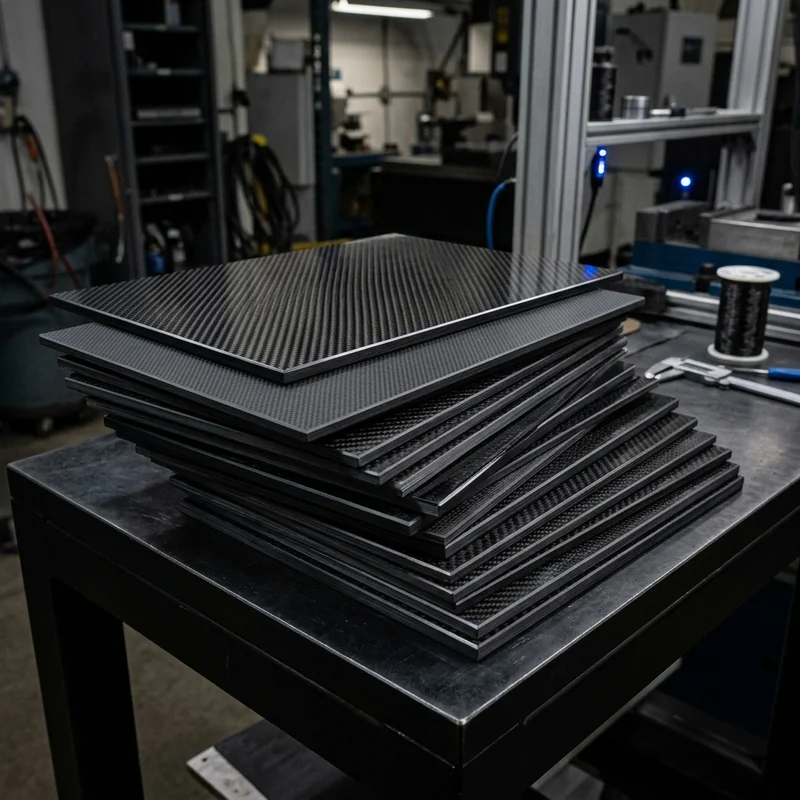
Carbon fiber standard plate-3k stripe
Lightweight, ultra-rigid standard sheets for drone fuselages, robot housings, facades and structural applications.

Carbon Fiber Plate — 3K Twill T700 3.0mm
Medium-thickness 3.0mm carbon fiber plate offering significantly higher load capacity while maintaining attractive 3K twill finish. Suitable for structural brackets, reinforcement plates, and load-bearing panels.

Carbon Fiber Plate — 3K Twill T700 1.5mm
Thin 1.5mm carbon fiber plate with 3K twill weave surface. Lightweight and stiff, commonly used for covers, panels, drone bodies, and applications requiring a premium aesthetic appearance.
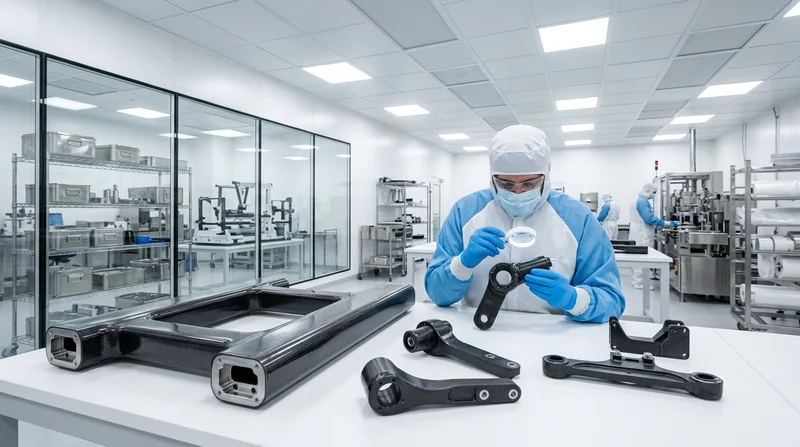
Custom Carbon Fiber Medical Device Components
Medical-grade carbon fiber components manufactured for imaging equipment, surgical instruments, and patient support systems. Carbon fiber's radiolucency (X-ray transparency) and high strength-to-weight ratio make it ideal for CT scanner beds, wheelchair frames, surgical robot arms, and MRI-compatible accessories. Biocompatible resin systems available.

Square Carbon Fiber Tube — 3K Twill T700
Square cross-section carbon fiber tube manufactured with 3K twill weave for torsional strength. Preferred for structural frames, trusses, and support columns where rectangular geometry offers design flexibility.