
For decades, composite parts were optimized for performance per kilogram, and nobody hurried the resin. A typical aerospace-grade epoxy cured for hours in an autoclave, and the cost model accepted it. High-volume manufacturing changed the equation: when automotive and consumer electroni
Introduction
For decades, composite parts were optimized for performance per kilogram, and nobody hurried the resin. A typical aerospace-grade epoxy cured for hours in an autoclave, and the cost model accepted it. High-volume manufacturing changed the equation: when automotive and consumer electronics OEMs quote cycle times of 60 to 90 seconds per part, a resin system that needs three hours of oven cure is not a processing detail — it is a business model killer. Fast-cure and UV-curable resin systems exist to close precisely that gap, shifting composites from slow batch production to line-rate manufacturing.
The trade-off that defines the field is speed versus window: faster cure generally means shorter working time, higher exotherm, and more demanding process control. UV-curable systems push this trade to its logical extreme by decoupling cure from temperature, using light instead of heat to trigger polymerization on demand. This article examines the main fast-cure chemistries, the process architectures that exploit them, and the practical constraints — exotherm, cure depth, and tooling — that determine whether a fast-cure system is right for a given application.
The Chemistry of Fast Cure
Three chemistry families dominate high-rate composite production, each with a different cure mechanism and time scale:
- Fast-cure epoxies use highly reactive amine or anhydride hardeners, often accelerated by catalysts, to cure in 2-10 minutes at 120-180 °C rather than hours at the same temperature. They retain the mechanical performance and chemical resistance of conventional epoxies and are the mainstream choice for compression-molded structural parts.
- Acrylate-based resins (including Elium liquid thermoplastic resins) polymerize by free-radical addition in 1-5 minutes at moderate temperatures, producing thermoplastic matrices that are weldable, recyclable, and tough. They suit infusion and RTM processes that need fast demold without sacrificing impact resistance.
- UV-curable resins (acrylate and cationic chemistries) polymerize in seconds to minutes when exposed to UV light. Cationic UV systems, based on epoxy chemistry with photoacid generators, continue curing in the dark after the light is removed — a key advantage for thick parts where UV penetration is limited.
The selection between these families is governed by part geometry, production rate, and service environment. The table below summarizes the typical process parameters for high-rate production systems:
| Resin System | Cure Time | Cure Temperature | Typical Process | Representative Application |
|---|---|---|---|---|
| Fast-cure epoxy | 2-10 min | 120-180 °C | Compression molding, RTM | Automotive structural parts, leaf springs |
| Acrylate (liquid thermoplastic) | 1-5 min | 60-100 °C | Infusion, RTM | Body panels, mass-transit components |
| UV-curable acrylate | Seconds-1 min | Ambient (UV lamp) | Coating, pultrusion, thin laminates | Consumer electronics, wind blade leading-edge coating |
| UV-curable cationic | Minutes (dark cure continues) | Ambient or low heat | RTM, bonding, potting | Thick-section parts, repair patches |
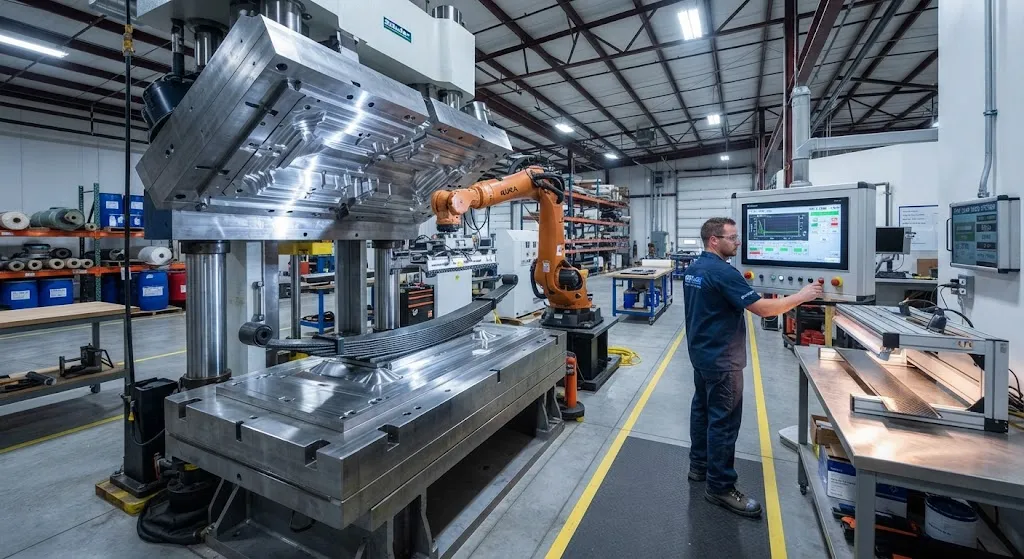
For structural automotive parts, fast-cure epoxy in compression molding is the dominant route: cycle times of 3-8 minutes per part are achievable with matched-metal tooling, and the resulting parts meet the crash and stiffness requirements of Class A and semi-structural applications.
Cure-on-Demand: The UV Advantage
The defining feature of UV curing is spatial and temporal control: polymerization starts only where and when light is applied. This cure-on-demand capability enables process architectures that heat-based curing cannot deliver. In pultrusion, UV lamps positioned immediately after the die allow the profile to cure at line speeds of several meters per minute without a long heated die; in coatings, a flash of UV converts a liquid film to a crosslinked surface in under a second; in bonding, UV-curable adhesives give operators unlimited open time until the part is aligned and the lamp fires.
UV curing also removes the energy cost and dwell time of heating a massive mold. Tooling stays near ambient temperature, so cycle time is governed by lamp output and cure depth rather than thermal mass. This makes UV processes attractive for thin laminates, skins, and coatings — but the physics of light penetration set a boundary: UV dose decays exponentially with depth, so cure depth for free-radical acrylate systems is typically limited to 1-5 mm depending on resin transparency and photoinitiator concentration. Cationic systems overcome this in part because the acid catalyst generated by light continues to propagate polymerization in the dark, curing through-thickness sections after the initial exposure.
Managing Exotherm and Part Quality
Fast cure means fast energy release, and exotherm management is the discipline that separates a good fast-cure process from a scrapped part. In a thick section, the heat released by rapid polymerization cannot escape quickly, so the internal temperature can spike well above the nominal cure temperature, causing degradation, residual stress, or even charring. The standard responses are staged cure profiles, slower hardener formulations in thick zones, and mold temperature control that removes heat from the part during the exotherm peak.
Part quality in fast-cure processes depends equally on process control. Because the working window shrinks from hours to minutes, resin viscosity, injection pressure, and mold temperature must be monitored and controlled to tighter tolerances. The benefits justify the effort: for a representative compression-molded automotive part, reducing oven cure from 30 minutes to 5 minutes can cut total cycle time by more than 40%, directly lowering cost per part and increasing the number of parts per mold per shift:
| Production Metric | Conventional Epoxy | Fast-Cure Epoxy | UV-Curable System |
|---|---|---|---|
| Typical cure time | 20-60 min | 3-8 min | 0.5-3 min |
| Tooling temperature | 120-180 °C | 120-180 °C | Ambient (UV lamp) |
| Energy per part | High (oven heat) | Moderate | Low (lamp only) |
| Parts per mold per shift (8 h) | 8-20 | 40-120 | 120+ (thin parts) |
| Typical bottleneck | Oven dwell | Demold temperature | Lamp area / cure depth |
Process simulation and mold thermal management are now standard tools for fast-cure programs: manufacturers model the exotherm and adjust the cure profile before the first shot, avoiding the trial-and-error that plagued early adopters of fast-cure systems.
Applications Driving Adoption
Automotive is the largest adopter of fast-cure epoxy systems, driven by structural applications where cycle time previously excluded composites entirely. Composite leaf springs for light trucks, seat structures, and battery enclosure covers are produced in compression molding with 3-8 minute cycles, and CFRP structural inserts for B-pillars and roof frames are molded with fast-cure resins that match paint-oven thermal exposure. Consumer electronics, where thin carbon fiber covers and frames must survive high throughput, favor UV-curable systems: cover panels are coated, printed, and cured in seconds on continuous lines.
Renewable energy is a quieter but significant adopter. Wind blade leading-edge protection coatings use UV-curable systems that cure quickly under portable lamps during field repair, and blade production lines evaluate UV-cured infusion for faster demold. In each case the value proposition is identical: cycle time reduction of 50-80% against conventional systems, achieved without compromising the mechanical properties the application demands.
Frequently Asked Questions
How much can fast-cure resin reduce production cycle time?
For compression molding, switching from a conventional 20-60 minute oven cure to a fast-cure epoxy typically reduces total cycle time by 40-60%, because the press dwell, which dominates the cycle, drops from tens of minutes to 3-8 minutes. For UV-curable thin parts, the cure step itself falls from minutes to seconds, so line throughput is often limited by handling and lamp area rather than chemistry. The practical gain depends on the part: thick structural parts gain less than thin laminates because exotherm and cure depth constraints limit how fast the resin can safely polymerize.
What is the difference between UV-curable acrylate and cationic UV resins?
Free-radical acrylate systems polymerize immediately under UV light and stop when the light stops; cure depth is limited to roughly 1-5 mm by light absorption, which suits thin laminates, coatings, and adhesives. Cationic systems use a photoacid generator that produces an acid catalyst under UV, and the catalyst then continues the polymerization in the dark after the lamp is removed. This dark-cure capability lets cationic resins cure thick sections and shadowed areas that a free-radical system cannot reach, at the cost of slower overall cure and sensitivity to moisture and basic contaminants. For thick structural parts cured at ambient temperature, cationic is usually the right choice; for fast thin-layer curing, acrylate wins on speed.
Does fast curing compromise mechanical properties?
Not inherently. A well-formulated fast-cure epoxy can match the mechanical performance of a conventional epoxy in the same carbon fiber laminate, because the final crosslink density is set by the resin chemistry, not the cure schedule. The risk appears when cure is accelerated past the formulation's design window: insufficient crosslinking, trapped voids from incomplete degassing, or microcracking from excessive exotherm can reduce strength and fatigue life. The engineering solution is to select a resin formulated for the target cure time, validate with coupon testing, and control the process so the actual cure profile matches the qualified one. Property knockdowns are a process failure, not a chemistry inevitability.
Why is UV curing not used for thick carbon fiber structural parts?
Light cannot penetrate a thick, opaque carbon fiber laminate: the fibers scatter and absorb the UV dose, so a free-radical system cures only the surface layers and leaves the interior uncured. Cationic systems extend the usable thickness through dark cure, but practical UV-cured structural parts are still limited to roughly 5-15 mm, and thick sections with complex geometry are better served by fast-cure epoxy, where heat propagates through the whole part. UV finds its structural role in thin skins, adhesives, repair patches, and coatings, while fast-cure epoxy and acrylate systems carry the load for thick load-bearing composites.
Conclusion
Fast-cure and UV-curable resin systems convert composite manufacturing from a batch process into a line-rate process, and in doing so they unlock applications that cycle time previously closed to composites. Fast-cure epoxies cut compression-molding cycles to minutes; acrylate systems deliver fast demold with thermoplastic toughness; UV-curable resins cure on demand in seconds. The cost is process discipline — exotherm control, tighter working-window management, and validated cure profiles — but the payoff is cycle time reductions of 40-80% and a cost model that works at automotive and consumer electronics volumes.
For manufacturers evaluating fast-cure programs, the fiber is half the equation: consistent, defect-controlled carbon fiber with predictable handling characteristics is what makes a minutes-long cure cycle reliable. Explore our carbon fiber sheet, fabric, and unidirectional laminate range suited to compression molding and RTM, or contact our engineering team for material data sheets and process support.
Related Articles
- Filament Wound Epoxy Tubing: Selection Guide for Industrial and Aerospace Applications
- Filament Wound Epoxy Tubes Advantages: Over Metal and Pultruded Alternatives
- Carbon Fiber Tube Strength: Analysis Methods and Design Allowables
- Filament Wound Epoxy Tubes: Mechanical Properties and Material Data Sheets
- Carbon Fiber Drone Blades and Propellers: Stiffness, Balance and Noise Reduction
- Fiberglass Filament Wound Tubes: Cost-Effective Alternative to Carbon Fiber
Interested in Our Products?
Contact our team for competitive pricing and technical specifications.
Get a QuoteRelated Products
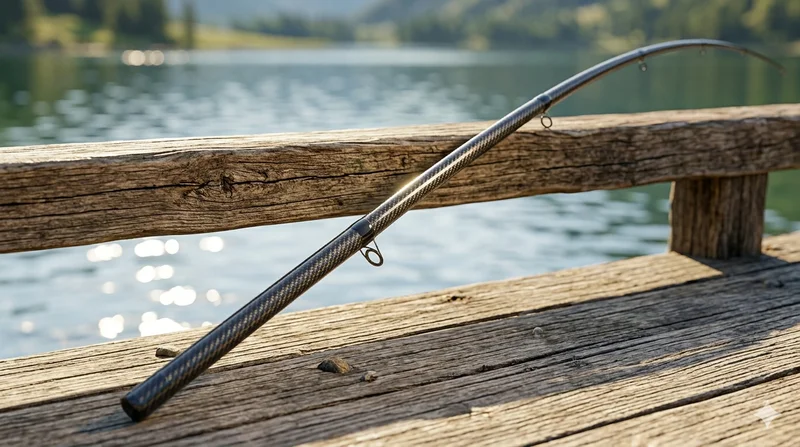
Carbon Fiber Fishing Rod Blank
High-quality carbon fiber fishing rod blank manufactured from multiple grades of Toray carbon fiber cloth. Available in a wide range of lengths, powers, and actions for freshwater and saltwater applications. Suitable for OEM rod building.

Carbon Fiber Plate — 3K Twill T700 1.5mm
Thin 1.5mm carbon fiber plate with 3K twill weave surface. Lightweight and stiff, commonly used for covers, panels, drone bodies, and applications requiring a premium aesthetic appearance.
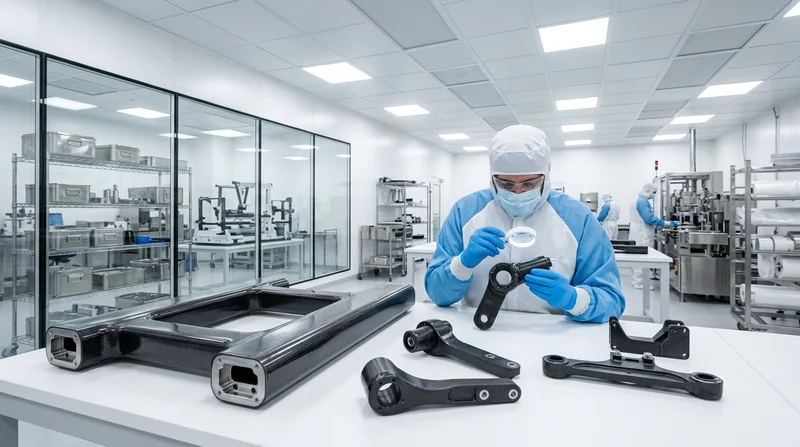
Custom Carbon Fiber Medical Device Components
Medical-grade carbon fiber components manufactured for imaging equipment, surgical instruments, and patient support systems. Carbon fiber's radiolucency (X-ray transparency) and high strength-to-weight ratio make it ideal for CT scanner beds, wheelchair frames, surgical robot arms, and MRI-compatible accessories. Biocompatible resin systems available.

Square Carbon Fiber Tube — 3K Twill T700
Square cross-section carbon fiber tube manufactured with 3K twill weave for torsional strength. Preferred for structural frames, trusses, and support columns where rectangular geometry offers design flexibility.
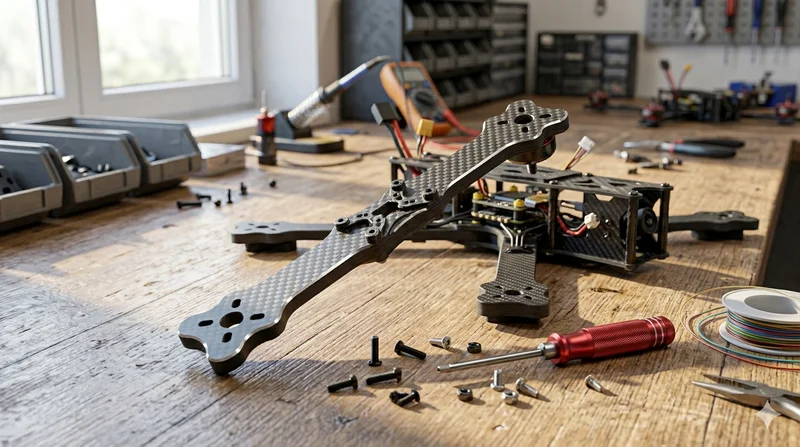
Carbon Fiber Drone Arm
Precision-molded carbon fiber drone arm combining unidirectional fiber for stiffness and woven layers for torsional strength. Designed for FPV, photography, and industrial drone platforms. Each arm is CNC-machined to exact specifications.