
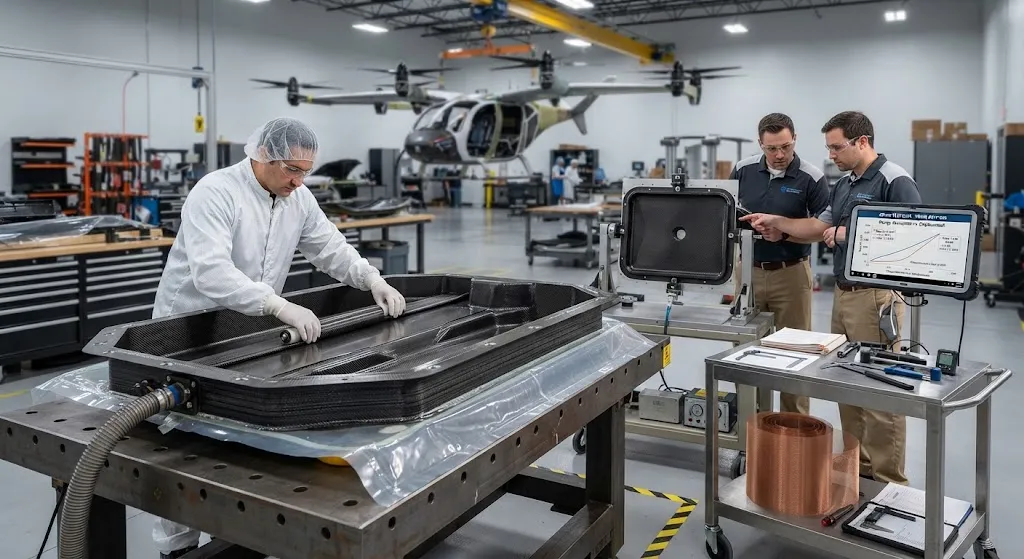
An eVTOL battery pack sits at the center of a new kind of safety equation. The pack is the heaviest removable mass on the aircraft, it stores enough energy to power a climb, and it must survive crash scenarios that automotive packs are not designed for — including steep descent rates an
Introduction
An eVTOL battery pack sits at the center of a new kind of safety equation. The pack is the heaviest removable mass on the aircraft, it stores enough energy to power a climb, and it must survive crash scenarios that automotive packs are not designed for — including steep descent rates and impact orientations that automotive crash standards never test. The enclosure is the structural boundary that protects the cells, and its design pulls the entire airframe in two directions at once: it must be strong enough to survive crash and thermal loads, yet light enough that the aircraft does not spend its payload margin carrying structure instead of battery.
This tension is why eVTOL battery enclosure development has become a testing ground for composite architecture. This article reviews the load cases an enclosure must pass, compares the material options with representative data, and lays out the decision framework for composite, metal, and hybrid enclosures.
What an eVTOL Battery Enclosure Must Survive
The enclosure requirements come from three directions: crash dynamics, thermal runaway containment, and electromagnetic compatibility. On crash, the enclosure must keep cells in place under high deceleration, prevent intrusion from surrounding structure, and in some cases absorb energy itself so the acceleration pulse on the cells stays survivable. Thermal runaway places a different demand: the enclosure must contain the vented gases, direct them through a designed vent path, and prevent flames and hot particles from reaching other cells or the airframe for a defined duration. Electromagnetic compatibility adds a shielding requirement, because motor controllers and power electronics generate high-frequency emissions that must not interfere with flight control systems, and the battery itself must not emit or absorb interference that disrupts avionics.
The table below summarizes the representative load cases and the properties they demand from the enclosure material:
| Requirement | Load Case | Key Material Property |
|---|---|---|
| Crash containment | High-g vertical and horizontal deceleration | Specific energy absorption, stiffness |
| Cell retention | Cell displacement under impact | Strength, fastening integrity |
| Thermal runaway venting | Pressure spike, C and CO2 gas flow | High-temperature stability, burst strength |
| Fire resistance | Flame impingement on enclosure wall | Fire barrier behavior, low thermal conductivity |
| EMI shielding | Motor and power converter emissions | Electrical conductivity of surfaces |
Three of the five rows point in directions composites handle well — specific energy absorption, stiffness, and low thermal conductivity. EMI shielding is the one requirement where unmodified CFRP is weak, and it drives most of the design complexity in composite enclosures.
Composite vs. Metal: The Data
Aluminum is the incumbent enclosure material for automotive packs and the natural baseline for eVTOL comparisons. A welded automotive-style aluminum tray achieves good crash performance at a known cost, but it carries a mass penalty that matters enormously on an aircraft. The comparison below uses representative values for a mid-size eVTOL pack enclosure, normalized to the aluminum baseline:
| Architecture | Mass (Relative) | Specific Energy Absorption (kJ/kg) | Thermal Conductivity (W/mK) | EMI Shielding |
|---|---|---|---|---|
| Welded aluminum tray (baseline) | 1.00 | 40-60 | 120-170 | Excellent (intrinsic) |
| CFRP monocoque | 0.55-0.65 | 70-100 | 0.5-7 in-plane | Poor without treatment |
| CFRP with copper mesh | 0.60-0.70 | 70-100 | 0.5-7 in-plane | Good (adds 0.5-1 kg) |
| Hybrid aluminum frame + CFRP panels | 0.75-0.85 | 50-75 | Local aluminum paths | Good at joints with bonding |
Two conclusions follow. A CFRP monocoque saves roughly 35-45 percent of enclosure mass versus aluminum, which on a typical eVTOL translates into meaningful extra payload or range. And the EMI gap is real but solvable — copper or aluminum mesh on the inner surface restores shielding at a modest mass cost, and hybrid designs lean on metal frames where conductivity matters most.
Crash Protection and Energy Absorption
Crashworthiness in composites is different from metals in a way that matters for enclosure design. Aluminum deforms plastically and absorbs energy through large ductile deformation; carbon fiber fails in a progressive crush mode, absorbing energy through fiber fracture, delamination, and debris compaction. When designed properly — with crushable zones, trigger features, and progressive failure modes — CFRP specific energy absorption can exceed that of aluminum by a substantial margin, which is the property that makes composite enclosures attractive for high-deceleration events.
The design consequence is that a composite enclosure must be engineered for controlled crushing rather than simply made thicker. Energy-absorbing ribs, crush initiators at the base, and hybrid layups with a ductile inner layer are the standard toolset. The enclosure also interacts with the airframe: a stiff composite tray can transfer crash loads into the structure, so the interface design — how the pack is attached and where the load path goes — is as important as the tray itself. eVTOL programs typically simulate the full pack-airframe crash sequence with explicit finite element analysis, validating the enclosure's crush behavior before full-scale sled tests.
Thermal Runaway Containment and Fire Resistance
Thermal runaway containment in a composite enclosure is both a materials and a systems challenge. CFRP has low through-thickness thermal conductivity, which slows heat transfer from a failed cell to the enclosure wall — an advantage over aluminum, which conducts heat rapidly to the outer surface and can spread the thermal event structurally. But the enclosure must also survive direct flame impingement and vented gas flows at high temperature, conditions that degrade unprotected polymer matrix.
- Vent path design: A rupture disk or pressure-relief vent in the enclosure routes vented gases away from cells and occupants; the path must be sized for the pack's worst-case venting flow and sealed against moisture.
- Thermal barriers: Intumescent coatings, ceramic fiber blankets, or mica-based liners on the enclosure interior slow fire penetration into cells and protect the composite wall from direct flame.
- Heat transfer management: Low-conductivity composite walls reduce heat soak to adjacent cells, extending the time before a neighboring cell reaches thermal runaway — the key metric regulators scrutinize in pack testing.
- Structural fire retention: The enclosure must retain basic integrity, not just survivable temperature, so the pack does not break apart during a fire event.
For eVTOL certification, regulators evaluate these behaviors under the applicable special conditions, and the demonstration is done at pack level — a composite enclosure that performs in a standardized thermal propagation test is the deliverable, not a single material property.
EMI Shielding and Power Electronics
The shielding requirement is frequently the deciding factor in architecture selection. Unidirectional and woven carbon fibers are poor bulk conductors compared with aluminum, and while the composite itself provides some shielding, it is generally insufficient for the strict emissions and susceptibility limits applied to flight-critical systems. The practical fixes are well proven: a metal mesh or expanded metal layer co-cured or bonded to the inner surface, conductive paints and coatings, or localized metal inserts at connector interfaces.
Shielding performance depends on the quality of continuous electrical contact, which is why seams, fasteners, and lid interfaces get as much design attention as the panel material. Compression-seal EMI gaskets around the enclosure perimeter, conductive adhesive at joints, and bonded metal grounding straps complete the shielding envelope. The mass and cost of these treatments are modest, but they must be budgeted in the enclosure design from the start — retrofitting shielding onto a finished composite tray is far more expensive than designing it in.
Frequently Asked Questions
How much weight can a composite battery enclosure save on an eVTOL?
Compared with a welded aluminum tray, a CFRP monocoque enclosure typically saves 35-45 percent of enclosure mass, and a hybrid aluminum-frame design with composite panels saves 15-25 percent. On a typical eVTOL, enclosure mass is a meaningful fraction of the battery system, so these savings translate directly into additional payload or range — often the deciding factor between meeting and missing performance targets. The trade-off is added design effort for EMI shielding and thermal protection.
Why is a composite enclosure harder to certify than an aluminum one?
Certification of composite enclosures requires demonstrating behavior that metal designers take for granted: progressive energy absorption under crash, fire retention under flame impingement, and EMI shielding through surface treatment. The composite-specific failure modes — delamination, crush fragmentation, and fire degradation of the polymer matrix — must be characterized and shown to remain within acceptable limits across the operating envelope. Most programs manage this through explicit simulation plus pack-level thermal propagation and crash tests, with the composite behavior validated at coupon and subcomponent level first.
When does a hybrid aluminum-composite enclosure make more sense than full composite?
A hybrid design makes sense when the pack is large, when EMI requirements are strict, or when crash load paths benefit from a ductile metal frame. The aluminum frame provides intrinsic shielding paths and proven fastening, while CFRP panels carry the mass savings. Hybrids typically save 15-25 percent versus full aluminum, less than a full composite monocoque, but with lower technical risk and faster development. Full composite wins when the weight target is aggressive and the program has the analysis and test depth to qualify the composite behavior.
Conclusion
Composite battery enclosures for eVTOL aircraft deliver a 35-45 percent mass reduction over aluminum while improving specific energy absorption and thermal isolation, at the cost of deliberate design work in EMI shielding, fire protection, and crush control. Hybrid aluminum-composite architectures capture most of the benefit at lower risk. The enclosure decision is a systems trade-off, not a material preference — the winning architecture is the one that satisfies crash, thermal, and electromagnetic requirements within the aircraft's mass budget.
For programs evaluating enclosure materials, the data ground the discussion: compare specific energy absorption, through-thickness thermal response, and shielding strategy, not just stiffness. Explore our carbon fiber laminates and prepregs for aerospace structures, or contact our engineering team to discuss test data and material formats for battery enclosure programs.
Part of topic
Related Articles
- Carbon Fiber Plate Amazon: Complete Guide
- Carbon Fiber And PU Case: Complete Guide
- Carbon Fiber Parts For Cars: Complete Guide
- Carbon Fiber Manufacturing Companies: Complete Guide
- Carbon Fiber Parts Manufacturing: Complete Guide
- Carbon Fiber Sheets for Sale: A Buyer Checklist for Thickness, Weave and Finish
Interested in Our Products?
Contact our team for competitive pricing and technical specifications.
Get a QuoteRelated Products

Carbon Fiber Plate — 3K Twill T700 1.5mm
Thin 1.5mm carbon fiber plate with 3K twill weave surface. Lightweight and stiff, commonly used for covers, panels, drone bodies, and applications requiring a premium aesthetic appearance.

Square Carbon Fiber Tube — 3K Twill T700
Square cross-section carbon fiber tube manufactured with 3K twill weave for torsional strength. Preferred for structural frames, trusses, and support columns where rectangular geometry offers design flexibility.
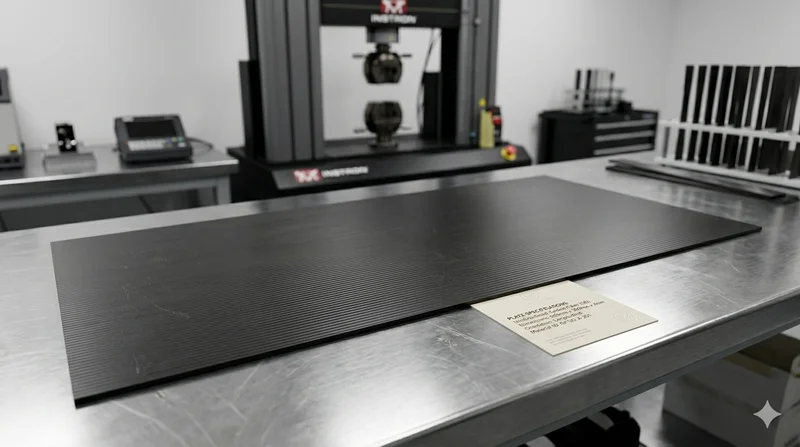
Carbon Fiber Plate — UD Unidirectional T700
Unidirectional carbon fiber plate with all fibers oriented in a single direction for maximum strength along the fiber axis. Essential for structural reinforcements, splints, and applications where load direction is predictable.
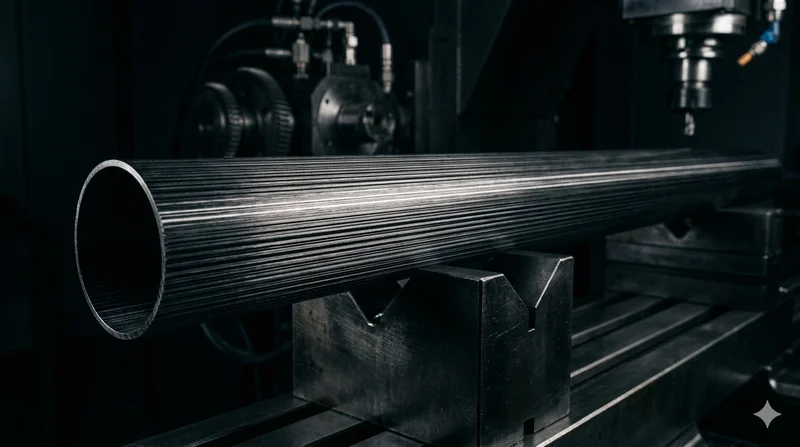
Round Carbon Fiber Tube — UD Unidirectional T700
Unidirectional (UD) round tube with all fibers aligned axially for maximum longitudinal stiffness. Ideal for applications requiring high bending rigidity with minimal weight, such as shafts, struts, and structural reinforcements.
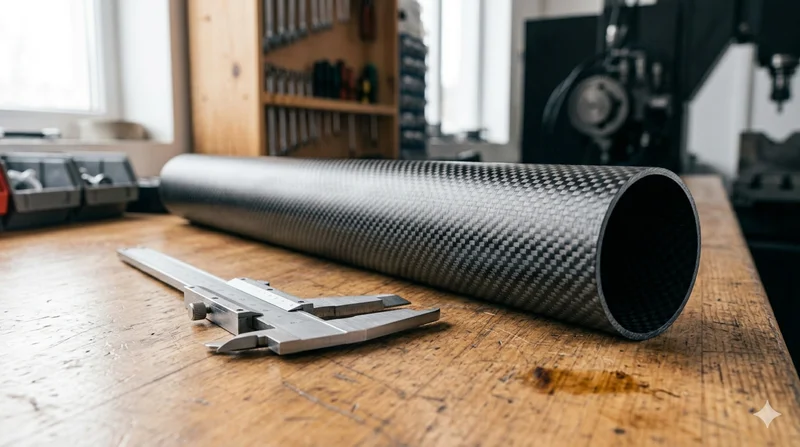
Round Carbon Fiber Tube — 3K Plain Weave T700
Standard round carbon fiber tube manufactured from Toray T700 grade fiber with 3K plain weave. Offers balanced strength and stiffness for general industrial applications including robotics, automation, sports equipment, and aerospace structures.