
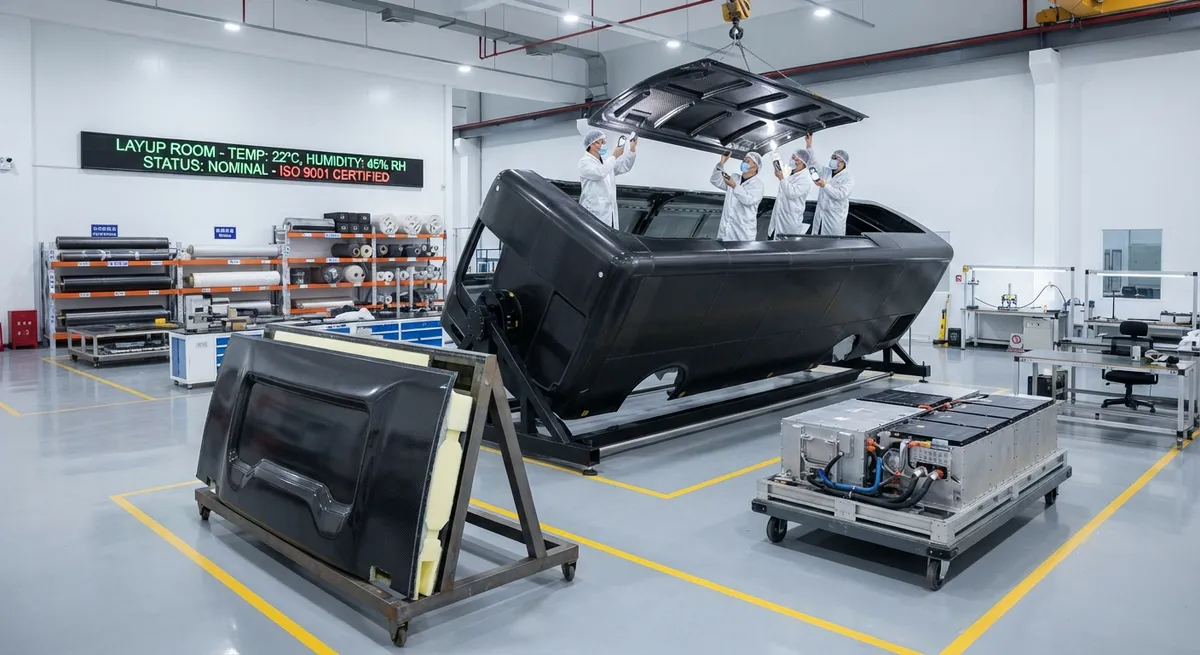
Electric bus weight reduction through carbon fiber composite body panels and structural members. Analysis of monocoque vs. space-frame designs, specific weight savings per component, battery range impact, and lifecycle cost analysis for transit authorities.
The Weight Challenge in Electric Bus Design
Electric buses face a fundamental trade-off: larger battery packs mean longer range but add significant mass, which in turn increases energy consumption per kilometer. A standard 12-meter electric bus with a 350 kWh battery pack weighs approximately 14-16 tons curb weight, of which the battery contributes 2.5-3 tons. Every 100 kg of structural weight reduction translates to approximately 1.2-1.5% improvement in effective range, making weight reduction one of the most cost-effective engineering priorities for transit authorities.
Carbon fiber reinforced polymer (CFRP) body structures offer the most aggressive weight reduction pathway currently available at commercial scale. Unlike steel monocoque constructions weighing 4.5-5.5 tons for a complete body-in-white, a CFRP equivalent can achieve 2.2-2.8 tons — a reduction of 45-50% before any secondary mass savings from smaller brakes, reduced suspension loads, and lower frame reinforcement requirements.
Monocoque vs. Space-Frame Architectures
Two primary structural approaches dominate CFRP bus body design: full monocoque and hybrid space-frame with composite panel cladding.
| Parameter | Full CFRP Monocoque | Hybrid Aluminum Space-Frame + CFRP Panels |
|---|---|---|
| Body weight (12m bus) | 2,200-2,500 kg | 2,800-3,400 kg |
| Tooling investment | $4-6 million | $1.5-2.5 million |
| Production rate | 2-4 units/day per mold set | 6-10 units/day |
| Crash energy absorption | Excellent (homogeneous) | Good (tuned crush zones) |
| Repair complexity | High (requires bonded repair) | Moderate (panel replacement) |
| Weight savings vs. steel | 50-55% | 35-40% |
| Cost premium vs. steel body | 3.2-3.8x | 1.8-2.2x |
For small-to-medium production runs of 200-800 buses per year, the hybrid approach offers the best balance of weight savings and capital efficiency. Full monocoque becomes economically viable at volumes above 1,500 units annually, where mold amortization per unit drops below $3,000.
Component-Level Weight Savings
A detailed weight breakdown of a 12-meter CFRP-hybrid electric bus reveals specific savings across each major structural group:
- Roof panel (3.2m × 2.5m): Steel 95 kg → CFRP 42 kg (56% reduction). Single-piece RTM panel with integrated stiffening ribs.
- Side panels (left + right, each 11.8m × 1.6m): Steel 145 kg each → CFRP 68 kg each (53% reduction). Co-cured with foam core for thermal insulation.
- Floor pan (12m × 2.4m): Steel 220 kg → CFRP sandwich 98 kg (55% reduction). Load-bearing with integrated battery tray mounting points.
- Front/rear end caps: Steel 85 kg each → CFRP 40 kg each (53% reduction). Class A surface finish, paint-ready.
- Underbody fairings: Steel 120 kg → CFRP 55 kg (54% reduction). Aerodynamic shape for drag reduction.
Total body structure weight reduction: approximately 1,850 kg compared to a steel body, representing a 48% overall weight saving.
Battery Range Impact Analysis
The 1,850 kg body weight reduction directly improves energy efficiency. For a 12-meter electric bus operating on a typical urban cycle (stop-start with 60% regenerative braking recovery), the range impact is substantial:
- Baseline (steel body, 350 kWh): 280-320 km effective range
- Hybrid CFRP (350 kWh): 325-375 km range (+16% improvement)
- Full CFRP monocoque (350 kWh): 345-395 km range (+22% improvement)
- Full CFRP monocoque with downsized 300 kWh pack: 295-340 km range (-5% from baseline pack, but saves $18,000-22,000 in battery cost and 700 kg additional weight)
The most cost-optimal configuration for most transit routes (daily distance 200-280 km) is the hybrid CFRP body with a 300-320 kWh battery pack, offering an effective range of 310-355 km while reducing battery cost by 10-15%.
Fire Safety and Regulatory Compliance
CFRP bus bodies must meet ECE R66 (rollover strength), ECE R118 (fire resistance of interior materials), and UN ECE R100 (electrical safety of EVs). Fire-resistant resin systems — phenolic, bismaleimide, and fire-retardant epoxy formulations — are essential for passenger compartment applications. Test data shows that phenolic CFRP panels achieve a heat release rate of less than 50 kW/m² under ISO 5660 cone calorimeter testing, meeting the most stringent bus fire safety standards globally.
Lifecycle Cost Analysis for Transit Operators
Total cost of ownership over a 12-year bus service life reveals:
| Cost Component | Steel Body | Aluminum Body | CFRP Hybrid Body |
|---|---|---|---|
| Initial body cost | $45,000 | $62,000 | $95,000 |
| Battery cost (350 kWh) | $105,000 | $105,000 | $90,000 (300 kWh) |
| Energy cost (12 yr) | $288,000 | $276,000 | $235,000 |
| Maintenance (corrosion/repair) | $42,000 | $28,000 | $18,000 |
| Residual value | -$8,000 | -$12,000 | -$22,000 |
| Total TCO (12 yr) | $472,000 | $459,000 | $416,000 |
The CFRP hybrid body bus saves approximately $56,000 over 12 years versus steel, despite a $50,000 higher initial body cost and $15,000 lower battery investment. Energy savings account for 53% of the lifecycle benefit, corrosion reduction 24%, and residual value 14%.
FAQ
How does carbon fiber bus body repair work in practice?
Field repairs use bonded CFRP patch kits with room-temperature-curing epoxy adhesives. A typical 300×300 mm panel repair takes 4-6 hours including curing. Structural damage requires return-to-facility repair with autoclave or heated blanket post-cure. Major operators maintain at least one certified composites repair bay per 50 buses.
What is the crash behavior of CFRP bus bodies compared to steel?
CFRP monocoque structures absorb crash energy through progressive fiber fracture rather than plastic deformation. While peak deceleration is comparable, the energy absorption profile is different — CFRP exhibits higher initial stiffness followed by sudden energy release. Hybrid structures with aluminum crash cans at the front provide controlled progressive crush zones that match steel-body crash performance.
Can existing steel bus production lines be adapted for CFRP bodies?
Partial adaptation is possible for hybrid space-frame designs: the aluminum frame assembly can use modified jigging and robotic welding cells. However, composite panel production (prepreg cutting, layup, autoclave or compression molding, trim, drilling) requires dedicated facilities. A retrofit typically costs $3-8 million and takes 6-12 months.
Part of topic
Related Articles
- Recycled Carbon Fiber Market Forecast 2030: Technology Maturity and Commercialization Path
- South Korea Carbon Fiber Market 2026: Hydrogen Economy and Shipbuilding Innovation
- Wind Turbine Blade Leading Edge Protection 2026: Polyurethane, Tape, and Metallic Shield Solutions
- China Carbon Fiber Overcapacity 2026: Price War Impact and Industry Consolidation
- India Carbon Fiber Market 2026: Wind Energy, Aerospace, and Defense Expansion
- PAN Precursor Market 2026: Acrylonitrile Supply and Carbon Fiber Cost Structure
Interested in Our Products?
Contact our team for competitive pricing and technical specifications.
Get a QuoteRelated Products
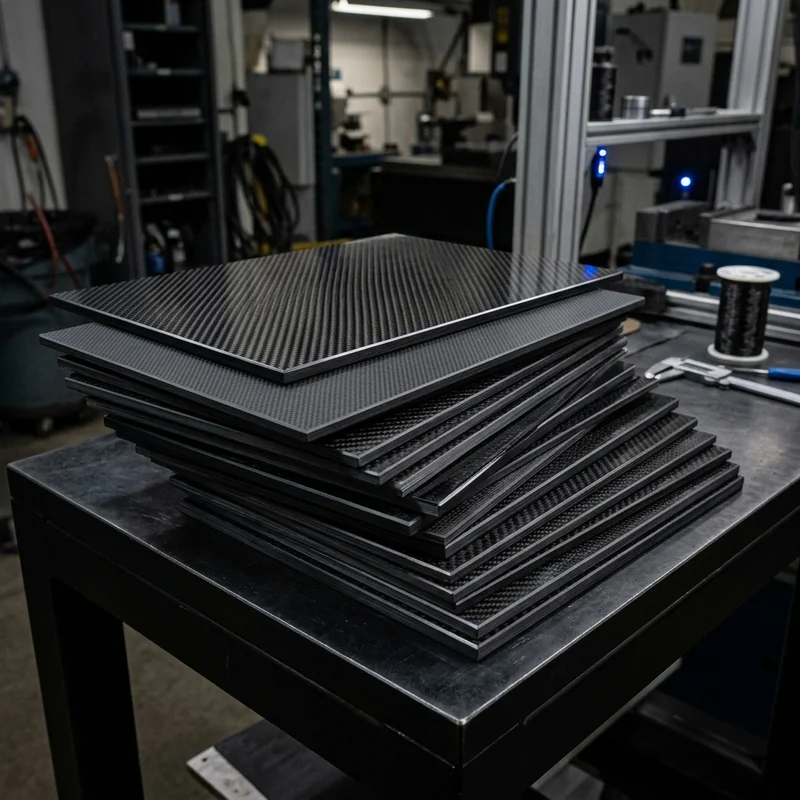
Carbon fiber standard plate-3k stripe
Lightweight, ultra-rigid standard sheets for drone fuselages, robot housings, facades and structural applications.

Carbon Fiber Plate — 3K Twill T700 3.0mm
Medium-thickness 3.0mm carbon fiber plate offering significantly higher load capacity while maintaining attractive 3K twill finish. Suitable for structural brackets, reinforcement plates, and load-bearing panels.

Carbon Fiber Plate — 3K Twill T700 1.5mm
Thin 1.5mm carbon fiber plate with 3K twill weave surface. Lightweight and stiff, commonly used for covers, panels, drone bodies, and applications requiring a premium aesthetic appearance.
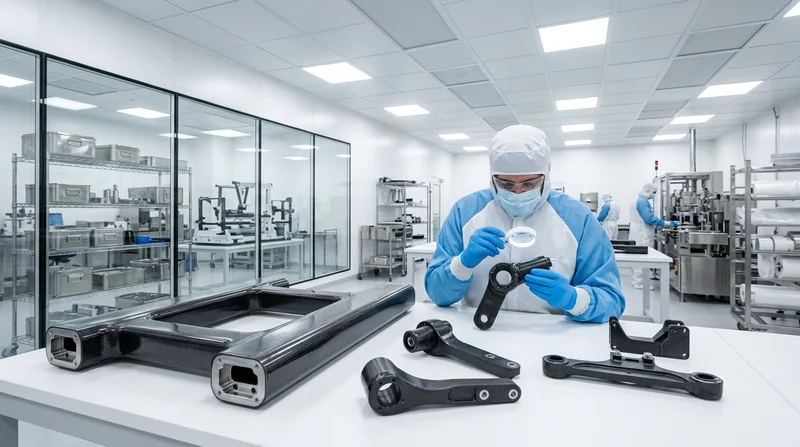
Custom Carbon Fiber Medical Device Components
Medical-grade carbon fiber components manufactured for imaging equipment, surgical instruments, and patient support systems. Carbon fiber's radiolucency (X-ray transparency) and high strength-to-weight ratio make it ideal for CT scanner beds, wheelchair frames, surgical robot arms, and MRI-compatible accessories. Biocompatible resin systems available.

Square Carbon Fiber Tube — 3K Twill T700
Square cross-section carbon fiber tube manufactured with 3K twill weave for torsional strength. Preferred for structural frames, trusses, and support columns where rectangular geometry offers design flexibility.