
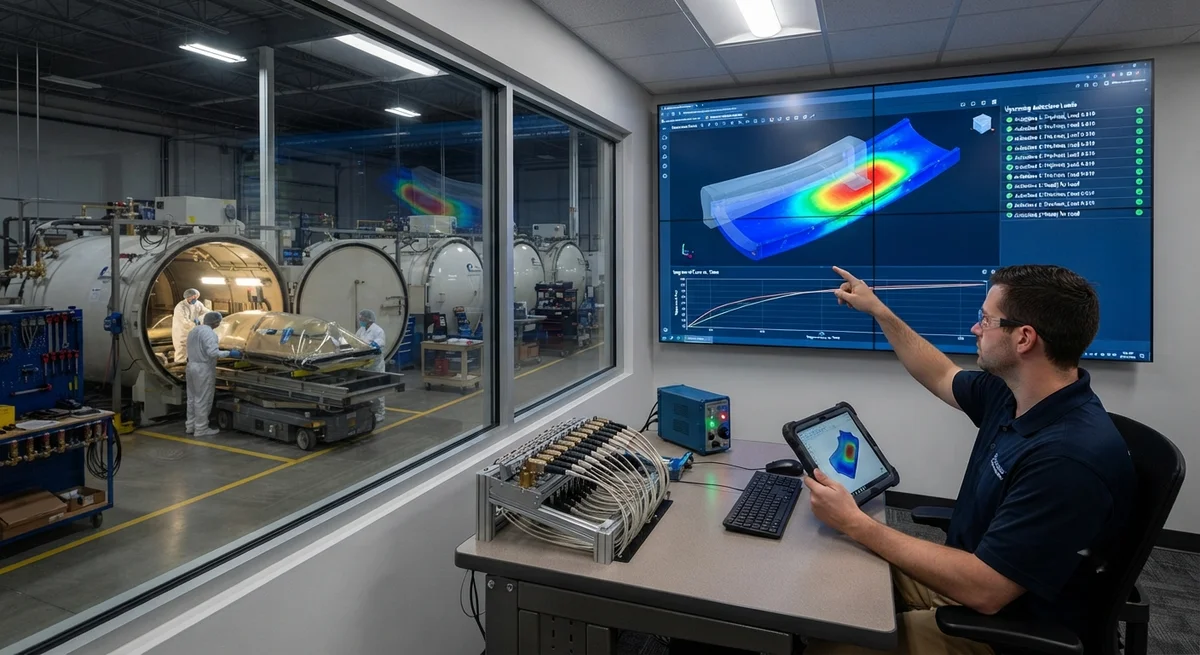
Carbon fiber composite manufacturing is one of the most parameter-sensitive production processes in modern industry. Cure temperature, pressure ramp, resin viscosity, fiber alignment, tool expansion, and ambient humidity all interact to decide whether a part comes out perfect, acceptabl
Introduction
Carbon fiber composite manufacturing is one of the most parameter-sensitive production processes in modern industry. Cure temperature, pressure ramp, resin viscosity, fiber alignment, tool expansion, and ambient humidity all interact to decide whether a part comes out perfect, acceptable, or scrap. For decades, fabricators managed this complexity with paper records, batch-level testing, and the accumulated judgment of experienced operators. Digital twins change that model: they create a continuously updated virtual replica of the physical process, so every decision about a running part can be informed by what the process is doing right now — not by what it was expected to do.
A digital twin is more than a simulation. It is a live, data-fed model that reflects the current state of a specific production asset — a layup cell, an autoclave, a resin transfer molding line — and uses that model to predict, alert, and optimize in real time. This article examines the three pillars of composite digital twins — process simulation, real-time quality tracking, and production optimization — and lays out a practical path for implementing one on an existing carbon fiber line.
What a Digital Twin Is in Composite Manufacturing
In the context of carbon fiber fabrication, a digital twin links three layers. The physical layer is the machine, tool, and part. The data layer collects sensor streams — thermocouples in the tool, pressure transducers in the autoclave, resin-flow sensors at injection ports, and ambient condition monitors. The model layer runs physics-based simulation and machine-learning models that interpret that data and project what will happen next.
- Physics-based simulation: Finite element analysis of cure kinetics, heat transfer, resin flow, and residual stress, running on the same geometry as the physical part.
- Machine-learning models: Trained on historical process data to predict quality outcomes — porosity, fiber volume fraction, geometric deviation — from live parameter streams.
- Digital thread: The full traceability record linking design data, material certificates, process parameters, sensor data, and inspection results for each individual part.
- Feedback loop: Model outputs that adjust process control — recommended dwell time extensions, pressure corrections, or tooling adjustments — back to the physical line.
The distinguishing feature of a digital twin, compared with a standalone simulation, is that the model is continuously synchronized with the physical process and continuously used to act on it. The twin lives and dies with the part being made.
Process Simulation: Predicting Cure and Flow Before the Part Exists
Process simulation is the predictive core of the twin. For an autoclave-cured part, the twin simulates the full cure cycle before and during production: heat-up gradients across the tool, resin viscosity evolution, degree of cure at every point, exotherm risk, and residual stress locked in during cool-down. For a resin transfer molding (RTM) line, the twin simulates resin flow front progression, fill time, void entrapment at race-tracking channels, and pressure distribution across the cavity.
The table below summarizes how simulation supports each major composite process:
| Process | What the Twin Simulates | Typical Improvement Delivered |
|---|---|---|
| Autoclave cure | Heat-up gradients, cure kinetics, exotherm, residual stress | 15-25% shorter cure cycles, fewer exotherm rejects |
| Resin transfer molding | Flow front, fill time, void entrapment, injection pressure | 10-20% fewer dry-spot and void rejects |
| Automated fiber placement | Gap/overlap distribution, steering radius, deposition rate | Better quality traceability per tow path |
| Compression molding (SMC) | Charge position, mold fill, fiber orientation flow | Higher fiber volume consistency |
| Filament winding | Winding pattern, tension profile, void formation | Improved burst-strength consistency |
Used offline, simulation shortens development time by reducing physical trials: a fabricator can evaluate a dozen cure-cycle candidates virtually and run only the two most promising on the line. Used online, the same model tracks the live part and can detect a slow heating zone that risks under-cure, prompting an extended dwell before it becomes scrap.
Real-Time Quality Tracking: Turning Sensor Data into Part Quality
Real-time quality tracking is where the twin earns its keep on the factory floor. Composite parts are traditionally inspected after cure — ultrasonic scanning, thermography, and geometric measurement — when a defect already means lost material and lost autoclave time. The digital twin moves quality detection earlier by correlating live process data with final quality.
Three tracking layers are typical. First, in-process sensors capture the state of the part: thermocouple arrays through the tool, dielectric sensors that follow resin state in RTM, fiber-optic sensors embedded or surface-mounted, and cure-monitoring devices that track degree of cure in real time. Second, the twin runs these streams through quality models trained on historical data — for example, a model that predicts porosity from pressure and temperature history at each zone. Third, the twin assigns a predicted quality score to the part as it progresses and flags deviations while correction is still possible.
- Porosity prediction: Models correlate autoclave pressure history and resin state with final void content, flagging parts at risk of exceeding the 1% void threshold typical in aerospace.
- Geometric deviation: The twin compares measured tool and part temperature distributions with simulated springback and distortion, predicting final shape deviation before demolding.
- Batch-level traceability: Every parameter, sensor reading, and model prediction is stored against the part's serial number, creating the full digital thread customers increasingly demand.
- Operator guidance: Live dashboards show predicted quality in real time, so operators act on model alerts rather than post-cure inspection findings.
The result is a shift from inspect-after-cure to monitor-during-process: defects are caught at the point they are created, when the corrective action — extending dwell, adjusting pressure, re-injecting resin — still costs minutes rather than a full part.
Production Optimization: Using the Twin to Run the Line Better
With simulation and quality tracking in place, the twin becomes a production optimization engine. Its models do three jobs continuously. Scheduling optimization uses the cure-cycle predictions to sequence autoclave loads: parts that can tolerate a shared cycle are batched together, and the twin forecasts autoclave availability from live cure status rather than planned averages. Energy and cost optimization models the cost of each cure cycle — electricity, nitrogen, labor, and tool occupancy — and proposes the lowest-cost cycle that still meets the quality envelope. And continuous improvement closes the loop: every part's data feeds back into the models, so the twin gets more accurate the longer it runs.
Measured results reported by composite manufacturers using digital-twin approaches include cure-cycle time reductions of 15-25%, scrap rate reductions of 20-40% in RTM operations, and first-pass-yield improvements that allow fewer duplicate builds for qualification parts. The economic case compounds: each percentage point of scrap avoided in an aerospace autoclave operation can be worth hundreds of thousands of dollars a year at production rates of hundreds of parts per month.
Implementation Path for an Existing Line
A practical digital twin implementation does not require replacing the production line. It follows five stages:
- Stage 1 — Data foundation: Instrument the process: confirm thermocouple coverage, add pressure and resin-state sensors where missing, and connect the data historian so every parameter is timestamped and stored per part.
- Stage 2 — Baseline simulation: Build a validated finite element model of one representative part and cycle, and tune it against measured thermocouple data until simulation matches reality within the process tolerance.
- Stage 3 — Quality models: Train prediction models on historical quality data, starting with the highest-scrap defect — usually voids or porosity — and validate against ultrasonic inspection results.
- Stage 4 — Live pilot: Run the twin in shadow mode on one cell, letting it predict and alert while operators continue normal control, until operators trust and refine it.
- Stage 5 — Closed-loop control: Connect model recommendations to process control, starting with advisory dwell and pressure adjustments, then expanding to scheduling and energy optimization.
Most fabricators see meaningful value at Stage 3, where quality models begin flagging at-risk parts in real time. The hardware cost is modest — sensors, a historian, and computing — relative to the scrap and cycle-time savings, and the data foundation pays for itself in traceability alone when customers require full process records.
Frequently Asked Questions
What is the difference between a simulation and a digital twin?
A simulation is a one-time or on-demand model run — for example, a cure-cycle analysis performed offline before production. A digital twin is a continuously synchronized model: it receives live sensor data from the physical process, updates its state, predicts outcomes, and feeds recommendations back to the line. The twin is bound to a specific production asset and part, and it improves with every part produced.
How much does a digital twin implementation cost?
The cost varies with the data already in place. A baseline implementation for an existing line — sensor upgrades, a data historian, one validated simulation model, and quality-prediction models — typically runs in the tens of thousands of dollars in software and services for a single process cell, with sensor hardware additional. Payback usually comes from scrap reduction and shorter cure cycles within the first year; the digital-thread traceability alone often justifies the investment where customers require process records.
Can a digital twin work with existing equipment that is not smart?
Yes. Legacy autoclaves, presses, and injection machines can be retrofitted with thermocouple arrays, pressure transducers, and data acquisition without replacing the machine. The twin only needs reliable, timestamped data streams; it does not require the machine itself to have built-in connectivity. Retrofitting is a common first step and delivers most of the quality-tracking benefit.
What are the main challenges of digital twins for composites?
The main challenges are data quality — process data is only useful if sensors are calibrated and histories are complete — model validation, and cultural adoption. A twin that disagrees with experienced operators will be ignored unless it is demonstrably accurate, which is why the implementation path starts with a validated baseline simulation and a shadow-mode pilot before any closed-loop control.
Conclusion
Digital twins pair the physics of composite processing with live production data to deliver what composite manufacturers have always needed: the ability to see a defect forming before it exists, and to run the line at the lowest cost that still meets quality. Process simulation compresses development cycles, real-time quality tracking moves inspection from after-cure to during-process, and production optimization turns the accumulated data of every part into continuous improvement. For a fabricator, the path is incremental and starts with the data foundation, not with new machines.
Whether you are building the sensor and simulation stack for a new line or retrofitting an existing autoclave cell, the material side matters just as much as the software side — consistent, traceable carbon fiber inputs make process models more reliable. Explore our carbon fiber fabrics and prepreg materials with consistent batch documentation, or contact our engineering team to discuss material specifications for your digital manufacturing program.
Part of topic
Related Articles
- Carbon Fiber Drone Blades and Propellers: Stiffness, Balance and Noise Reduction
- Fiberglass Filament Wound Tubes: Cost-Effective Alternative to Carbon Fiber
- Filament Wound Epoxy Tube Design: Wall Thickness, Fiber Angle and Load Optimization
- Filament Wound Epoxy Tubes: Testing Standards and Quality Assurance
- Filament Wound Epoxy Tubes Manufacturing: Process and Quality Control
- Filament Wound Fiberglass Tube: Process Parameters and Performance vs Carbon Fiber
Interested in Our Products?
Contact our team for competitive pricing and technical specifications.
Get a QuoteRelated Products
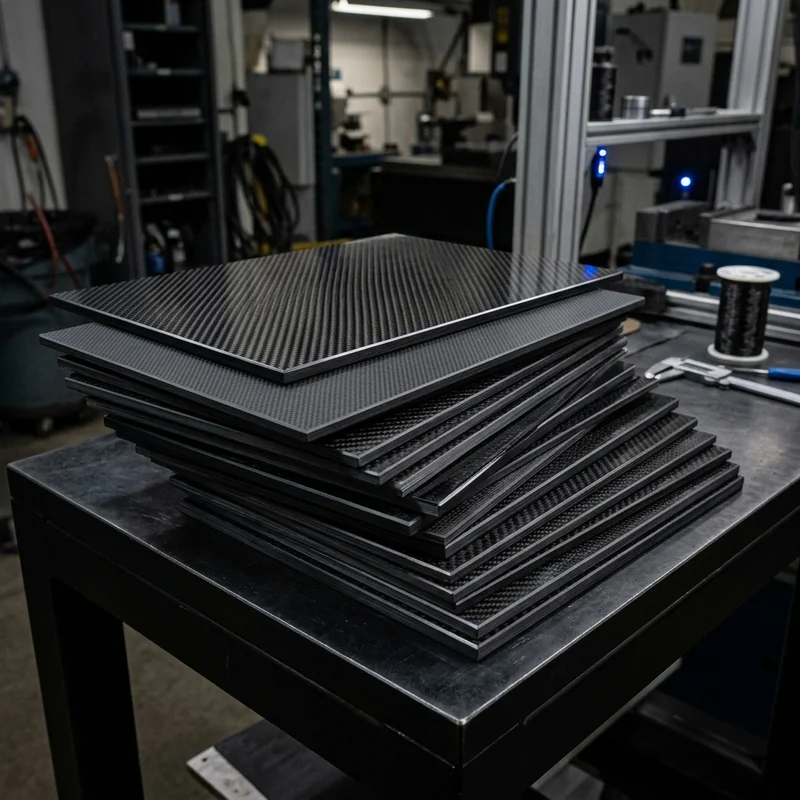
Carbon fiber standard plate-3k stripe
Lightweight, ultra-rigid standard sheets for drone fuselages, robot housings, facades and structural applications.

Carbon Fiber Plate — 3K Twill T700 3.0mm
Medium-thickness 3.0mm carbon fiber plate offering significantly higher load capacity while maintaining attractive 3K twill finish. Suitable for structural brackets, reinforcement plates, and load-bearing panels.

Carbon Fiber Plate — 3K Twill T700 1.5mm
Thin 1.5mm carbon fiber plate with 3K twill weave surface. Lightweight and stiff, commonly used for covers, panels, drone bodies, and applications requiring a premium aesthetic appearance.
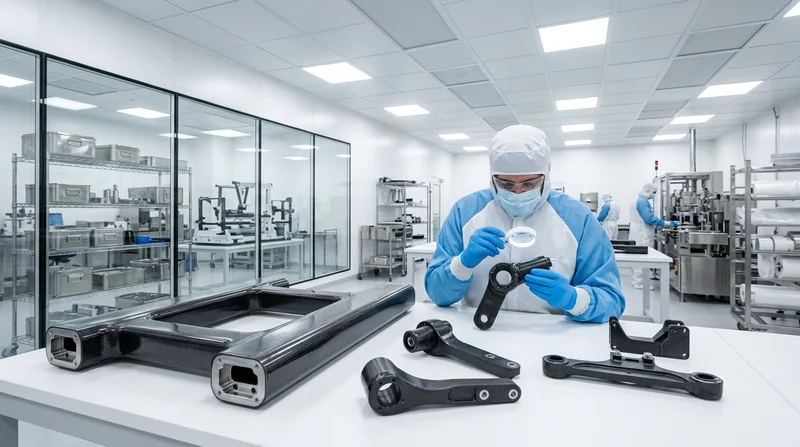
Custom Carbon Fiber Medical Device Components
Medical-grade carbon fiber components manufactured for imaging equipment, surgical instruments, and patient support systems. Carbon fiber's radiolucency (X-ray transparency) and high strength-to-weight ratio make it ideal for CT scanner beds, wheelchair frames, surgical robot arms, and MRI-compatible accessories. Biocompatible resin systems available.

Square Carbon Fiber Tube — 3K Twill T700
Square cross-section carbon fiber tube manufactured with 3K twill weave for torsional strength. Preferred for structural frames, trusses, and support columns where rectangular geometry offers design flexibility.