
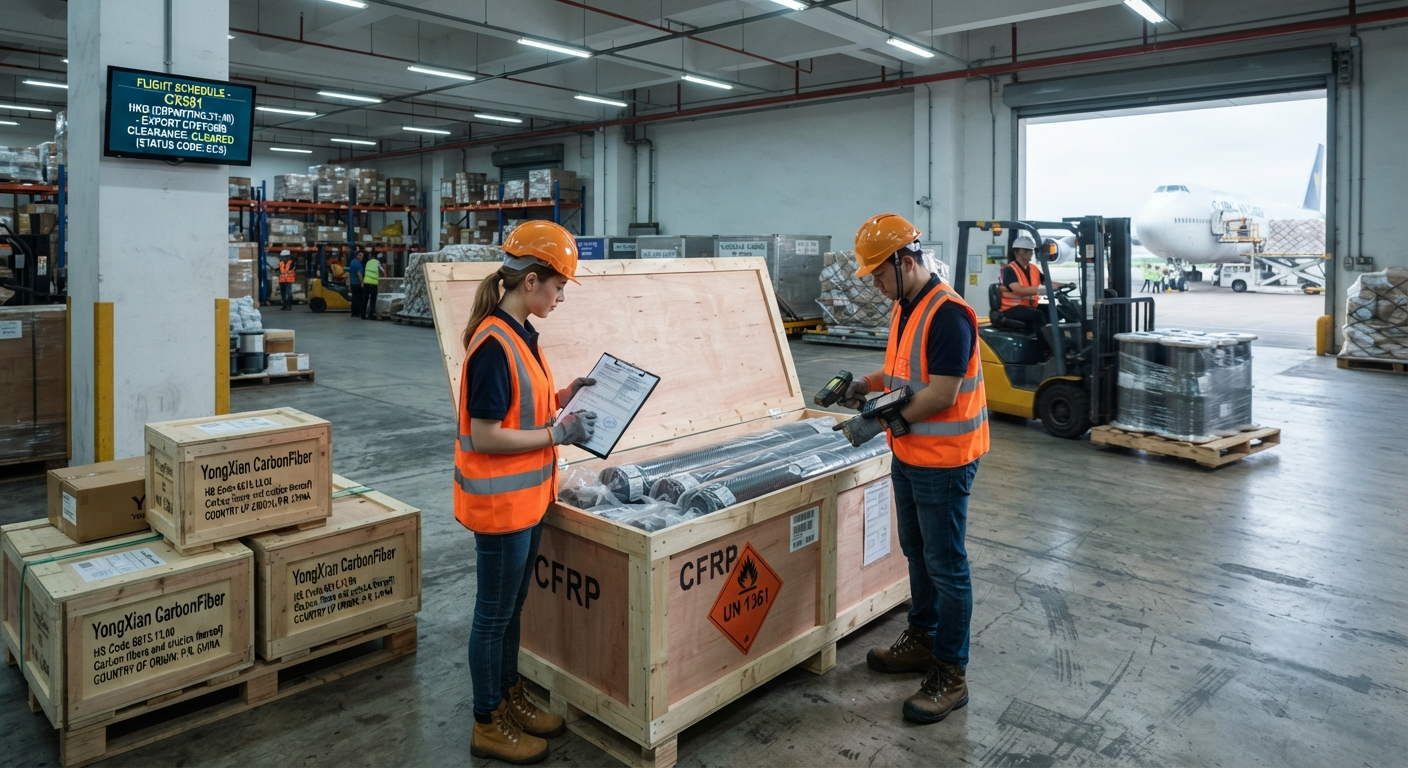
B2B guide to carbon fiber export customs clearance covering HS Code classification, dual-use export controls, mandatory documentation packages, Incoterm selection, and country-specific regulations for global carbon fiber shipments.
Understanding Carbon Fiber Export Classification and HS Code Determination
The export of carbon fiber materials and finished composite products requires precise classification under the Harmonized Commodity Description and Coding System (HS Code) administered by the World Customs Organization. Misclassification is the single most common cause of customs delays and penalty assessments in carbon fiber shipments, with industry surveys indicating that 23% of first-time carbon fiber exporters face detention or reclassification actions. For manufacturers and distributors operating in the B2B carbon fiber supply chain, mastering HS Code determination is not optional — it is a regulatory necessity that directly impacts duty rates, export control licensing, and transit times.
Carbon fiber falls primarily under HS Chapter 68 (Articles of Stone, Plaster, Cement, Asbestos, Mica or Similar Materials) for raw fiber forms, or Chapter 39 (Plastics and Articles Thereof) for certain prepreg and compound formulations. The specific eight-digit HS Code depends on the material's physical form — continuous filament tow, chopped fiber, woven fabric, or nonwoven mat. Continuous carbon fiber tow of 12,000 to 50,000 filaments per bundle typically classifies under HS 6815.11.00, while woven carbon fiber fabrics with areal weights between 160 and 640 g/m² fall under HS 6815.13.00 or HS 5911.20.00 depending on whether the fabric is coated or impregnated. Prepreg materials — carbon fiber fabric pre-impregnated with epoxy or phenolic resin — require particular attention because the resin content percentage determines whether the product classifies as a textile (Chapter 59) or as a plastic article (Chapter 39).
The consequences of incorrect HS Code assignment are severe. A European Union study on customs compliance in advanced materials trade found that 34% of carbon fiber shipments flagged for audit involved HS Code errors, resulting in average penalty assessments of €12,800 per shipment and detention periods of 8 to 14 working days. For time-sensitive aerospace or automotive production shipments, these delays can trigger contractual penalty clauses worth tens of thousands of euros per day. Exporters should engage a licensed customs broker with specific experience in advanced composite materials — generic brokerage firms without carbon fiber expertise consistently produce higher error rates in classification determinations.
Essential Export Documentation Package
A complete carbon fiber export documentation package comprises six mandatory documents, each serving a distinct regulatory and commercial function. The commercial invoice must include the HS Code at the six-digit level as a minimum, with eight- or ten-digit codes preferred for markets such as China, Japan, and the European Union. The invoice should clearly state the carbon fiber type (PAN-based or pitch-based), filament count, tensile modulus range, and areal weight where applicable. Unit prices must be stated in the agreed Incoterm — CIF (Cost, Insurance, Freight) and FOB (Free on Board) being the most common in carbon fiber trade — and the total declared value must accurately reflect the transaction value without under-declaration, which is a customs fraud trigger in virtually all jurisdictions.
| Document | Issuing Party | Key Content | Common Errors |
|---|---|---|---|
| Commercial Invoice | Exporter | HS Code, Incoterm, unit values, total declared value, product description | Insufficient product detail; wrong HS Code digit length |
| Packing List | Exporter | Net/gross weight per package, package dimensions, pallet count, marks & numbers | Missing carbon fiber UN number (UN 1361 for carbon fibers) for dangerous goods |
| Certificate of Origin (COO) | Chamber of Commerce or authorized body | Country of origin, percentage of local content, HS Code chapter | Failure to obtain preferential COO for FTA-eligible shipments |
| Bill of Lading / Air Waybill | Carrier | Consignor/consignee, vessel/flight number, port of loading/discharge, number of packages | Incorrect hazardous goods classification on air waybill |
| Export Declaration (Customs) | Exporter through customs agent | Statistical value, export license reference (if applicable), country of destination | Missing dual-use export control license reference for high-modulus fibers |
| Material Safety Data Sheet (MSDS) | Manufacturer or distributor | Hazard classification, handling precautions, transport classification | Outdated MSDS or missing country-specific regulatory statements |
The Certificate of Origin warrants special attention in carbon fiber trade because preferential duty rates under free trade agreements — such as the USMCA, EU-South Korea FTA, and RCEP — can reduce applicable duties by 4% to 12% ad valorem. To qualify, the carbon fiber must undergo sufficient transformation in the exporting country, typically defined as a change in HS Code chapter or a minimum regional value content of 40% to 60%. For processors who import carbon fiber precursor (polyacrylonitrile) and convert it to carbon fiber through stabilization and carbonization, the substantial transformation test is generally satisfied. However, for traders who simply repackage imported carbon fiber without additional processing, the Certificate of Origin may be denied.
Dual-Use Export Controls and Licensing Requirements
Carbon fiber is classified as a dual-use material under the Wassenaar Arrangement on Export Controls for Conventional Arms and Dual-Use Goods and Technologies. High-performance carbon fibers with a tensile modulus exceeding 230 GPa (M30 grade and above) and those with a tensile strength exceeding 2,000 MPa are subject to export controls in most industrialized nations. The Wassenaar Arrangement's Sensitive List and Very Sensitive List identify specific carbon fiber types — particularly those produced from mesophase pitch with modulus values exceeding 380 GPa — as requiring explicit export licenses to destinations outside allied nations.
The European Union's Dual-Use Regulation (EU 2021/821) and the U.S. Export Administration Regulations (EAR) under Category 1 of the Commerce Control List (CCL) establish the primary regulatory frameworks for carbon fiber exports. Under the EAR, high-modulus carbon fibers (modulus ≥ 230 GPa at 295 K) classified under ECCN 1C010.a require a license for export to countries designated as national security (NS) controlled destinations — a list that includes China, Russia, Iran, North Korea, and Syria. Applications must include end-user certification, a detailed statement of intended use, and product technical datasheets. Processing times range from 30 to 90 days, and exporters should account for this timeline in contract planning.
- U.S. ECCN 1C010.a: Carbon fibers with tensile modulus ≥ 230 GPa at 295 K — requires NS license for controlled destinations, no license required for most allied nations under License Exception ENC.
- EU Dual-Use Annex I Category 1C: Matches US controls for modulus ≥ 230 GPa fibers — licensing authority: national competent authority of the member state where the exporter is established.
- Japan METI Control: Carbon fibers with modulus ≥ 230 GPa under Foreign Exchange and Foreign Trade Act — license required for exports to countries on the Friendshoring List vs. Non-Friendshoring List.
- China Dual-Use Export Controls (2024): New regulations effective December 2024 require export license for high-performance carbon fibers with tensile strength ≥ 4,000 MPa or modulus ≥ 240 GPa.
- South Korea Strategic Trade Controls: Carbon fibers listed under Category 1 of the Strategic Items List — export declarations mandatory for all shipments to non-KORUS FTA partners.
Incoterms and Risk Transfer in Carbon Fiber Trade
The choice of Incoterm in carbon fiber export contracts fundamentally determines the allocation of transport risk, insurance responsibility, and customs clearance obligations between buyer and seller. For carbon fiber shipments — which are high-value, sensitive to environmental conditions, and potentially subject to export controls — the selection of Incoterm requires careful consideration of each party's capabilities. EXW (Ex Works) places full responsibility on the buyer for export clearance, which is problematic when the buyer lacks familiarity with the exporting country's dual-use control regulations. CIF (Cost, Insurance, Freight) places transport and insurance costs on the seller but transfers risk at the port of loading, leaving the buyer responsible for import clearance and onward logistics.
DAP (Delivered at Place) and DDP (Delivered Duty Paid) are increasingly preferred in carbon fiber trade between established partners, as they provide the seller with full control over the logistics chain, including customs clearance at both ends. This is particularly relevant for time-sensitive aerospace supply chains where production line stoppages cost $50,000 to $100,000 per hour. However, DDP carries significant tax liability exposure for the seller in jurisdictions with complex value-added tax regimes. For carbon fiber shipments valued above $250,000, many B2B contracts now specify CIP (Carriage and Insurance Paid To) with Institute Cargo Clauses (A) all-risk insurance coverage, providing the highest level of cargo protection for these sensitive materials.
Frequently Asked Questions
What is the correct HS Code for carbon fiber prepreg?
Carbon fiber prepreg classification depends on the matrix resin content. Prepregs with thermosetting resin content below 50% by weight typically classify under HS 5911.20.00 (Textile fabrics used in machinery or plant), while those with resin content at or above 50% may classify under HS 3921.90.90 (Other plates, sheets, film, foil and strip of plastics). The binding customs ruling in the EU (Case C-276/13) established that classification follows the material that gives the product its essential character — generally the reinforcing fiber rather than the matrix when fiber content predominates.
Do I need an export license for standard-modulus (230 GPa) carbon fiber?
Yes, in most jurisdictions. The 230 GPa threshold is the baseline control parameter under both the Wassenaar Arrangement and national regulations including the U.S. EAR, EU Dual-Use Regulation, and Japan's FEFTA. However, many allied nations benefit from license exceptions or general export authorizations. For example, exports from the EU to the United States, Japan, Switzerland, Norway, Australia, Canada, and the United Kingdom are covered by EU General Export Authorisation EU001, eliminating the need for individual license applications. Always verify the specific destination's control status with your national export control authority before shipping — relying on outdated country classifications is a common compliance failure.
How should carbon fiber be packaged for international shipment to prevent damage?
Carbon fiber tows and fabrics must be packaged to prevent moisture absorption, physical abrasion, and contamination during transit. Standard practice includes sealing carbon fiber rolls in polyethylene moisture-barrier bags with desiccant packs (silica gel, minimum 50 g per roll), cushioned with polyethylene foam wrap (minimum 10 mm thickness), and packed in corrugated cardboard or plywood export crates. The outer packaging must bear the UN identification number for carbon fiber in the appropriate dangerous goods class. For air freight, IATA Dangerous Goods Regulations require that carbon fiber shipments be accompanied by a shipper's declaration for dangerous goods (DGD) when the material is shipped in quantities exceeding the excepted quantity limits — typically 30 kg net per package for the 4.2 flammable solids class.
Related Articles
- Recycled Carbon Fiber Market Forecast 2030: Technology Maturity and Commercialization Path
- South Korea Carbon Fiber Market 2026: Hydrogen Economy and Shipbuilding Innovation
- Wind Turbine Blade Leading Edge Protection 2026: Polyurethane, Tape, and Metallic Shield Solutions
- China Carbon Fiber Overcapacity 2026: Price War Impact and Industry Consolidation
- India Carbon Fiber Market 2026: Wind Energy, Aerospace, and Defense Expansion
- PAN Precursor Market 2026: Acrylonitrile Supply and Carbon Fiber Cost Structure
Interested in Our Products?
Contact our team for competitive pricing and technical specifications.
Get a QuoteRelated Products
Carbon fiber standard plate-3k stripe
Lightweight, ultra-rigid standard sheets for drone fuselages, robot housings, facades and structural applications.

Carbon Fiber Plate — 3K Twill T700 3.0mm
Medium-thickness 3.0mm carbon fiber plate offering significantly higher load capacity while maintaining attractive 3K twill finish. Suitable for structural brackets, reinforcement plates, and load-bearing panels.

Carbon Fiber Plate — 3K Twill T700 1.5mm
Thin 1.5mm carbon fiber plate with 3K twill weave surface. Lightweight and stiff, commonly used for covers, panels, drone bodies, and applications requiring a premium aesthetic appearance.

Custom Carbon Fiber Medical Device Components
Medical-grade carbon fiber components manufactured for imaging equipment, surgical instruments, and patient support systems. Carbon fiber's radiolucency (X-ray transparency) and high strength-to-weight ratio make it ideal for CT scanner beds, wheelchair frames, surgical robot arms, and MRI-compatible accessories. Biocompatible resin systems available.

Square Carbon Fiber Tube — 3K Twill T700
Square cross-section carbon fiber tube manufactured with 3K twill weave for torsional strength. Preferred for structural frames, trusses, and support columns where rectangular geometry offers design flexibility.