
A custom carbon fiber drone frame decision shapes every metric that follows: flight time, payload, vibration signature, and repair cost after a hard landing. Off-the-shelf frames force compromises on arm length, mount spacing, and plate thickness that a purpose-built layup resolves in the first revi
Introduction
A custom carbon fiber drone frame decision shapes every metric that follows: flight time, payload, vibration signature, and repair cost after a hard landing. Off-the-shelf frames force compromises on arm length, mount spacing, and plate thickness that a purpose-built layup resolves in the first revision. This guide walks the full path from load case definition to a fabrication-ready package, so engineering and procurement move together instead of trading emails for weeks.
You will learn how tube selection, plate thickness, and layup schedule interact, what a realistic price band looks like for prototype and volume tiers, and the five checks that separate a competent composite shop from a laser-cut acrylic reseller.
Why a Custom Carbon Fiber Drone Frame Beats a COTS Frame
Commercial off-the-shelf frames optimize for one popular configuration. A custom build lets you set arm length for the exact motor and prop, place the flight controller where the IMU reads cleanest, and thicken only the load paths that actually see stress. The result is measurable: 8 to 15 percent endurance gain on the same battery is common when the frame weight drops without sacrificing stiffness.
- Arm length and motor spacing: set to your motor KV and prop diameter, not a generic 350mm class.
- Plate thickness gradient: thicker at arm roots and motor mounts, thinner in the center bay where bending moments are lower.
- Cable routing: embedded channels or grommet holes specified in the drawing instead of drilled after cure.
- Mount pattern: flight controller, GPS, and payload brackets land on first-article hardware, not on M3 holes you ream later.
Carbon Fiber Tube Custom Selection for Drone Arms
Arms are the highest-cycle load path on a multirotor, so carbon fiber tube custom choices dominate frame performance. Round tubes give the best torsional stiffness per gram; square or rectangular profiles simplify arm-to-plate joints but cost 10 to 20 percent more in machining. Wall thickness is the second lever: 1.0mm suits sub-250g builds, 1.5mm covers 500g to 1kg classes, and 2.0mm is the safe floor above 1.5kg payload drones.
| Frame class | Tube OD | Wall | Arm length | Typical frame weight |
|---|---|---|---|---|
| Micro / sub-250g | 6-8 mm | 0.8-1.0 mm | 100-130 mm | 45-80 g |
| Racing / 5 inch | 10-12 mm | 1.0-1.5 mm | 220-250 mm | 180-260 g |
| Industrial 5-10 kg | 16-22 mm | 1.5-2.0 mm | 350-550 mm | 650-1200 g |
| Fixed-wing spar | 25-40 mm | 2.0-3.0 mm | 600-1500 mm | per wing set |
Specify fiber grade in the drawing: T300-class handles most multirotor work, T700 or equivalent buys stiffness margin for heavy-lift arms that see repeated hard landings. Ask for roll-level certificates so a batch substitution cannot slip into your program.
Carbon Fiber Plate Custom Parts for Mounts and Protection
Bottom plates, top decks, and camera cages are where carbon fiber plate custom work pays for itself. Plate is cheaper per part than machined billet and far stiffer than G10 at equal weight. The practical range for drone structures is 1.5mm to 3.0mm: 1.5mm for electronics covers, 2.0mm for main structural plates, 3.0mm for skid plates and landing gear hardpoints.
- Main plate: 2.0mm 3K twill or plain weave, CNC cut with chamfered arm slots.
- Camera cage: 2.0 to 2.5mm plate with vibration-isolated mounting holes.
- Landing skids: 3.0mm plate with replaceable abrasion strips bonded on the contact face.
- Battery tray: 1.5mm plate with slots sized to your strap width, not a generic 25mm.
Design to Fabrication Workflow That Actually Works
Five steps keep a custom frame program on schedule. Skip any of them and you buy a second revision with your own money.
- Load case and mass budget: write down AUW, max thrust, and crash factor (3g to 5g is typical) before any geometry.
- CAD freeze and drawing package: STEP plus 2D drawings with tolerances on critical holes; PDF is not enough for a machine shop.
- Layup schedule sign-off: fiber orientation, core if any, and cure profile agreed in writing with the fabricator.
- First article inspection: dimension check on five parts, one static load test on a dummy arm, then release for the pilot batch.
- Batch release with lot traceability: certificate numbers recorded against your purchase order for every delivery.
Cost Benchmarks and Vendor Checks
Prototype sets of five frames typically land between USD 80 and USD 150 per frame depending on tube count and plate complexity. At 100-unit volume the same design drops to USD 25 to USD 45 if the shop owns CNC and press capacity. Lead time runs two to three weeks for prototypes and four to six weeks for production batches once drawings are frozen. Before you place the order, confirm three things: the shop machines its own carbon in house, it can produce a lot-linked certificate, and it will sign a simple NDA on your geometry.
Frequently Asked Questions
How long does a custom carbon fiber drone frame program take from drawing to first flight?
Plan four to six weeks for a first prototype: one week for CAD and layup discussion, two weeks fabrication, one week incoming inspection and assembly. Production batches add two to four weeks depending on queue.
Is a custom frame worth it under 500 units per year?
Yes, if endurance or payload is a hard requirement. The non-recurring engineering amortizes quickly when the frame weight drops 10 to 15 percent against a COTS baseline and you stop paying rush airfreight for spares that never quite fit.
What fiber grade should I specify for industrial multirotor arms?
T700-class or equivalent for arms above 300mm span on frames over 3kg AUW. T300 is adequate for sub-250g and racing builds where cost matters more than stiffness margin.
Conclusion
A custom carbon fiber drone frame program succeeds when the load case, tube selection, and plate layout are frozen together and the fabricator can prove lot traceability. Treat the drawing package as a contract and the first article as a gate, and the frame will fly the numbers you designed for on the first battery.
YongXian supplies carbon fiber tube custom cuts and CNC carbon fiber plate custom parts for drone OEMs, with lot certificates and sample support. Review our tube and plate range or send your drawing for a quote.
Part of topic
Related Articles
- Is Carbon Fiber Rod Good? Strength, Flex, and Best Use Cases
- Carbon Fiber Plate for Shoe: Materials, Thickness, and Use Cases
- Carbon Fiber Plates in Running Shoes: How They Work and When They Help
- Carbon Fiber Top Tube Repair: Cracks, Paint and Reinforcement
- Carbon Fiber Road Wheels: What Matters for Buyers
- Carbon Fiber Drone Chassis Design: Loads, Layout and Layup
Interested in Our Products?
Contact our team for competitive pricing and technical specifications.
Get a QuoteRelated Products

Round Carbon Fiber Tube — 3K Plain Weave T700
Standard round carbon fiber tube manufactured from Toray T700 grade fiber with 3K plain weave. Offers balanced strength and stiffness for general industrial applications including robotics, automation, sports equipment, and aerospace structures.

Square Carbon Fiber Tube — 3K Twill T700
Square cross-section carbon fiber tube manufactured with 3K twill weave for torsional strength. Preferred for structural frames, trusses, and support columns where rectangular geometry offers design flexibility.

Carbon Fiber Plate — 3K Twill T700 3.0mm
Medium-thickness 3.0mm carbon fiber plate offering significantly higher load capacity while maintaining attractive 3K twill finish. Suitable for structural brackets, reinforcement plates, and load-bearing panels.

Round Carbon Fiber Tube — 3K Twill
Lightweight and ultra-stiff round tubes ideal for drone frames, robotics, and structural applications.
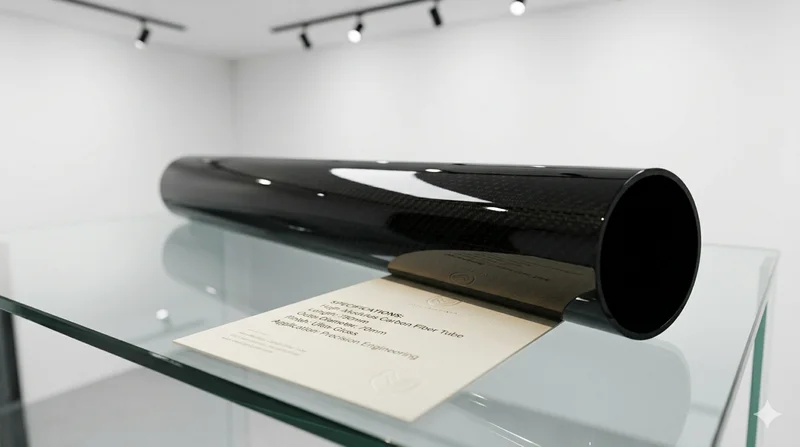
High Modulus Round Carbon Fiber Tube — M40
High modulus round tube manufactured with M40 grade fiber (tensile modulus 400 GPa). Designed for applications where maximum stiffness-to-weight ratio is critical, such as optical systems, precision machinery, and aerospace structures.