
Continuous fiber reinforced thermoplastics (CFRT) represent one of the most significant shifts in composite materials technology over the past decade. Unlike traditional thermoset composites — where the resin matrix undergoes an irreversible chemical cross-linking reaction during cure — thermoplasti
Introduction
Continuous fiber reinforced thermoplastics (CFRT) represent one of the most significant shifts in composite materials technology over the past decade. Unlike traditional thermoset composites — where the resin matrix undergoes an irreversible chemical cross-linking reaction during cure — thermoplastic matrices can be repeatedly melted, reshaped, and welded without degrading their mechanical properties. This fundamental difference in polymer chemistry translates into transformative manufacturing advantages: cycle times measured in minutes rather than hours, mechanical joining through welding instead of adhesive bonding, and end-of-life recyclability that thermoset systems simply cannot offer.
The global CFRT market is projected to grow at a compound annual growth rate of 12.8% through 2030, driven primarily by automotive lightweighting mandates and the need for faster production cycles in high-volume manufacturing. This article examines how continuous fiber reinforced thermoplastics compare to thermoset composites across processing, performance, and sustainability dimensions, and reviews the applications where CFRT delivers the strongest value proposition.
CFRT Material Systems: Resin and Fiber Combinations
The performance envelope of a CFRT laminate depends on the pairing of thermoplastic resin matrix with continuous fiber reinforcement. The most commercially significant combinations include:
- PP/glass fiber: The highest-volume CFRT system, used in automotive semi-structural parts. Polypropylene offers the lowest resin cost ($1.50-2.50/kg) and excellent chemical resistance, but its low melting point (165°C) limits service temperature. Tensile strength of unidirectional PP/glass laminates reaches 800-1,100 MPa.
- PA6/PA66/glass or carbon fiber: Polyamide matrices provide higher service temperatures (up to 120°C continuous) and superior impact resistance. PA6/carbon CFRT laminates achieve tensile strengths of 1,200-1,800 MPa with fiber volume fractions of 50-60%.
- PEEK/carbon fiber: The high-performance end of the CFRT spectrum. Polyether ether ketone offers continuous service temperatures above 250°C, excellent chemical resistance, and outstanding fatigue performance. PEEK/carbon laminates reach tensile strengths exceeding 2,000 MPa — comparable to aerospace-grade thermoset prepregs.
- PPS/carbon fiber: Polyphenylene sulfide provides a balance between PEEK-level performance and processability, with continuous service temperatures up to 200°C and inherent flame resistance without additives.
The choice of matrix resin directly determines the processing window, service environment, and cost structure of the final part. For high-volume automotive applications, PP and PA6 systems dominate; for aerospace and demanding industrial applications, PEEK and PPS systems are preferred.
Processing Advantages: CFRT vs Thermoset Cycle Times
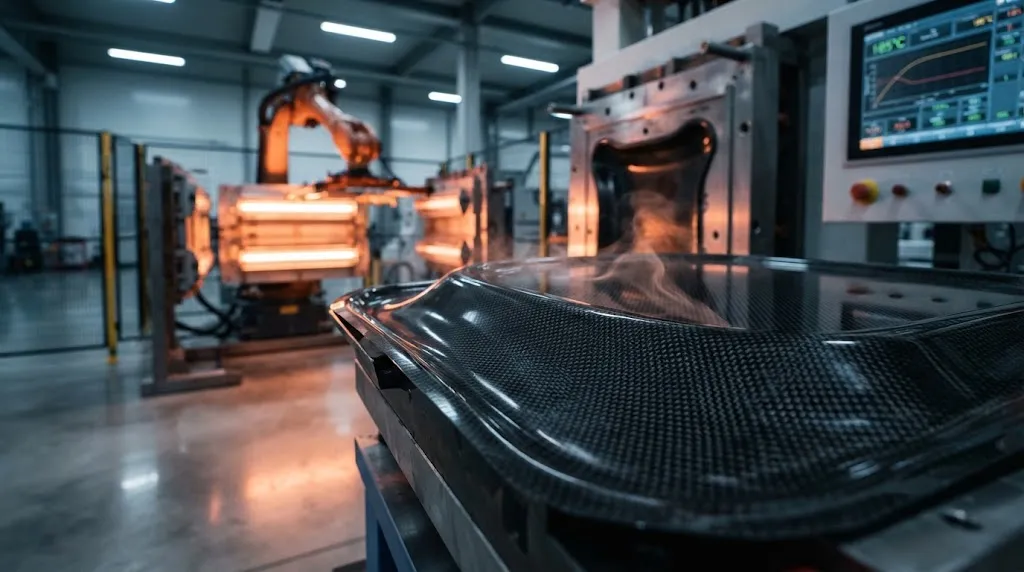
The most compelling manufacturing advantage of continuous fiber reinforced thermoplastics is the elimination of the thermoset cure cycle. Thermoset prepreg systems require elevated temperature autoclave cycles — typically 120-180°C for 2-6 hours at 3-7 bar pressure — to initiate and complete the cross-linking reaction. CFRT materials, by contrast, only need heating above the matrix melting point, forming under pressure, and cooling to solidify.
| Parameter | Thermoset Prepreg | CFRT (Injection/Compression) | CFRT (Thermoforming) |
|---|---|---|---|
| Cycle time | 2-6 hours (autoclave) | 2-5 minutes | 30-90 seconds |
| Tooling temperature | 120-180°C | 200-400°C (resin dependent) | 200-400°C |
| Press pressure | 3-7 bar (autoclave) | 10-30 MPa (injection) | 1-5 MPa |
| Post-cure required | Yes (typically 2-4 hours) | No | No |
| Joining method | Adhesive bonding / mechanical fasteners | Welding (ultrasonic, induction, resistance) | Welding |
| Recyclability | Limited (ground filler only) | Full melt recycling possible | Full melt recycling |
For automotive bumper beams, roof rails, and structural reinforcements, CFRT thermoforming achieves cycle times of 30-90 seconds — directly compatible with metal stamping press rhythms. This speed advantage is the primary driver of CFRT adoption in high-volume automotive production, where thermoset cycle times of several hours are economically prohibitive above approximately 50,000 parts per year.
Mechanical Performance Comparison
Continuous fiber reinforced thermoplastics match or exceed thermoset composites in most mechanical properties when properly processed. The key differences lie in impact behavior, fatigue performance, and temperature-dependent properties:
- Impact resistance: CFRT laminates absorb 2-5 times more energy during low-velocity impact than equivalent thermoset laminates, due to the ductile deformation behavior of the thermoplastic matrix. This makes CFRT inherently more damage-tolerant — a significant advantage for automotive crash structures.
- Fatigue performance: PEEK/carbon CFRT systems demonstrate fatigue endurance limits at 60-70% of static tensile strength, compared to 50-60% for toughened epoxy/carbon systems. The thermoplastic matrix resists microcrack initiation under cyclic loading.
- Specific stiffness: CFRT and thermoset laminates achieve comparable specific stiffness values (100-150 GPa/(g/cm³)) at similar fiber volume fractions. The matrix contribution to stiffness is secondary to the fiber reinforcement.
- Temperature sensitivity: Thermoplastic matrices exhibit a glass transition or melting transition that causes a sharper drop in mechanical properties above the transition temperature compared to the more gradual degradation of thermoset systems. PP-based CFRT loses significant stiffness above 100°C, while PEEK-based CFRT maintains properties to 250°C.
For applications where impact damage tolerance and fast recycling are priorities — automotive bumper systems, reusable packaging, and sporting goods — CFRT provides clear performance advantages. For high-temperature aerospace primary structures, thermoset systems or high-performance CFRT (PEEK, PPS) remain necessary.
Automotive and Industrial Applications
CFRT adoption is accelerating across several high-volume sectors:
- Automotive semi-structural parts: Bumper beams, roof rail reinforcements, seat structures, and battery tray lids in electric vehicles. OEMs including BMW, Audi, and Hyundai have qualified CFRT systems for series production, with typical part weights of 2-8 kg per vehicle.
- Building and construction: Pultruded CFRT profiles for window frames, door frames, and structural reinforcements where corrosion resistance eliminates the maintenance cycle of aluminum or steel.
- Consumer electronics: Laptop frames, tablet housings, and smartphone chassis using thin-wall CFRT thermoformed panels (0.4-0.8 mm thickness) for stiffness at minimal weight.
- Industrial automation: Robot arm components, gantry structures, and conveyor frames where the combination of low inertia, high stiffness, and vibration damping improves positioning accuracy and throughput.
The automotive sector alone is expected to consume 45,000-60,000 tonnes of CFRT material annually by 2028, representing approximately 15-20% of the total automotive composites market.
Frequently Asked Questions
Can CFRT parts be welded to metal structures?
Yes — one of the unique advantages of continuous fiber reinforced thermoplastics is the ability to join thermoplastically to metal components through techniques such as friction stir welding, induction welding, or laser-assisted tape placement. The thermoplastic matrix melts at the joint interface, creating a metallurgical bond with the metal surface when surface preparation and process parameters are properly controlled. This eliminates the need for mechanical fasteners or adhesive bonding in hybrid metal-CFRT structures, reducing assembly time and weight.
What is the typical cost difference between CFRT and thermoset composites?
Raw material costs for CFRT are generally 10-25% higher than equivalent thermoset prepreg systems, primarily due to the higher cost of engineering thermoplastic resins (PEEK at $80-120/kg vs epoxy at $30-50/kg). However, total part cost often favors CFRT when manufacturing cycle time, tooling amortization, joining costs, and end-of-life recycling value are included in the analysis. For high-volume automotive production (above 100,000 parts per year), CFRT thermoforming typically achieves 20-40% lower total part cost than thermoset compression molding.
Is CFRT truly recyclable, or is this an overstatement?
CFRT is mechanically recyclable — meaning the material can be remelted and reprocessed into new parts without chemical degradation of the polymer matrix. Commercial recycling operations grind CFRT production scrap and end-of-life parts into granules, which are then injection-molded or compression-molded into lower-grade applications. The recycled material retains 60-80% of its original mechanical properties depending on fiber length degradation during reprocessing. True closed-loop recycling — where recycled CFRT replaces virgin material in the same application — remains limited to short-fiber systems, but the circular economy pathway is significantly more viable than for thermoset composites, which can only be downcycled into ground filler.
Conclusion
Continuous fiber reinforced thermoplastics are reshaping the composite materials landscape by combining the structural performance of thermoset systems with manufacturing speed, joinability, and recyclability. For automotive, electronics, and industrial applications where cycle time, impact tolerance, and end-of-life responsibility drive material selection, CFRT offers compelling advantages over traditional thermoset composites. For high-temperature aerospace primary structures, PEEK and PPS-based CFRT systems now provide thermoset-equivalent performance with the added benefits of thermoplastic processing.
To explore CFRT material options for your application, browse our carbon fiber product range or contact our engineering team for material selection guidance and sample availability for testing.
Part of topic
Related Articles
- Carbon Fiber Polymer Matrix Composite Fire Resistance: Intumescent Coatings and Fire-Barrier Solutions
- Carbon Fiber HP-RTM Cycle Time Optimization: High-Pressure Resin Transfer Molding for Automotive
- Carbon Fiber Nanostitching and Interleaving: Toughness Enhancement for Delamination Resistance
- Bio-Based Carbon Fiber Precursors: Lignin and Polyethylene for Low-Cost Production
- Large-Tow Carbon Fiber Cost Analysis: 48K vs 60K Price-Performance Comparison
- Carbon Fiber-Resin Interface Bonding: Surface Treatment and Coupling Agent Optimization
Interested in Our Products?
Contact our team for competitive pricing and technical specifications.
Get a QuoteRelated Products

Carbon Fiber Fishing Rod Blank
High-quality carbon fiber fishing rod blank manufactured from multiple grades of Toray carbon fiber cloth. Available in a wide range of lengths, powers, and actions for freshwater and saltwater applications. Suitable for OEM rod building.

Carbon Fiber Plate — 3K Twill T700 1.5mm
Thin 1.5mm carbon fiber plate with 3K twill weave surface. Lightweight and stiff, commonly used for covers, panels, drone bodies, and applications requiring a premium aesthetic appearance.

Carbon Fiber Plate — 3K Twill T700 3.0mm
Medium-thickness 3.0mm carbon fiber plate offering significantly higher load capacity while maintaining attractive 3K twill finish. Suitable for structural brackets, reinforcement plates, and load-bearing panels.

Carbon Fiber Trekking Pole
Lightweight carbon fiber trekking pole manufactured from high-grade carbon fiber tube. Weighs only 160g per pole while providing superior shock absorption and durability for hiking, trail running, and backpacking.

Square Carbon Fiber Tube — 3K Twill T700
Square cross-section carbon fiber tube manufactured with 3K twill weave for torsional strength. Preferred for structural frames, trusses, and support columns where rectangular geometry offers design flexibility.