
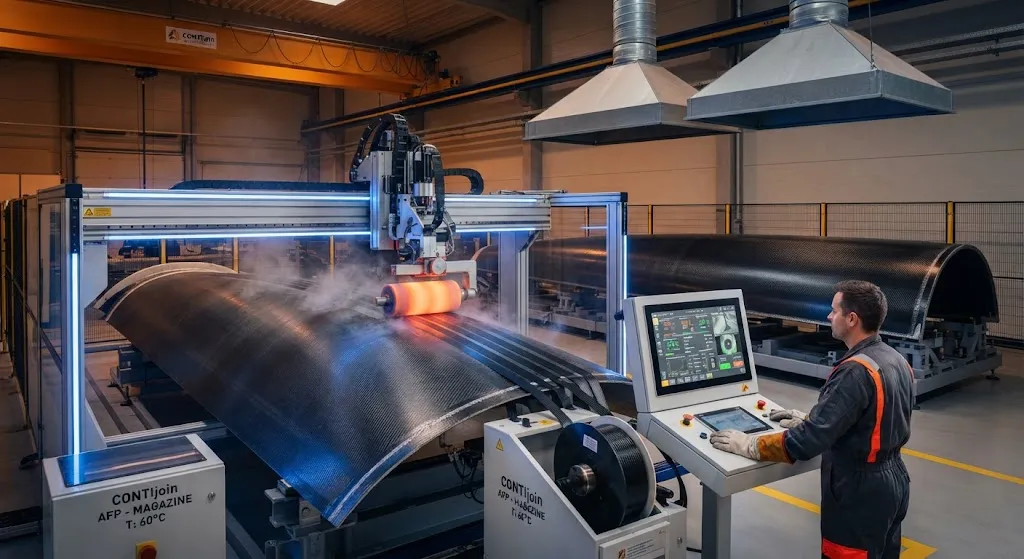
The wind energy industry faces a critical manufacturing bottleneck as blade lengths exceed 80 meters and demand for offshore wind installations accelerates globally. Traditional thermoset-based spar cap manufacturing requires multi-stage processes with lengthy cure cycles that constrain
Introduction
The wind energy industry faces a critical manufacturing bottleneck as blade lengths exceed 80 meters and demand for offshore wind installations accelerates globally. Traditional thermoset-based spar cap manufacturing requires multi-stage processes with lengthy cure cycles that constrain production throughput. The Fraunhofer Thermo-Blade-Spine project, utilizing CONTIjoin technology, represents a breakthrough in thermoplastic composite assembly for large wind blades, demonstrating automated fiber placement with in-situ consolidation that can reduce manufacturing cycle times by 40-60% while maintaining structural performance requirements.
CONTIjoin technology addresses the fundamental challenge of joining thermoplastic carbon fiber components in a continuous, automated process that eliminates the need for secondary bonding operations. The technology enables spar cap assembly directly during the fiber placement process, fusing thermoplastic matrix systems at elevated temperatures and consolidating under pressure in a single pass. This article examines the CONTIjoin process, its application to wind blade spar assembly, and the manufacturing advantages that make it viable for next-generation blade production.
CONTIjoin Technology Overview
CONTIjoin is a patented automated fiber placement technology that combines thermoplastic tape layup with in-situ welding and consolidation. The system operates by heating thermoplastic prepreg tapes to their melting point (typically 350-400°C for PEEK-based systems) and fusing adjacent tapes and structural elements under controlled pressure and temperature. The key process innovations include:
- Heated compaction roller: A precision-controlled roller maintains temperature and pressure at the nip point, ensuring complete fusion between adjacent tape courses without thermal degradation of the matrix.
- Infrared preheating: Multi-zone IR heaters preheat the substrate and incoming tape to optimal welding temperature, enabling consistent bond quality across the full tape width.
- Real-time temperature monitoring: Infrared pyrometers measure surface temperature at the consolidation point, providing closed-loop control to maintain process window tolerances.
- Multi-axis tape steering: Robotic placement heads enable complex spar cap geometries with variable fiber orientations, accommodating the curved profiles required for aerodynamic blade sections.
The thermoplastic matrix systems most commonly used with CONTIjoin include PEEK (polyetheretherketone), PEKK (polyetherketoneketone), and PAEK (polyaryletherketone) families, offering continuous use temperatures of 200-260°C and excellent chemical resistance for offshore wind environments.
Application to Wind Blade Spar Assembly
The Thermo-Blade-Spine project applies CONTIjoin technology specifically to spar cap manufacturing and assembly, addressing the structural core of wind turbine blades. The spar assembly process consists of several integrated steps:
- Spar cap layup: Unidirectional thermoplastic carbon fiber tapes are placed in the spar cap mold using CONTIjoin heads, building up the required laminate thickness with precise fiber orientation control.
- Shear web integration: Thermoplastic shear webs are positioned and welded to the spar caps during the placement process, creating an integrated spar structure without adhesive bonding.
- Root joint formation: The spar root section is built up with additional reinforcement plies and consolidated to meet the high-stress requirements at the blade root connection.
- In-situ consolidation: The entire spar assembly is consolidated under heat and pressure in a single oven cure cycle, eliminating the need for secondary autoclave processing.
This integrated approach reduces the number of manufacturing steps from 8-12 in traditional thermoset processing to 3-4 steps in the CONTIjoin process, with corresponding reductions in labor content, material handling, and production floor space requirements.
Manufacturing Advantages for Next-Generation Blades
The manufacturing benefits of CONTIjoin thermoplastic spar assembly translate directly to production economics for large wind blades. The following table compares key manufacturing parameters between traditional thermoset and CONTIjoin thermoplastic processes:
| Manufacturing Parameter | Thermoset (Epoxy) | CONTIjoin Thermoplastic | Improvement |
|---|---|---|---|
| Spar cap cure cycle time | 8-12 hours | 2-4 hours | 60-75% reduction |
| Secondary bonding operations | 3-4 operations | 0 (in-situ welded) | Eliminated |
| Labor content per spar (person-hours) | 40-60 | 15-25 | 55-60% reduction |
| Production floor space per spar | 120-180 m² | 60-90 m² | 50% reduction |
| Material waste | 15-25% | 5-10% | 60-70% reduction |
| Spar-to-blade assembly time | 6-8 hours | 2-3 hours | 60-65% reduction |
The 40-60% reduction in total manufacturing cycle time is the most significant advantage, enabling blade manufacturers to increase production rates without proportional increases in facility investment. For a factory producing 200 blades per year, CONTIjoin technology could reduce spar manufacturing time from 8,000-12,000 hours to 3,000-5,000 hours annually, freeing capacity for additional production or reducing overtime requirements.
Structural Performance Considerations
The transition from thermoset to thermoplastic matrix systems for spar caps requires validation that structural performance meets design requirements. CONTIjoin technology addresses this through several mechanisms:
- Higher fracture toughness: Thermoplastic matrices like PEEK exhibit 5-10x higher fracture toughness than thermoset epoxies, providing improved damage tolerance and fatigue resistance in the spar cap structure.
- Welded joint strength: In-situ welded thermoplastic joints achieve 85-95% of parent material strength, compared to 70-85% for adhesive-bonded thermoset joints, due to molecular chain interdiffusion across the weld interface.
- Creep resistance: Semi-crystalline thermoplastics like PEEK and PEKK demonstrate superior creep resistance at elevated temperatures, important for spar caps operating in hot desert or tropical offshore environments.
- Recyclability: Thermoplastic spar caps can be melted and reprocessed at end-of-life, addressing the growing sustainability requirements for wind blade decommissioning and recycling.
Frequently Asked Questions
How does CONTIjoin thermoplastic welding compare to traditional adhesive bonding for spar caps?
CONTIjoin thermoplastic welding creates molecular bonds between components through heat and pressure, achieving 85-95% of parent material strength at the joint. Traditional adhesive bonding relies on chemical adhesion between the adhesive and substrate surfaces, typically achieving 70-85% strength transfer. The welded joint benefits from being chemically identical to the base material, eliminating the weak adhesive layer that represents the most common failure initiation site in bonded structures. Additionally, welded joints are not susceptible to environmental degradation of the adhesive, providing more consistent long-term performance in the harsh operating environments of offshore wind turbines. The process time advantage is significant: welding completes in minutes versus hours for adhesive cure, contributing to the overall cycle time reduction.
What are the challenges of implementing CONTIjoin technology for large blade spar manufacturing?
Several challenges must be addressed for industrial implementation. Equipment investment is substantial, with CONTIjoin fiber placement systems costing $2-5 million depending on capacity and configuration. Thermoplastic prepreg materials are currently 20-40% more expensive than thermoset equivalents, though this premium is offset by reduced cycle times and eliminated secondary operations. Process window control requires sophisticated temperature monitoring and feedback systems to ensure consistent weld quality across spar caps that may be 60+ meters long. Training requirements are significant, as operators must understand thermoplastic processing, temperature control, and in-situ consolidation mechanics. Additionally, the wind industry's certification framework is still adapting to thermoplastic spar cap designs, requiring additional testing and qualification efforts compared to established thermoset approaches.
Conclusion
CONTIjoin thermoplastic spar assembly technology represents a paradigm shift in wind blade manufacturing, addressing the production bottleneck that constrains the industry's ability to meet offshore wind deployment targets. The 40-60% reduction in manufacturing cycle time, elimination of secondary bonding operations, and improved structural performance through higher fracture toughness and welded joint efficiency make CONTIjoin a compelling technology for next-generation blade production.
As the Thermo-Blade-Spine project transitions from demonstration to industrial application, the wind energy industry stands to benefit from manufacturing innovations that reduce cost, improve quality, and enable larger blade designs. For blade manufacturers evaluating production technology investments, CONTIjoin offers a pathway to higher throughput with reduced labor and floor space requirements. Explore our thermoplastic carbon fiber tape range, including PEEK and PEKK-based systems qualified for CONTIjoin processing, or contact our wind energy solutions team to discuss thermoplastic spar assembly technology for your manufacturing operations.
Part of topic
Related Articles
- Bio-Based Carbon Fiber Precursors: Lignin and Polyethylene for Low-Cost Production
- Large-Tow Carbon Fiber Cost Analysis: 48K vs 60K Price-Performance Comparison
- Carbon Fiber-Resin Interface Bonding: Surface Treatment and Coupling Agent Optimization
- Digital Twin for Carbon Fiber Manufacturing: Real-Time Process Monitoring and Defect Prevention
- Thermoplastic Carbon Fiber Welding for Automotive: Ultrasonic and Induction Welding Process Windows
- Large-Tow Carbon Fiber Wet Spinning: Process Optimization for 48K/60K Production Efficiency
Interested in Our Products?
Contact our team for competitive pricing and technical specifications.
Get a QuoteRelated Products
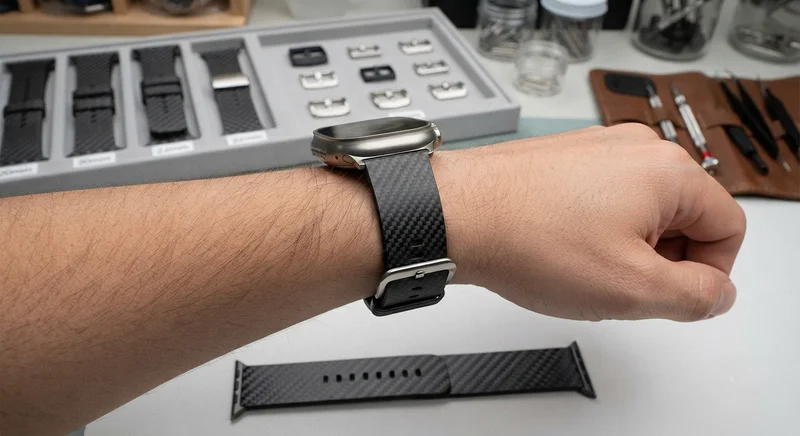
Carbon Fiber Watch Strap — 20mm/22mm Quick-Release
Premium carbon fiber watch strap with quick-release spring bars. Woven from T700 3K twill prepreg with a flexible resin system that conforms to the wrist. Available in 20mm and 22mm lug widths, compatible with Apple Watch, Samsung Galaxy Watch, Garmin, and traditional mechanical watches. Features a stainless steel buckle and carbon fiber keepers. The natural weave pattern makes each strap unique.
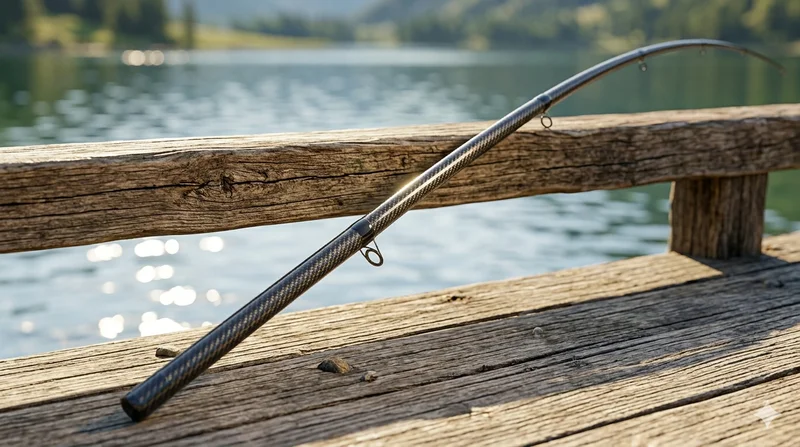
Carbon Fiber Fishing Rod Blank
High-quality carbon fiber fishing rod blank manufactured from multiple grades of Toray carbon fiber cloth. Available in a wide range of lengths, powers, and actions for freshwater and saltwater applications. Suitable for OEM rod building.

Carbon Fiber Plate — 3K Twill T700 1.5mm
Thin 1.5mm carbon fiber plate with 3K twill weave surface. Lightweight and stiff, commonly used for covers, panels, drone bodies, and applications requiring a premium aesthetic appearance.

Carbon Fiber Plate — 3K Twill T700 3.0mm
Medium-thickness 3.0mm carbon fiber plate offering significantly higher load capacity while maintaining attractive 3K twill finish. Suitable for structural brackets, reinforcement plates, and load-bearing panels.

Square Carbon Fiber Tube — 3K Twill T700
Square cross-section carbon fiber tube manufactured with 3K twill weave for torsional strength. Preferred for structural frames, trusses, and support columns where rectangular geometry offers design flexibility.