Central Europe's wind energy sector is entering a phase where the focus is shifting from new installations to the maintenance and life extension of an aging fleet. Germany alone operates approximately 30 GW of onshore wind capacity, with the average turbine age exceeding 12 years. Polan
Introduction
Central Europe's wind energy sector is entering a phase where the focus is shifting from new installations to the maintenance and life extension of an aging fleet. Germany alone operates approximately 30 GW of onshore wind capacity, with the average turbine age exceeding 12 years. Poland's wind fleet, concentrated in the northern coastal regions, has an average age of 9-11 years, while the Czech Republic's smaller installed base of 3.5 GW is similarly aging. Across the region, turbines installed during the 2008-2015 expansion wave are now approaching or exceeding their original 20-year design life, creating a structural shift in demand from construction services to operations and maintenance.
The maintenance challenge is particularly acute for composite components — blades, nacelle covers, and tower section reinforcement — which represent the highest-value repair and replacement market within wind turbine O&M. Blade damage from leading-edge erosion, lightning strikes, and fatigue cracking affects an estimated 15-20% of the installed fleet annually, requiring specialized composite repair technicians, materials, and logistics infrastructure that did not exist when these turbines were first commissioned. The emergence of regional O&M clusters is the industry's response to this concentrated, geographically specific demand.
The Aging Fleet: Scale and Maintenance Demand
The Central European wind fleet's age profile creates a predictable escalation in maintenance intensity. The table below quantifies the installed base and projected maintenance demand across the three largest markets:
| Country | Installed Capacity (GW) | Average Turbine Age (yrs) | Turbines > 10 yrs (%) | Est. Annual Blade Repair Demand (units) |
|---|---|---|---|---|
| Germany | 30.2 | 12.4 | 68% | 2,800-3,200 |
| Poland | 8.1 | 10.2 | 52% | 650-800 |
| Czech Republic | 3.5 | 11.8 | 61% | 280-350 |
| Total Central Europe | 41.8 | — | — | 3,730-4,350 |
The annual blade repair demand of 3,730-4,350 units across the region translates to a composite materials market of approximately €45-65 million per year for repair resins, carbon fiber reinforcement, and protective coatings. This market is growing at 8-12% annually as the fleet ages and repair frequency increases. By 2030, the annual blade repair demand is projected to reach 5,500-6,500 units, with the composite materials component expanding to €70-95 million per year.
Beyond blade repair, the aging fleet creates demand for nacelle cover replacement (typically FRP or composite sandwich construction), tower section reinforcement at flange connections, and retrofit of existing structures with composite strengthening systems. These secondary composite applications add an estimated 20-30% to the total maintenance material demand.
O&M Cluster Structure and Geography
The Central European wind O&M landscape is consolidating around three geographic clusters, each with distinct characteristics and service capabilities:
- North German Cluster (Schleswig-Holstein, Lower Saxony): The largest and most mature cluster, anchored by service companies that evolved from the original turbine manufacturers and independent power producers. The cluster includes blade repair workshops in Husum and Cuxhaven, composite materials distributors with inventory in Kiel and Hamburg, and mobile repair teams that service both onshore and the growing North Sea offshore fleet. The cluster handles approximately 45% of Germany's annual blade repair volume.
- Polish Baltic Cluster (Pomerania, Warmia-Masuria): An emerging cluster driven by Poland's rapid wind buildout in the 2012-2019 period. The cluster is centered on Gdansk and Szczecin, with blade repair facilities developed by local engineering firms and international O&M providers expanding into the Polish market. The cluster currently handles about 60% of Poland's blade repair demand but is investing heavily in capacity to serve the offshore wind pipeline expected from 2028.
- Czech-Moravian Cluster (Central Bohemia, Moravia): A smaller, specialized cluster focused on the Czech Republic's aging onshore fleet and serving as a logistics hub for cross-border repair operations into Slovakia and eastern Austria. The cluster's strength is in tower and foundation repair rather than blade specialist work, with composite repair capabilities concentrated in a few specialist firms.
These clusters are interconnected by a mobile repair workforce that travels between sites, specialized logistics providers transporting blade sections and composite repair materials, and insurance companies that drive repair-versus-replace decisions based on cost-benefit analysis. The cluster model reduces response time — critical for minimizing turbine downtime — and creates economies of scale for composite materials procurement and technician training.
Composite Repair Technology and Materials
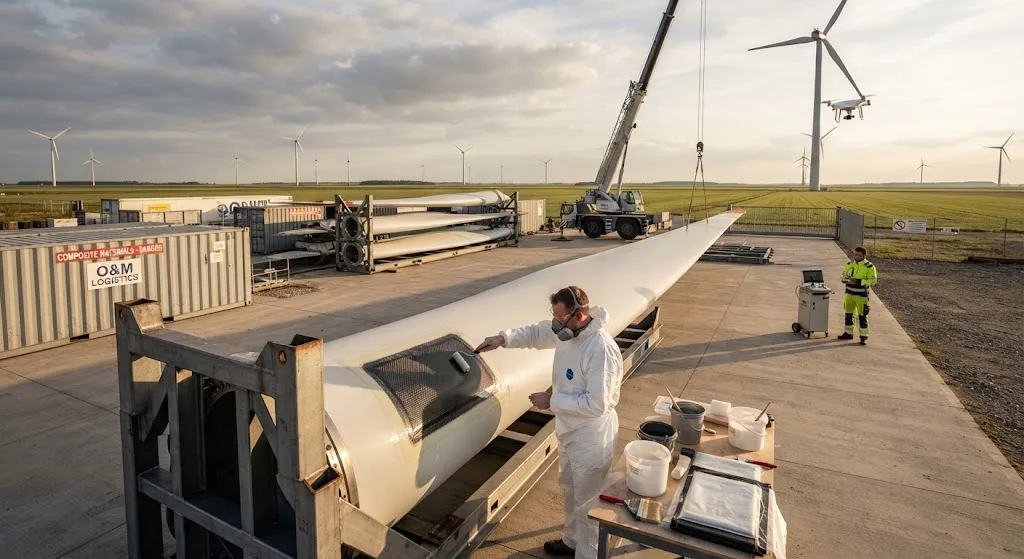
Wind turbine blade composite repair in Central Europe follows standardized procedures developed by the blade manufacturers and adapted by independent service providers. The repair process typically involves:
- Damage assessment: Drone-based visual inspection and thermographic scanning to map damage extent, followed by non-destructive testing (ultrasonic or tap testing) to determine delamination depth.
- Surface preparation: Removal of damaged material using grinding or machining, followed by surface cleaning and treatment with adhesion promoters.
- Repair layup: Application of repair plies using wet layup or prepreg patch techniques, typically employing glass fiber or carbon fiber fabric with epoxy or vinyl ester resin systems. Carbon fiber is used for spar cap repairs requiring high stiffness; glass fiber for aerodynamic surface repairs.
- Curing and finishing: Vacuum bag curing at ambient or elevated temperature, followed by surface finishing to restore aerodynamic profile. Leading-edge protection films or coatings are applied to prevent re-erosion.
The materials market for blade repair is dominated by epoxy-based systems, with a growing share of faster-curing vinyl ester and polyurethane formulations that reduce turbine downtime. Carbon fiber reinforcement for spar cap repairs represents approximately 15-20% of the blade repair materials market by value, with glass fiber comprising the remainder. The shift toward longer blades (60-80 meters) with carbon fiber spar caps is increasing the carbon fiber content of repair operations.
Market Opportunities for Composite Suppliers
The Central European wind O&M cluster creates several specific opportunities for composite material suppliers:
- Regional inventory positioning: Maintaining blade repair materials (resins, fabrics, core materials) in regional warehouses within the O&M clusters reduces lead times from weeks to days, a critical advantage when turbine downtime costs €1,500-3,000 per day per megawatt of capacity.
- Technical service partnerships: Providing on-site technical support for complex repairs — spar cap carbon fiber layup, structural adhesive bonding — differentiates material suppliers from commodity distributors and builds customer loyalty.
- Standardized repair kits: Pre-packaged repair kits combining resin, hardener, fabric, and consumables for common damage types (leading-edge erosion, lightning strike, trailing edge delamination) simplify procurement for O&M operators and reduce material waste.
- Life extension consulting: As turbines exceed original design life, composite-based structural strengthening systems — external CFRP wrapping of tower sections, blade root reinforcement — create a new market for materials and engineering services.
The total addressable market for composite materials in Central European wind O&M is projected to reach €90-120 million per year by 2030, with carbon fiber representing €15-25 million of that total. The cluster model — concentrating demand in specific geographic locations — makes regional inventory and technical service commercially viable in ways that a dispersed market would not.
Frequently Asked Questions
How long can wind turbine blades be repaired before replacement becomes necessary?
Most blade damage can be repaired multiple times over the turbine's life, with each repair extending service by 5-10 years. Industry practice limits blade repair to instances where the structural integrity of the spar cap is not compromised — if the primary load-carrying structure is damaged beyond a threshold (typically >30% cross-section loss), blade replacement is specified. A well-maintained blade can undergo 3-5 major repairs before reaching end of life, making composite repair far more cost-effective than replacement at €150,000-300,000 per blade. The key variable is whether damage is detected early through routine inspection — unrepaired erosion or cracks can propagate to the point where repair is no longer feasible.
What is the typical response time for emergency blade repair in Central Europe?
Response time varies by damage severity and location. For critical structural damage (large delamination, spar cap cracks), emergency response teams can be on-site within 48-72 hours from the nearest O&M cluster. Non-critical repairs (leading-edge erosion, minor surface damage) are typically scheduled within 2-4 weeks during low-wind periods to minimize energy production loss. The cluster model — with mobile teams and pre-positioned materials — has reduced average response times from 2-3 weeks (2018) to 5-7 days (2026) for standard repairs. Offshore installations in the North Sea have longer response times due to vessel availability constraints.
Are there environmental regulations affecting composite blade repair and disposal in the EU?
The EU Waste Framework Directive and national implementations in Germany (Verordnung über Anlagen zum Umgang mit Abfällen) and Poland require that composite waste from blade repairs be managed as industrial waste. Spent resins, grinding dust, and removed damaged material must be collected and disposed of through licensed hazardous waste handlers. The CIRCLE4WIN project and emerging pyrolysis infrastructure are creating pathways for recycling blade repair waste, but as of 2026, most composite waste from repair operations still goes to landfill. The EU End-of-Life Vehicle Directive revision, expected in 2027, may extend producer responsibility frameworks to wind energy, potentially requiring O&M operators to fund recycling infrastructure.
Conclusion
Central Europe's aging wind fleet is creating a structural shift in maintenance demand, with annual blade repair requirements of 3,700-4,400 units and a composite materials market growing at 8-12% per year. The regional O&M cluster model — concentrated in North Germany, the Polish Baltic, and Czech-Moravia — is the industry's response to this demand, creating efficient supply chains for composite repair materials and specialized technician networks. For composite suppliers, the opportunity lies in regional inventory positioning, technical service partnerships, and standardized repair kits that reduce response times and material waste in a market where turbine downtime directly translates to lost revenue.
For composite material suppliers evaluating entry into the Central European wind O&M market, the cluster model offers a focused approach to customer engagement and inventory deployment. Explore our carbon fiber and composite repair product range, including materials suited to wind turbine blade repair applications, or contact our engineering team to discuss regional supply strategies for the Central European wind service market.
Part of topic
Related Articles
- Recycled Carbon Fiber Market Forecast 2030: Technology Maturity and Commercialization Path
- South Korea Carbon Fiber Market 2026: Hydrogen Economy and Shipbuilding Innovation
- Wind Turbine Blade Leading Edge Protection 2026: Polyurethane, Tape, and Metallic Shield Solutions
- China Carbon Fiber Overcapacity 2026: Price War Impact and Industry Consolidation
- India Carbon Fiber Market 2026: Wind Energy, Aerospace, and Defense Expansion
- PAN Precursor Market 2026: Acrylonitrile Supply and Carbon Fiber Cost Structure
Interested in Custom Carbon Fiber Products?
Contact our team for competitive pricing and technical specifications.
Get a Quote