
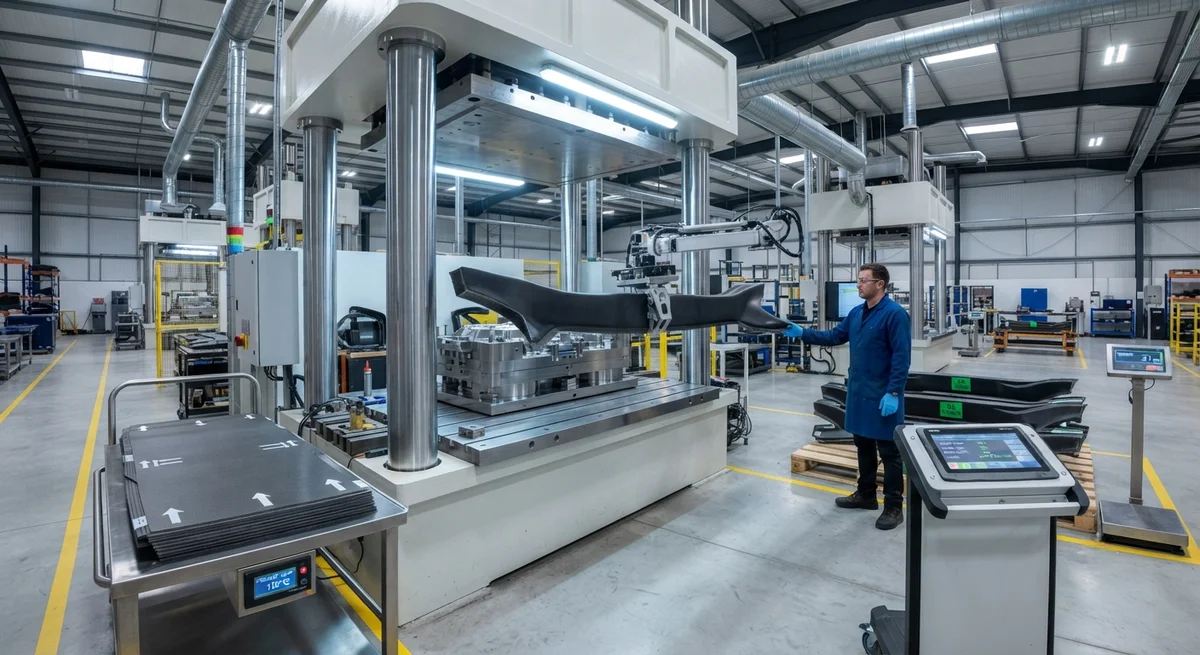
A data-driven framework for evaluating carbon fiber composite substitution of die-cast aluminum, zinc, and injection-molded plastic components across automotive, consumer electronics, and industrial equipment sectors, including cost-breakeven analysis, tooling comparison, cycle time trade-offs, and volume-based decision criteria.
Carbon Fiber Replacement for Die-Cast Metal and Injection-Molded Plastic: When Does It Make Economic Sense?
The question of substituting carbon fiber composites for traditional die-cast metal or injection-molded plastic components is one of the most frequently debated topics in manufacturing engineering. Carbon fiber offers undeniable advantages — weight reduction of 40–60% versus aluminum die-castings, 20–30% higher specific stiffness than magnesium, and a coefficient of thermal expansion near zero that eliminates dimensional stability concerns in precision assemblies. However, the raw material cost premium — carbon fiber prepreg priced at $35–75 per kilogram compared to $3–6 per kilogram for aluminum die-casting alloy or $2–5 per kilogram for glass-filled nylon — creates a substantial economic barrier that can only be justified under specific production volume, performance, and total cost of ownership conditions.
This article provides a structured framework for B2B engineering and procurement teams to evaluate whether carbon fiber replacement makes economic sense for their specific component geometries, production volumes, and performance requirements. We analyze three case studies across automotive, consumer electronics, and industrial equipment sectors, with data drawn from actual production conversions and supply chain cost models.
The Economic Framework: Volume, Tooling, and Cycle Time
The decision to replace a die-cast or injection-molded component with carbon fiber turns on three interdependent variables: production volume (annual quantity), tooling investment (one-time capital expenditure), and cycle time (direct labour and machine cost per part). The relationship is governed by the Total Part Cost equation:
Total Cost per Part = (Raw Material Cost + Direct Labour + Machine Cost + Finishing) + (Tooling Amortization / Annual Volume)
For die-casting, tooling costs are substantial — a single-cavity aluminum die-cast die for a medium-complexity component (e.g., an automotive transmission housing) costs $80,000–$250,000. This tooling lasts 150,000–500,000 shots before requiring refurbishment. Injection molding tooling for a comparable plastic component (e.g., glass-filled nylon) costs $40,000–$120,000 with tool life of 500,000–2,000,000 cycles. Carbon fiber composite tooling (compression mould or prepreg layup mould) is significantly less expensive at $8,000–$40,000 per mould set, with tool life limited to 5,000–20,000 parts for epoxy-based composite tooling or up to 100,000 parts for steel tooling used in compression moulding of sheet moulding compound (SMC) or carbon fiber SMC.
The cycle time comparison is equally important. High-pressure die casting achieves cycle times of 60–120 seconds for small-to-medium components and 3–8 minutes for large components. Injection moulding cycles range from 20–60 seconds for thin-wall parts to 2–5 minutes for thicker structural components. Carbon fiber layup processes — even when optimized with fast-cure prepregs and out-of-autoclave methods — require 15–60 minutes per part for compression moulding or 2–8 hours for prepreg vacuum bag curing. This cycle time penalty limits carbon fiber to applications where the weight and performance benefits justify slower throughput, or where low production volumes make the tooling cost advantage of composite processes the decisive factor.
| Parameter | Die-Cast Aluminum (A380) | Injection-Molded (PA66-GF30) | Carbon Fiber Prepreg (Epoxy) | Carbon Fiber SMC |
|---|---|---|---|---|
| Material Cost ($/kg) | $3–$6 | $2–$5 | $35–$75 | $12–$25 |
| Density (g/cm³) | 2.71 | 1.36 | 1.55 | 1.45 |
| Tensile Strength (MPa) | 310 | 180 | 780 | 180–250 |
| Tensile Modulus (GPa) | 71 | 9.5 | 68 | 30–40 |
| Tooling Cost ($, medium complexity) | $80K–$250K | $40K–$120K | $10K–$30K | $15K–$40K |
| Tool Life (cycles) | 150K–500K | 500K–2M | 5K–20K | 50K–100K |
| Cycle Time (min) | 1–8 | 0.3–5 | 15–480 | 3–15 |
| Weight Relative to Al (1 kg part) | 1.0 kg | 0.50 kg | 0.57 kg | 0.54 kg |
| Part Cost at 1K/yr (per part) | $85–$270 | $50–$140 | $50–$125 | $45–$95 |
| Part Cost at 10K/yr (per part) | $12–$35 | $7–$17 | $45–$110 | $25–$55 |
| Part Cost at 100K/yr (per part) | $6–$12 | $4–$8 | $40–$105 | $18–$40 |
Case Study 1: Automotive — Structural Cross-Car Beam
A tier-1 automotive supplier evaluated replacing a die-cast aluminum cross-car beam (instrument panel support structure) with a carbon fiber reinforced polypropylene (CF-PP) compression moulded alternative for a low-volume luxury EV platform (8,000 units per year). The aluminum die-cast beam weighed 3.8 kg, required a tooling investment of $180,000, and cost $14.50 per part at volume (including material, processing, and tooling amortization).
The CF-PP alternative — manufactured using chopped carbon fiber (25% weight fraction, 12 mm fiber length) in a polypropylene matrix, compression moulded in 8 minutes — weighed 2.1 kg (45% reduction). Tooling for the compression mould was $38,000. Per-part cost was $16.80 at the 8,000-unit annual volume — 16% more expensive than the aluminum baseline. However, the weight reduction enabled an additional 15 km of electric range on the WLTP cycle, and the CF-PP beam absorbed 35% more impact energy in a 50 km/h frontal offset crash simulation. The OEM accepted the cost premium of $2.30 per part based on the range extension benefit, valuing each kg saved at $8–$12 across the vehicle's lifecycle.
The breakeven analysis showed that if production volume were to increase to 25,000 units per year, the CF-PP part cost would fall to $12.20 — 16% below the aluminum baseline — making the economic case unambiguously favorable. At the actual 8,000-unit volume, the premium was deemed acceptable for the brand's flagship EV.
Case Study 2: Consumer Electronics — Laptop Enclosure Base
A major consumer electronics OEM examined replacing an injection-molded magnesium alloy (AZ91D) laptop base with a thin-ply carbon fiber composite alternative. The magnesium die-cast base, weighing 145 g, cost $3.80 at 500,000 units per year, using a four-cavity die costing $280,000 amortized over 12 months.
Carbon fiber composites face a structural challenge in thin-wall enclosure applications: achieving equivalent stiffness at the same thickness requires a modulus >65 GPa (matching magnesium's 45 GPa requires a 12% thickness increase due to the cubic relationship of stiffness to thickness in bending). The proposed solution used a 0.6 mm thick laminate of high-modulus carbon fiber prepreg (395 GPa fiber modulus) with a thin magnesium internal frame for boss and rib features.
The carbon fiber base weighed 68 g (53% reduction). Per-part cost was $11.20 — 3× the magnesium baseline — driven by the labor-intensive hand layup, 4-hour autoclave cycle, and trim/finish operations. However, two factors tilted the decision in favour of carbon fiber: the 77 g weight saving per unit contributed to a total device weight reduction of 120 g (including a lighter battery), enabling the marketing claim of "sub-1.0 kg professional laptop"; and the carbon fiber base provided 40% better RF transparency for the embedded 5G antennas compared to magnesium, eliminating the need for antenna window cutouts and plastic inserts. The OEM launched the product at a $150 retail premium, with the BOM cost increase absorbed at the product level rather than the component level.
Case Study 3: Industrial Equipment — Robot End-Effector Arm
An industrial automation manufacturer compared a die-cast aluminum robot end-effector arm (current design: 920 g, six-axis machining required after casting) with a carbon fiber prepreg composite version for a high-speed pick-and-place delta robot. The aluminum arm cost $47 at 2,500 units per year (including CNC machining of critical datums, surface finishing, and hard anodizing).
The carbon fiber version used unidirectional prepreg tape layup optimized with FEA for the specific bending and torsional loading of the delta robot motion profile. The composite arm weighed 390 g (58% reduction), with an FEA-validated stiffness 30% higher than the aluminum baseline in the critical Z-axis direction. Part cost was $62 at 2,500 units per year — a 32% premium. However, the reduced mass allowed a 0.4-second reduction in cycle time for a standard pick-and-place operation (800 mm move distance, 50 g payload), increasing the robot's throughput from 55 to 64 picks per minute — a 16% improvement.
At 2,500 units per year with an assumed machine hourly rate of $85 for the production cell, the cycle time improvement translated to $18,700 per year in increased productivity per robot. Over a fleet of 50 robots in the customer's factory, the annual productivity gain was $935,000 — dwarfing the per-component cost premium. The ROI period for the carbon fiber arm was calculated at 4.2 months, making the economic case for substitution overwhelming.
When Carbon Fiber Replacement Makes Economic Sense: Decision Criteria
Based on the case studies and cost modelling above, we can define a set of threshold conditions under which carbon fiber replacement of die-cast or injection-molded components is economically justified:
- Volume Threshold: Below 500 units per year, carbon fiber prepreg layup is typically lowest-cost due to minimal tooling investment. Between 500–10,000 units per year, carbon fiber SMC or compression moulding can be competitive with die-casting when tooling amortization is included. Above 50,000 units per year, traditional processes regain the cost advantage unless weight saving unlocks a system-level economic benefit (range extension, productivity, shipping savings).
- Weight Saving Multiplier: If the weight saved generates a system-level economic benefit valued at >$50/kg saved (aerospace fuel savings, EV range extension at $100–$200/kWh battery cost, high-speed robot productivity), carbon fiber can justify material cost premiums of 5–10× over metals.
- Performance Requirement: Components requiring a CTE below 5 ppm/°C for precision alignment, or specific stiffness above 25 GPa/(g/cm³) (aluminum = 26, steel = 26, carbon fiber UD = 44–70), are naturally suited to carbon fiber regardless of production volume.
- Part Consolidation: A single moulded carbon fiber component replacing a 5–8 piece welded or bolted metal assembly eliminates fasteners, reduces assembly labour, and often covers the material cost premium through simplified supply chain and reduced quality inspection.
- Thermal Management: Components in high-heat environments over 150°C favour metals, while carbon fiber with high-temperature epoxy (200°C+ continuous) can compete in the 150–200°C range if weight is critical.
Frequently Asked Questions for B2B Engineering Buyers
Q: What is the maximum annual volume at which carbon fiber SMC is cost-competitive with aluminum die-casting?
A: Based on current production data from multiple Tier-1 automotive suppliers, carbon fiber SMC (sheet moulding compound) is cost-competitive with aluminum die-casting at annual volumes of 5,000–30,000 units for automotive-class components. At volumes below 5,000, the tooling cost advantage of SMC ($15K–$40K vs. $80K–$250K for die-casting) dominates, yielding per-part savings of 10–35%. At volumes above 30,000, the longer SMC cycle time (3–15 minutes vs. 1–8 minutes for die-casting) and higher material cost begin to outweigh the tooling advantage. However, if the weight saving enables secondary economic benefits — such as EV range extension valued at $100–$150 per kWh of battery capacity — the breakeven volume can extend to 100,000 units per year or higher.
Q: How do carbon fiber tooling costs compare for low-volume (under 1,000 parts per year) production?
A: For low-volume production, carbon fiber composites offer a dramatic tooling cost advantage. A prepreg hand-layup composite mould for a 300 mm × 400 mm part costs $3,000–$8,000, compared to $40,000–$80,000 for a single-cavity aluminum die-cast die or $20,000–$50,000 for an injection mould. This tooling cost differential means that at 500 parts per year, the amortized tooling cost per part is $6–$16 for carbon fiber versus $80–$160 for die-casting — more than offsetting the higher raw material cost of carbon fiber. Additionally, composite moulds can be fabricated in 2–4 weeks versus 12–20 weeks for metal tooling, accelerating time-to-market for new product introductions and prototyping iterations.
Q: Can carbon fiber components replace injection-molded plastic in high-volume consumer electronics (1M+ units/year)?
A: At ultra-high volumes (>1M units/year), injection-molded plastic holds an overwhelming cost advantage due to sub-30-second cycle times, fully automated processes, and material costs of $2–$5/kg. Carbon fiber replacement at these volumes is only economically viable if: (a) the component's weight saving enables a dominant product differentiator (e.g., an entire device weight class reduction); (b) the carbon fiber provides a functional advantage that eliminates downstream costs (e.g., RF transparency eliminating antenna cutout tooling); or (c) the product is positioned in a premium segment where the BOM cost increase can be passed to the consumer. Emerging technologies — such as carbon fiber reinforced thermoplastics with injection moulding cycle times under 60 seconds — are narrowing this gap, with commercial applications appearing in high-end smartphone midframes and drone arms at volumes of 500K–2M units per year.
Q: What are the pitfalls of transitioning from metal die-casting to carbon fiber composite manufacturing?
A: Engineering teams familiar with isotropic metal design often underestimate the complexity of anisotropic composite design. Key pitfalls include: (1) stress concentrations at fastener locations — carbon fiber lacks the plastic deformation zone of metals, requiring over-designed or titanium-reinforced bolt holes; (2) moisture absorption — epoxy composites absorb 0.5–2.0% moisture by weight, affecting dimensional stability in precision assemblies unless the ply stack is balanced and symmetric; (3) electrical conductivity — carbon fiber is conductive (0.5–5 × 10⁻³ Ω·cm), unlike plastics, requiring electrical isolation from sensitive electronics; (4) repair complexity — damaged carbon fiber parts cannot be welded or re-melted like metals or thermoplastics, requiring bonded patch repairs or replacement; (5) supply chain maturity — carbon fiber prepregs have limited shelf life (typically 30 days at −18°C storage for standard-epoxy prepreg, with 10–21 days of out-life at 21°C), requiring cold chain logistics and just-in-time manufacturing discipline.
Related Articles
- Recycled Carbon Fiber Market Forecast 2030: Technology Maturity and Commercialization Path
- South Korea Carbon Fiber Market 2026: Hydrogen Economy and Shipbuilding Innovation
- Wind Turbine Blade Leading Edge Protection 2026: Polyurethane, Tape, and Metallic Shield Solutions
- China Carbon Fiber Overcapacity 2026: Price War Impact and Industry Consolidation
- India Carbon Fiber Market 2026: Wind Energy, Aerospace, and Defense Expansion
- PAN Precursor Market 2026: Acrylonitrile Supply and Carbon Fiber Cost Structure
Interested in Our Products?
Contact our team for competitive pricing and technical specifications.
Get a QuoteRelated Products
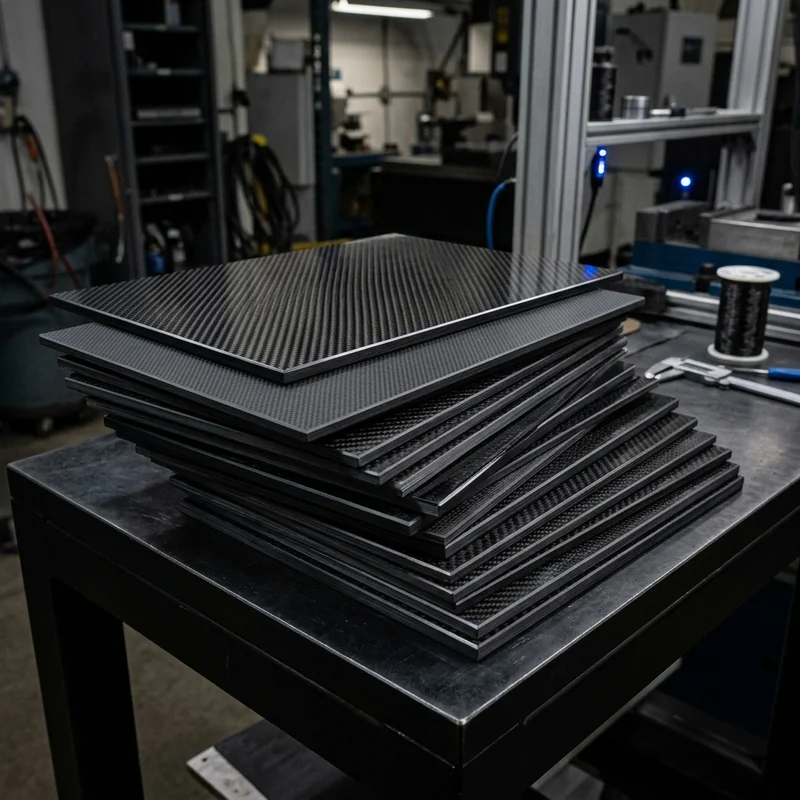
Carbon fiber standard plate-3k stripe
Lightweight, ultra-rigid standard sheets for drone fuselages, robot housings, facades and structural applications.

Carbon Fiber Plate — 3K Twill T700 1.5mm
Thin 1.5mm carbon fiber plate with 3K twill weave surface. Lightweight and stiff, commonly used for covers, panels, drone bodies, and applications requiring a premium aesthetic appearance.

Square Carbon Fiber Tube — 3K Twill T700
Square cross-section carbon fiber tube manufactured with 3K twill weave for torsional strength. Preferred for structural frames, trusses, and support columns where rectangular geometry offers design flexibility.

Carbon Fiber Plate — 3K Twill T700 3.0mm
Medium-thickness 3.0mm carbon fiber plate offering significantly higher load capacity while maintaining attractive 3K twill finish. Suitable for structural brackets, reinforcement plates, and load-bearing panels.
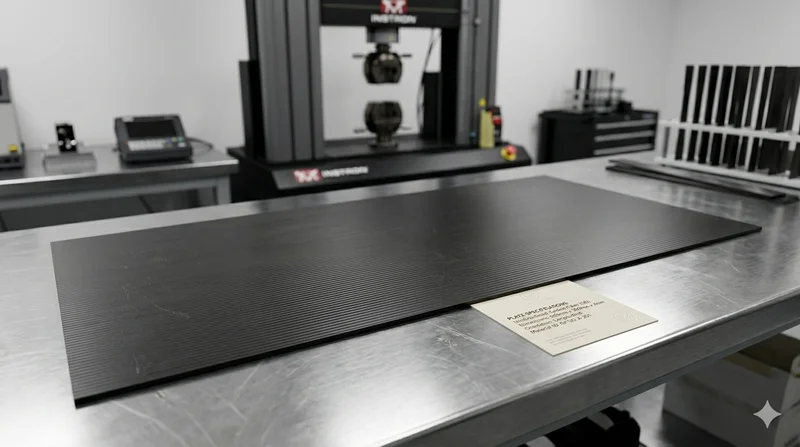
Carbon Fiber Plate — UD Unidirectional T700
Unidirectional carbon fiber plate with all fibers oriented in a single direction for maximum strength along the fiber axis. Essential for structural reinforcements, splints, and applications where load direction is predictable.