
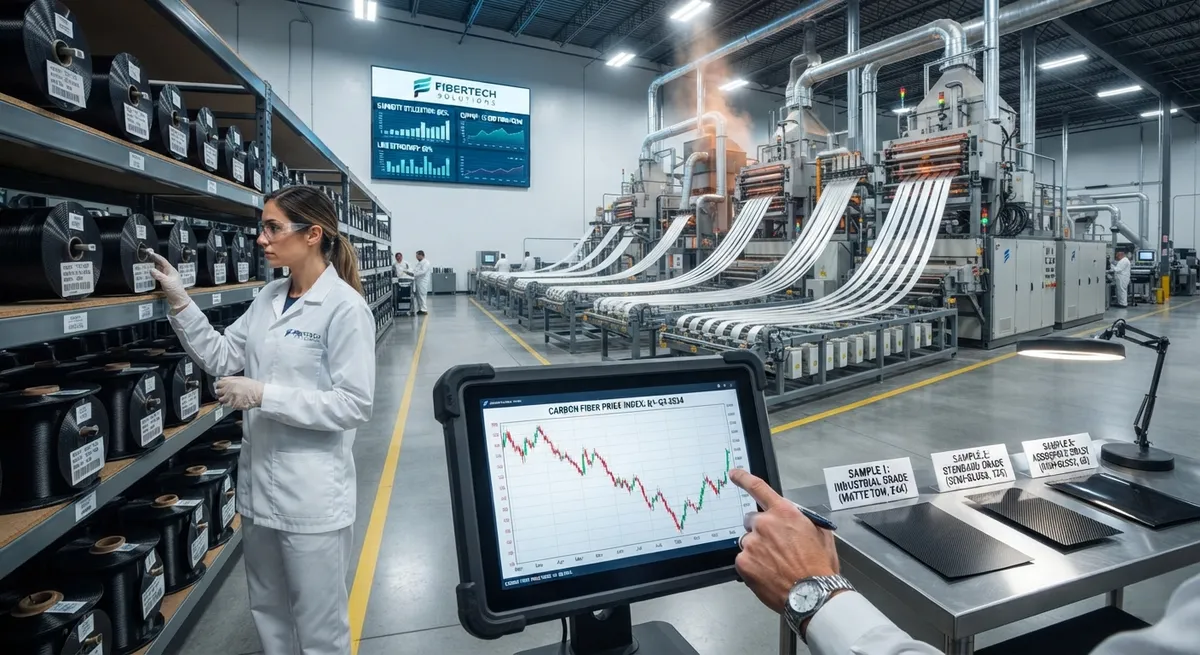
No material price moves tell a clearer story about supply and demand than carbon fiber's. In 2022, industrial T300-12K tow sold for about $33 per kilogram. By the end of 2024, the same fiber was trading near $12 per kilogram — a 60%+ collapse driven by the surge of new production capaci
Introduction
No material price moves tell a clearer story about supply and demand than carbon fiber's. In 2022, industrial T300-12K tow sold for about $33 per kilogram. By the end of 2024, the same fiber was trading near $12 per kilogram — a 60%+ collapse driven by the surge of new production capacity in China that far outpaced demand growth. Yet in the same period, aerospace-grade fiber has held near $80 per kilogram, and premium high-modulus grades remain far above that. The result is a market where a single product name covers price tiers separated by an order of magnitude.
2026 is adding a new chapter: the first coordinated price hike cycle in years, led in January by Toray and China's Jilin Chemical Fiber with increases of roughly 10-20% across select grades. For buyers, the questions are practical — where are prices now, which grades are tightening, and how should a sourcing strategy account for a market that is simultaneously oversupplied at the bottom and constrained at the top. This article organizes the 2026 price landscape by grade, quantifies the tiers, and translates the data into a sourcing framework.
The Price Tiers: How Grades Are Priced
Carbon fiber is not a commodity with one price; it is a ladder of grades priced by mechanical properties, process control, and qualification status. The table below shows indicative 2026 price ranges for the main commercial grades:
| Grade segment | Typical tow sizes | Indicative price (USD/kg) |
|---|---|---|
| Industrial / standard modulus (T300-class) | 12K, 24K, 48K | $12-16 |
| Standard modulus (T700-class) | 12K, 24K | $18-25 |
| Intermediate modulus / high strength (T800-class) | 12K | $35-50 |
| Aerospace-grade prepreg tow (T800/T1100-class) | 12K | $60-100 |
| High modulus (M40J/M55J-class) | 12K, 6K | $150-300+ |
The spread between tiers is not cosmetic. Aerospace grades carry qualification data packages, traceability, and consistent mechanical allowables that cost real money to produce and maintain. High-modulus grades add expensive graphitization processing. Industrial grades, by contrast, are produced at enormous scale with less testing, which is why they bear the brunt of capacity-driven price competition.
The 2022-2024 Crash: How T300 Fell from $33 to $12/kg
The collapse in industrial-grade prices has a simple arithmetic: capacity grew faster than demand. Between 2020 and 2024, global carbon fiber capacity roughly doubled as Chinese producers commissioned line after line, pushing annual nameplate capacity well past 100,000 tonnes. Demand growth — strong in wind energy, pressure vessels, and automotive — could not absorb the output, so utilization fell, and producers began competing on price for the first time in the industry's modern history.
The result is visible in the T300 tier. What sold at $33/kg in 2022 traded near $12/kg by late 2024, with some large-volume contract prices reported even lower. Several producers operated at a loss, and the crash forced consolidation: weaker players halted expansions, while vertically integrated producers with low-cost raw material positions kept capacity running. For buyers, the crash was a windfall on direct fiber cost, but it also carried risk — supply from marginal producers was the first to dry up when demand recovered.
The January 2026 Hike Cycle
January 2026 marked the first coordinated price increase in several years. Toray announced price adjustments of approximately 10% across selected carbon fiber product lines, citing higher energy and raw material costs and the need to restore profitability after the low-price period. China's Jilin Chemical Fiber followed with increases reported in the 10-20% range on specific standard-modulus products, and other Chinese producers signaled similar moves.
The hike cycle is significant for three reasons. First, it signals that the bottom of the price cycle is in: capacity growth has slowed, and demand for standard-modulus fiber in wind, pressure vessels, and sports equipment is absorbing available supply. Second, the increases are selective rather than across the board — industrial grades with genuine oversupply remain under pressure, while tightening grades carry the price action. Third, the coordinated timing suggests producers are testing whether the market will accept higher prices as demand strengthens, which means buyers can no longer assume year-over-year price declines in any tier.
Why Aerospace Grade Commands a Premium
The price index's most striking feature is the gap between volume share and revenue share. Aerospace applications account for roughly 13.4% of global carbon fiber demand by volume but about 44.1% of industry revenue. The arithmetic behind that gap is the premium itself: aerospace fiber sells at $60-100/kg against $12-16/kg for industrial grades, and the premium is justified by what buyers actually pay for:
- Qualification and traceability: Aerospace fiber ships with materials qualification, batch traceability, and statistically validated mechanical allowables that take years and millions of dollars to establish.
- Tight process control: Tensile strength and modulus distributions are controlled far tighter than industrial grades, requiring slower, more disciplined production lines.
- Specialized forms: Most aerospace consumption is in prepreg and specialized tow formats with tight handling and shelf-life requirements, adding conversion cost.
- Low volume flexibility: Aerospace demand is high-value but modest in tonnage, so producers cannot amortize costs over the same volumes as industrial fiber.
For buyers, the lesson is that "carbon fiber price" without a grade qualifier is meaningless — the same kilogram can cost $12 or $80 depending on the specification behind it.
What the 2026 Index Means for Buyers
Three implications follow from the current price structure:
- Grade selection drives cost more than negotiation: Specifying a T700-grade fiber where T300 meets the requirement multiplies material cost by roughly 1.5-2x before any supplier discussion. Engineering the grade down to the requirement is the highest-leverage cost move.
- Long-term agreements protect against the hike cycle: With producers testing 10-20% increases, fixed-price or price-capped supply agreements signed now lock in pre-hike levels for standard-modulus demand.
- Availability, not just price, is the constraint at the top: Aerospace and high-modulus grades are capacity-limited; lead times and allocation matter more than a few dollars per kilogram, so qualification and dual-sourcing decisions should be made early.
Frequently Asked Questions
Why is carbon fiber priced so differently across grades?
Each price tier reflects a different combination of production volume, process control, and qualification cost. Industrial T300-class fiber is made in very large runs with commercial testing and competes on scale, landing near $12-16/kg. Aerospace fiber is made in smaller, slower, more tightly controlled campaigns, carries qualification data packages and traceability, and sells at $60-100/kg. High-modulus grades add expensive graphitization and even tighter controls, reaching $150-300+/kg. The same raw material, polyacrylonitrile, becomes a different product depending on how precisely and how rigorously it is processed — and the market prices that rigor.
Will the January 2026 price hikes stick?
The hikes are most likely to stick where supply is genuinely tight — standard-modulus and intermediate-modulus grades where capacity growth has slowed and demand is growing. They are least likely to stick at the bottom of the industrial tier, where oversupply persists and large contract buyers can still source competitively from multiple producers. The coordinated timing is a signal that producers believe the demand-supply balance has turned; whether all announced increases are realized depends on capacity discipline holding through 2026. Buyers should treat announced hikes as negotiation floors for tight grades and as pressure points to challenge for oversupplied grades.
How should a manufacturer lock in carbon fiber costs for 2026?
The practical sequence is: first, engineer the grade down to the real requirement — many products can run on T300 or T700-class fiber rather than premium grades. Second, sign annual or multi-year agreements with price caps or fixed pricing for the grades you actually consume, protecting against the hike cycle. Third, qualify a second source, ideally a domestic producer for standard-modulus fiber, to create negotiating leverage and supply security. Fourth, separate the sourcing strategy by tier — industrial grades are a volume game where spot and contract prices stay close, while aerospace and high-modulus grades need early allocation, long lead times, and qualified dual sourcing.
Conclusion
The 2026 carbon fiber price index is a two-speed market. Industrial T300-class fiber sits near $12/kg after a brutal oversupply-driven crash, aerospace grade holds near $80/kg on qualification and control, and the January 2026 hike cycle led by Toray and Jilin Chemical Fiber signals that the low point of the cycle is behind the industry. The revenue split — 13.4% of volume generating 44.1% of revenue — is the clearest possible demonstration that grade specification, not tonnage, determines what carbon fiber actually costs. For buyers, the winning play is grade discipline, tiered sourcing, and locking supply terms before the hike cycle fully takes hold.
For a practical view of how fiber price translates into component cost, explore our carbon fiber products across industrial, standard-modulus, and aerospace-grade segments, or contact our team for sourcing guidance matched to your grade requirements and budget.
Part of topic
Related Articles
- Carbon Fibre Sheet Supplier UK: Sourcing Options and Specification Checklist
- Carbon Fiber Sheets Near Me Suppliers: Local Stock vs Factory Direct
- Filament Wound Epoxy Tubes: Industry Standards and Compliance Requirements
- Carbon Fiber Dealers Near Me: What a Good Dealer Actually Adds
- Carbon Fiber Supplies Near Me: Local Sourcing Without Compromising Spec
- Carbon Fiber for Sale: Online Platforms and Direct Sales Channel Comparison
Interested in Our Products?
Contact our team for competitive pricing and technical specifications.
Get a QuoteRelated Products

Carbon Fiber Fishing Rod Blank
High-quality carbon fiber fishing rod blank manufactured from multiple grades of Toray carbon fiber cloth. Available in a wide range of lengths, powers, and actions for freshwater and saltwater applications. Suitable for OEM rod building.

Carbon Fiber Plate — 3K Twill T700 1.5mm
Thin 1.5mm carbon fiber plate with 3K twill weave surface. Lightweight and stiff, commonly used for covers, panels, drone bodies, and applications requiring a premium aesthetic appearance.

Carbon Fiber Plate — 3K Twill T700 3.0mm
Medium-thickness 3.0mm carbon fiber plate offering significantly higher load capacity while maintaining attractive 3K twill finish. Suitable for structural brackets, reinforcement plates, and load-bearing panels.
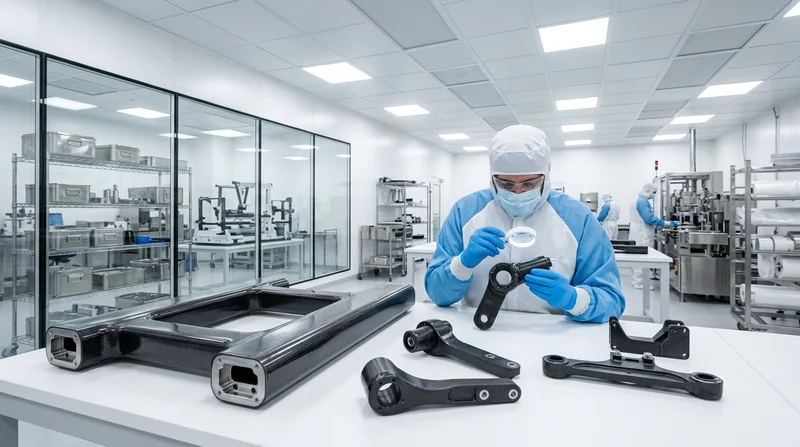
Custom Carbon Fiber Medical Device Components
Medical-grade carbon fiber components manufactured for imaging equipment, surgical instruments, and patient support systems. Carbon fiber's radiolucency (X-ray transparency) and high strength-to-weight ratio make it ideal for CT scanner beds, wheelchair frames, surgical robot arms, and MRI-compatible accessories. Biocompatible resin systems available.

Square Carbon Fiber Tube — 3K Twill T700
Square cross-section carbon fiber tube manufactured with 3K twill weave for torsional strength. Preferred for structural frames, trusses, and support columns where rectangular geometry offers design flexibility.