
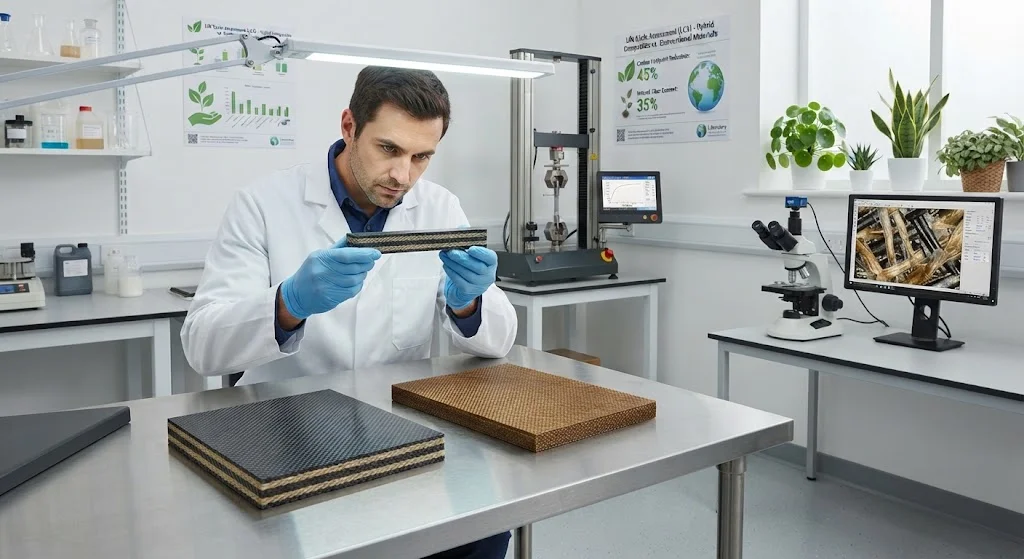
The global push toward sustainability is reshaping material selection across industries. In the composites sector, carbon fiber reinforced polymers (CFRPs) dominate high-performance applications due to their exceptional specific strength and stiffness, but they carry a significant environmental burd
Introduction
The global push toward sustainability is reshaping material selection across industries. In the composites sector, carbon fiber reinforced polymers (CFRPs) dominate high-performance applications due to their exceptional specific strength and stiffness, but they carry a significant environmental burden. Manufacturing one kilogram of standard PAN-based carbon fiber requires approximately 200-300 MJ of energy and produces 20-30 kg of CO₂ equivalent emissions. At end of life, thermoset CFRPs are difficult to recycle, and most end up in landfill or incineration.
Natural fiber reinforced composites — using fibers derived from plants such as flax, hemp, jute, and kenaf — offer dramatically lower environmental impact. Natural fiber production requires 10-20 times less energy per kilogram than carbon fiber and absorbs CO₂ during plant growth. However, natural fibers alone cannot match carbon fiber's mechanical performance, particularly in stiffness-critical applications. Hybrid composites that combine carbon fiber with natural fiber reinforcement in strategic layer configurations offer a pragmatic compromise: reducing environmental impact by 30-50% while retaining 60-80% of pure carbon fiber mechanical properties. This article examines the science, performance data, and practical applications of carbon fiber bio-composites.
Natural Fiber Properties and Selection
Each natural fiber type offers distinct mechanical and environmental characteristics that influence its suitability for hybrid composites:
| Natural Fiber | Tensile Strength (MPa) | Elastic Modulus (GPa) | Density (g/cm³) | CO₂ per kg Fiber (kg) | Water Absorption (%) |
|---|---|---|---|---|---|
| Flax | 345-1,500 | 27-80 | 1.50 | 0.7 | 7-12 |
| Hemp | 550-900 | 38-70 | 1.48 | 0.9 | 8-12 |
| Jute | 393-800 | 13-27 | 1.46 | 0.6 | 12-18 |
| Kenaf | 284-800 | 14-53 | 1.45 | 0.8 | 10-15 |
| Carbon fiber (T300) | 3,530 | 230 | 1.76 | 23.0 | ~0 |
| E-glass | 3,450 | 72 | 2.54 | 1.4 | 0.1-0.2 |
Flax fiber is the most widely studied natural fiber for composite reinforcement, with tensile strength approaching 1,500 MPa and modulus up to 80 GPa in carefully processed technical fibers. Hemp offers comparable strength with slightly higher stiffness. Jute and kenaf are lower-cost alternatives with adequate properties for semi-structural applications. The key challenge for all natural fibers is moisture sensitivity — water absorption of 7-18% can degrade the fiber-matrix interface and reduce mechanical properties by 10-30%. Surface treatments including alkaline, silane, and acetylation treatments reduce moisture sensitivity and improve interfacial adhesion.
Hybrid Composite Architecture and Design
The arrangement of carbon fiber and natural fiber layers in a hybrid composite determines its mechanical behavior. Three primary configurations are used:
- Interleaved (layer-by-layer): Alternating plies of carbon fiber and natural fiber create a laminate with graded properties. The carbon fiber plies provide stiffness and strength, while natural fiber plies provide damping, impact resistance, and reduced cost. This is the most common configuration for automotive interior panels.
- Intra-ply (mixed fiber): Carbon and natural fibers are mixed within the same ply, creating a homogeneous hybrid at the ply level. This approach provides more uniform properties but is harder to manufacture with conventional equipment.
- Fiber-matrix hybrid: Natural fiber mats serve as the core material in sandwich structures, with carbon fiber skins providing bending stiffness. This configuration maximizes weight reduction while using natural fibers where they perform best — in shear-dominated core applications.
Design guidelines for hybrid composites include placing carbon fiber plies at the outer surfaces where bending stresses are highest, positioning natural fiber plies in the neutral axis region, and ensuring adequate fiber-matrix adhesion through surface treatments. A typical automotive interior panel might use a [carbon/flax/carbon] layup with 40% carbon fiber volume fraction, achieving 60% of pure carbon fiber stiffness at 45% lower embodied energy.
Mechanical Performance of Hybrid Composites
Published research data demonstrates the property trade-offs achievable with carbon fiber-natural fiber hybrids:
| Property | Pure CF/Epoxy | CF/Flax Hybrid (50/50) | CF/Hemp Hybrid (50/50) | Pure Flax/Epoxy |
|---|---|---|---|---|
| Tensile Strength (MPa) | 1,200-1,500 | 450-650 | 400-600 | 80-120 |
| Elastic Modulus (GPa) | 135-150 | 55-75 | 50-70 | 10-15 |
| Flexural Strength (MPa) | 1,500-1,800 | 500-700 | 450-650 | 100-150 |
| Impact Energy (kJ/m²) | 15-25 | 35-55 | 30-50 | 25-40 |
| Damping Factor (tan δ) | 0.02-0.04 | 0.05-0.08 | 0.04-0.07 | 0.06-0.10 |
| Embodied Energy (MJ/kg) | 80-120 | 40-60 | 40-60 | 5-10 |
The data reveals a clear trade-off: CF/flax hybrids at 50/50 by weight achieve approximately 40-50% of pure carbon fiber strength and modulus, but with 40-50% lower embodied energy. The damping ratio of hybrid composites is 50-100% higher than pure carbon fiber, making them attractive for vibration-sensitive applications. For applications where pure carbon fiber performance is not required — interior panels, non-structural fairings, consumer product housings — hybrids offer a compelling sustainability advantage.
Manufacturing and Processing Considerations
Carbon fiber bio-composites can be manufactured using standard composite processing methods with several modifications:
- Moisture control: Natural fibers must be dried to less than 5% moisture content before processing. Pre-drying at 80-100°C for 2-4 hours is standard practice. Moisture in the fiber causes void formation during cure and degrades the fiber-matrix interface.
- Temperature limitations: Natural fibers degrade above 200°C, limiting processing temperature. Epoxy cure cycles must stay below 180°C, and thermoplastic matrices such as PLA (170°C melting point) or bio-based PA11 are preferred for natural fiber hybrid composites.
- Surface treatment: Alkaline treatment (2-5% NaOH solution for 1-3 hours) or silane coupling agent application improves fiber-matrix adhesion by 20-40%, partially compensating for the inherent smoothness of natural fiber surfaces.
- Compression molding: The most common process for hybrid composites, offering fast cycle times (2-5 minutes), good surface finish, and high fiber volume fractions (45-55%). Pre-formed fiber stacks are placed in a heated matched-die mold and compressed at 10-20 MPa.
Applications in Automotive and Consumer Products
Carbon fiber bio-composites are finding adoption in applications where sustainability credentials are valued alongside performance:
- Automotive interior panels: Door cards, headliners, and instrument panel structures using CF/flax hybrids reduce weight by 20-30% compared with glass fiber while meeting automotive OEM sustainability targets. Several European premium vehicle manufacturers have adopted hybrid composites for interior trim.
- Consumer electronics housings: Laptop cases, smartphone back covers, and wearable device housings using carbon fiber flax hybrids offer premium aesthetics with lower environmental impact. The visible natural fiber texture provides a distinctive design element.
- Sporting goods: Bicycle frames, ski cores, and surfboard stringers using CF/hemp or CF/flax hybrids achieve weight reduction over glass fiber with added vibration damping benefits. Several boutique bicycle manufacturers offer hybrid composite frames as a sustainable premium option.
- Furniture and architectural panels: Carbon fiber bio-composite panels for furniture and interior architecture combine structural performance with sustainable material storytelling for design-conscious markets.
Frequently Asked Questions
How much can carbon fiber bio-composites reduce environmental impact?
Carbon fiber bio-composites with 50% natural fiber content by weight reduce embodied energy by 40-50% and CO₂ emissions by 30-50% compared with pure carbon fiber laminates. The reduction depends on the natural fiber type — flax and hemp offer the best combination of mechanical properties and environmental credentials. At end of life, natural fiber components are partially biodegradable, and the reduced carbon fiber content simplifies recycling processes.
What are the main limitations of natural fibers in hybrid composites?
The three main limitations are moisture sensitivity (natural fibers absorb 7-18% water by weight, which can degrade the fiber-matrix interface), temperature resistance (natural fibers degrade above 200°C, limiting processing and service temperatures), and batch-to-batch variability in mechanical properties due to differences in plant growing conditions and processing. These limitations are managed through surface treatments, controlled processing, and design margins that account for property scatter.
Are carbon fiber bio-composites suitable for structural applications?
Carbon fiber bio-composites are suitable for semi-structural and secondary structural applications where pure carbon fiber performance is not required. For primary load-bearing structures, pure carbon fiber or carbon/glass hybrid composites remain preferred. However, as natural fiber processing improves and surface treatments advance, the performance gap is narrowing — recent research demonstrates CF/flax hybrids achieving 60-70% of pure carbon fiber specific stiffness, approaching the threshold for some primary structural applications.
Conclusion
Carbon fiber bio-composites represent a meaningful step toward sustainable high-performance materials. By combining carbon fiber with natural fibers such as flax or hemp in strategic hybrid architectures, manufacturers can reduce embodied energy and carbon emissions by 30-50% while retaining 60-80% of pure carbon fiber mechanical properties. The trade-off is acceptable for a wide range of semi-structural applications in automotive, consumer products, and sporting goods where sustainability requirements are driving material selection alongside traditional performance metrics.
For product designers and manufacturers seeking to balance performance with environmental responsibility, carbon fiber bio-composites offer a practical, scalable pathway. YongXian supplies carbon fiber fabrics and technical textiles suitable for hybrid composite layups. Explore our carbon fiber product range or contact our engineering team to discuss hybrid material systems for your sustainable composite program.
Part of topic
Related Articles
- RFID Tracking for Carbon Fiber Supply Chain: Traceability and Quality Assurance
- Infrared Heating for Carbon Fiber Cure: Energy Efficiency and Cycle Time Reduction
- Out-of-Autoclave Carbon Fiber Processing: OoA Certification and Aerospace Qualification
- Carbon Fiber Polymer Matrix Composite Fire Resistance: Intumescent Coatings and Fire-Barrier Solutions
- Carbon Fiber HP-RTM Cycle Time Optimization: High-Pressure Resin Transfer Molding for Automotive
- Continuous Fiber Reinforced Thermoplastics: CFRT vs Thermoset Processing and Applications
Interested in Our Products?
Contact our team for competitive pricing and technical specifications.
Get a QuoteRelated Products
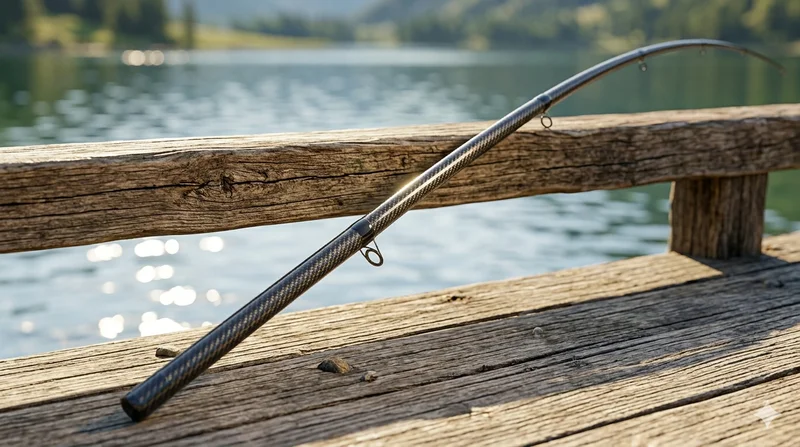
Carbon Fiber Fishing Rod Blank
High-quality carbon fiber fishing rod blank manufactured from multiple grades of Toray carbon fiber cloth. Available in a wide range of lengths, powers, and actions for freshwater and saltwater applications. Suitable for OEM rod building.

Carbon Fiber Plate — 3K Twill T700 1.5mm
Thin 1.5mm carbon fiber plate with 3K twill weave surface. Lightweight and stiff, commonly used for covers, panels, drone bodies, and applications requiring a premium aesthetic appearance.

Carbon Fiber Plate — 3K Twill T700 3.0mm
Medium-thickness 3.0mm carbon fiber plate offering significantly higher load capacity while maintaining attractive 3K twill finish. Suitable for structural brackets, reinforcement plates, and load-bearing panels.
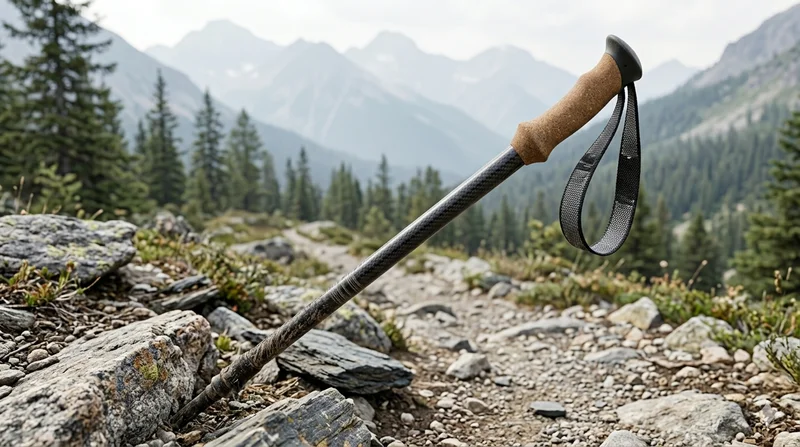
Carbon Fiber Trekking Pole
Lightweight carbon fiber trekking pole manufactured from high-grade carbon fiber tube. Weighs only 160g per pole while providing superior shock absorption and durability for hiking, trail running, and backpacking.

Square Carbon Fiber Tube — 3K Twill T700
Square cross-section carbon fiber tube manufactured with 3K twill weave for torsional strength. Preferred for structural frames, trusses, and support columns where rectangular geometry offers design flexibility.