
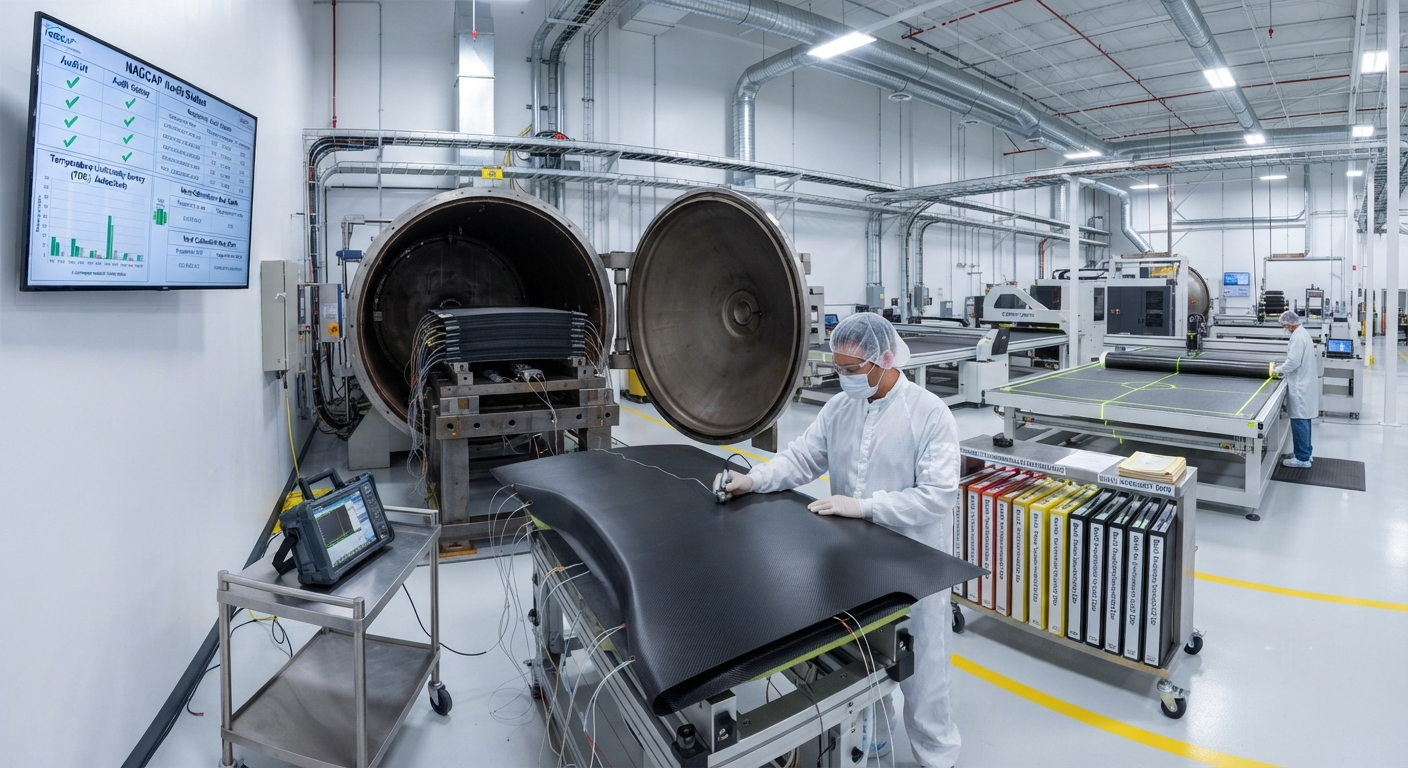
Comprehensive guide to carbon fiber aerospace supplier qualification covering NADPAC accreditation, AS9100 Rev D quality management systems, Boeing D1-4426, Airbus AP2108, and Safran QMS customer-specific audits. Includes cost analysis, common nonconformances, and a phased 12–24 month qualification timeline for B2B composite suppliers targeting the aerospace supply chain.
The Aerospace Supplier Qualification Landscape
Becoming a qualified supplier to the aerospace industry is one of the most demanding and rewarding milestones a carbon fiber manufacturer can achieve. Unlike commercial-grade composite supply chains, aerospace procurement is governed by a multi-layered framework of international standards, customer-specific requirements, and rigorous third-party audits. The three pillars of this framework — NADCAP (National Aerospace and Defense Contractors Accreditation Program), AS9100 (the aerospace-specific quality management system standard), and customer-specific audit programs — form an interlocking qualification system that every carbon fiber composite supplier must navigate.
Aerospace-grade carbon fiber production demands traceability from precursor polymer through carbonization to final composite fabrication. The qualification process typically spans 12–24 months from initial application to full production approval, with capital investment in quality infrastructure often exceeding $500,000 for a mid-size composite manufacturing facility. For B2B carbon fiber suppliers targeting the commercial aerospace, defense, or space markets, understanding this qualification architecture is not optional — it is the price of entry.
NADPAC Accreditation for Composite Suppliers
NADPAC is the cornerstone of aerospace supplier qualification for special processes. Administered by the Performance Review Institute (PRI), NADCAP establishes uniform accreditation requirements for processes including nondestructive testing, heat treatment, chemical processing, and — critically for carbon fiber suppliers — composite fabrication and materials testing.
For composite material suppliers, the relevant NADCAP checklists include AC7118 (Composite Fabrication) and AC7122 (Composite Testing). These checklists evaluate over 200 individual process requirements spanning:
- Raw material receiving and storage: Carbon fiber prepregs must be stored at controlled freezer temperatures (typically -18°C ± 5°C). Receiving inspection must verify certificate of analysis (COA) parameters including fiber areal weight (FAW), resin content, volatile content, and gel time. Non-conforming materials require quarantine with documented disposition within 30 days.
- Tooling and equipment control: Autoclave, oven, and press calibration must meet ASME or ASTM standards with thermocouple verification at a minimum of 9 points per platen. Temperature uniformity surveys (TUS) must be conducted annually or after any major repair. Vacuum integrity testing to 25 inHg minimum is required for all bagging processes.
- Process parameter documentation: Every layup, debulk, cure, and post-cure sequence must be documented with operator signature, timestamp, and parameter verification. C:Program FilesCure cycle data — temperature ramps, hold times, pressure application, and cool-down rates — must be recorded digitally with audit trail capability for a minimum of 10 years.
- Nondestructive testing capability: Suppliers must demonstrate ultrasonic C-scan capability with reference standards traceable to NIST or equivalent. Pulse-echo and through-transmission methods require calibration on material-matched reference blocks containing known defects (flat-bottom holes, inclusions, delaminations).
NADPAC audits are conducted every 12 months, with the first year requiring a full on-site audit of approximately 3–5 days. Renewal audits follow a 24-month cycle but annual surveillance audits remain mandatory. Nonconformances are categorized as critical, major, or minor; a single critical nonconformance (defined as a defect that would likely result in the failure of a flight-critical component) triggers immediate suspension of accreditation.
AS9100 Quality Management Systems
AS9100 Rev D (and its equivalent EN 9100 and JIS Q 9100) forms the quality management system foundation for aerospace suppliers worldwide. While NADCAP addresses specific processes, AS9100 addresses the overall quality system — risk management, design control, purchasing, production, and continuous improvement.
Key AS9100 requirements specifically relevant to carbon fiber composite suppliers include:
| AS9100 Clause | Requirement | Carbon Fiber Supplier Implementation | Typical Timeline |
|---|---|---|---|
| 7.1.4 — Risk Management | Identify and manage product and process risks | FMEA for each prepreg product family; PFMEA for layup, cure, and inspection processes; risk register with severity × frequency matrix | 3–6 months |
| 7.4.1 — Purchasing | Control of externally provided products | Approved supplier list (ASL) with performance scoring; incoming inspection of PAN precursor fiber by lot; COA verification against procurement specification | Ongoing |
| 8.1 — Operational Planning | Product realization planning | Production part approval process (PPAP) at Level 3 minimum; first article inspection (FAI) per AS9102 for each new tool or process change | 4–8 weeks per FAI |
| 8.3.3 — Design Inputs | Design and development inputs | Material specification review; acceptance criteria defined with customer engineering; testing to ASTM D3039 (tensile), D3410 (compression), D3518 (shear), D6484 (open-hole compression) | 2–4 weeks per specification |
| 9.1.1 — Monitoring and Measurement | Customer satisfaction and product conformity | Monthly quality dashboard with PPM defect rate, on-time delivery, and customer complaint response time targets (< 5 business days) | Ongoing |
| 10.1 — Nonconformity and Corrective Action | Nonconformity management and CAPA | 8D problem-solving methodology; root cause analysis with 5-why or fishbone; corrective action verification through process capability study (CpK ≥ 1.33) | 30–90 days per CAPA |
Third-party AS9100 certification is conducted by accredited registrars such as BSI, SGS, TÜV, or DNV. The certification process includes a pre-assessment (Stage 1) of documentation readiness — approximately 2 days — followed by a full certification audit (Stage 2) of 4–8 days depending on facility size. Recertification occurs every 36 months with annual surveillance audits in between.
According to PRI data from 2025, composite material suppliers with AS9100 certification report an average 40% reduction in customer audit duration, as OEMs increasingly rely on the AS9100 framework rather than duplicating the audit with their own checklists.
Customer-Specific Audit Programs
Beyond NADCAP and AS9100, each major aerospace OEM maintains proprietary supplier qualification programs with additional requirements that often exceed industry standards. The three most influential programs for carbon fiber suppliers are Boeing's D1-4426, Airbus's AP2108, and Safran's QMS requirements.
Boeing D1-4426 — Supplier Quality Requirements for Composite Structures — is perhaps the most detailed customer-specific specification in the industry. It mandates supplier capability in five areas: (1) prepreg handling and storage with real-time temperature monitoring and automated freezer alarm systems, (2) automated ply cutting with Gerber or similar machines certified to ±0.5 mm accuracy, (3) laser projection layup verification for ply boundary and orientation, (4) cure monitoring with dielectric sensors for resin cure state determination, and (5) ultrasonic inspection with automated scanning systems capable of 0.5 mm resolution defect detection. Boeing also requires suppliers to maintain a minimum 90% first-pass yield for all composite parts before customer acceptance.
Airbus AP2108 — Supplier Approval for Composite Components — emphasizes process stability and statistical process control (SPC). Airbus mandates CpK values of ≥ 1.33 for all critical parameters (cure temperature, dwell pressure, bag vacuum level) and requires suppliers to submit monthly SPC charts for review. For carbon fiber material suppliers specifically, Airbus requires lot-release testing per AITM (Airbus Industrial Test Methods) standards for interlaminar shear strength (AITM 1-0008), glass transition temperature (AITM 1-0003), and fiber volume fraction (AITM 1-0004).
Safran QMS — Safran's supplier quality system — applies to engine nacelle and thrust reverser composite structures and focuses heavily on flame, smoke, and toxicity (FST) testing. Suppliers must demonstrate compliance with FAR 25.853 (flammability) and provide test reports from ISO 17025-accredited laboratories. Safran also requires two-zone temperature control in autoclaves and ovens to ensure temperature uniformity within ±3°C across all part surfaces during cure.
Cost of Qualification and ROI Analysis
The financial commitment required for aerospace supplier qualification is substantial but the return on investment can be equally compelling:
- AS9100 certification costs: $15,000–$40,000 for certification audit plus $5,000–$10,000 annually for surveillance audits. Internal preparation costs including consultant fees, documentation development, and training typically add $30,000–$80,000.
- NADPAC accreditation costs: $8,000–$15,000 per audit cycle plus $3,000–$5,000 annual renewal fees. The cost of process demonstration samples and NDT reference standards can add $20,000–$50,000.
- Capital investment: Facilities upgrades including freezer storage ($15,000–$40,000), autoclave calibration systems ($10,000–$25,000), NDT equipment ($80,000–$250,000 for ultrasonic C-scan), and laboratory testing equipment ($50,000–$150,000 for universal test machine and environmental chamber).
- Revenue uplift: Qualified aerospace carbon fiber suppliers command price premiums of 30–80% over unqualified suppliers for equivalent materials. At an average annual revenue of $2–5 million per qualified aerospace account, the payback period for qualification investment is typically 6–18 months.
Common Nonconformances and How to Avoid Them
Data from PRI audit reports (2023–2025) reveals the most frequent NADCAP nonconformances for composite material suppliers:
- Incomplete or missing material traceability (22% of audits) — Solution: implement barcode-based material tracking from receiving through kitting to layup, with automated lot traceability reports.
- Inadequate temperature uniformity survey documentation (18%) — Solution: conduct TUS quarterly rather than annually, with 15+ thermocouple points and automated report generation.
- Expired or uncalibrated NDT reference standards (15%) — Solution: establish a calibration management system with 90-day advanced notification and backup standards for critical reference blocks.
- Incomplete operator training records (14%) — Solution: implement a learning management system (LMS) with automated certification expiry tracking and mandatory refresher training at 12-month intervals.
- Nonconforming material disposition delays (11%) — Solution: require documented disposition within 14 calendar days for all nonconforming materials; escalate to customer engineering after 21 days.
Frequently Asked Questions
What is the difference between NADPAC and AS9100? Do I need both?
NADPAC and AS9100 serve complementary but distinct purposes. AS9100 is a quality management system (QMS) standard that applies to the organization's overall processes — purchasing, design, production planning, risk management, and continuous improvement. It is audited by accredited third-party registrars (BSI, SGS, TÜV, DNV). NADPAC, on the other hand, is a specific process accreditation program for special processes (composite fabrication, composite testing, NDT, etc.). NADPAC audits are conducted by PRI auditors who are subject matter experts in those specific processes. Most aerospace prime contractors require both: AS9100 as the foundation QMS and NADPAC as the specific process accreditation. Operating without one or both will disqualify your organization from bidding on virtually all aerospace composite contracts. We strongly recommend pursuing AS9100 certification first (6–9 months typical timeline) followed by NADPAC (additional 3–6 months) to stagger the resource demand and allow the QMS to mature before the more technically demanding process audit.
How long does it take to become a qualified aerospace carbon fiber supplier?
The full qualification timeline from project initiation to first production delivery typically spans 12–24 months. A realistic phased schedule is: Months 1–3 — Gap analysis against AS9100 and NADPAC requirements, documentation system setup, and quality manual development. Months 4–7 — AS9100 internal audit, management review, and Stage 1 (documentation) certification audit. Months 7–9 — AS9100 Stage 2 certification, parallel NADPAC application submission, and process demonstration sample fabrication. Months 10–14 — NADPAC on-site audit, nonconformance closure, and accreditation award. Months 15–18 — Customer-specific qualification (OEM audit per Boeing D1-4426 or Airbus AP2108). Months 18–24 — Production part approval process (PPAP), first article inspection, and initial production run. Suppliers that have already invested in ISO 9001:2026 certification can typically shorten this timeline by 3–5 months.
What are the minimum annual sales required to justify aerospace qualification costs?
Based on industry benchmark data from the Composites Manufacturing Association, the minimum viable annual revenue from aerospace composite sales to recoup qualification costs within 24 months is approximately $500,000–$750,000. This figure assumes $100,000–$150,000 in total qualification costs (AS9100 + NADPAC + capital improvements) and a 15–18 month payback target. However, this threshold decreases significantly when qualification opens doors to multiple OEMs — a single NADPAC-accredited composite supplier can serve Boeing, Airbus, Spirit, Safran, and their tier-1 subcontractors simultaneously. Facilities with existing NADPAC or AS9100 coverage for other processes (metallics, coatings) face lower incremental costs. A more compelling business case emerges at $1.5–2.0 million in projected annual aerospace revenue, where qualification costs represent less than 10% of first-year project value and gross margins of 40–55% (versus 15–25% for non-aerospace composites) accelerate payback to under 12 months.
Part of topic
Related Articles
- Recycled Carbon Fiber Market Forecast 2030: Technology Maturity and Commercialization Path
- South Korea Carbon Fiber Market 2026: Hydrogen Economy and Shipbuilding Innovation
- Wind Turbine Blade Leading Edge Protection 2026: Polyurethane, Tape, and Metallic Shield Solutions
- China Carbon Fiber Overcapacity 2026: Price War Impact and Industry Consolidation
- India Carbon Fiber Market 2026: Wind Energy, Aerospace, and Defense Expansion
- PAN Precursor Market 2026: Acrylonitrile Supply and Carbon Fiber Cost Structure