
Carbon fibre parts for cars have moved from Formula 1 exclusivity into mainstream performance, restoration, and even daily-driver upgrades. The appeal is simple: carbon fibre reinforced polymer (CFRP) offers roughly five times the specific strength of steel at one fifth of the weight, which means a
Introduction
Carbon fibre parts for cars have moved from Formula 1 exclusivity into mainstream performance, restoration, and even daily-driver upgrades. The appeal is simple: carbon fibre reinforced polymer (CFRP) offers roughly five times the specific strength of steel at one fifth of the weight, which means a bonnet, roof, or driveshaft can shed 50-70% of its mass without losing stiffness. Every kilogram saved matters — lighter cars accelerate harder, stop shorter, corner with less body roll, and consume less fuel or battery energy.
This guide explains what carbon fibre parts for cars actually deliver, how they are manufactured, which components give the best return, and what buyers should check when sourcing parts from suppliers, whether for a road car, a track car, or a low-volume production programme.
Why Carbon Fibre Parts for Cars Matter
Weight reduction is the clearest benefit, but where the weight sits matters as much as how much is removed. Reducing unsprung and rotating mass — wheels, suspension arms, brake components, driveshafts — improves suspension response and reduces inertia that the engine must overcome. Reducing sprung mass above the wheel centre lowers the centre of gravity and improves weight distribution. Typical savings for common components are shown below:
| Component | Steel | Aluminium | Carbon Fibre | Saving vs Steel |
|---|---|---|---|---|
| Bonnet (hood) | 25 kg | 14 kg | 8 kg | ~68% |
| Boot lid | 18 kg | 10 kg | 6 kg | ~67% |
| Doors (pair) | 60 kg | 36 kg | 22 kg | ~63% |
| Roof panel | 15 kg | 9 kg | 5 kg | ~67% |
| Driveshaft | 11 kg | 6 kg | 3 kg | ~73% |
Beyond weight, carbon fibre offers directional stiffness tuning that metals cannot match. Fibres can be oriented to be stiff exactly where loads are highest, which is why carbon fibre parts for cars often feel sharper and more responsive than the heavier parts they replace.
To put the numbers in context, a typical mid-size saloon weighing 1,500 kg carries roughly 300-400 kg of body structure and closures. Replacing the major upper-body panels with carbon fibre removes 60-100 kg, a 4-7% mass reduction that improves fuel economy by roughly 2-4% and, on an electric vehicle, extends range by a similar margin. The same reduction also improves the power-to-weight ratio: a 300 hp car that loses 100 kg performs as if its engine had gained roughly 20 hp, which is why lightweighting is treated as a performance investment rather than a weight-saving exercise.
How Carbon Fibre Parts for Cars Are Manufactured
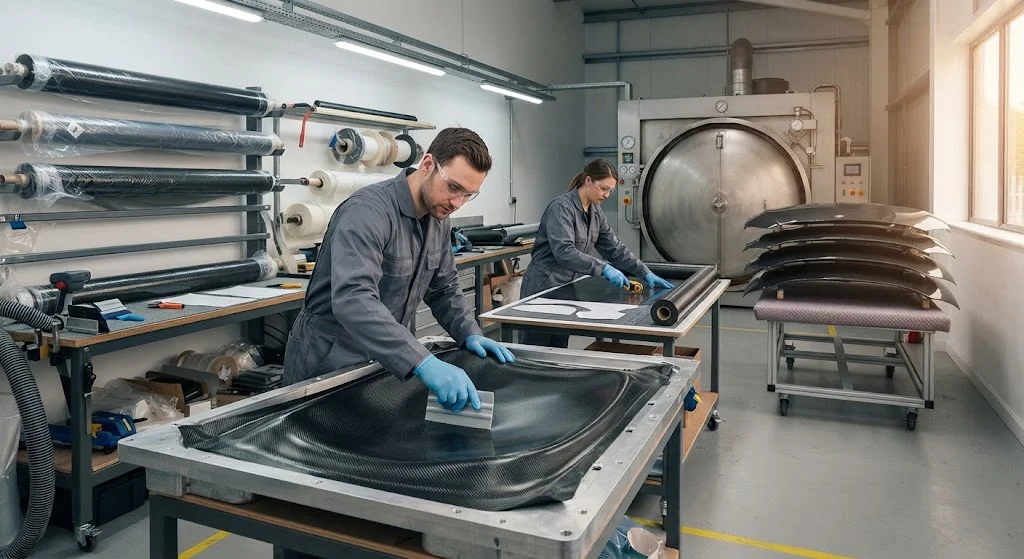
The manufacturing process determines the mechanical properties, surface quality, and cost of the finished part. The four processes that dominate the automotive sector are:
- Prepreg autoclave: Pre-impregnated carbon fibre sheets are laid into a mould and cured under heat and pressure in an autoclave. Highest quality, best fibre volume fraction, used for structural and visible parts, but slow and expensive.
- High-pressure resin transfer moulding (HP-RTM): Dry preforms are injected with resin under high pressure in a heated steel mould. Cycle times of 3-10 minutes make it the process of choice for OEM and high-volume aftermarket parts.
- Compression moulding with sheet moulding compound (SMC): Chopped or continuous fibre sheet is pressed into shape. Lower mechanical properties but very fast cycles and the lowest cost for mass production.
- Wet layup / vacuum bagging: Hand-laminated fabric cured under vacuum. Cheap for prototypes and one-off parts, but properties depend heavily on operator skill.
For visible parts, surface finish is controlled by the mould surface and a final clear coat, while structural parts rely on fibre volume fraction of 55-65% achieved by prepreg or HP-RTM processes.
Which Carbon Fibre Parts Give the Best Return
Not all parts are worth converting to carbon fibre. The best candidates are large, heavy panels high on the car and rotating components. The table below summarises typical process choice and cost position for the most common upgrades:
| Component | Typical Process | Weight Saving | Relative Cost |
|---|---|---|---|
| Bonnet | Prepreg autoclave or HP-RTM | 50-70% | Medium |
| Spoiler / splitter | Prepreg autoclave | 50-65% | Low-medium |
| Roof panel | Prepreg autoclave | 60-70% | High |
| Driveshaft | Filament winding | 60-75% | High |
| Seat shells | Prepreg or SMC | 40-60% | Medium |
| Brake ducts / air intakes | Wet layup or SMC | 40-55% | Low |
Aerodynamic parts deserve special mention. Spoilers, diffusers, splitters, and canards made from carbon fibre are lighter than their plastic or metal equivalents and can be manufactured with the exact stiffness and flex required at speed, which is why motorsport teams specify carbon fibre aero components almost exclusively.
Crash Safety and Long-Term Durability
Carbon fibre absorbs energy differently from steel. Rather than crumpling, well-designed CFRP structures fail progressively by fibre fracture and delamination, absorbing significant energy per kilogram. This is why carbon fibre parts for cars are standard in Formula 1 survival cells, which pass impact tests far beyond road-car requirements. However, carbon fibre is brittle: a visible crack can indicate internal damage, so structural parts should be inspected after impacts, typically with ultrasonic or tap testing.
Durability is generally excellent — CFRP does not corrode and resists UV when properly coated — but surface damage, edge chipping, and prolonged exposure to untreated UV can degrade the resin. Buyers should specify a UV-stable clear coat and edge sealing for exterior parts. For safety-critical applications, parts should be manufactured under a quality system such as ISO 9001 with process documentation and, where required, third-party validation.
Cost and Suppliers: Buying Carbon Fibre Parts for Cars
Carbon fibre parts for cars cost more than their metal counterparts because the raw material is expensive and the processes are slow. A bonnet that costs 200 dollars in steel may cost 1,500-3,000 dollars in carbon fibre. The economics improve with volume: tooling and mould costs, which are significant for HP-RTM, amortise across units. Lead times from suppliers typically run 4-12 weeks for custom parts, longer for new tooling.
When evaluating carbon fibre parts suppliers, check their process capability (prepreg autoclave versus wet layup), their quality certifications, whether they offer CAD-to-part development, and their experience with automotive applications. Buyers in the USA and Europe should also confirm local distribution or shipping arrangements, because large panels are costly to freight. A reputable supplier will provide material data sheets, fibre type (typically T300 or T700 grade), and evidence of QC testing for every batch.
Frequently Asked Questions
Is carbon fibre worth it for a street car?
For a street car, carbon fibre parts make sense when weight reduction is a real goal rather than a cosmetic one. A bonnet, boot lid, and roof can remove 40-60 kg from the upper half of the car, improving acceleration, braking, and fuel economy, and lowering the centre of gravity. If the car is daily driven, choose parts with UV-stable coatings and consider that they are more fragile in parking-lot bumps than steel panels. Cosmetic-only carbon (stickers or wrapped plastic) provides no performance benefit.
How much weight can I actually save?
Typical savings are 50-70% of the original component weight: a 25 kg steel bonnet becomes an 8 kg carbon fibre bonnet, a 11 kg steel driveshaft becomes a 3 kg carbon unit, and a pair of 60 kg steel doors becomes about 22 kg in carbon. For a full exterior carbon conversion on a typical saloon, expect a total reduction of 80-150 kg, which is roughly equivalent to removing one adult passenger from the car.
Can damaged carbon fibre parts be repaired?
Yes, in many cases. Cosmetic damage such as cracked clear coat can be sanded, re-coated, and polished. Structural damage can be repaired by scarfing out the damaged area and bonding in new prepreg patches, a process used routinely by motorsport teams. The key rule is that repairs should be performed by a shop experienced with CFRP, using documented procedures, because an invisible internal delamination that is not repaired will grow under load. Small chips and edge damage should be sealed promptly to prevent moisture ingress.
Conclusion
Carbon fibre parts for cars deliver the largest weight savings available per kilogram spent, with the best returns coming from large upper-body panels and rotating components. The technology has matured: prepreg autoclave and HP-RTM processes produce consistent, safe, high-performance parts, and the supply chain now serves everyone from OEMs to individual owners.
When you are ready to specify parts for your project, browse our carbon fibre automotive components or contact our technical team for material specifications, process recommendations, and a quotation for your application.
Related Articles
Interested in Our Products?
Contact our team for competitive pricing and technical specifications.
Get a QuoteRelated Products
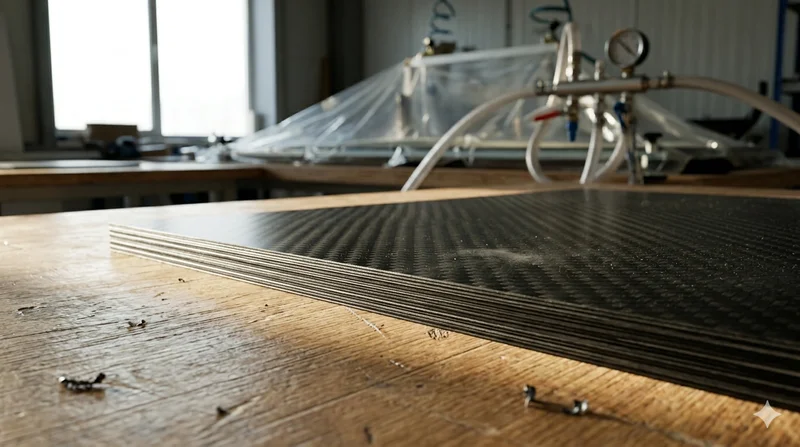
Carbon Fiber Plate — 3K Twill T700 3.0mm
Medium-thickness 3.0mm carbon fiber plate offering significantly higher load capacity while maintaining attractive 3K twill finish. Suitable for structural brackets, reinforcement plates, and load-bearing panels.

Carbon Fiber Plate — 3K Twill T700 1.5mm
Thin 1.5mm carbon fiber plate with 3K twill weave surface. Lightweight and stiff, commonly used for covers, panels, drone bodies, and applications requiring a premium aesthetic appearance.

Square Carbon Fiber Tube — 3K Twill T700
Square cross-section carbon fiber tube manufactured with 3K twill weave for torsional strength. Preferred for structural frames, trusses, and support columns where rectangular geometry offers design flexibility.
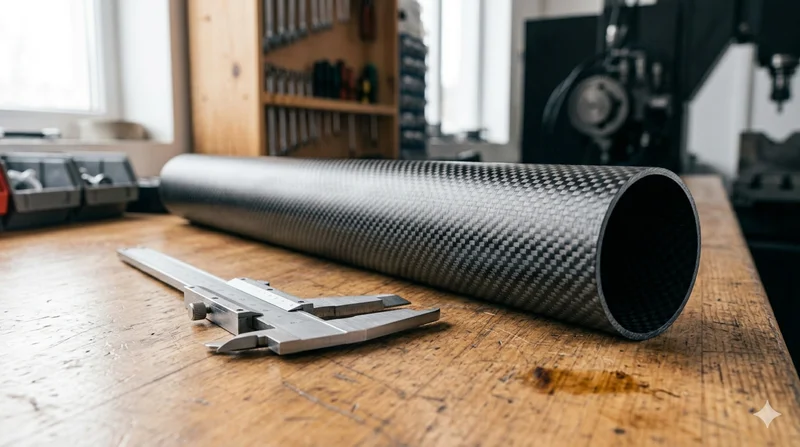
Round Carbon Fiber Tube — 3K Plain Weave T700
Standard round carbon fiber tube manufactured from Toray T700 grade fiber with 3K plain weave. Offers balanced strength and stiffness for general industrial applications including robotics, automation, sports equipment, and aerospace structures.
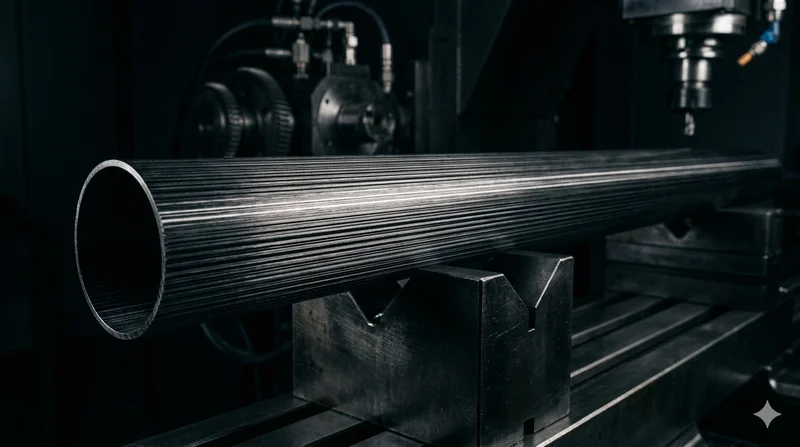
Round Carbon Fiber Tube — UD Unidirectional T700
Unidirectional (UD) round tube with all fibers aligned axially for maximum longitudinal stiffness. Ideal for applications requiring high bending rigidity with minimal weight, such as shafts, struts, and structural reinforcements.