
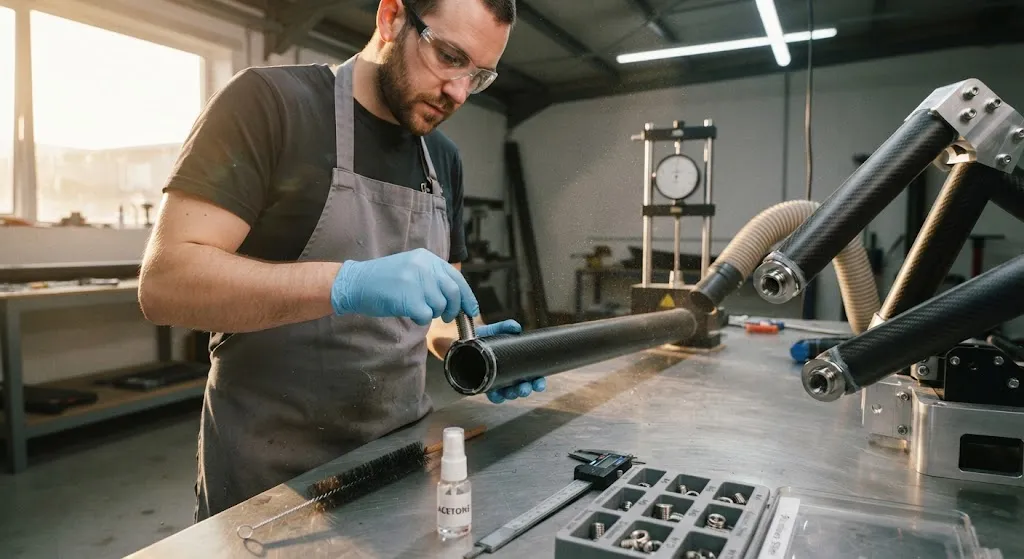
A carbon fiber tube threaded insert is a machined metal fitting bonded, crimped, or expanded into the end of a carbon fiber tube to provide an internal machine thread. A pultruded or roll-wrapped tube is a thin hollow shell that cannot be tapped like a solid metal bar, so the threaded insert is the
Introduction
A carbon fiber tube threaded insert is a machined metal fitting bonded, crimped, or expanded into the end of a carbon fiber tube to provide an internal machine thread. A pultruded or roll-wrapped tube is a thin hollow shell that cannot be tapped like a solid metal bar, so the threaded insert is the component that turns the tube end into a real connection point. Hinges, brackets, ball joints, and second tubes can then be bolted directly to the carbon tube without a clamp that would crush the composite wall. Every folding tripod, drone arm, robot gantry, camera boom, and modular display frame relies on a carbon fiber tube threaded insert to carry load from the fastener into the tube. The difference between a frame that stays rigid for years and one that develops a loose, rattling joint after a few assembly cycles usually comes down to insert selection and installation quality.
This guide explains what threaded inserts do, the types available, thread standards and engagement, torque and pull-out limits, installation steps, failure modes, and the specifications to define when sourcing.
What a Carbon Fiber Tube Threaded Insert Does
A threaded insert performs four jobs at once, and every design decision should be judged against them:
- Creates a machine thread: The insert gives the tube a standard M-series or UN thread, so an off-the-shelf bolt, stud, or eyelet can be fastened directly to the tube end.
- Protects the composite wall: Carbon fiber resists tension well but crushes easily under a bolt head or clamp. The insert spreads that local load over a bonded area instead of a single point.
- Distributes load into the tube: A bonded or potted insert transfers axial and bending load gradually along its length rather than concentrating it at the tube mouth.
- Enables assembly and service: A thread lets components be assembled, adjusted, replaced, and packed flat without cutting or re-gluing the tube.
Because the tube itself is often stronger than the joint, the insert and its bond are normally the limiting factor in the assembly. Designing for the insert, not only the tube, is what separates a structure that meets its load case from one that fails at the end fitting.
Threaded Insert Types and Thread Standards
Threaded inserts fall into four practical families, each with a different load capacity, installation method, and cost:
- Bonded threaded plug: A machined aluminium or stainless-steel plug with an internal thread is glued into the tube end with structural epoxy. This gives the highest pull-out strength and the widest thread range, but it is permanent.
- Rivnut-style threaded sleeve: A tubular threaded sleeve is set into a prepared bore and crimped or bonded in place, giving a low-profile thread with a smaller footprint than a full plug.
- Expanding threaded insert: A split sleeve or wedge expands against the tube wall when a bolt is tightened, gripping by friction alone. It needs no adhesive and is removable, but it can ovalise thin tubes and carries less load.
- Potted end fitting: A metal eye or clevis is potted into the tube end with a filled resin, often used where a through-bolt or pin is preferred over a tapped thread.
The table below summarises typical performance on a 25 mm outside diameter carbon fiber tube with a 1.5 mm wall:
| Insert Type | Typical Pull-Out Load | Thread Range | Removable | Best For |
|---|---|---|---|---|
| Bonded threaded plug | 8-15 kN | M4 to M12 | No | Structural frames, tripod legs, robot arms |
| Rivnut-style sleeve | 3-6 kN | M4 to M6 | No | Low-profile panel and bracket fixing |
| Expanding insert | 2-5 kN | M5 to M8 | Yes | Adjustable fixtures, field repairs |
| Potted end fitting | 6-12 kN | Pin or bolt 5-8 mm | No | Hinges, clevis joints, struts |
The figures assume a correctly prepared bond. Inserts bonded to an abraded, solvent-wiped surface with two-part epoxy routinely reach the top of their range, while the same insert on a mould-release-contaminated bore can lose more than half its capacity.
Installing a Carbon Fiber Tube Threaded Insert
Installation quality, not insert cost, controls joint strength. The steps below apply to bonded inserts, the most common structural choice:
- Cut and square the tube: Cut with a fine-tooth blade or abrasive wheel, then square and deburr the end so the insert seats fully without a diagonal gap.
- Prepare the bore: Abrade the inner wall with a flapper or bottle brush and wipe it with solvent to remove mould release and dust. This step alone can double bond strength.
- Control the adhesive gap: Aim for 0.05-0.20 mm between insert and tube wall. A loose fit relies on a thick adhesive layer that fails in peel; a tight fit starves the joint of adhesive.
- Apply structural adhesive: Use a two-part epoxy rated 20-35 MPa shear strength and apply it to both surfaces with a small rotation to spread it evenly.
- Cure before loading: Hold the assembly straight and undisturbed for the full cure time, typically 24-48 hours at room temperature, or follow the adhesive heat-cure schedule for faster turnaround.
- Check the thread: Run a tap or a known bolt through the insert to confirm no adhesive has entered the thread before it fully cures.
For expanding and rivnut-style inserts the critical controls are bore tolerance and wall thickness. A split insert on a tube with a wall below 1.2 mm concentrates stress at the expansion zone and is a common cause of ovalisation, so a bonded plug with a metal liner is the safer choice on thin walls.
Thread Engagement, Torque, and Pull-Out Data
Pull-out strength is governed by three variables: bonded area, adhesive quality, and how well the insert matches the tube bore. Bond area scales with insert length and tube circumference, and an embedded length of four to six times the tube diameter is enough for most structural joints; longer inserts add little because the adhesive shear is already spread over a large area.
| Parameter | Typical Value | Design Note |
|---|---|---|
| Thread engagement | 1.5 x bolt diameter | Prevents thread stripping in soft alloys |
| Recommended embedment | 4-6 x tube diameter | Longer adds little strength |
| Adhesive shear strength | 20-35 MPa | Two-part structural epoxy |
| Adhesive gap | 0.05-0.20 mm | Thin, uniform layer is strongest |
| Recommended tightening torque | 2-8 Nm (M4 to M8) | Enough to seat, not to crush |
| Service temperature | -40 to +120 C | Epoxy creeps above 100 C |
A bonded M8 insert in a 25 mm tube with a four-diameter embedment typically sustains 8-15 kN in direct tension when the bond is correctly made. Bending loads reduce this figure because the load concentrates at the insert edge, and torsion is lower again unless the insert is keyed or pinned. The practical conclusion is that the bond and the thread, not the metal body, are usually the weakest links, which is why surface preparation and correct torque deserve more attention than the insert alloy grade.
Preventing Thread and Galvanic Failure
Most field failures fall into a few repeatable categories:
- Thread stripping: Too little engagement or a soft insert alloy strips under load. Specify 1.5 times the bolt diameter in engagement and a 6061-T6 or stainless insert.
- Peel failure at the tube mouth: A sharp insert shoulder or a poorly seated bond lets the joint peel open under bending. Chamfer the insert and tube end, and add a small adhesive fillet at the mouth.
- Galvanic corrosion: Carbon fiber is cathodic relative to most metals, so bare aluminium in wet or salt service corrodes quickly. Anodise the insert or isolate it with a glass-fibre layer.
- Crushed or ovalised wall: Over-tightened expanding inserts or direct bolt clamping collapse thin tubes. Use a bonded plug or a wider clamp with a liner.
- Adhesive starvation: A too-tight fit leaves no adhesive and a dry joint. Check the fit on a scrap section before production.
Sourcing Carbon Fiber Tube Threaded Inserts
When buying a carbon fiber tube threaded insert, define the following in writing:
| Specification Item | What to Define | Why It Matters |
|---|---|---|
| Tube outside diameter and wall | Exact OD and wall thickness | Sets insert diameter and bond gap |
| Insert material | 6061-T6 aluminium, 303/304 stainless, brass | Determines strength, weight, corrosion |
| Thread size and pitch | M4 to M12, or custom | Must match the mating fastener |
| Insert length | 4-6 x tube diameter embedment | Controls pull-out capacity |
| Finish | Anodised, passivated, or bare | Protects against galvanic corrosion |
| Validation data | Pull-out test certificate | Confirms the joint meets the design load |
Most buyers begin with a search for a carbon fiber tube threaded insert near me or carbon fiber tube threaded insert suppliers, and many then compare a local machinist with a carbon fiber tube threaded insert USA supplier on price and lead time. Whichever route you take, ask for a pull-out test certificate on a sample assembly before committing to volume. A single destructive test on your specific tube, insert, adhesive, and surface preparation tells you more than any datasheet, and it gives your quality team a baseline against which production batches can be checked.
Frequently Asked Questions
How strong is a carbon fiber tube threaded insert?
A correctly bonded threaded insert typically sustains 8-15 kN in axial pull-out on a 25 mm tube with a 1.5 mm wall and a four-diameter embedment. Expanding inserts carry less, roughly 2-5 kN, because they grip by friction rather than a bonded area, and rivnut-style sleeves sit in the 3-6 kN range. Bond quality dominates the result: the same insert with poor surface preparation can lose more than half its capacity, so a pull-out test on the actual assembly is the only reliable number.
What thread engagement is needed for a threaded insert?
A general rule is 1.5 times the bolt diameter of engagement in the insert, which for an M6 bolt means about 9 mm of threaded length. In soft aluminium this prevents the thread from stripping before the bolt reaches its own strength. Where space is tight, a stainless insert allows a shorter engagement because its higher shear strength carries the same load in less depth. Always check the thread with a known bolt after bonding to be sure no adhesive has blocked it.
Can I glue a threaded insert into a carbon fiber tube myself?
Yes, and it is a common workshop job. Cut and square the tube, abrade the bore with a bottle brush, wipe it with solvent, and mix a two-part structural epoxy. Apply adhesive to both surfaces, insert the fitting with a slight twist to spread the glue, and hold it straight for the full cure time. The two critical details are a thin, uniform adhesive gap of 0.05-0.20 mm and thorough removal of mould release from the tube bore. Without those, the joint can fail at well under half its rated load.
Conclusion
A carbon fiber tube threaded insert is a small, inexpensive part that decides whether a composite frame is a reliable structure or a set of loose tubes. Bonded threaded plugs give the highest pull-out strength and the widest thread range, rivnut-style sleeves trade strength for a low profile, expanding inserts offer removability, and potted end fittings suit pinned joints. The engineering is well understood: prepare the bore, keep the adhesive gap thin and uniform, choose engagement of 1.5 times the bolt diameter, and protect against galvanic corrosion whenever the frame sees moisture.
If you are building a carbon fiber frame or replacing a metal structure with a lighter composite one, browse our carbon fiber tube and threaded insert range with pultruded and roll-wrapped tubes in T300, T700, and high-modulus grades plus matching aluminium and stainless inserts, or contact our engineering team for insert selection and a quote for your project.
Part of topic
Related Articles
Interested in Our Products?
Contact our team for competitive pricing and technical specifications.
Get a QuoteRelated Products

Carbon Fiber Plate — 3K Twill T700 3.0mm
Medium-thickness 3.0mm carbon fiber plate offering significantly higher load capacity while maintaining attractive 3K twill finish. Suitable for structural brackets, reinforcement plates, and load-bearing panels.

Carbon Fiber Plate — 3K Twill T700 1.5mm
Thin 1.5mm carbon fiber plate with 3K twill weave surface. Lightweight and stiff, commonly used for covers, panels, drone bodies, and applications requiring a premium aesthetic appearance.

Square Carbon Fiber Tube — 3K Twill T700
Square cross-section carbon fiber tube manufactured with 3K twill weave for torsional strength. Preferred for structural frames, trusses, and support columns where rectangular geometry offers design flexibility.
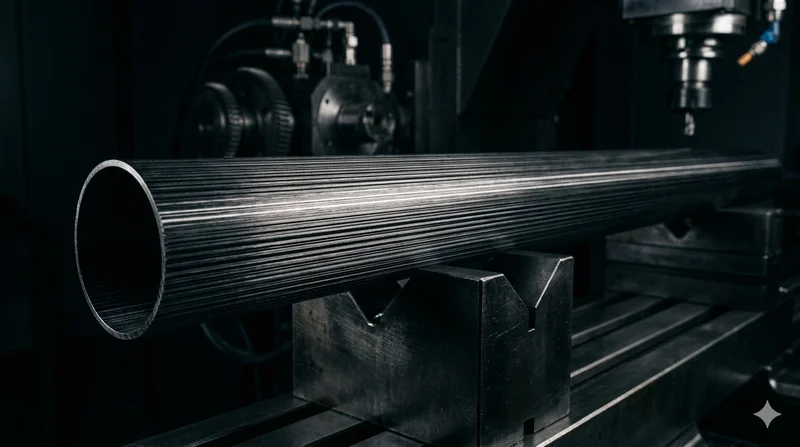
Round Carbon Fiber Tube — UD Unidirectional T700
Unidirectional (UD) round tube with all fibers aligned axially for maximum longitudinal stiffness. Ideal for applications requiring high bending rigidity with minimal weight, such as shafts, struts, and structural reinforcements.
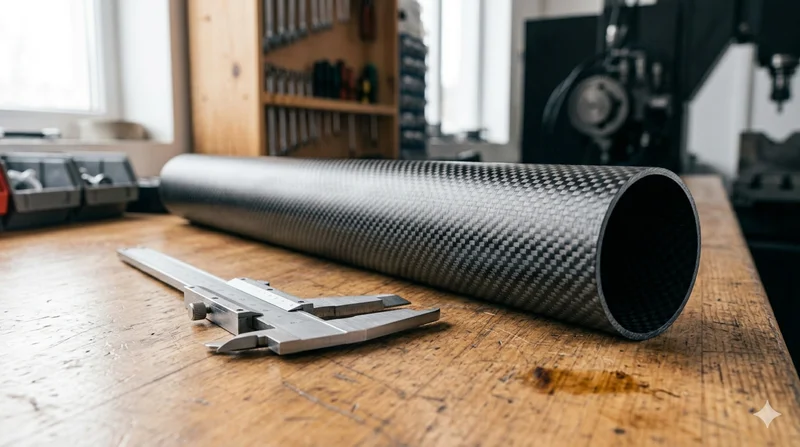
Round Carbon Fiber Tube — 3K Plain Weave T700
Standard round carbon fiber tube manufactured from Toray T700 grade fiber with 3K plain weave. Offers balanced strength and stiffness for general industrial applications including robotics, automation, sports equipment, and aerospace structures.