
Carbon fiber sheets and resin are the two halves of every laminated composite part. The carbon fiber sheet is the reinforcement: strong, stiff, and almost entirely load-bearing along the fibre direction. The resin is the matrix: weaker than the fibre on its own, but essential because it binds the fi
Introduction
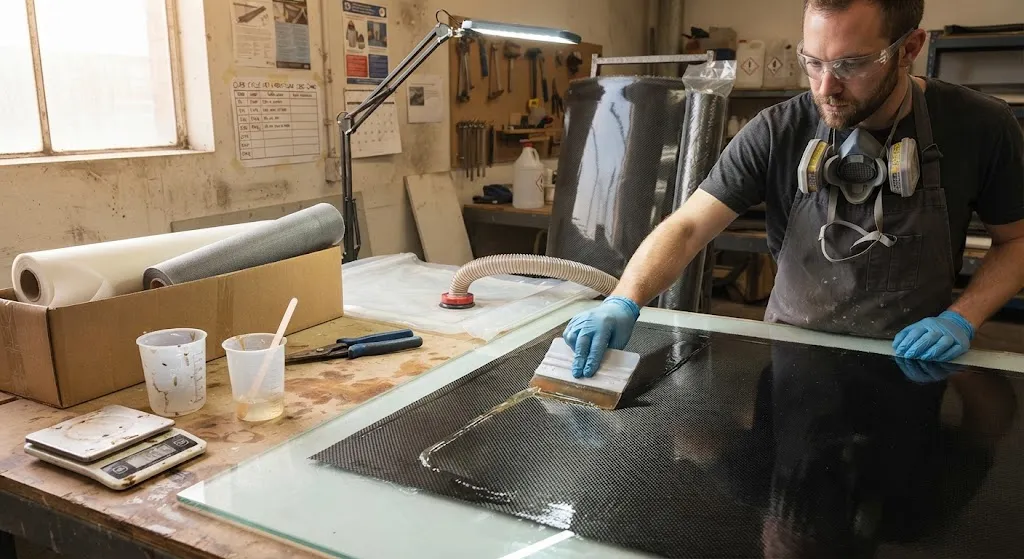
Carbon fiber sheets and resin are the two halves of every laminated composite part. The carbon fiber sheet is the reinforcement: strong, stiff, and almost entirely load-bearing along the fibre direction. The resin is the matrix: weaker than the fibre on its own, but essential because it binds the fibres together, protects them from abrasion and moisture, and transfers load from one fibre to the next. Neither works alone. A dry carbon fiber sheet carries almost nothing, and resin without fibre is brittle and weak. Getting carbon fiber sheets and resin to work as a system, with the right fibre volume, the right resin for the service, and a cure that leaves no voids, is what separates a reliable laminate from a part that delaminates in service. This guide explains how the two components interact, the resin and sheet types available, and the process choices that control the result.
It covers resin systems for carbon fiber sheets, the sheet formats you can buy, wet layup versus prepreg, and the cure and post-cure practice that turns a stack of layers into a structural laminate.
How Carbon Fiber Sheets and Resin Work Together
A laminate is a partnership in which each component does the job it is best at:
- The fibre carries the load: Carbon fiber has a tensile strength of roughly 3500 to 7000 MPa and a modulus of 230 GPa and above, far beyond any resin, but only along the fibre axis.
- The resin transfers load: The matrix shears between fibres so that a load applied to a few fibres is shared across the sheet rather than concentrating on the ones directly under the fixing.
- The resin protects the fibre: It seals the carbon against moisture, abrasion, and galvanic contact with metals, all of which degrade a bare fibre surface.
- The interface decides strength: A good bond between fibre and resin lets the composite approach the fibre's own strength; a poor bond lets the fibres pull out and the laminate fail early.
The single number that captures this partnership is the fibre volume fraction, the share of the laminate that is fibre rather than resin. A hand-laid laminate typically reaches 35 to 50 percent fibre by volume, while a well-made prepreg laminate reaches 55 to 65 percent, which is why the same carbon fiber sheet can produce a laminate twice as stiff depending on how it is processed.
Resin Systems Used with Carbon Fiber Sheets
The resin must be chosen for the service environment as much as for strength. The table below compares the common systems:
| Resin System | Cure Temperature | Key Property | Best Used For |
|---|---|---|---|
| Two-part epoxy | Room to 120 °C | Highest strength, low shrinkage | Structural laminates, aerospace, motorsport |
| Vinyl ester | Room temperature | Chemical and water resistance | Marine, pipes, tanks |
| Polyester | Room temperature | Low cost | Cosmetic panels, low-load parts |
| Phenolic | About 150 °C | Fire, smoke, and toxicity performance | Aircraft interiors, rail |
| Bismaleimide | About 200 °C | High-temperature service | Engine and high-heat components |
For most structural work with carbon fiber sheets, a two-part epoxy is the default because it wets carbon well, cures at low temperature, and gives the highest mechanical properties. Vinyl ester is chosen where chemical exposure matters, and phenolic is specified when fire, smoke, and toxicity rules apply. The resin's service temperature matters as much as its strength: an epoxy that performs well at room temperature will creep and lose stiffness above about 100 °C, so any part near an engine, exhaust, or motor needs a resin rated for the actual temperature.
Sheet Formats: Dry Fabric, Prepreg, and Cured Laminate
Carbon fiber sheet comes in three practical forms, and the choice drives the whole process:
- Dry woven fabric or unidirectional sheet: Bare carbon fibre with no resin, supplied on a roll. It is the cheapest form and needs a wet layup, giving good drape and easy handling but a lower fibre volume.
- Prepreg sheet: Fabric or unidirectional fibre pre-impregnated with a precisely metered resin. The fibre and resin ratio is set by the supplier, so the user gets a consistent, high fibre volume without mixing resin by hand.
- Cured laminate sheet: A flat panel already consolidated and cured, sold by thickness. It needs no resin at all and is simply cut and machined into finished parts.
The three formats serve different needs. Dry fabric suits one-off parts and complex shapes where drape matters. Prepreg suits repeatable, high-quality structural parts where weight and strength must be controlled. Cured laminate sheet suits machined plates, brackets, and flat components where the user wants to skip the layup entirely and start from a solid stock material.
Wet Layup versus Prepreg for Carbon Fiber Sheets and Resin
The process choice sets the achievable quality. The comparison below is the one most buyers need:
| Factor | Wet Layup | Prepreg |
|---|---|---|
| Fibre volume fraction | 35-50 percent | 55-65 percent |
| Resin control | Mixed and applied by hand | Pre-metered by supplier |
| Cure schedule | Room temperature or low oven | 120-180 °C in oven or autoclave |
| Consistency part to part | Depends on operator skill | High and repeatable |
| Tooling and cost | Low | Higher, needs vacuum bag or autoclave |
| Best for | Prototypes, repairs, large simple shapes | Structural parts, weight-critical production |
Wet layup is the accessible route: mix epoxy, wet out the sheet, lay it into the mould, and consolidate by hand or with a vacuum bag. It is flexible and cheap but leaves more resin than ideal, so the laminate is heavier and less stiff for the same fibre. Prepreg is the production route: the resin is already in the sheet, so the operator lays, debulks, and cures to a defined schedule, reaching a higher fibre volume and a more consistent part. The trade is capital and effort: prepreg needs a freezer for storage and a cure oven or autoclave for a proper result.
Curing and Post-Cure of Carbon Fiber Sheets and Resin
The cure cycle, not just the resin choice, decides the final properties of the laminate. The essentials are:
- Control the resin-to-fibre ratio: Excess resin adds weight without strength and makes the laminate brittle, so use a vacuum bag or a bleeder layer to remove the surplus during cure.
- Follow the ramp and dwell: Heat slowly to avoid exotherm and trapped volatiles, hold at the specified dwell temperature to complete the reaction, and cool under control to limit residual stress.
- Apply post-cure when needed: A room-temperature-cured epoxy reaches only part of its potential; a post-cure at 80 to 150 °C raises the glass transition temperature and the final strength.
- Consolidate to remove voids: Pressure from a vacuum bag or autoclave collapses trapped air and draws excess resin out, raising fibre volume and cutting porosity.
- Respect the resin's service limit: Do not post-cure above the point where the resin degrades, and never load a part above its resin's glass transition temperature.
A useful rule is that the laminate's usable temperature is set by the resin, while its strength and stiffness are set by the fibre. A part can have the highest-grade carbon sheet available and still fail early if the resin was cured poorly or is asked to work above its glass transition temperature.
Sourcing Carbon Fiber Sheets and Resin
When buying carbon fiber sheets and resin, define the following so the material matches the process and the load:
| Specification Item | What to Define | Why It Matters |
|---|---|---|
| Sheet format | Dry fabric, prepreg, or cured laminate | Determines the process and tooling |
| Fibre grade and weave | T300, T700, twill, plain, or unidirectional | Sets strength, stiffness, and drape |
| Resin system | Epoxy, vinyl ester, polyester, or phenolic | Sets temperature and chemical resistance |
| Areal weight | Grams per square metre | Controls thickness and layer count |
| Cure schedule | Ramp, dwell, and post-cure temperature | Decides final mechanical properties |
| Validation data | Fibre volume and void content test report | Confirms laminate quality |
Most buyers begin with a search for a carbon fiber sheet and resin near me or for carbon fiber sheets and resin suppliers, and many then compare a local distributor with a carbon fiber sheets and resin USA supplier on price, stock, and technical support. Whichever route you take, ask for the fibre volume and void content on a representative sample, and confirm the resin's glass transition temperature against your service condition. For a structural part, order a small quantity first and make a trial laminate, because the sheet, the resin, the cure schedule, and the operator technique interact, and only a test part proves the combination works.
Frequently Asked Questions
What is the best resin for carbon fiber sheets?
For most structural parts, a two-part epoxy is the best all-round choice because it wets carbon fiber well, cures at low temperature, and gives the highest strength and stiffness. Vinyl ester is preferred where chemical or water resistance matters, such as marine and pipe work, and polyester is used only for low-cost cosmetic panels. Phenolic is specified when fire, smoke, and toxicity rules apply, as in aircraft interiors. The service temperature is often the deciding factor, since an epoxy loses stiffness above about 100 °C and a high-temperature part needs a resin rated for the actual condition.
Can I use polyester resin with carbon fiber?
You can physically, but it is rarely a good choice for a structural part. Polyester bonds less strongly to carbon fibers than epoxy, shrinks more during cure, and is more brittle, so a polyester laminate is weaker and more prone to cracking than the same sheet laid up in epoxy. Polyester is acceptable for cosmetic panels or very low-load parts where cost is the priority, but for anything that carries a real load, epoxy is the correct matrix. If chemical resistance is the reason for considering polyester, vinyl ester is the better compromise because it keeps good chemical resistance with stronger fibre bonding.
Do carbon fiber sheets and resin need a post-cure?
A post-cure is not always mandatory, but it substantially improves a room-temperature-cured epoxy. A resin cured at room temperature reaches only part of its potential strength and has a lower glass transition temperature. A controlled post-cure at 80 to 150 °C raises both, giving a stiffer, stronger, and more heat-resistant laminate. The exact schedule comes from the resin datasheet, and exceeding it can degrade the resin rather than improve it. For non-critical parts, a room-temperature cure is often enough, but any part that will see load or heat benefits from a proper post-cure.
Conclusion
Carbon fiber sheets and resin form a system in which the fibre carries the load and the resin binds and protects it, so the quality of a laminate depends on both and on how they are processed together. The fibre volume fraction, the resin's temperature and chemical limits, and the cure schedule decide whether the finished part approaches the fibre's strength or fails early at the interface. Dry fabric, prepreg, and cured laminate sheet each suit different needs, and wet layup and prepreg trade cost against consistency and fibre volume.
If you need carbon fiber sheets and the right resin for your process, browse our carbon fiber sheet and resin range with dry fabric, prepreg, and cured laminate options in T300, T700, and high-modulus grades plus matching epoxy systems, or contact our engineering team with your load case and service temperature for a material recommendation and a quote.
Part of topic
Related Articles
Interested in Our Products?
Contact our team for competitive pricing and technical specifications.
Get a QuoteRelated Products

Carbon Fiber Plate — 3K Twill T700 3.0mm
Medium-thickness 3.0mm carbon fiber plate offering significantly higher load capacity while maintaining attractive 3K twill finish. Suitable for structural brackets, reinforcement plates, and load-bearing panels.

Carbon Fiber Plate — 3K Twill T700 1.5mm
Thin 1.5mm carbon fiber plate with 3K twill weave surface. Lightweight and stiff, commonly used for covers, panels, drone bodies, and applications requiring a premium aesthetic appearance.

Square Carbon Fiber Tube — 3K Twill T700
Square cross-section carbon fiber tube manufactured with 3K twill weave for torsional strength. Preferred for structural frames, trusses, and support columns where rectangular geometry offers design flexibility.
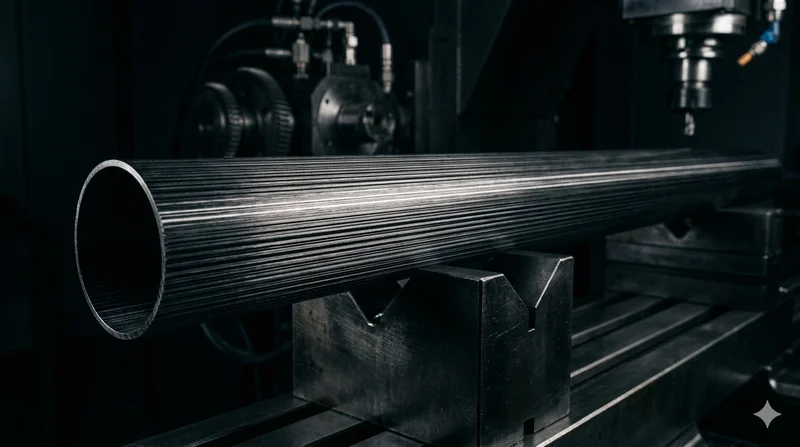
Round Carbon Fiber Tube — UD Unidirectional T700
Unidirectional (UD) round tube with all fibers aligned axially for maximum longitudinal stiffness. Ideal for applications requiring high bending rigidity with minimal weight, such as shafts, struts, and structural reinforcements.
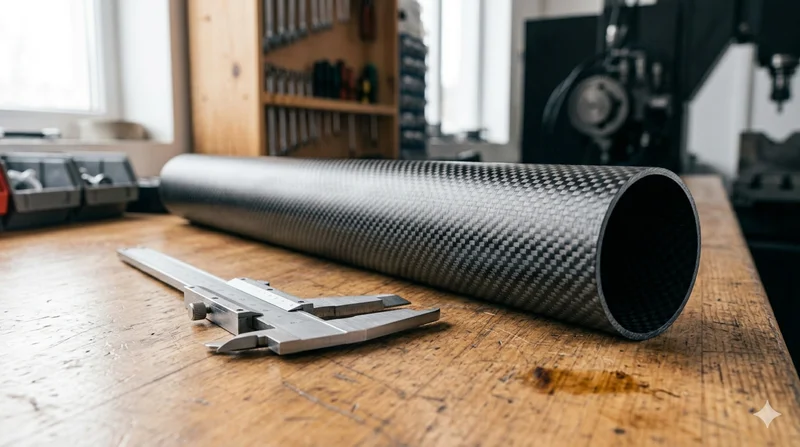
Round Carbon Fiber Tube — 3K Plain Weave T700
Standard round carbon fiber tube manufactured from Toray T700 grade fiber with 3K plain weave. Offers balanced strength and stiffness for general industrial applications including robotics, automation, sports equipment, and aerospace structures.