
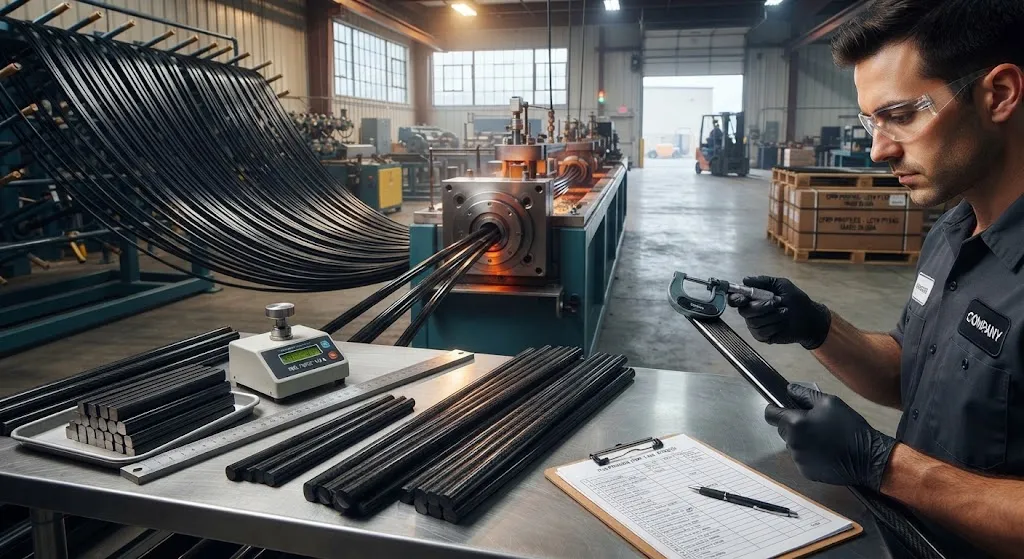
Carbon fiber rods / strips are the two most commonly ordered pultruded carbon fiber profiles: round rods for shafts, booms, and guide rails, and flat strips for spars, stiffeners, and braces. Both are made by pulling continuous carbon fiber tows through a resin bath and a heated die, which produces
Introduction
Carbon fiber rods / strips are the two most commonly ordered pultruded carbon fiber profiles: round rods for shafts, booms, and guide rails, and flat strips for spars, stiffeners, and braces. Both are made by pulling continuous carbon fiber tows through a resin bath and a heated die, which produces a profile with exceptional axial stiffness and strength at roughly one fifth of the weight of an equivalent steel section. Because the process is continuous, rods and strips are economical, consistent, and available in long lengths — which is why they appear in everything from drone booms and RC aircraft spars to kite frames, robotic arms, and automotive braces.
This guide explains how carbon fiber rods and strips are manufactured, how the round and flat profiles differ in mechanical behaviour, the specifications to define when sourcing, and the applications where each form delivers the clearest advantage.
Carbon Fiber Rods and Strips: Manufacturing and Key Differences
Both rods and strips are produced by pultrusion: unidirectional carbon fiber tows are pulled through a resin bath, gathered into the required cross-section, and cured as they pass through a heated die. The die defines the shape — round for rods, rectangular for strips — and the fibre stays continuous along the full length, which is what gives pultruded profiles their exceptional axial properties. Some strips are instead cut from cured sheet or roll-wrapped for special cases, but pultrusion dominates because it is faster and cheaper at volume.
The table below compares a round rod and a flat strip of similar cross-sectional area:
| Property | Round Rod (6 mm) | Flat Strip (12 x 3 mm) |
|---|---|---|
| Cross-sectional area (mm²) | 28.3 | 36 |
| Tensile strength (MPa) | 1,400-2,100 | 1,200-1,800 |
| Tensile modulus (GPa) | 120-160 | 100-140 |
| Weight per metre (g) | 45-47 | 57-59 |
| Bending behaviour | Equal in all directions | Stiff in flat plane, flexible across thickness |
| Fastening | Collars, clamps, end fittings | Adhesive bonding, through-holes, edge clamping |
The key difference is in bending behaviour: a round rod bends equally in every direction, which suits shafts and guide rails, while a strip is stiff in its flat plane but flexible across its thickness, which suits spars and stiffeners that must resist bending in one direction only. Choosing the wrong cross-section means paying for stiffness you do not use, or fighting flexibility you did not expect.
Carbon Fiber Rods and Strips: Specifications and Grades
When sourcing carbon fiber rods and strips, define these parameters in the specification:
| Parameter | Typical Range | Why It Matters |
|---|---|---|
| Cross-section | Rod 1-50 mm; strip 1-30 mm wide, 1-6 mm thick | Sets stiffness and the mounting method |
| Fibre grade | T300, T700, T800, high-modulus | Determines the strength and modulus baseline |
| Fiber volume fraction | 55-65% typical for pultrusion | Governs achievable stiffness and consistency |
| Straightness | 0.1-1.0 mm per metre | Critical for guide rails and visible spars |
| Surface finish | Glossy, matte, or textured | Affects bonding, aesthetics, and UV protection |
| Length and tolerance | Continuous stock or cut-to-length | Drives assembly fit and scrap rate |
Two practical points deserve emphasis. First, specify the fibre grade in writing, because a profile quoted at commodity prices may use lower-grade fibre with noticeably lower modulus. Second, for structural applications, request straightness data and batch traceability; a strip that bows 2 mm over a metre will show up as a misaligned spar in an aircraft model, and a rod with hidden waviness will fatigue prematurely in a robotic arm.
Applications of Carbon Fiber Rods and Strips
Rods and strips serve different structural roles, often within the same product:
- Drones and UAVs: Round rods for booms, arms, and landing gear struts; strips for frame stiffeners and camera gimbal mounts.
- Model and RC aircraft: Strips for wing spars and tail booms; rods for pushrods and linkage systems, replacing heavier steel wire.
- Kites and outdoor gear: Rods for frames and spars that must spring back after folding; strips for edge stiffeners.
- Robotics and automation: Rods as linear guide rails and drive shafts; strips as lightweight frame members on gantries and end-effectors.
- Automotive and marine: Strips as brace stiffeners and trim; rods for push-pull controls and shafting where corrosion resistance matters.
- Musical instruments and sporting goods: Rods in archery arrows and fishing rod blanks; strips as neck stiffeners and brace supports.
In each application the design rule is the same: use rods where loading can come from any direction, and use strips where the load is predominantly in one plane, so that the cross-section works with the load rather than against it.
Sourcing Carbon Fiber Rods and Strips
Carbon fiber rods and strips are commodity products with one important difference from other materials: the quality spread between suppliers is wide, and the price difference does not always reflect it. Buy on three criteria. First, documented material properties — request the material data sheet and fibre grade so that the modulus and strength you design with are the properties you receive. Second, dimensional consistency — measure the diameter or thickness across the batch, because tolerance drift changes both stiffness and how the profile seats in end fittings. Third, straightness and surface quality — a straight, sealed-surface profile is easier to bond, paint, and mount than a bowed one, and it behaves more predictably in service.
Reputable carbon fiber rod and strip suppliers offer cut-to-length service, custom cross-sections, and material certificates on request. For buyers in North America and Europe, lead times for standard pultruded profiles are typically short, and ordering continuous stock lengths and cutting in-house is the most economical route for high-volume projects. Whatever the project size, the specification discipline is the same: grade, cross-section, straightness, and traceability, confirmed in writing before the order is placed.
Frequently Asked Questions
What is the difference between a carbon fiber rod and a carbon fiber strip?
A rod is round and bends equally in every direction, which makes it ideal for shafts, booms, and guide rails where loads can arrive from any angle. A strip is flat and rectangular: it is stiff when bent in its flat plane but flexible when bent across its thin dimension, which makes it ideal for spars and stiffeners that resist bending in one direction. The two are manufactured by the same pultrusion process and use the same fibres and resins; the choice between them is purely a question of the loading direction and the mounting method in your design.
Can carbon fiber rods and strips be cut and drilled?
Yes, both can be cut with a fine-tooth saw or abrasive cut-off wheel, and drilled with sharp carbide or diamond tooling. Cut slowly and support the profile on both sides of the cut to avoid delamination and fuzzing at the ends. For drilling, use a backing plate and light feed; pilot holes help on strips. Sealing cut ends with a thin epoxy is recommended wherever the profile will be exposed to moisture or cyclic loading, because exposed fibre ends are the entry point for water and stress. For joints, adhesive bonding with a structural epoxy or bonded metal fittings is generally more reliable than mechanical fasteners alone.
Are carbon fiber strips stiffer than steel strips of the same size?
In terms of raw stiffness, no: a unidirectional pultruded carbon fiber strip has a tensile modulus of roughly 100-140 GPa, lower than steel's 200-210 GPa. But because carbon fiber is about five times lighter (1.55-1.65 g/cm³ versus 7.85 g/cm³), a carbon strip is roughly two to three times stiffer per unit mass. In practical terms, a carbon strip can replace a steel strip of equal stiffness at about one third of the weight, which is why weight-critical structures in drones, aircraft, and robotics use carbon despite the higher material cost. Always compare stiffness per unit mass, not modulus alone, when choosing between the two.
Conclusion
Carbon fiber rods and strips are the workhorses of composite construction: continuous pultruded profiles that provide exceptional axial stiffness at a fraction of the weight of metal. Round rods handle loads from any direction in shafts, booms, and guide rails, while flat strips resist one-plane bending in spars, stiffeners, and braces — and both are economical, consistent, and available in long lengths. The specification requirements are well understood: fibre grade, cross-section, straightness, and documented traceability.
If you are designing a lightweight structure and need rods, strips, or a custom cross-section, explore our carbon fiber rod and strip range, available in T300, T700, and high-modulus grades with cut-to-length service, or contact our engineering team for specification guidance and a quote for your project.
Related Articles
Interested in Our Products?
Contact our team for competitive pricing and technical specifications.
Get a QuoteRelated Products
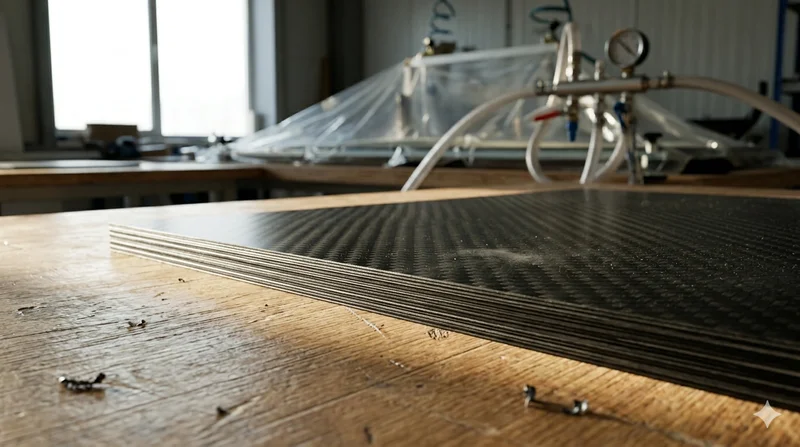
Carbon Fiber Plate — 3K Twill T700 3.0mm
Medium-thickness 3.0mm carbon fiber plate offering significantly higher load capacity while maintaining attractive 3K twill finish. Suitable for structural brackets, reinforcement plates, and load-bearing panels.
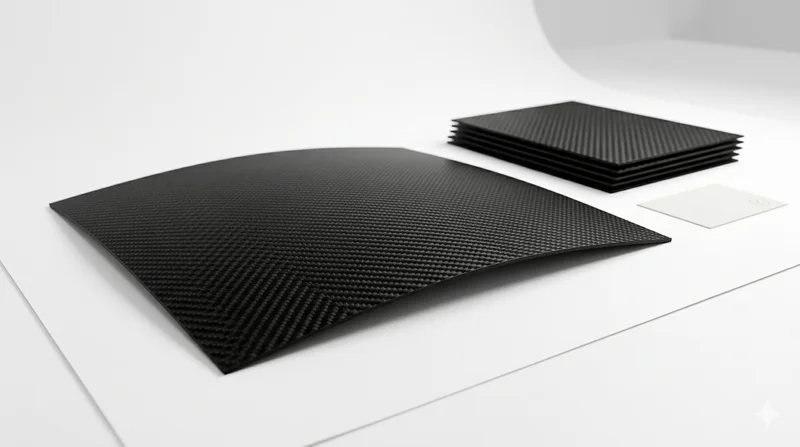
Carbon Fiber Plate — 3K Twill T700 1.5mm
Thin 1.5mm carbon fiber plate with 3K twill weave surface. Lightweight and stiff, commonly used for covers, panels, drone bodies, and applications requiring a premium aesthetic appearance.
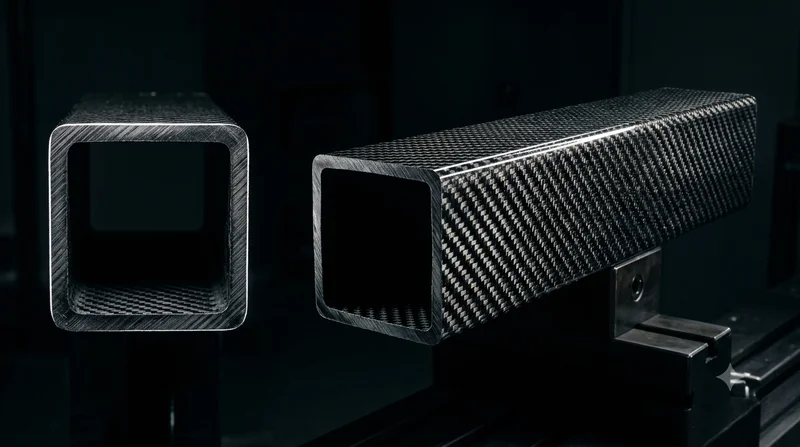
Square Carbon Fiber Tube — 3K Twill T700
Square cross-section carbon fiber tube manufactured with 3K twill weave for torsional strength. Preferred for structural frames, trusses, and support columns where rectangular geometry offers design flexibility.
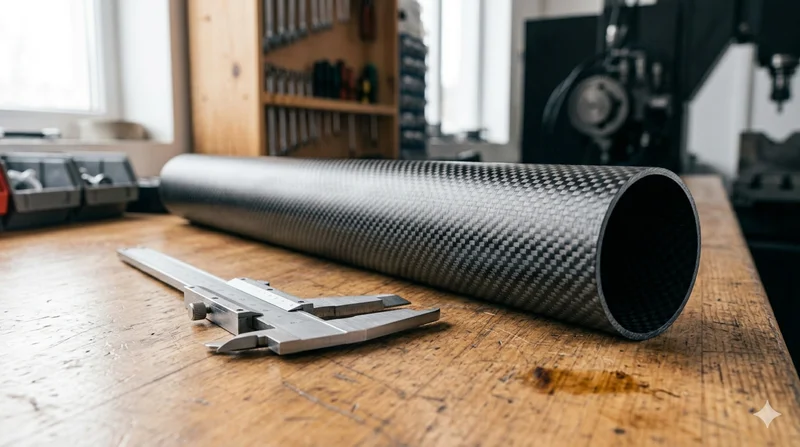
Round Carbon Fiber Tube — 3K Plain Weave T700
Standard round carbon fiber tube manufactured from Toray T700 grade fiber with 3K plain weave. Offers balanced strength and stiffness for general industrial applications including robotics, automation, sports equipment, and aerospace structures.
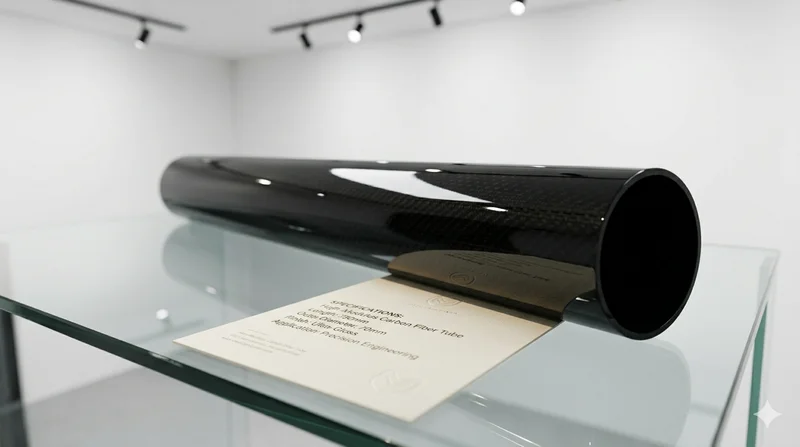
High Modulus Round Carbon Fiber Tube — M40
High modulus round tube manufactured with M40 grade fiber (tensile modulus 400 GPa). Designed for applications where maximum stiffness-to-weight ratio is critical, such as optical systems, precision machinery, and aerospace structures.