
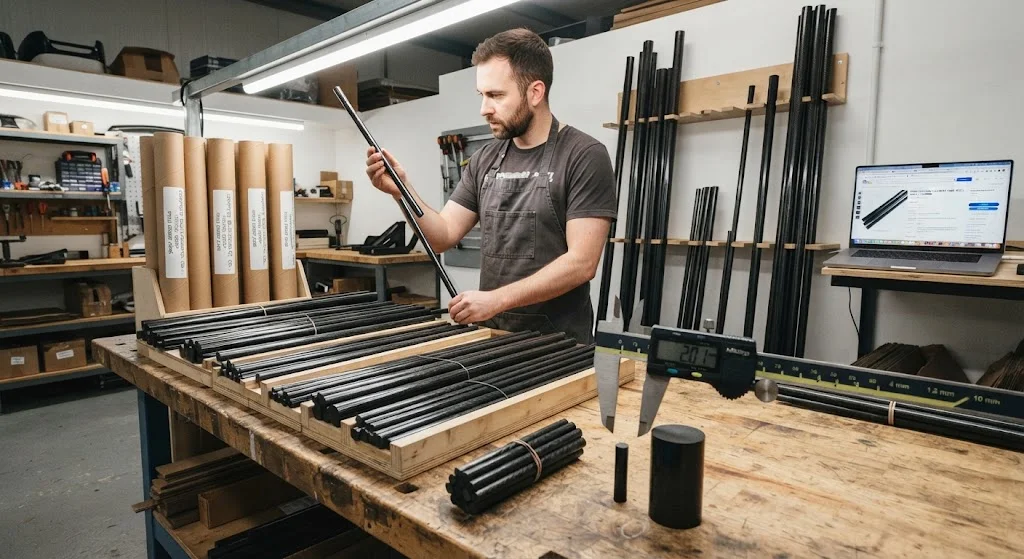
Searching for carbon fiber rods Amazon listings returns hundreds of results: solid and hollow rods from 1 mm to 20 mm in diameter, cut to lengths from 250 mm to 1,000 mm, priced from a few dollars to fifty or more per rod. For hobbyists building drones, model aircraft, RC vehicles, and 3D printer up
Introduction
Searching for carbon fiber rods Amazon listings returns hundreds of results: solid and hollow rods from 1 mm to 20 mm in diameter, cut to lengths from 250 mm to 1,000 mm, priced from a few dollars to fifty or more per rod. For hobbyists building drones, model aircraft, RC vehicles, and 3D printer upgrades, this is the most convenient way to buy small quantities quickly. But the same search also returns listings where the fibre grade is unstated, the diameter is approximate, and the "carbon fiber" description covers rods that are really glass fibre with a carbon wrap. This guide explains what carbon fiber rods Amazon sellers actually offer, how to read a listing critically, and when a dedicated carbon fiber rod supplier is the better choice.
We cover the two manufacturing methods you will find, the quality signals to check in a listing, realistic price expectations, and how to move from retail rods to consistent production-grade supply.
What Carbon Fiber Rods Amazon Sellers Offer
Amazon carbon fiber rod listings fall into a few distinct categories. The table below summarises what you will typically find:
| Type | Diameter Range | Lengths | Typical Price | Typical Use |
|---|---|---|---|---|
| Solid pultruded rod | 1-6 mm | 250-1,000 mm | $5-20 per rod | Model aircraft, RC, kite spars |
| Hollow tube | 4-20 mm | 250-1,000 mm | $8-50 per tube | Drone arms, push rods, frames |
| Flat strip / rod pack | 1-3 mm | 300-1,000 mm | $10-30 per pack | 3D printer upgrades, stiffeners |
| Filament wound rod | 6-25 mm | 300-1,000 mm | $15-80 per rod | Prop shafts, high-load struts |
Most listings are solid pultruded rods, which are inexpensive and consistent. Hollow tubes and filament wound rods cost more and appear in fewer listings. Many sellers bundle several diameters in one pack, which is convenient for prototyping but makes it harder to judge the quality of any single rod.
Pultruded vs Filament Wound Rods
The two manufacturing methods behind nearly all carbon fiber rods on Amazon produce different properties:
| Property | Pultruded Rod | Filament Wound Rod |
|---|---|---|
| Process | Continuous fibres pulled through a resin bath and die | Fibres wound around a rotating mandrel at angles |
| Fibre orientation | Mostly along the length (0°) | Helical and hoop layers (angle-controlled) |
| Bending strength | Good | Higher, multi-directional |
| Torsional strength | Low | High |
| Surface finish | Smooth, glossy | Textured, wound pattern visible |
| Typical diameter | 1-10 mm | 6-50 mm |
| Relative cost | Lower | Higher |
For most hobby uses — kite spars, push rods, model aircraft stiffeners — a pultruded rod is the right and economical choice. Filament wound rods earn their higher price where loads come from several directions, such as drive shafts and struts that see bending plus torsion. If a listing does not state the method, a smooth glossy rod under about 8 mm is almost always pultruded.
Quality Signals to Check in a Listing
Reading carbon fiber rods Amazon listings critically avoids most disappointments. Look for these signals before ordering:
- Stated fibre grade: Listings that name a grade such as T300 or T700 are more credible than ones that just say "carbon fiber". Most retail rods use T300-class fibre.
- Exact diameter tolerance: A rod listed as "3 mm" should state a tolerance such as +/-0.1 mm. Pultruded rods are consistent, but cheap listings may round the size.
- Straightness claim: Thin rods bend in storage and shipping. Listings that acknowledge straightness, or offer longer lengths pre-straightened, are more reliable for precision work.
- Solid vs hollow clarity: Confirm whether you are buying a solid rod or a tube; the two are often mixed in search results and have very different stiffness and weight.
- Review evidence on flexing: Photos and reviews showing the rod bending under load tell you more than the description about real-world stiffness.
- Resin quality mention: Rods described as epoxy-based hold up better than unspecified polyester resin rods under repeated loading.
One common Amazon pitfall is listings described as carbon fiber that are fibreglass rods with a carbon veil wrap. Check the photos closely: a genuine pultruded carbon rod is uniformly black through the cross-section, while a wrapped fibreglass rod shows lighter material where cut ends are visible.
When Amazon Is the Right Choice
Carbon fiber rods on Amazon suit several situations well:
- Prototyping and one-off builds: Buying a few rods of several diameters is cheaper and faster than a minimum order from a supplier.
- Learning and testing: Inexpensive rods let you test stiffness and fit before committing to a material specification.
- Small repairs: Replacing a kite spar or model aircraft push rod does not justify a production order.
- Immediate availability: Two-day delivery beats a two-week lead time when a project deadline is close.
The limitation is consistency and traceability. Retail rods rarely carry a material data sheet, and the same listing can be supplied by different factories over time, so reordering the same rod later may not give identical properties. For one-off builds this rarely matters; for repeatable results it does.
Carbon Fiber Rods Amazon: When to Buy from a Specialist Supplier
Step up from Amazon to a dedicated carbon fiber rod supplier when your use becomes repeatable or load-bearing:
- Production quantities: When you need dozens or hundreds of rods with identical properties, direct supply gives consistent batches and lower per-unit cost.
- Specified grades: Suppliers can provide T700 or T800 fibre, documented tensile strength, and a material data sheet you cannot get from a retail listing.
- Custom dimensions: Exact diameters, lengths, and tolerances cut to your drawing, rather than the fixed sizes in a listing.
- Certification and QC: Batch records, dimensional inspection reports, and consistent surface finish matter for commercial products and regulated industries.
- Volume pricing: Per-rod cost drops substantially with quantity, making direct supply cheaper than Amazon for steady production.
For commercial products, the traceability argument is decisive: if a rod fails in the field, you need to know exactly what fibre, resin, and process made it. A retail listing cannot answer that question; a supplier's batch records can.
Frequently Asked Questions
Are the carbon fiber rods on Amazon real carbon fiber?
Most solid rods under about 8 mm sold as carbon fiber on Amazon are genuine pultruded carbon fibre reinforced polymer, usually T300-class. The main exceptions are larger tubes and some cheap listings that are fibreglass with a carbon outer veil. To check what you are getting, look at cut ends in the photos: a genuine carbon rod is uniformly dark through the cross-section, while a wrapped fibreglass rod shows lighter material at the cut end. Reviews with photographs of flexing and cut ends are the most reliable evidence in a listing.
How do I choose the right carbon fiber rod diameter?
Diameter is the main control over stiffness and strength: bending stiffness scales with the fourth power of diameter, so a 4 mm rod is about 16 times stiffer than a 2 mm rod of the same material. Start with the load and span you need, then pick the smallest diameter that gives acceptable deflection; this keeps weight and cost low. For typical hobby uses, 2-3 mm rods suit kite spars and push rods, 4-6 mm rods suit model aircraft spars and RC frames, and 8 mm or larger suits drone arms and structural struts. If a listing gives a stiffness or load figure, compare rods on that basis rather than diameter alone.
Why do carbon fiber rods on Amazon vary so much in price?
Price differences come from the manufacturing method, fibre grade, resin system, diameter tolerance, and quality control. Pultruded T300 rods in standard sizes are inexpensive to produce, so low prices are expected; prices rise for filament wound rods, larger diameters, tighter tolerances, and packs with multiple sizes. Be cautious with listings priced far below the typical range for the size, since the cheapest rods may use lower-grade fibre, unspecified resin, or inconsistent diameters. For critical parts, a modest price increase to a listing that states grade and tolerance is usually worth it.
Conclusion
Carbon fiber rods on Amazon are a fast, inexpensive way to get quality rods for prototyping, hobby builds, and small repairs — provided you read the listing critically and know the difference between pultruded and filament wound rods. Check the fibre grade, diameter tolerance, and cut ends before ordering, and match the rod type to the loads it will see. When your project moves from one-off builds to repeatable production or load-bearing use, a dedicated carbon fiber rod supplier gives you consistent batches, documented specifications, and lower per-unit cost.
For consistent production-grade carbon fiber rods with documented specifications, browse our carbon fibre tube and rod range or contact our technical team for custom diameters, grades, and volume pricing.
Related Articles
Interested in Our Products?
Contact our team for competitive pricing and technical specifications.
Get a QuoteRelated Products
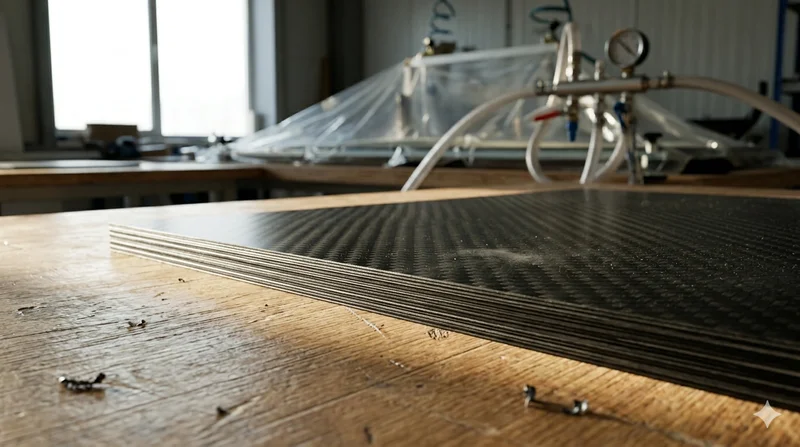
Carbon Fiber Plate — 3K Twill T700 3.0mm
Medium-thickness 3.0mm carbon fiber plate offering significantly higher load capacity while maintaining attractive 3K twill finish. Suitable for structural brackets, reinforcement plates, and load-bearing panels.
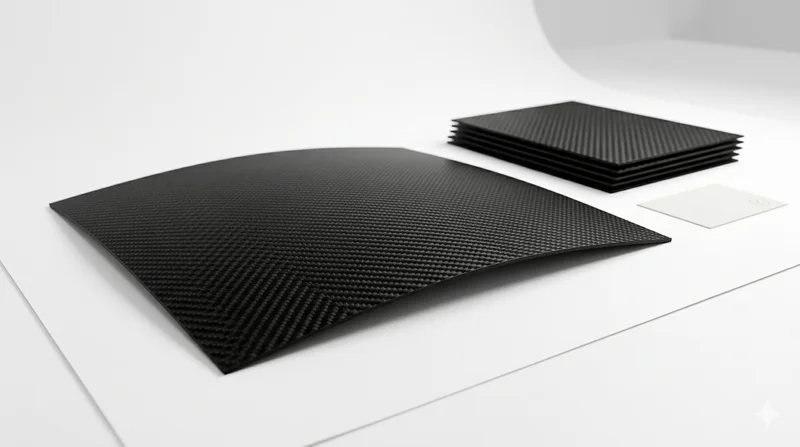
Carbon Fiber Plate — 3K Twill T700 1.5mm
Thin 1.5mm carbon fiber plate with 3K twill weave surface. Lightweight and stiff, commonly used for covers, panels, drone bodies, and applications requiring a premium aesthetic appearance.
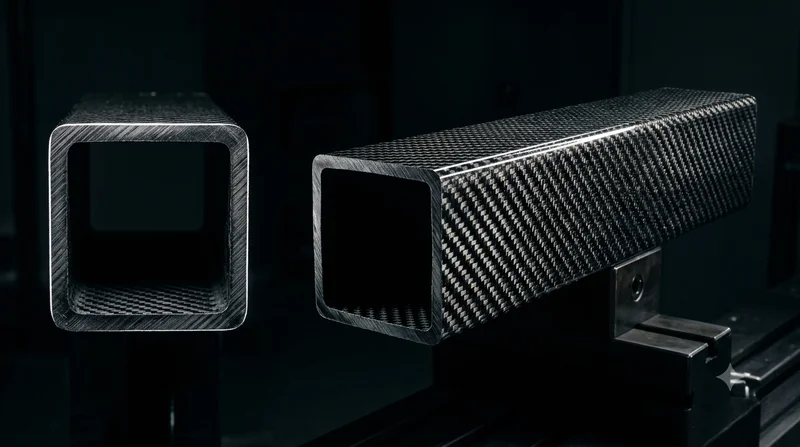
Square Carbon Fiber Tube — 3K Twill T700
Square cross-section carbon fiber tube manufactured with 3K twill weave for torsional strength. Preferred for structural frames, trusses, and support columns where rectangular geometry offers design flexibility.
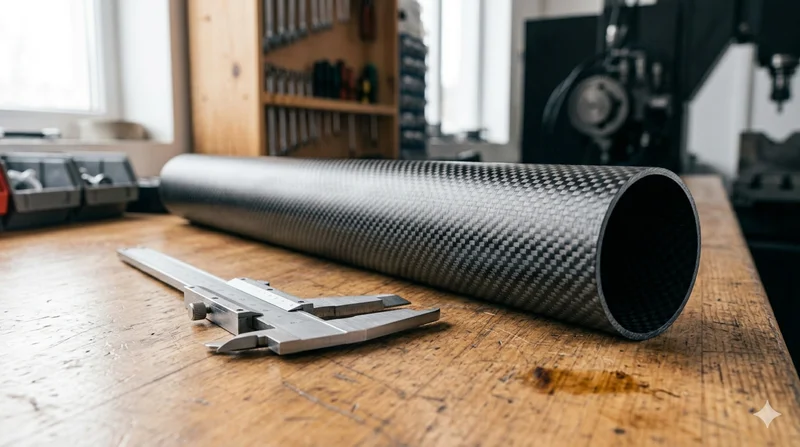
Round Carbon Fiber Tube — 3K Plain Weave T700
Standard round carbon fiber tube manufactured from Toray T700 grade fiber with 3K plain weave. Offers balanced strength and stiffness for general industrial applications including robotics, automation, sports equipment, and aerospace structures.
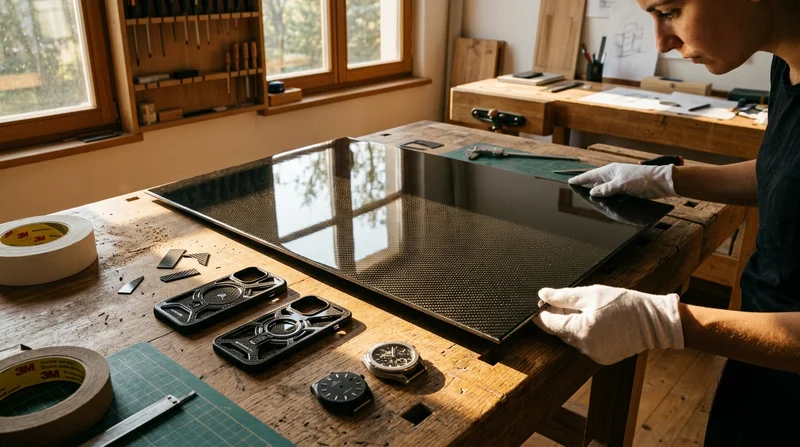
Carbon Fiber Plate — High-Gloss Decorative
High-gloss decorative carbon fiber plate with a mirror-like surface finish. The glossy coating enhances the visible 3K twill weave, creating a premium aesthetic for consumer-facing applications. Lightweight yet stiff, available in thin gauges for easy cutting and forming.