
Carbon fiber rods are among the most versatile structural components in modern engineering: a solid or tubular rod made from carbon fiber reinforced polymer that delivers a stiffness-to-weight ratio several times higher than steel. Engineers choose carbon fiber rods when a component must be light, s
Introduction
Carbon fiber rods are among the most versatile structural components in modern engineering: a solid or tubular rod made from carbon fiber reinforced polymer that delivers a stiffness-to-weight ratio several times higher than steel. Engineers choose carbon fiber rods when a component must be light, stiff, and stable over long service lives — from the arms of industrial robots to the spars of UAV wings, from fishing rod blanks to medical braces. Because they are manufactured as continuous lengths, rods are also one of the most cost-effective forms of carbon fiber composite per unit of performance.
This guide explains how carbon fiber rods are manufactured, how they compare with steel, aluminium, and fibreglass, the applications where they deliver the clearest advantage, and the specifications you must define to source them reliably.
How Carbon Fiber Rods Are Manufactured
Carbon fiber rods are produced by three principal processes, each suited to different diameters, volumes, and performance targets:
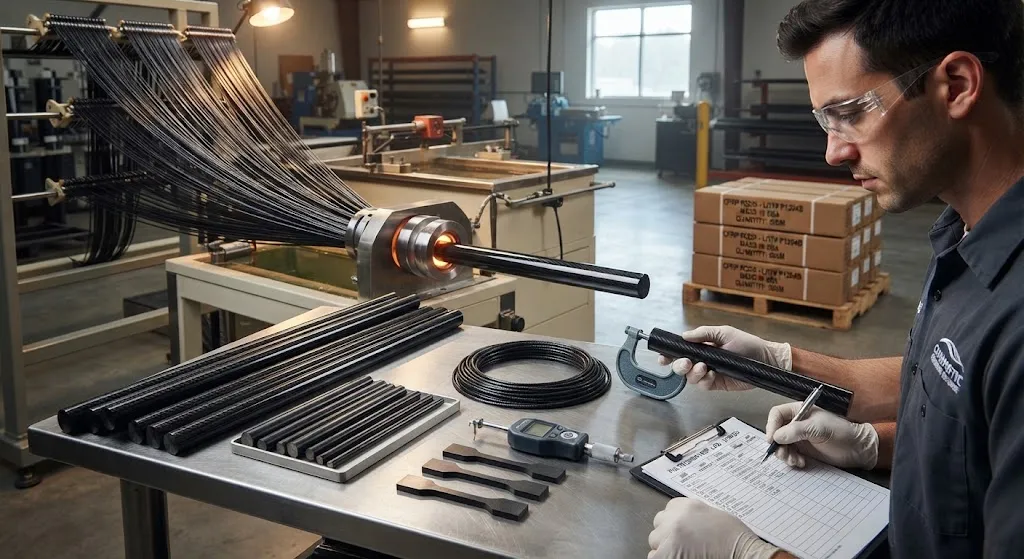
- Pultrusion: Continuous carbon fiber tows are pulled through a resin bath and a heated die that shapes and cures the rod in one pass. Pultruded rods are the most common and economical, with consistent cross-sections, excellent axial properties, and lengths limited only by handling equipment — typically up to 6-12 metres.
- Roll wrapping: Pre-preg or dry woven fabric is rolled around a mandrel to build the wall thickness of a tubular rod, then cured under heat and pressure. This method suits tubes and larger-diameter rods where hoop strength and a precise internal bore matter.
- Filament winding: Continuous tows are wound onto a rotating mandrel at controlled angles, allowing the layup to be tuned for combined axial and hoop loading. Filament-wound rods are used where biaxial strength is required, such as drive shafts and pressure applications.
Most solid rods use pultrusion with unidirectional fiber, which maximises axial stiffness and strength. The table below compares typical mechanical properties of a pultruded carbon fiber rod with alternative materials at similar diameters:
| Property | Carbon Fiber Rod (T700) | Steel Rod | Aluminium Rod | Fibreglass Rod |
|---|---|---|---|---|
| Tensile strength (MPa) | 1,400-2,100 | 400-700 | 200-450 | 700-1,200 |
| Tensile modulus (GPa) | 120-160 | 200-210 | 68-72 | 35-50 |
| Density (g/cm³) | 1.55-1.65 | 7.85 | 2.70 | 1.9-2.1 |
| Specific stiffness (GPa per g/cm³) | 77-100 | 26 | 26 | 18-25 |
| Fatigue endurance | Excellent | Good with limits | Limited by yield | Good |
| Corrosion resistance | Excellent | Poor without coating | Good, galvanic risks | Excellent |
The specific stiffness column is the headline number: a carbon fiber rod is roughly three times stiffer per unit mass than steel or aluminium, which is why replacing a metal rod with carbon fiber produces such large weight savings at equal stiffness.
Key Applications of Carbon Fiber Rods
Carbon fiber rods appear in applications where their combination of properties is worth the higher material cost:
- Robotics and automation: Linear-motion shafts, parallel-kinematic arms, and lightweight end-effectors where lower inertia enables faster cycle times and smaller motors.
- Drones and UAVs: Booms, arms, and landing gear struts that must stay stiff and light to maximise flight time and payload.
- Aerospace: Control rods, push-pull tubes, and structural struts where certified material traceability and predictable fatigue behaviour are mandatory.
- Marine and water sports: Mast spars, rigging, and paddle shafts that must resist saltwater without corroding.
- Medical and rehabilitation: Brace frames, walking aids, and prosthetic components that combine strength with very low weight.
- Fishing and outdoor equipment: Rod blanks and tent poles where flexural stiffness, spring-back, and lightness are the primary requirements.
In each case the design trade-off is the same: a higher material price is accepted because the system-level benefit — lighter structure, faster motion, or longer service life — outweighs it.
Specifications to Define When Sourcing
Reliable sourcing of carbon fiber rods depends on a written specification. The parameters that matter most:
| Parameter | Typical Range | Why It Matters |
|---|---|---|
| Diameter | 1-50 mm standard; larger on request | Sets stiffness, strength, and fit with end fittings |
| Fibre grade | T300, T700, T800, or high-modulus | Determines the modulus and strength baseline |
| Fiber volume fraction | 55-65% typical for pultrusion | Governs achievable stiffness and consistency |
| Surface finish | Glossy, matte, or textured | Affects bonding, aesthetics, and UV protection |
| Straightness | 0.1-1.0 mm per metre | Critical for linear-motion and rotating applications |
| Length and tolerance | Cut-to-length with defined tolerance | Drives assembly fit and scrap rate |
Two practical points deserve emphasis. First, specify the fibre grade explicitly — a "carbon fiber rod" quoted at commodity prices may use lower-grade fiber with noticeably lower modulus. Second, for structural applications, request batch traceability and a material data sheet so that every delivered rod is backed by documented properties.
Cost and Buying Considerations
Carbon fiber rods cost more per kilogram than steel or aluminium, but the comparison buyers should make is per installed component, not per kilogram. Because a carbon fiber rod achieves equal stiffness at roughly one third of the weight, a structure designed around carbon rods can be lighter and may need smaller motors, bearings, and support frames — reducing the total system cost. Rods are also sold in continuous lengths and cut to size, which keeps material utilisation high and waste low compared with machined parts.
When buying carbon fiber rods, compare suppliers on three dimensions: documented material properties and traceability, dimensional accuracy against your specification, and consistency across batches. A supplier that can provide material data sheets, batch records, and tight straightness control is worth more than the lowest unit price, particularly for structural or safety-relevant applications.
Frequently Asked Questions
How strong is a carbon fiber rod compared with a steel rod of the same diameter?
In tensile strength, a unidirectional pultruded carbon fiber rod (1,400-2,100 MPa with T700 fibre) is roughly three to four times stronger than a common structural steel rod (400-700 MPa). In stiffness, carbon's tensile modulus is lower than steel (120-160 GPa versus 200-210 GPa) at the same diameter, but because carbon is about five times lighter, it is roughly three times stiffer per unit mass. The practical implication is that a carbon rod designed for the same stiffness as steel weighs about one third as much, and a rod designed for the same strength can be much smaller. Under bending, the comparison depends on diameter and wall thickness, so always compare rods on a specific loading case rather than on a single property.
Can carbon fiber rods be cut, drilled, and machined?
Yes, carbon fiber rods can be cut, drilled, and machined, but with precautions. Use a fine-tooth blade, diamond-coated tooling, or abrasive cutting for clean edges, and cut slowly to avoid fibre delamination at the end. When drilling, support the rod to prevent splitting and use sharp drill bits with light feed; carbide or diamond tooling lasts longest. Machined ends should be sealed with a thin epoxy or a machined collar where they will be loaded, because exposed cut ends are where moisture and stress concentrate. For threaded connections, bonded metal end fittings are usually more reliable than cutting threads directly into the composite, because threads in the rod end reduce the load-carrying cross-section.
What is the difference between a carbon fiber rod and a carbon fiber tube?
A rod is solid, while a tube is hollow. At equal outside diameter, a solid rod has higher bending and torsional stiffness and strength because it carries material across the full cross-section. A tube achieves most of the bending stiffness of a rod with far less material, because bending resistance is concentrated in the outer fibres — a tube with a thin wall can be 50-70% lighter than a solid rod of the same outside diameter at comparable bending stiffness. This is why tubes dominate lightweight bending applications such as booms and spars, while solid rods are preferred where axial tension or compression dominates, where small diameters are needed, or where end fittings and fastening are simpler on a solid section.
Conclusion
Carbon fiber rods deliver a specific stiffness roughly three times that of steel or aluminium, with excellent fatigue endurance and corrosion resistance, which is why they have become standard components in robotics, drones, aerospace, marine, and medical equipment. The technology is mature — pultrusion produces consistent, economical rods in continuous lengths — and the specification requirements are well understood: fibre grade, diameter, straightness, and documented traceability.
If you are designing a lightweight structure or replacing metal rods in an existing product, explore our carbon fiber rod and tube range, available in T300, T700, and high-modulus grades with cut-to-length service, or contact our engineering team for specification guidance and a quote for your project.
Related Articles
Interested in Our Products?
Contact our team for competitive pricing and technical specifications.
Get a QuoteRelated Products

Carbon Fiber Plate — 3K Twill T700 3.0mm
Medium-thickness 3.0mm carbon fiber plate offering significantly higher load capacity while maintaining attractive 3K twill finish. Suitable for structural brackets, reinforcement plates, and load-bearing panels.

Carbon Fiber Plate — 3K Twill T700 1.5mm
Thin 1.5mm carbon fiber plate with 3K twill weave surface. Lightweight and stiff, commonly used for covers, panels, drone bodies, and applications requiring a premium aesthetic appearance.

Square Carbon Fiber Tube — 3K Twill T700
Square cross-section carbon fiber tube manufactured with 3K twill weave for torsional strength. Preferred for structural frames, trusses, and support columns where rectangular geometry offers design flexibility.
Round Carbon Fiber Tube — 3K Plain Weave T700
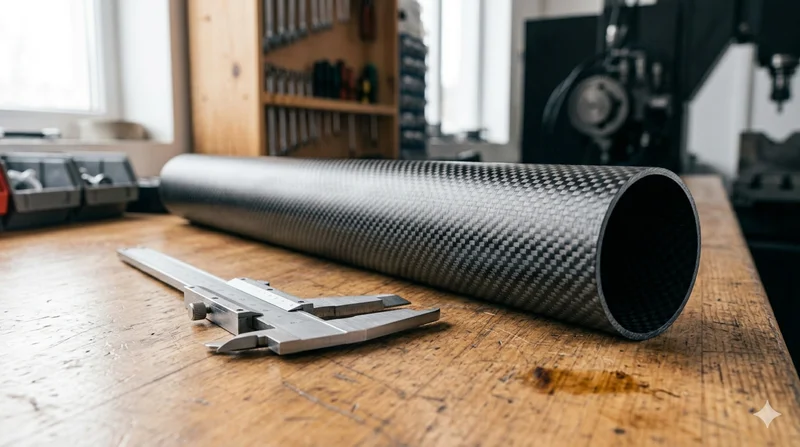
Standard round carbon fiber tube manufactured from Toray T700 grade fiber with 3K plain weave. Offers balanced strength and stiffness for general industrial applications including robotics, automation, sports equipment, and aerospace structures.
High Modulus Round Carbon Fiber Tube — M40
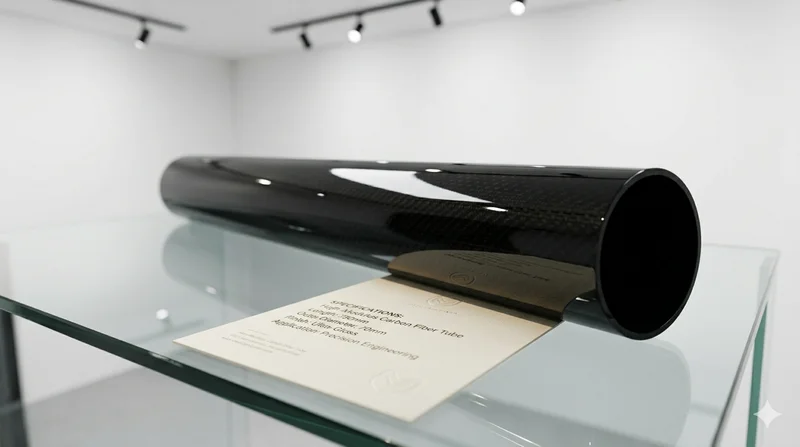
High modulus round tube manufactured with M40 grade fiber (tensile modulus 400 GPa). Designed for applications where maximum stiffness-to-weight ratio is critical, such as optical systems, precision machinery, and aerospace structures.