
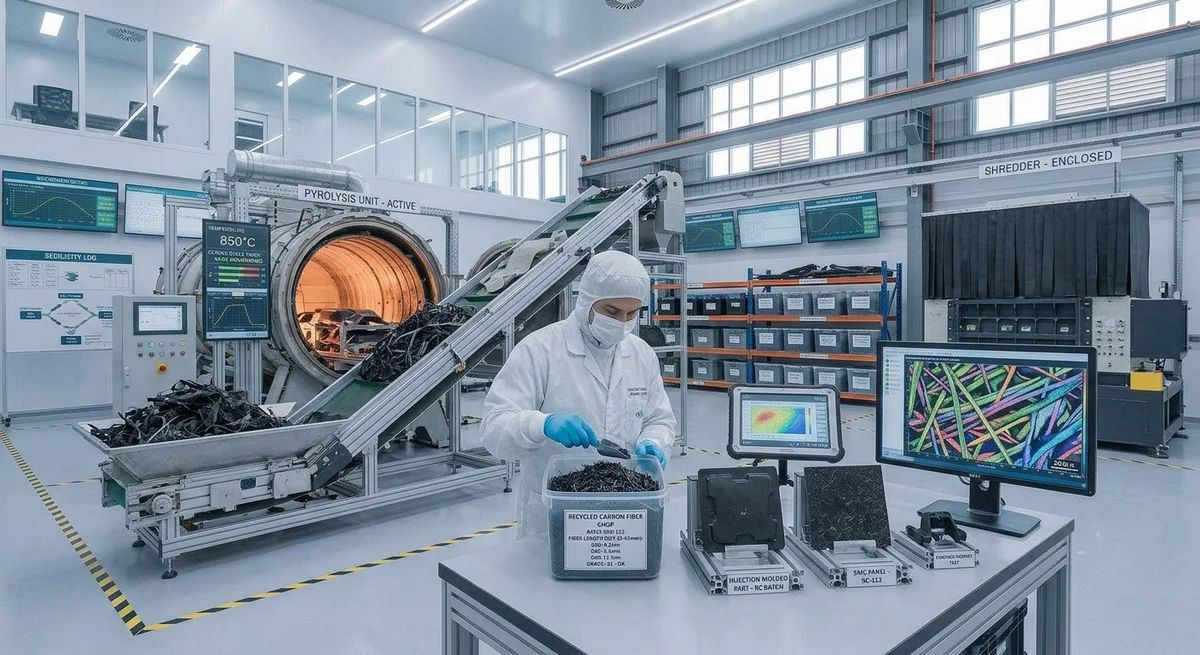
Carbon fiber recycling has transitioned from an environmental consideration to an economically viable industrial process. With global carbon fiber production exceeding 200,000 metr
Recycling Technologies and Cost Analysis
Current Commercial Processes
Four primary recycling technologies have achieved commercial scale:
| Technology | Process Description | Fiber Quality | Cost per kg | Maturity |
|---|---|---|---|---|
| Pyrolysis | Thermal decomposition at 400-800°C in inert atmosphere, resin removed, fibers recovered | 70-90% of virgin strength | $8-15/kg | Commercial (ELG Carbon Fibre, Carbon Conversions) |
| Fluidized bed | Oxidative removal of resin in fluidized sand bed at 450-550°C | 60-80% of virgin strength | $5-10/kg | Demo/commercial (Milled Carbon, DLR) |
| Solvolysis | Chemical dissolution of resin using solvents (supercritical water, alcohols, acids) | 85-98% of virgin strength | $12-25/kg | Pilot/commercial (Hitachi, Adherent Tech) |
| Microwave-assisted | Selective heating of fibers with microwave energy, resin pyrolysis | 80-95% of virgin strength | $10-18/kg | Pilot (University of Nottingham, industrial partners) |
Cost Comparison: Virgin vs Recycled Carbon Fiber
| Fiber Type | Price Range (USD/kg) | Key Characteristics |
|---|---|---|
| Virgin T700 (12K, standard modulus) | $18-28 | Consistent quality, aerospace-grade |
| Virgin T300 (3K, standard modulus) | $25-40 | Fine tow, woven fabric grade |
| Recycled (chopped, 3-12 mm) | $8-15 | Cost-effective, non-continuous |
| Recycled (milled, 50-200 µm) | $5-10 | Injection molding grade |
| Recycled (aligned discontinuous) | $12-18 | Higher mechanical performance |
The price gap of 40-60% between virgin and recycled fiber makes rCF economically attractive for applications where continuous fiber reinforcement is not required.
Recycled Carbon Fiber Material Properties
Mechanical Property Retention
Fiber strength retention depends on the recycling process and fiber type:
- Pyrolysis-recovered fibers: Retain 70-90% of tensile strength; modulus largely unaffected (95-100% retention). Surface treatment (oxidation, sizing application) can improve interfacial bonding in re-manufactured composites.
- Solvolysis-recovered fibers: Retain 85-98% of virgin fiber properties, approaching virgin quality. Higher cost limits application to specialized uses.
- Fluidized bed-recovered fibers: Lower strength retention (60-80%) but lowest cost. Suitable for non-structural and semi-structural applications.
Fiber Length Distribution
Recycled fibers are predominantly short (3-50 mm in chopped form, 50-200 µm in milled form). This limits their use in continuous-fiber applications but opens opportunities in:
- Injection molding compounds: 3-12 mm chopped fiber reinforced PA6, PA66, PEEK, or PP
- Sheet molding compounds (SMC): 12-50 mm fibers in compression-molded parts
- Nonwoven mats and veils: Random orientation, used in EMI shielding or cosmetic layers
- 3D printing filaments: rCF-reinforced PLA, ABS, or nylon filaments
Applications and Market Segments
Automotive (Non-Structural)
The automotive sector is the largest consumer of rCF, accounting for approximately 45% of recycled fiber demand. Applications include:
- Underbody shields: Compression-molded SMC with 20-40% rCF content, replacing glass fiber SMC at comparable cost with 30% weight reduction
- Interior trim panels: Injection-molded PA6 with 15-30% rCF, providing class-A surface finish capability
- Engine bay components: Heat-resistant PA66 with 20-30% rCF, replacing metal brackets and covers
- Brake components: rCF-reinforced phenolic pads for reduced weight and improved thermal conductivity
Consumer Electronics
Lightweight laptop casings, tablet frames, and smartphone components use injection-molded rCF compounds for their combination of stiffness, EMI shielding capability, and aesthetic appeal. The segment accounts for approximately 25% of rCF demand.
Construction and Infrastructure
Non-structural applications include:
- Concrete reinforcement fibers: Chopped rCF (10-30 mm) at 0.5-1.5% volume fraction for crack control in industrial flooring
- Architectural panels: Compression-molded rCF panels for facade cladding, offering 40-60% weight reduction vs aluminum
- Bridge repair wraps: Nonwoven rCF mats impregnated with epoxy for column wrapping (non-structural seismic retrofit)
Wind Energy
Blade manufacturers are investigating rCF for secondary structural elements including shear webs, root inserts, and internal stiffeners. While primary structural components still require virgin fiber, incorporating 15-25% rCF in non-critical areas can reduce total blade material cost by 8-12%.
Economic Viability Factors
Regulatory Drivers
EU regulations (EU Waste Framework Directive, End-of-Life Vehicle Directive) increasingly mandate composite recycling. The proposed Carbon Border Adjustment Mechanism (CBAM) may further increase virgin carbon fiber costs by adding carbon pricing to energy-intensive PAN precursor production. These regulatory trends favor recycled fiber adoption.
Volume and Supply Chain
Current global rCF production capacity is approximately 5,000-7,000 metric tons annually, projected to reach 15,000 metric tons by 2028. Key supply chain considerations for B2B buyers:
1. Feedstock availability: Scrap from aerospace manufacturing (Toray, Hexcel) and wind blade end-of-life provides consistent quality input material
2. Processing consistency: Batch-to-batch fiber property variation remains a concern; buyers should require statistical process control documentation
3. Sizing compatibility: rCF may lack the sizing (surface treatment) applied to virgin fibers; verify compatibility with target resin systems
FAQ
How much cheaper is recycled carbon fiber compared to virgin?
Recycled carbon fiber typically costs 40-60% less than virgin fiber. Chopped rCF (3-12 mm) ranges from $8-15/kg compared to virgin T700 at $18-28/kg. Milled grades are the most economical at $5-10/kg.
What strength retention does recycled carbon fiber have?
Strength retention varies by recycling process: pyrolysis yields 70-90%, solvolysis yields 85-98%, and fluidized bed processing yields 60-80% of virgin fiber tensile strength. Modulus retention is generally higher (95-100%) across all processes.
What are the main applications for recycled carbon fiber?
Automotive non-structural components (45% of demand), consumer electronics (25%), construction and infrastructure (15%), and wind energy secondary structures account for the majority of rCF applications. Injection molding and compression molding are the primary manufacturing processes.
Part of topic
Related Articles
- Recycled Carbon Fiber Market Forecast 2030: Technology Maturity and Commercialization Path
- South Korea Carbon Fiber Market 2026: Hydrogen Economy and Shipbuilding Innovation
- Wind Turbine Blade Leading Edge Protection 2026: Polyurethane, Tape, and Metallic Shield Solutions
- China Carbon Fiber Overcapacity 2026: Price War Impact and Industry Consolidation
- India Carbon Fiber Market 2026: Wind Energy, Aerospace, and Defense Expansion
- PAN Precursor Market 2026: Acrylonitrile Supply and Carbon Fiber Cost Structure
Interested in Our Products?
Contact our team for competitive pricing and technical specifications.
Get a QuoteRelated Products
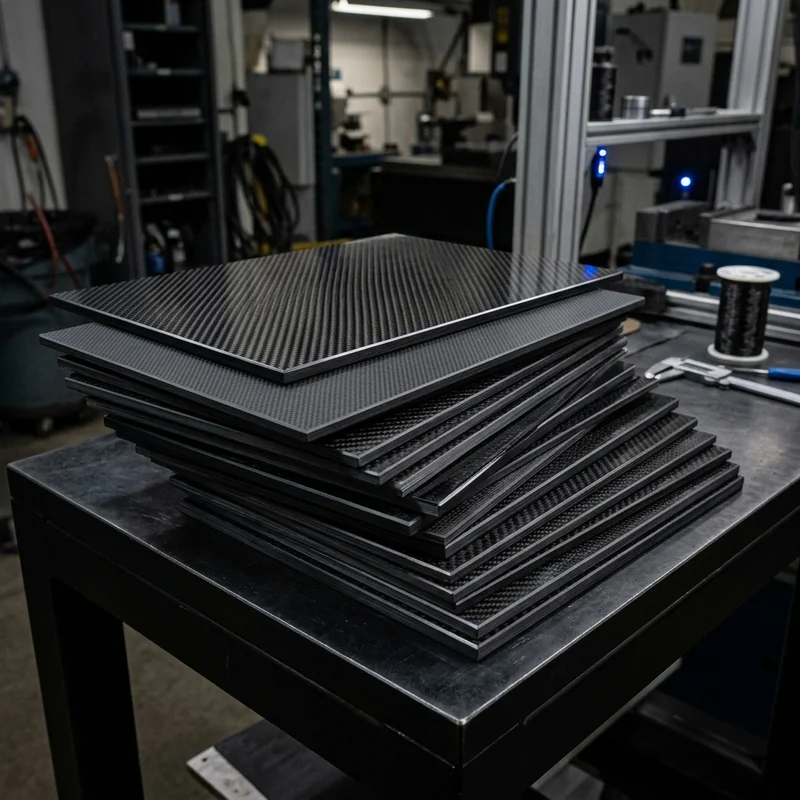
Carbon fiber standard plate-3k stripe
Lightweight, ultra-rigid standard sheets for drone fuselages, robot housings, facades and structural applications.

Carbon Fiber Plate — 3K Twill T700 1.5mm
Thin 1.5mm carbon fiber plate with 3K twill weave surface. Lightweight and stiff, commonly used for covers, panels, drone bodies, and applications requiring a premium aesthetic appearance.

Square Carbon Fiber Tube — 3K Twill T700
Square cross-section carbon fiber tube manufactured with 3K twill weave for torsional strength. Preferred for structural frames, trusses, and support columns where rectangular geometry offers design flexibility.

Carbon Fiber Plate — 3K Twill T700 3.0mm
Medium-thickness 3.0mm carbon fiber plate offering significantly higher load capacity while maintaining attractive 3K twill finish. Suitable for structural brackets, reinforcement plates, and load-bearing panels.
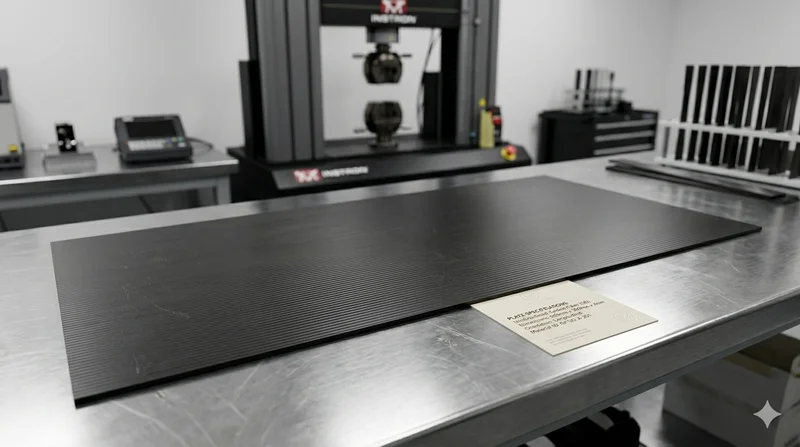
Carbon Fiber Plate — UD Unidirectional T700
Unidirectional carbon fiber plate with all fibers oriented in a single direction for maximum strength along the fiber axis. Essential for structural reinforcements, splints, and applications where load direction is predictable.