
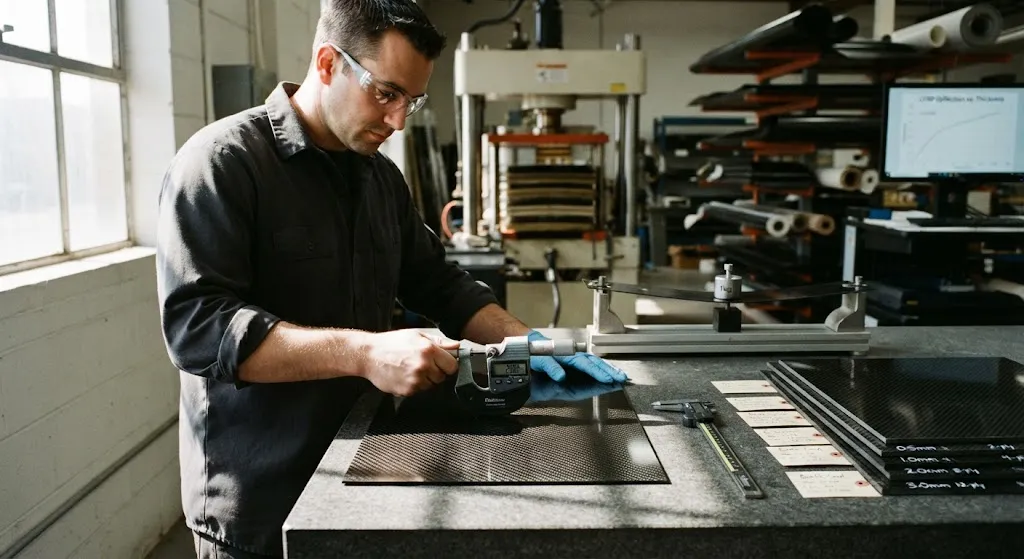
Carbon fiber plate thickness is the single specification that most strongly controls how a composite panel behaves, yet it is also the one buyers most often guess at. A plate that is too thin flexes under load, transmits vibration, and may delaminate; a plate that is too thick wastes weight and cost
Introduction
Carbon fiber plate thickness is the single specification that most strongly controls how a composite panel behaves, yet it is also the one buyers most often guess at. A plate that is too thin flexes under load, transmits vibration, and may delaminate; a plate that is too thick wastes weight and cost and can be impossible to drill or form cleanly. Because bending stiffness rises with the cube of thickness, moving from a 1.0 mm plate to a 2.0 mm plate does not make the part twice as stiff — it makes it roughly eight times stiffer, a change that transforms a design. Understanding that relationship is the key to specifying carbon fiber plate thickness correctly the first time.
This guide covers the standard thicknesses stocked in the market, how thickness and layup interact, a practical method for selecting a plate by span and load, and the measurement and tolerance details that should appear on every purchase order.
Standard Carbon Fiber Plate Thickness Options
Carbon fiber plate is built by stacking prepreg plies and curing them under heat and pressure, so the achievable thickness is a multiple of the cured ply thickness — typically 0.10 to 0.25 mm per ply depending on fibre areal weight. Suppliers consolidate these ply counts into a set of nominal stock thicknesses:
- 0.5 mm and 1.0 mm: Thin skins for lightweight covers, drone body panels, RC airframe skins, and cosmetic faces where stiffness comes from a core or frame.
- 1.5 mm and 2.0 mm: The workhorses for brackets, chassis panels, robot arms, and multirotor arms; a good balance of stiffness and weight.
- 2.5 mm and 3.0 mm: Structural plates for load-bearing brackets, suspension components, tooling, and prosthetics that see bending and impact.
- 4.0 mm to 6.0 mm and above: Heavy structural sections for machine tooling, marine hardware, and applications where stiffness outweighs the weight penalty.
The table below gives the areal weight and relative performance of common thicknesses for a standard-modulus, quasi-isotropic laminate with a density of about 1.55 g/cm³:
| Nominal Thickness | Areal Weight (kg/m²) | Relative Bending Stiffness | Relative Bending Strength | Typical Use |
|---|---|---|---|---|
| 0.5 mm | 0.78 | 1.0 | 1.0 | Cosmetic skins, light covers |
| 1.0 mm | 1.55 | 8.0 | 4.0 | Drone body panels, RC skins |
| 2.0 mm | 3.10 | 64.0 | 16.0 | Brackets, robot arms, plates |
| 3.0 mm | 4.65 | 216.0 | 36.0 | Structural brackets, tooling |
| 5.0 mm | 7.75 | 1000.0 | 100.0 | Heavy tooling, marine hardware |
The stiffness and strength columns are indexed to the 0.5 mm plate, so they show the power of the cube and square relationships directly: a 5 mm plate is about a thousand times stiffer in bending than a 0.5 mm plate, for a weight penalty of only ten times.
How Carbon Fiber Plate Thickness Affects Stiffness
For a flat plate in bending, stiffness scales with the cube of thickness, while strength scales with the square. The reason is geometric: the material far from the neutral axis carries most of the bending load, and moving material outward is exactly what increasing thickness does. Practical consequences follow from that single fact:
- Stiffness is cheap, strength is not: Adding thickness is the most efficient way to stop a plate from flexing, because a small thickness increase produces a large stiffness gain.
- Weight grows linearly: Doubling thickness doubles weight, but multiplies stiffness by eight — a favourable trade when deflection is the design driver.
- Layup orientation still matters: A thick plate of plies all aligned in one direction is stiff in that direction and weak in the others. A quasi-isotropic layup gives balanced stiffness but a lower modulus in any single direction.
- Thin plates fail differently: Below about 1.0 mm, a plate becomes sensitive to handling damage, edge cracking, and local buckling, so thin skins usually need a supporting core or frame.
The most common specification error is measuring a plate's performance by its nominal thickness alone while ignoring the layup. A 2 mm plate of well-oriented high-modulus fibre can outperform a 3 mm plate of low-grade woven material in the direction that matters, at lower weight.
Choosing the Right Carbon Fiber Plate Thickness
Selection starts from the load case, not the shelf. The method below is a fast first-pass estimate for a flat plate that carries a bending load:
- Define the span and support: Measure the unsupported distance between supports. A cantilever (fixed at one end) deflects far more than a plate simply supported at both ends for the same load.
- Set an allowable deflection: A common rule for precision equipment is span divided by 500; for a structure where flex is visible, span divided by 250 is often acceptable.
- Estimate the section stiffness: Bending stiffness is the elastic modulus times the second moment of area. For a flat strip of width b and thickness t, the second moment is b times t cubed divided by 12, which is why thickness dominates.
- Check the strength: Confirm the bending stress at the working load is below the material's flexural strength with a margin, typically a factor of two or more for dynamic loads.
- Add thickness for durability, not just stiffness: Impact, fastener pull-through, and edge handling often set a minimum practical thickness of 1.5-2.0 mm even when deflection allows less.
The table below gives first-pass thickness guidance for a 200 mm simply supported span with a 10 kg central load, assuming a quasi-isotropic standard-modulus laminate:
| Thickness | Approx. Central Deflection | Verdict |
|---|---|---|
| 1.0 mm | 18-25 mm | Far too flexible |
| 2.0 mm | 2.3-3.2 mm | Suitable for light, non-precision use |
| 3.0 mm | 0.7-1.0 mm | Good for general structural work |
| 5.0 mm | 0.15-0.22 mm | Rigid; use where deflection must be tiny |
These are estimates for early sizing only. Final selection should come from a measured flexural modulus for the actual layup, because the difference between a unidirectional and a woven laminate can shift deflection by 30 percent or more.
Carbon Fiber Plate Thickness Tolerance and Measurement
Nominal thickness is not the same as delivered thickness, and the gap is where most quality disputes begin. Prepreg plate is cured between platens, so the finished sheet carries a tolerance that depends on ply count, mould quality, and whether the surface is a peel-ply finish or a sanded cosmetic face. A few points matter when specifying:
- State nominal and tolerance: A typical commercial tolerance is plus or minus 0.10 to 0.20 mm, or plus or minus 10 percent on thicker sheets. Thin cosmetic plates can deviate more.
- Measure consistently: Use a micrometer with flat anvils at several points, not a caliper at a single spot, because cured plates can be slightly thicker at the centre than the edges.
- Account for the surface finish: A peel-ply surface and a gloss cosmetic surface of the same nominal plate can measure differently after finishing.
- Expect resin-rich surfaces: The outer resin layer adds thickness but little stiffness, so a plate that measures slightly over nominal may not be proportionally stronger.
Sourcing Carbon Fiber Plate
When ordering carbon fiber plate, define the following in writing:
| Specification Item | What to Define | Why It Matters |
|---|---|---|
| Nominal thickness | Target mm and tolerance | Sets stiffness and fit in an assembly |
| Layup and fibre | Unidirectional, woven, or quasi-isotropic; T300 to T700 | Controls directional stiffness and strength |
| Surface finish | Peel-ply, matte, or gloss cosmetic | Affects bonding, painting, and thickness |
| Panel size | Sheet dimensions and grain direction | Minimises waste and keeps orientation correct |
| Flatness | Maximum allowable bow or twist | Critical for tooling and precision parts |
| Test data | Flexural modulus and strength | Confirms the plate meets the load case |
Most projects start with a search for carbon fiber plate thickness near me or carbon fiber plate thickness suppliers, then widen to a carbon fiber plate thickness USA supplier when the required thickness or layup is not stocked locally. Before committing to a large order, request a sample of the exact thickness and layup and measure it yourself. A plate that measures 1.85 mm instead of a specified 2.00 mm loses about 25 percent of its bending stiffness, a difference that matters in any precision assembly.
Frequently Asked Questions
What is the most common carbon fiber plate thickness?
The 1.5 mm to 3.0 mm range covers the majority of applications. Thin 1.0 mm and 1.5 mm plates are used for drone body panels, RC airframe skins, and cosmetic covers where a core or frame provides the stiffness. The 2.0 mm to 3.0 mm plates are the workhorses for brackets, robot arms, chassis panels, and tooling, because they carry real bending loads without excessive weight. Above 4 mm the plate becomes a heavy structural section, used for machine tooling and marine hardware where rigidity outweighs the weight penalty. The right answer always depends on the span and load, not on a default.
Does a thicker carbon fiber plate mean a stronger plate?
Thicker means stiffer and stronger, but not in the same proportion. Bending stiffness rises with the cube of thickness, so doubling thickness makes a plate about eight times stiffer. Bending strength rises with the square, so the same doubling makes it about four times stronger. Weight, meanwhile, only doubles. That is why adding thickness is the cheapest way to remove deflection, and why a thin plate should be stiffened with a core or ribs rather than simply thickened when weight is critical. In practice, impact resistance and fastener pull-through often set the minimum usable thickness before stiffness does.
How is carbon fiber plate thickness measured and specified?
Measure with a flat-anvil micrometer at several points across the sheet, because cured plate can run slightly thicker at the centre than at the edges. Specify both a nominal thickness and a tolerance, typically plus or minus 0.10 to 0.20 mm for thin sheets, or plus or minus 10 percent for thick sections. Be aware that a peel-ply surface and a sanded cosmetic surface of the same nominal plate can measure differently, and that the outer resin-rich layers add thickness but very little stiffness. For critical parts, request the actual measured thickness and the flexural modulus, not just the catalogue figure.
Conclusion
Carbon fiber plate thickness is the lever that moves stiffness, strength, and weight together, and the cube relationship makes it unusually powerful. Selecting a plate starts with the span, the load, and an allowable deflection, then adds thickness for durability and fastener bearing. The common mistakes are specifying thickness without defining the layup, and accepting a nominal figure without measuring the delivered sheet, because a few tenths of a millimetre can change stiffness by a quarter.
If you are specifying a carbon fiber plate for a frame, bracket, or panel, browse our carbon fiber plate range in thicknesses from 0.5 mm to 6 mm and layups from woven cosmetic to high-modulus quasi-isotropic, or contact our engineering team for thickness selection and a quote for your project.
Part of topic
Related Articles
Interested in Our Products?
Contact our team for competitive pricing and technical specifications.
Get a QuoteRelated Products

Carbon Fiber Plate — 3K Twill T700 3.0mm
Medium-thickness 3.0mm carbon fiber plate offering significantly higher load capacity while maintaining attractive 3K twill finish. Suitable for structural brackets, reinforcement plates, and load-bearing panels.

Carbon Fiber Plate — 3K Twill T700 1.5mm
Thin 1.5mm carbon fiber plate with 3K twill weave surface. Lightweight and stiff, commonly used for covers, panels, drone bodies, and applications requiring a premium aesthetic appearance.

Square Carbon Fiber Tube — 3K Twill T700
Square cross-section carbon fiber tube manufactured with 3K twill weave for torsional strength. Preferred for structural frames, trusses, and support columns where rectangular geometry offers design flexibility.
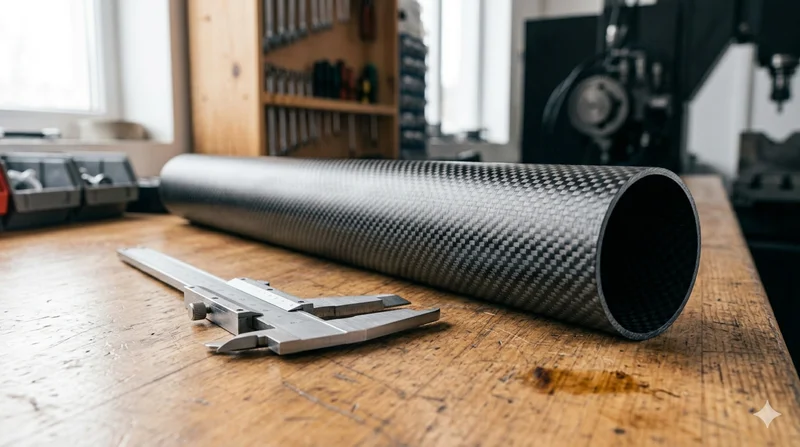
Round Carbon Fiber Tube — 3K Plain Weave T700
Standard round carbon fiber tube manufactured from Toray T700 grade fiber with 3K plain weave. Offers balanced strength and stiffness for general industrial applications including robotics, automation, sports equipment, and aerospace structures.
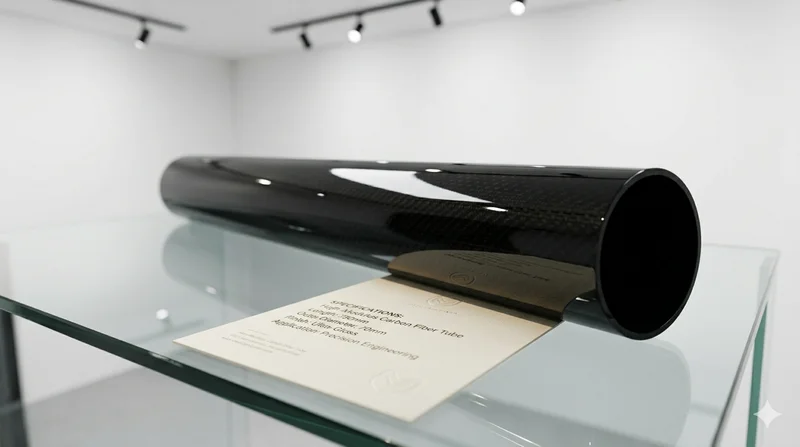
High Modulus Round Carbon Fiber Tube — M40
High modulus round tube manufactured with M40 grade fiber (tensile modulus 400 GPa). Designed for applications where maximum stiffness-to-weight ratio is critical, such as optical systems, precision machinery, and aerospace structures.