
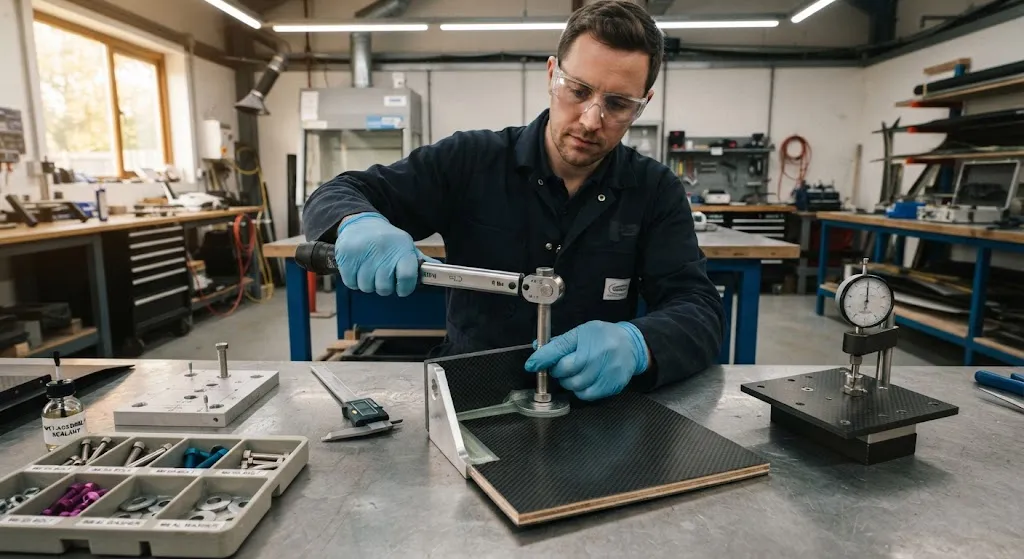
Carbon fiber plate metal fasteners are the bolts, screws, rivets, threaded inserts, and clamps that join carbon fiber plates to brackets, frames, and other panels. Carbon fiber is strong and stiff, but it is also brittle and conducts electricity, so a metal fastener behaves very differently in a car
Introduction
Carbon fiber plate metal fasteners are the bolts, screws, rivets, threaded inserts, and clamps that join carbon fiber plates to brackets, frames, and other panels. Carbon fiber is strong and stiff, but it is also brittle and conducts electricity, so a metal fastener behaves very differently in a carbon plate than in an aluminium one. The plate does not yield around a bolt hole the way metal does; instead it cracks, delaminates, or crushes if the hole, edge distance, or torque is wrong. At the same time, carbon is cathodic to most metals, so a bare metal fastener in a wet environment will drive galvanic corrosion that loosens the joint over time. Designing carbon fiber plate metal fasteners correctly means controlling load paths, edge geometry, hole quality, and electrical isolation, not simply picking a bolt that fits.
This guide covers fastener types, load paths, edge distance and hole quality, galvanic isolation, installation torque, and the specifications to define when sourcing.
Why Metal Fasteners in Carbon Fiber Plate Need Care
Metal and composite joints fail differently, and understanding why is the basis of every design rule:
- Brittle failure: metal yields and redistributes load around a hole; carbon fiber cracks at the hole edge once local stress passes its limit, so peak stress must be kept low by design.
- Notch sensitivity: an undersized hole, a hole drilled without backing, or a sharp cut edge starts a crack that grows under cyclic load.
- Clamping and delamination: carbon plate laminates resist in-plane load well but peel apart between plies, so a fastener that pulls the plate apart starts delamination.
- Galvanic corrosion: carbon is cathodic to steel, aluminium, and most alloys, so the metal corrodes and the joint loses preload.
The practical consequence is that a carbon fiber plate metal fastener joint should be designed for bearing and tear-out, with generous edge distance, clean holes, and a layer that isolates the metal from the carbon.
Fastener Types for Carbon Fiber Plate
The table below compares the fasteners most often used with carbon fiber plate:
| Fastener | Typical Use | Removable | Design Note |
|---|---|---|---|
| Hex bolt and nut | Primary structural joints | Yes | Highest load; needs washer and correct torque |
| Countersunk screw | Flush aerodynamic panels | Yes | Countersink can delaminate thin plate; add a doubler |
| Blind rivet | Non-structural panel fixing | No | Fast, but limited load and no preload |
| Threaded insert | Serviceable joints in thin plate | Yes | Distributes load; needs correct embedment |
| Hi-Lok or lockbolt | High-vibration structural joints | No | Controlled clamp-up, aerospace accepted |
| Clamp or bracket | Frames where drilling is unwanted | Yes | Spreads load over a lined contact area |
In practice, structural joints use bolts or lockbolts, serviceable panels use threaded inserts, and non-structural skins use rivets. Whichever is chosen, the fastener should be stainless steel, anodised aluminium, or coated, and it should never bear directly on bare carbon without isolation.
Load Paths: Bearing, Tear-Out, and Net-Section
A bolted carbon plate joint can fail in three ways, and each is controlled by geometry:
| Failure Mode | What Governs It | Design Rule |
|---|---|---|
| Bearing | Hole diameter, plate thickness, bearing strength | Keep bearing stress below 300-500 MPa for standard epoxy laminate |
| Tear-out | Edge distance to the hole centre | Minimum 2.5 to 4 times hole diameter |
| Net-section tension | Remaining plate width after holes | Keep hole area below 25 percent of the cross-section |
| Bolt shear or pull-through | Fastener strength and washer area | Use a washer under every head or nut |
Edge distance is the single most common cause of failure in the field. A hole too close to the edge tears out at a fraction of the plate's potential load, and no larger bolt compensates for it. The rule of thumb is a minimum edge distance of 2.5 times the hole diameter for a non-critical joint, rising to 4 times for a critical, fatigue-loaded joint. Hole spacing should be at least four diameters centre to centre, and the net section should retain at least 75 percent of the original width.
Galvanic Corrosion and Isolation
Carbon fiber is a conductor and sits high in the galvanic series, so when it contacts a less noble metal in the presence of an electrolyte, the metal becomes the anode and corrodes. The effect is worst with bare aluminium and mild steel in wet, salt, or humid service.
- Choose resistant metals: stainless steel and titanium are far more resistant than bare aluminium or steel.
- Isolate the interface: a thin glass-fibre ply or a polymer film between the plate and the metal breaks the conductive path.
- Coat the fastener: anodised aluminium, passivated stainless, or a plated finish reduces attack.
- Seal the joint: a wet-assembly sealant stops moisture reaching the interface in humid or marine use.
- Avoid mixed-metal stacks: do not let a steel bolt contact bare aluminium while both touch carbon in a wet joint.
For dry indoor frames the risk is low, but any outdoor, marine, or high-humidity application should treat isolation as mandatory rather than optional.
Installation and Hole Quality
Joint strength depends as much on hole quality as on the fastener:
- Drill with the right tool: use a diamond or carbide bit at moderate speed; a dull bit pushes fibers apart and leaves delamination.
- Back the plate: support the exit side with a sacrificial layer so the fibers are cut, not punched through.
- Control hole size: aim for a close clearance of about 0.1 to 0.2 mm; too loose lets the joint rattle, too tight forces the fastener and starts cracks.
- Deburr and seal: remove burrs and seal the hole with the isolating layer left intact around the edge.
- Torque correctly: use a torque wrench and a washer; over-tightening crushes the laminate and under-tightening lets the joint slip.
A recommended tightening torque depends on bolt size and plate thickness, but the principle is to clamp the plies without crushing them. For a typical M6 bolt in a 5 mm plate, a torque in the range of 5 to 10 Nm usually seats the joint without damaging the laminate, and this should always be confirmed with a pull or bearing test on a sample.
Sourcing Carbon Fiber Plate Metal Fasteners
When specifying carbon fiber plate metal fasteners, define the following in writing:
| Specification Item | What to Define | Why It Matters |
|---|---|---|
| Fastener material | Stainless 304/316, anodised aluminium, titanium, plated steel | Strength and corrosion resistance |
| Size and grade | M4 to M12, 8.8 or A2/A4 | Load capacity and compatibility |
| Coating or isolation | Anodised, passivated, or isolating washer | Prevents galvanic corrosion |
| Washer type | Flat washer, wide washer, bonded seal | Spreads clamp load, protects laminate |
| Edge distance kit | Drill jigs, hole templates | Ensures correct geometry |
| Validation data | Bearing or pull test certificate | Confirms the joint meets the load case |
Most buyers start with a search for carbon fiber plate metal fasteners near me or carbon fiber plate metal fasteners suppliers, and many then compare a local stockist with a carbon fiber plate metal fasteners USA supplier on price, grade availability, and lead time. Ask for the material certificate and, for structural joints, a bearing test on a sample of your actual plate. A single destructive test tells you the real joint capacity, and it gives your quality team a baseline to check production against.
Frequently Asked Questions
Can you bolt directly through carbon fiber plate?
Yes, but not without thought. A bolted joint works if the edge distance is at least 2.5 times the hole diameter, the hole is drilled cleanly with a diamond or carbide bit, and the load stays below the laminate bearing strength. A washer under the head or nut spreads the clamp load and protects the plate. For critical or fatigue-loaded joints, increase edge distance to four diameters and consider a doubler plate. Never rely on a large bolt to fix a hole that is too close to the edge.
Do metal fasteners cause corrosion in carbon fiber plate?
They can. Carbon fiber is cathodic to most metals, so a bare aluminium or steel fastener in a wet or salty environment will drive galvanic corrosion of the metal, which then loosens the joint. The fix is to use stainless or titanium fasteners, isolate the interface with a thin glass-fibre ply or polymer film, seal the joint with a wet-assembly sealant, and avoid mixed-metal stacks. For dry indoor use the risk is low, but outdoors or in marine service, isolation is mandatory.
How tight should you torque a fastener in carbon fiber plate?
Torque enough to clamp the plies without crushing them, and always with a flat washer under the head or nut. For a typical M6 bolt in a 5 mm plate, 5 to 10 Nm usually seats the joint without damaging the laminate, but the exact figure depends on plate thickness, ply stack, and the fastener. Always confirm with a pull or bearing test on a sample, use a calibrated torque wrench, and check the joint after a few load cycles to be sure no delamination has started at the hole.
Conclusion
Carbon fiber plate metal fasteners are ordinary bolts, screws, rivets, and inserts, but they must be applied with rules that respect the material. Carbon fiber is strong and brittle, so joints fail by bearing, tear-out, or delamination rather than by yielding, and edge distance of 2.5 to 4 times the hole diameter is the single most important geometric control. Carbon and metal also form a galvanic couple, so resistant alloys, an isolating layer, and sealed interfaces are needed wherever the joint sees moisture. Drilled cleanly, torqued correctly, and isolated properly, a metal-fastened carbon plate joint is light, strong, and durable.
If you are joining carbon fiber plates to a frame or building a bolted composite assembly, browse our carbon fiber plate and fastener range with standard, intermediate, and high-modulus plates plus matching stainless and anodised fasteners and isolating washers, or contact our engineering team for joint design advice and a quote for your project.
Part of topic
Related Articles
Interested in Our Products?
Contact our team for competitive pricing and technical specifications.
Get a QuoteRelated Products

Carbon Fiber Plate — 3K Twill T700 3.0mm
Medium-thickness 3.0mm carbon fiber plate offering significantly higher load capacity while maintaining attractive 3K twill finish. Suitable for structural brackets, reinforcement plates, and load-bearing panels.

Carbon Fiber Plate — 3K Twill T700 1.5mm
Thin 1.5mm carbon fiber plate with 3K twill weave surface. Lightweight and stiff, commonly used for covers, panels, drone bodies, and applications requiring a premium aesthetic appearance.

Square Carbon Fiber Tube — 3K Twill T700
Square cross-section carbon fiber tube manufactured with 3K twill weave for torsional strength. Preferred for structural frames, trusses, and support columns where rectangular geometry offers design flexibility.
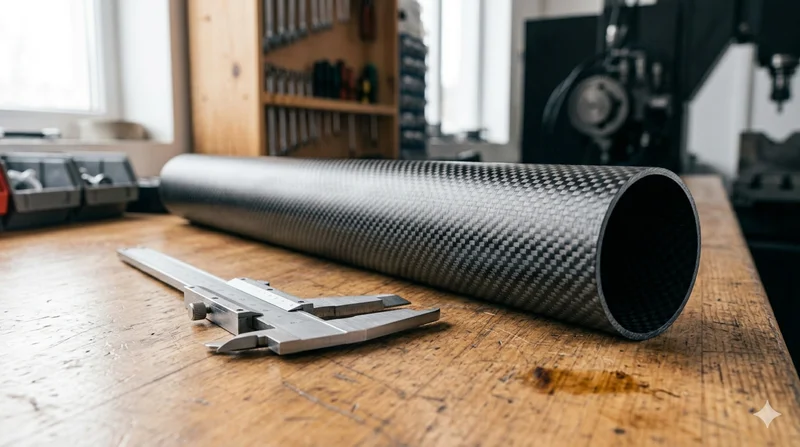
Round Carbon Fiber Tube — 3K Plain Weave T700
Standard round carbon fiber tube manufactured from Toray T700 grade fiber with 3K plain weave. Offers balanced strength and stiffness for general industrial applications including robotics, automation, sports equipment, and aerospace structures.
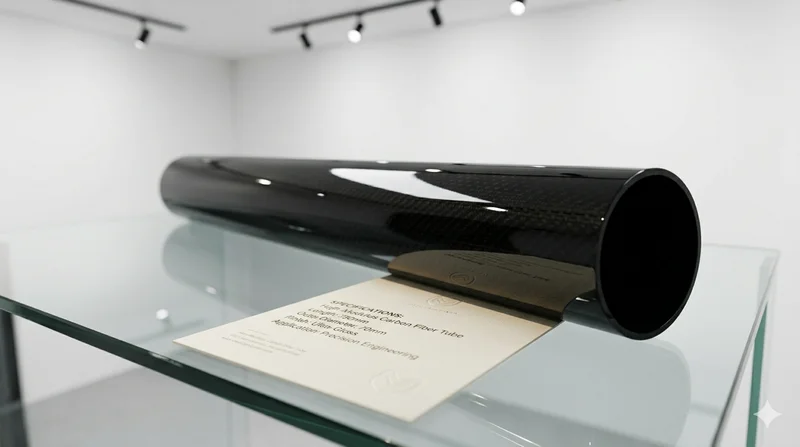
High Modulus Round Carbon Fiber Tube — M40
High modulus round tube manufactured with M40 grade fiber (tensile modulus 400 GPa). Designed for applications where maximum stiffness-to-weight ratio is critical, such as optical systems, precision machinery, and aerospace structures.