
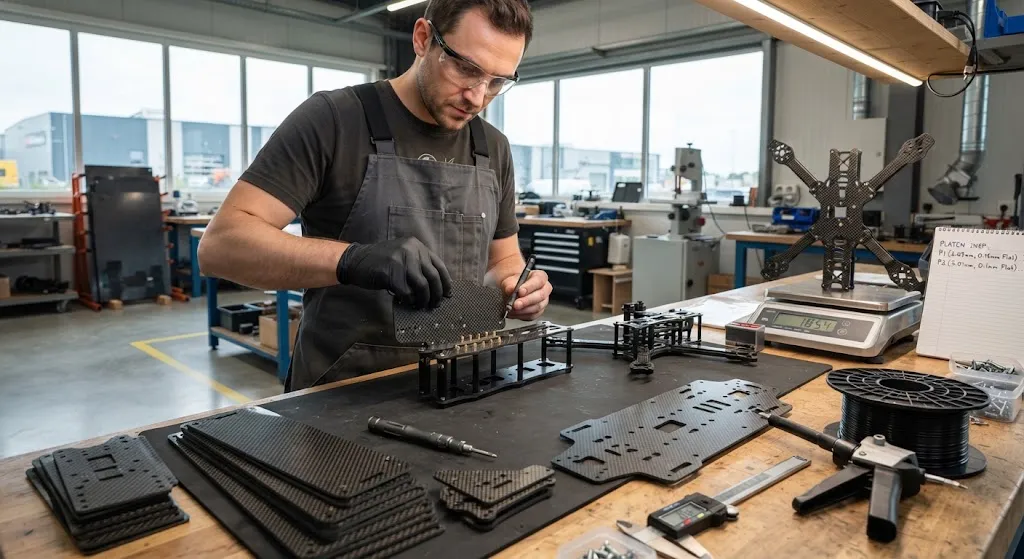
A carbon fiber plate frame is a structural assembly built from flat, machined sheets of carbon fiber reinforced polymer: side plates, cross members, and brackets cut from cured composite plate and joined with screws, inserts, or adhesive. This construction is everywhere in lightweight engineering —
Introduction
A carbon fiber plate frame is a structural assembly built from flat, machined sheets of carbon fiber reinforced polymer: side plates, cross members, and brackets cut from cured composite plate and joined with screws, inserts, or adhesive. This construction is everywhere in lightweight engineering — the familiar black frame of a racing drone, the chassis plates of a camera gimbal, the side panels of a robot arm, and the mounting structure of automated test equipment. A carbon fiber plate frame is attractive because flat plate is simple to machine, tolerances are easy to hold, and the resulting structure is far stiffer per kilogram than an equivalent metal frame.
This guide explains how carbon fiber plate is manufactured, how plate frames are designed and joined, how the material data translates into frame performance, and the specifications buyers should define when sourcing plate frames or the plate to build them.
How Carbon Fiber Plate Is Manufactured
Flat carbon fiber plate is produced by two principal routes, which set different mechanical and cost profiles:
- Compression moulding of prepreg laminates: Pre-impregnated carbon fiber fabric or unidirectional tape is stacked in a mould and cured under heat and pressure. This route gives the best fibre alignment, the highest stiffness, and the most consistent thickness, at the highest cost per kilogram.
- Resin infusion of dry fabric: Dry carbon fabric is stacked in a vacuum bag, resin is drawn through under vacuum, and the laminate cures at room or elevated temperature. This route is cheaper and suits larger or thicker plates, with slightly lower fibre volume fraction.
After cure, plates are cut to size and machined: water-jet cutting for clean edges without heat damage, CNC routing for holes and slots, and surface sanding for a consistent finish. The table below compares typical properties of carbon fiber plate with the metal plates it usually replaces:
| Property | Carbon Plate (T700, 0/90) | Aluminium 6061-T6 | Steel Plate |
|---|---|---|---|
| Tensile strength (MPa) | 600-900 | 290-310 | 400-550 |
| Tensile modulus (GPa) | 60-70 | 68-70 | 200-210 |
| Density (g/cm³) | 1.55-1.60 | 2.70 | 7.85 |
| Specific stiffness (GPa per g/cm³) | 38-45 | 25-26 | 25-27 |
| Fatigue endurance | Excellent | Good with limits | Good |
| Corrosion resistance | Excellent | Good, galvanic risks | Poor without coating |
The key insight is the specific stiffness column: a quasi-isotropic carbon plate is about 50-70 percent stiffer per unit mass than aluminium plate. Because many frames are stiffness-limited rather than strength-limited, that difference converts directly into a lighter frame at equal deflection, or a stiffer frame at equal weight.
Carbon Fiber Plate Frame Architectures
Most carbon fiber plate frames follow one of three architectures, chosen by the loading and assembly requirements:
- Monocoque plate chassis: Two or more parallel side plates joined by cross members and standoffs, forming a torsion-resistant box. Used for drone bodies, camera rigs, and small robots, where components mount on the flat faces of the plates.
- Sandwich plate panels: Two thin carbon plates bonded to a lightweight core, producing a panel with very high bending stiffness per kilogram. Used for floors, decks, and machine covers where flat, stiff surfaces are needed.
- Lattice and gusset frames: Narrow plate members cut into ribs, gussets, and brackets that brace a skeleton. Used for lightweight enclosures and test fixtures where weight is critical and surfaces are not.
The table below summarises the design choice in terms of stiffness, weight, and cost:
| Architecture | Relative Bending Stiffness | Relative Weight | Relative Cost | Typical Use |
|---|---|---|---|---|
| Monocoque plate chassis | High | Medium | Medium | Drones, robots, gimbals |
| Sandwich plate panel | Very high | Low | High | Floors, decks, covers |
| Lattice and gusset frame | Medium | Lowest | Low | Enclosures, test fixtures |
For a given application, the monocoque chassis is usually the default because it balances stiffness, component mounting, and manufacturing simplicity. Sandwich panels are chosen when a large flat surface must resist bending, and lattice frames when the structure is primarily a spacer that keeps components in position.
Joining and Mounting Plate Frames
The way plates are joined determines how much of the material's stiffness survives in the assembled frame. Common joining methods, in order of increasing load capacity:
- Threaded inserts and screws: Metal inserts bonded or pressed into holes in the plate, allowing repeated assembly and disassembly. Ideal for component mounting and maintenance access, with each insert rated for a defined pull-out load.
- Bonded lap joints: Plates joined with structural adhesive over an overlap area, transferring load through shear. Stronger and lighter than screws, but permanent and requiring fixturing during cure.
- Bolted joints with steel or aluminium hardware: Through-bolts with washers spread the load on the plate surface. Simple and demountable, but the bolt holes reduce the net section and introduce local stress concentrations.
Design rules for plate frames follow directly from these methods. First, keep holes away from plate edges — a hole closer than two diameters to an edge leaves too little material to carry the load and tears out under shock. Second, when bolting, use large washers or steel backing plates to spread the bearing load across the laminate, because the compressive strength of the resin in the through-thickness direction is low. Third, protect cut edges, which are the entry point for moisture and the origin of delamination in service; a thin epoxy edge seal is standard practice on machined carbon plate.
Applications of Carbon Fiber Plate Frames
Carbon fiber plate frames appear wherever a stiff, light, machinable structure is worth the material cost:
- Drones and UAVs: The classic carbon plate frame — motor mounts, arm plates, and central stack — delivering a stiff airframe at minimal weight for maximum flight time.
- Camera and gimbal systems: Rigid plate platforms and arm structures that hold sensors steady while motors correct for motion.
- Robotics and automation: Chassis and mounting plates for robot arms, linear stages, and end-of-arm tooling where low inertia improves speed and accuracy.
- Industrial test equipment: Fixtures and support frames that must hold tolerances under repeated loading without creeping.
- Medical equipment: X-ray-transparent support plates and patient positioning boards where metal would obstruct imaging.
- Motorsport and outdoor gear: Chassis plates for electric vehicles, bicycle components, and portable equipment housings.
In each case the decision logic is the same as for any composite application: the frame is heavier on a per-unit basis than a metal alternative, but the system benefit — longer flight time, faster motion, sharper images, or lower transport weight — pays for the material.
Sourcing and Specification Checklist
When buying carbon fiber plate or a finished plate frame, define the following in writing:
| Specification Item | What to Define | Why It Matters |
|---|---|---|
| Plate thickness | 1.0-10 mm standard; thicker on request | Sets stiffness, weight, and machining behaviour |
| Fibre grade and layup | T300, T700, or high-modulus; 0/90 or quasi-isotropic | Determines modulus and strength in both axes |
| Fibre volume fraction | 55-65% typical | Governs achievable stiffness and consistency |
| Surface finish | Glossy, matte, or sanded | Affects appearance, bonding, and UV protection |
| Machining specification | Water-jet, CNC routing, hole pattern drawing | Determines edge quality and dimensional accuracy |
| Edge sealing | Epoxy edge seal on all machined edges | Prevents moisture ingress and delamination |
Two practical points deserve emphasis. First, specify the layup explicitly: a 0/90 plate is stiffer along the fibre directions, while a quasi-isotropic plate behaves the same in every direction, which matters for frames loaded from multiple axes. Second, request a material data sheet and, for structural frames, a sample plate for drilling and edge-quality inspection before committing to volume.
Frequently Asked Questions
Can carbon fiber plate be drilled and machined like aluminium?
Yes, carbon fiber plate can be cut, drilled, routed, and water-jet machined, but with different tooling rules than metal. Use carbide or diamond-coated tooling and moderate speeds with light feed to avoid tearing the fibres at hole edges. Climb-milling or routing from both sides prevents edge splintering on the exit face, and a backing board under the plate gives clean through-holes. After machining, seal every cut edge with thin epoxy, because raw cut edges are where moisture enters and delamination starts. Water-jet cutting is the cleanest method for large plates because it produces edge quality without heat damage, while CNC routing is preferred for precise hole patterns and slots.
Is a carbon fiber plate frame stiffer than an aluminium frame?
At equal weight, yes: a quasi-isotropic carbon plate has roughly 1.5-1.7 times the specific stiffness of aluminium plate, so a frame with the same geometry weighs about 35-45 percent less at equal stiffness. At equal geometry, the carbon frame is stiffer in absolute terms by roughly the same ratio, but also lighter, so both advantages apply at once. The practical result is that a carbon plate frame is typically 40-60 percent lighter than an equivalent aluminium frame designed for the same deflection limit. The comparison is stiffness-driven because most frames are limited by deflection rather than by material strength; in strength terms the margin over aluminium is smaller but still positive in the fibre directions.
How thick should carbon fiber plate be for a drone frame?
For most small and medium drones, 2.0-3.0 mm plate is the standard choice for arm and chassis plates with T700 fibre in a 0/90 layup. Racing drones often use 3.0-4.0 mm arms for crash resistance, while light long-endurance aircraft can drop to 1.5-2.0 mm where weight matters more than impact strength. The right thickness depends on the span of the plate, the motor thrust and payload, and the expected crash loads — a good starting point is to design for the deflection limit first, then check the plate against impact and shock loads. Request a sample plate and run a simple bend test on your specific span before finalising the design.
Conclusion
Carbon fiber plate frames deliver a specific stiffness roughly 50-70 percent above aluminium with excellent fatigue and corrosion behaviour, which is why flat plate has become the default building block for drones, camera systems, robots, and test equipment. The technology is mature: compression-moulded prepreg and infused laminates produce consistent plate, water-jet and CNC machining hold tight tolerances, and inserts, screws, and bonded joints give engineers a full toolbox for assembly. The remaining engineering is in the details — layup choice, edge sealing, hole placement, and load spreading — all of which are well understood and easy to specify.
If you are designing a lightweight frame or replacing a metal chassis, browse our carbon fiber plate and sheet range in T300, T700, and high-modulus grades with cutting and CNC machining service, or contact our engineering team for design guidance and a quote for your project.
Part of topic
Related Articles
Interested in Our Products?
Contact our team for competitive pricing and technical specifications.
Get a QuoteRelated Products

Carbon Fiber Plate — 3K Twill T700 3.0mm
Medium-thickness 3.0mm carbon fiber plate offering significantly higher load capacity while maintaining attractive 3K twill finish. Suitable for structural brackets, reinforcement plates, and load-bearing panels.

Carbon Fiber Plate — 3K Twill T700 1.5mm
Thin 1.5mm carbon fiber plate with 3K twill weave surface. Lightweight and stiff, commonly used for covers, panels, drone bodies, and applications requiring a premium aesthetic appearance.

Square Carbon Fiber Tube — 3K Twill T700
Square cross-section carbon fiber tube manufactured with 3K twill weave for torsional strength. Preferred for structural frames, trusses, and support columns where rectangular geometry offers design flexibility.
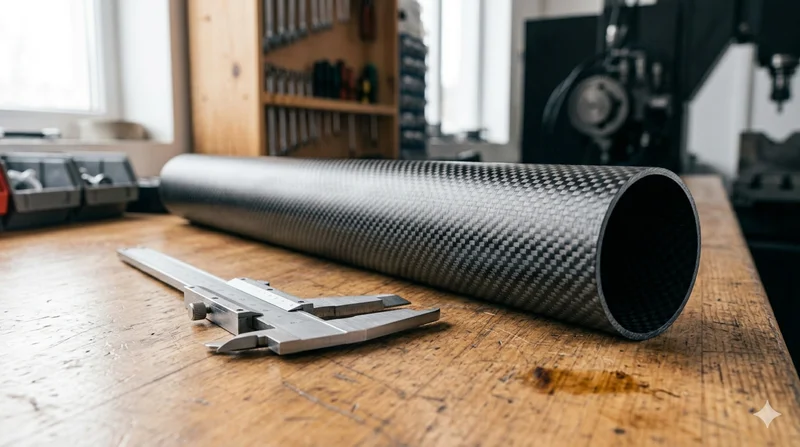
Round Carbon Fiber Tube — 3K Plain Weave T700
Standard round carbon fiber tube manufactured from Toray T700 grade fiber with 3K plain weave. Offers balanced strength and stiffness for general industrial applications including robotics, automation, sports equipment, and aerospace structures.
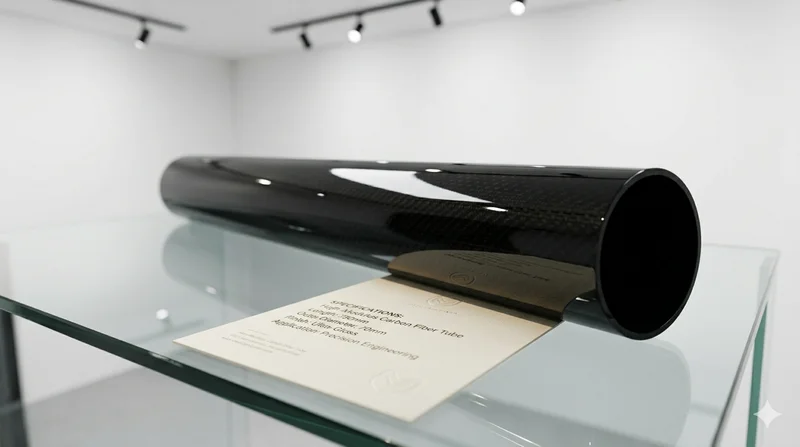
High Modulus Round Carbon Fiber Tube — M40
High modulus round tube manufactured with M40 grade fiber (tensile modulus 400 GPa). Designed for applications where maximum stiffness-to-weight ratio is critical, such as optical systems, precision machinery, and aerospace structures.