
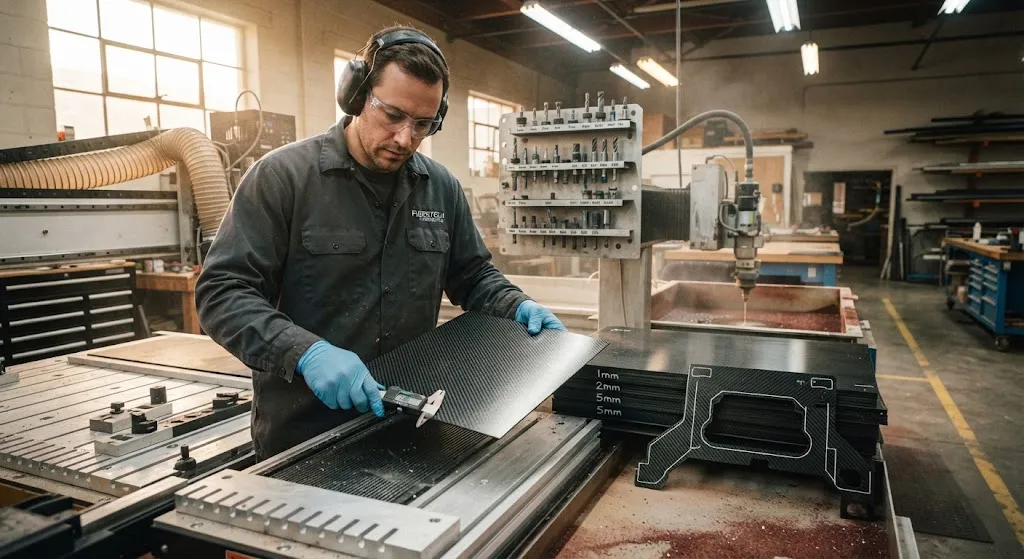
A carbon fiber plate is a flat sheet of carbon fiber reinforcement set in a polymer resin, supplied in thicknesses from 0.5 mm to 25 mm and cut to size. It is the sheet form of the same material used in tubes and profiles: strong and stiff along the fiber direction, very light, and resistant to fati
Introduction
A carbon fiber plate is a flat sheet of carbon fiber reinforcement set in a polymer resin, supplied in thicknesses from 0.5 mm to 25 mm and cut to size. It is the sheet form of the same material used in tubes and profiles: strong and stiff along the fiber direction, very light, and resistant to fatigue and corrosion. Designers reach for carbon fiber plate when a part must be thin, flat, and rigid, such as a drone frame, a robot arm link, a motorsport floor panel, or a stiffening gusset. Unlike a metal plate, carbon fiber plate cannot be bent cold or welded, so it is normally used flat or in a gentle curve formed in the mould. Choosing the right grade, weave, resin, and thickness is what makes carbon fiber plate deliver its weight advantage without failing at a fixing hole or a machined edge.
This guide explains what carbon fiber plate is, the grades, weave and resin options, thickness and mechanical properties, applications, machining, and the specifications to define when sourcing.
What Is a Carbon Fiber Plate
Carbon fiber plate is made by stacking layers of carbon fiber reinforcement, each oriented in a chosen direction, and bonding them with resin. In a unidirectional (UD) plate every layer runs the same way, giving maximum strength and stiffness in one direction. In a woven plate the layers use a plain or twill fabric, giving more balanced properties in two directions and a visible weave surface. The laminate is consolidated in an autoclave, a heated press, or a vacuum bag, then trimmed and, for stock sizes, machined to a final edge.
- Solid plate: a fully dense laminate used where stiffness and strength dominate.
- Sandwich panel: thin carbon skins bonded to a foam or honeycomb core, used where bending stiffness matters more than weight.
- Cored plate: a carbon skin on a light core for local stiffening and fastening.
Because carbon fiber plate is often stiffer than aluminum of the same weight and far stiffer than steel of the same volume, it lets designers remove material without losing rigidity. The trade-off is cost, brittle failure, and the need to design around fixing points.
Grades, Weave, and Resin Options
Three choices define a carbon fiber plate: the fiber grade, the weave architecture, and the resin system.
| Choice | Common Options | What It Controls |
|---|---|---|
| Fiber grade | Standard modulus (230-240 GPa), intermediate (280-300 GPa), high modulus (350-600 GPa) | Stiffness and cost; higher modulus is stiffer but more brittle |
| Weave | Unidirectional, plain weave, twill weave, spread tow | Directional strength, balance, surface appearance |
| Resin | Epoxy, phenolic, BMI, thermoplastic PEEK or PEKK, vinyl ester | Temperature, fire, toughness, chemical resistance |
| Finish | Matte, gloss, peel-ply, sanded, or painted | Bonding, cosmetics, wear resistance |
A structural plate usually uses standard or intermediate modulus fiber in a UD or spread-tow construction, with an epoxy resin. A cosmetics panel uses a twill weave so the weave pattern shows. A high-temperature part, such as an engine bay shield, moves to a phenolic or BMI resin. A wear part, such as a sliding surface, may use a thermoplastic resin because it resists abrasion and can be thermoformed.
Thickness and Mechanical Properties
Carbon fiber plate is stocked in a range of standard thicknesses, and each thickness carries a different stiffness per unit width. The table below gives typical values for a quasi-isotropic epoxy plate:
| Property | Typical Value | Design Note |
|---|---|---|
| Standard thickness | 0.5, 1, 2, 3, 5, 10, 20 mm | Custom plies give any target |
| Density | 1.55-1.60 g/cm3 | About 60 percent lighter than aluminum |
| Tensile strength (UD) | 1200-1800 MPa | Along the fiber direction |
| Tensile strength (quasi-isotropic) | 600-900 MPa | Balanced in-plane |
| Flexural modulus | 50-70 GPa | Drives plate stiffness |
| Operating temperature | -50 to +120 C | Epoxy; higher with special resin |
Two rules matter when specifying thickness. First, stiffness rises with the cube of thickness, so doubling plate thickness multiplies bending stiffness roughly eight times; it is usually cheaper to add thickness than to fit a stronger fiber. Second, strength is set by the laminate layup, not the thickness alone, so a 3 mm quasi-isotropic plate and a 3 mm UD plate behave very differently. Always specify the layup, not just the thickness.
Applications of Carbon Fiber Plate
- Drone and UAV frames: thin plates for arms, body plates, and camera mounts where weight and stiffness are critical.
- Robotics: arm links, end-effector plates, and base plates that must be light and rigid.
- Motorsport and automotive: floor panels, splitters, seat shells, and battery trays.
- Aerospace and defense: brackets, ribs, and access panels with high stiffness-to-weight.
- Marine and sports: mast fittings, bike components, and board plate inserts.
- Industrial tooling: check fixtures, robot grippers, and wear plates.
In each case the plate replaces a metal part, so the design must move material away from the neutral axis and add thickness where stiffness is needed, rather than rely on a single strong fiber direction.
Machining and Fabrication of Carbon Fiber Plate
Carbon fiber plate machines differently from metal, and the practice responds to that:
- Cutting: abrasive waterjet, diamond-coated router, or diamond saw; laser cutting chars the resin and is avoided for structural edges.
- Dust control: carbon dust conducts electricity and irritates skin, so use dust extraction and a mask.
- Edge finishing: sand or chamfer edges to stop delamination and to remove the sharp, splintered edge the cut leaves.
- Hole drilling: use a diamond or carbide bit, back the plate with a sacrificial layer, and drill at moderate speed to avoid cracking.
- Tool wear: the fiber is abrasive, so tool life is short; expect to replace cutters often.
Because the plate is brittle, over-tightened fasteners and undersized holes start cracks that grow under load. Designing the fixing with enough edge distance and the right bolt torque is as important as choosing the plate grade.
Sourcing Carbon Fiber Plate
When buying carbon fiber plate, define the following in writing:
| Specification Item | What to Define | Why It Matters |
|---|---|---|
| Fiber grade | Standard, intermediate, or high modulus | Sets stiffness, weight, cost |
| Layup and weave | UD, plain, twill, spread tow, and ply angles | Controls strength and appearance |
| Thickness tolerance | Plus or minus 0.1 mm typical | Affects fit and stiffness |
| Resin system | Epoxy, phenolic, BMI, thermoplastic | Sets temperature and toughness |
| Surface finish | Matte, gloss, peel-ply, sanded | Bonding and cosmetics |
| Cut sheet sizes | Standard sheet or cut to size | Controls waste and cost |
Most buyers start with a search for carbon fiber plate near me or carbon fiber plate suppliers, and many then compare a stock sheet supplier with a carbon fiber plate USA supplier on price, thickness availability, and lead time. Ask for the actual layup and fiber grade, not just the thickness, because two plates of the same thickness can differ by a factor of two in stiffness. For structural work, request a certificate with fiber volume fraction and flexural modulus so the plate can be checked against the design.
Frequently Asked Questions
How strong is a carbon fiber plate?
Strength depends on the layup and fiber grade. A unidirectional plate reaches 1200-1800 MPa in tension along the fibers, while a quasi-isotropic plate falls to 600-900 MPa because only some plies align with the load. Stiffness is set by the flexural modulus, typically 50-70 GPa for a standard epoxy laminate. The numbers that matter for a plate are almost always stiffness and edge strength, not tensile strength, because real parts bend and fasten rather than pull purely in tension.
Can carbon fiber plate be machined and drilled?
Yes, with the right tooling. Waterjet and diamond-coated router bits cut clean edges, and diamond or carbide drills make clean holes when the plate is backed with a sacrificial layer and drilled at moderate speed. Avoid laser cutting for structural parts because it chars the resin. Always use dust extraction, as carbon dust conducts electricity and irritates skin, and chamfer edges after cutting to stop delamination and remove the sharp edge.
What thickness of carbon fiber plate should I choose?
Choose thickness from the stiffness you need, not by copying a metal part. Bending stiffness rises with the cube of thickness, so a small increase in thickness adds far more stiffness than switching to a stronger fiber. A 2 mm plate is typical for drone arms and small brackets, 3 to 5 mm for robot links and larger frames, and 10 mm and above for heavy structural plates. Specify the layup as well as the thickness, because layup sets the strength.
Conclusion
Carbon fiber plate is the sheet form of carbon composite: thin, stiff, light, and available from 0.5 mm to 25 mm in standard, intermediate, and high-modulus grades with epoxy, phenolic, or thermoplastic resin. The key design points are to specify the layup and fiber grade rather than thickness alone, to add thickness where stiffness is needed because stiffness rises with the cube of thickness, and to design fixing points so the brittle edge does not crack. Machined and drilled correctly, a carbon fiber plate replaces metal with a fraction of the weight.
If you are building a lightweight frame, panel, or bracket, browse our carbon fiber plate range in standard, intermediate, and high-modulus grades, UD and twill weaves, and thicknesses from 0.5 mm to 25 mm, or contact our engineering team for a cut-to-size quote and layup advice for your project.
Part of topic
Related Articles
Interested in Our Products?
Contact our team for competitive pricing and technical specifications.
Get a QuoteRelated Products
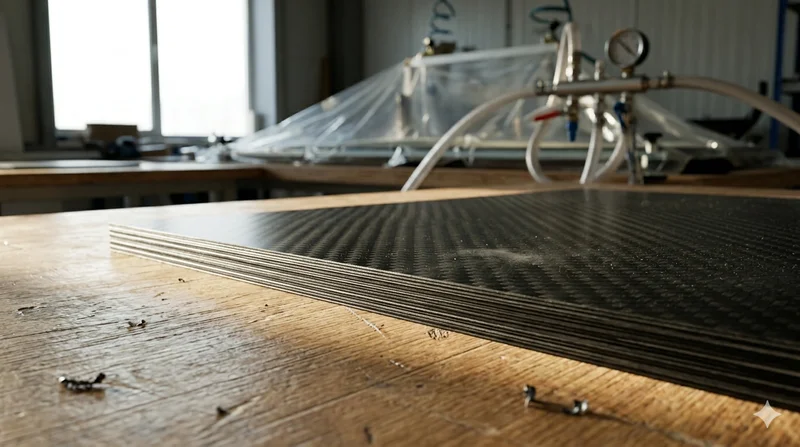
Carbon Fiber Plate — 3K Twill T700 3.0mm
Medium-thickness 3.0mm carbon fiber plate offering significantly higher load capacity while maintaining attractive 3K twill finish. Suitable for structural brackets, reinforcement plates, and load-bearing panels.

Carbon Fiber Plate — 3K Twill T700 1.5mm
Thin 1.5mm carbon fiber plate with 3K twill weave surface. Lightweight and stiff, commonly used for covers, panels, drone bodies, and applications requiring a premium aesthetic appearance.

Square Carbon Fiber Tube — 3K Twill T700
Square cross-section carbon fiber tube manufactured with 3K twill weave for torsional strength. Preferred for structural frames, trusses, and support columns where rectangular geometry offers design flexibility.
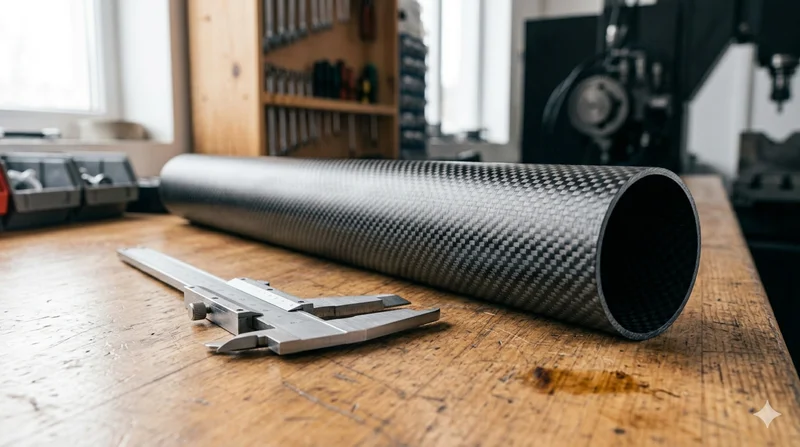
Round Carbon Fiber Tube — 3K Plain Weave T700
Standard round carbon fiber tube manufactured from Toray T700 grade fiber with 3K plain weave. Offers balanced strength and stiffness for general industrial applications including robotics, automation, sports equipment, and aerospace structures.
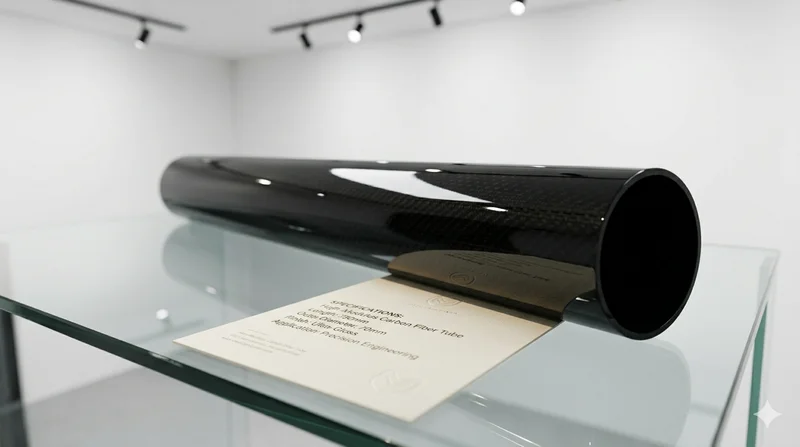
High Modulus Round Carbon Fiber Tube — M40
High modulus round tube manufactured with M40 grade fiber (tensile modulus 400 GPa). Designed for applications where maximum stiffness-to-weight ratio is critical, such as optical systems, precision machinery, and aerospace structures.