
Searching for a carbon fiber manufacturer in India usually returns two very different kinds of company: firms that convert carbon fiber into parts, fabric and prepreg, and the small group actually producing virgin fiber. Understanding which layer of the value chain a supplier sits in is the single m
Introduction
Searching for a carbon fiber manufacturer in India usually returns two very different kinds of company: firms that convert carbon fiber into parts, fabric and prepreg, and the small group actually producing virgin fiber. Understanding which layer of the value chain a supplier sits in is the single most useful filter when evaluating the market, because pricing, minimum order quantities and technical support all change with the layer. This guide maps the Indian composites landscape, explains what a carbon fiber supplier in India can and cannot deliver today, places carbon fiber fabric manufacturers in India in the chain, compares a carbon fiber sheet manufacturer in India against imported plate on landed cost and lead time, and closes with the verification checks worth running before any first order.
India's composites industry is large in glass fiber and growing quickly in carbon: demand is driven by wind energy, automotive, defence, rail and a fast-expanding drone sector, while domestic carbon fiber capacity remains a fraction of consumption — which is why imports from Japan, the United States, Europe and China still set the price floor.
Two Different Markets: Fiber Production Versus Conversion
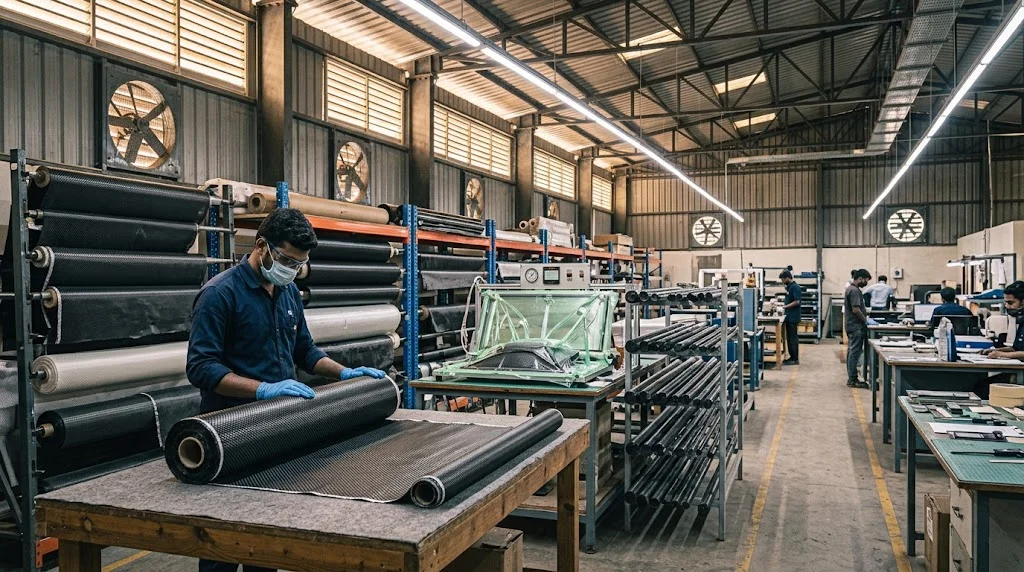
A virgin carbon fiber plant — polyacrylonitrile precursor, oxidation, carbonization, surface treatment, winding — is a heavy chemical-industry investment measured in thousands of crore. A conversion plant — cutting fabric, wet layup, vacuum infusion, autoclave prepreg, compression moulding, pultrusion lines — is a few tens of crore and far more common. Most companies that call themselves carbon fiber manufacturers in India sit in the second layer: they buy fibre or fabric, then sell value-added material or finished parts. That is not a criticism; conversion is a real business with real capability. It simply means the buyer should ask, in the first email, whether the company spins fibre, makes fabric, or builds parts.
| Value-chain layer | Typical Indian capability | What the buyer gets | Watch-outs |
|---|---|---|---|
| Virgin fibre | strategic programs, limited commercial volume | domestic supply security for defence | grade range narrower than Japanese or US lines |
| Fabric and UD tape | woven fabric, some UD, modest prepreg | shorter lead times than importing rolls | weave consistency and resin match need checking |
| Sheet and plate | infusion and autoclave plate, sandwich panels | local pricing in INR, regional freight | tolerance and flatness specs vary widely |
| Finished parts | automotive, rail, drone, sporting goods | design support and series production | IP and tooling ownership must be contracted |
What a Carbon Fiber Supplier in India Delivers Today
The competitive core of Indian supply is conversion: roll-wrapped tubes, pultruded rods and profiles, infused plates, moulded brackets, and an increasing number of drone-frame kits. Lead times for standard pultruded rod are often under two weeks domestically; custom roll-wrapped tube runs three to six weeks depending on mandrel availability. Price on standard pultruded stock is competitive with Chinese ex-works pricing once freight and duties are normalised for domestic delivery, and custom moulding becomes genuinely attractive above fifty pieces because labour-intensive layup costs less than in Europe or North America. Prepreg remains the weak link: domestic prepreg lines exist but the grade selection is thinner than from Japanese or US suppliers, so advanced programmes still import the material and localise the layup.
Carbon Fiber Fabric Manufacturers in India and the Import Dependency
Fabric weaving is the layer where Indian capability has grown fastest. Plain, twill and satin weaves in 3k and 12k tow are available domestically, UD tape exists in smaller widths, and several converters now stock common weights for quick-turn plate work. The dependency that remains is fibre itself: most fabric is woven from imported Japanese, American or Chinese tow, which means fabric pricing tracks the rupee-dollar rate and global fibre market with a lag of one to two months. When a fabric supplier quotes you, ask which fibre brand is on the loom this month — the answer determines both price stability and whether your laminate datasheet will match a repeat order six months later.
Carbon Fiber Sheet Manufacturer in India: Local Versus Imported Landed Cost
For standard quasi-isotropic plate in 2 to 6 mm thickness, a carbon fiber sheet manufacturer in India is usually the cheaper landed option for domestic projects: no ocean freight, no customs clearance delay, invoices in rupees, and technical visits possible within a day. Imported plate still wins on three fronts — certified aerospace-grade laminates with full traceability, ultra-flat optical grades, and exotic hybrids that no local line runs. A practical rule: prototype and series parts on local plate, imported plate only when a specification explicitly names it. Ask every Indian sheet manufacturer for a cured-property datasheet and a tolerance statement in writing; responses to that single request separate the professional shops from the trading houses within one email exchange.
Buyer Checks Before the First Order
Five checks cost an hour and prevent most first-order disappointments. Run all five before any deposit changes hands.
- Confirm the legal entity: check GST registration and the factory address, and ask for a works visit or a live video tour of the autoclave or infusion bay.
- Request a laminate datasheet: fibre brand, orientation sequence, resin system and cured mechanical properties, on letterhead or as a controlled document.
- Order a small paid sample: a single plate or a metre of tube before any production quantity.
- Write tolerances into the purchase order: dimension, flatness and surface finish belong in the PO, not in the email chain.
- Clarify tooling and design ownership: in writing, if you supply drawings for parts or moulds.
Companies that pass all five without friction are rare anywhere in the world; companies that fail three of them are common everywhere.
Frequently Asked Questions
Does India produce its own virgin carbon fiber?
Yes, at strategic and limited commercial scale, primarily aimed at defence and space programmes. Commercial grade breadth and volume still trail the major Japanese, US and Chinese producers, so most civil composites manufacturing in India runs on imported fibre.
Is Indian carbon fiber sheet cheaper than Chinese plate delivered to Europe?
For domestic Indian use, local plate almost always wins on landed cost. Exported to Europe, the freight and duty gap narrows sharply, and the answer depends on the grade: standard plate stays competitive, certified aerospace laminates usually do not.
How do I verify a carbon fiber manufacturer in India is a real factory?
Ask for GST and Udyam registration documents, a live video tour of the production floor, a recent customer reference in your industry, and a small paid sample order. Trading houses typically cannot produce a factory video with your sample running on a machine that day.
Conclusion
The average carbon fiber manufacturer in India is a capable converter working on imported fibre, and for tubes, plates and moulded parts that is exactly what many programmes need. Keep the value-chain layer in every conversation, demand the datasheet before the deposit, sample before series, and route certified or exotic material requirements to established global fibre producers while letting Indian conversion strength do what it does well — labour-intensive custom work at sensible prices.
YongXian manufactures carbon fiber tube, rod, plate and custom laminates with controlled layups and ships worldwide, including to buyers sourcing alongside Indian suppliers for multi-source programmes. Browse our carbon fiber range or send your drawing for a quote.
Part of topic
Related Articles
- Carbon Fibre Custom Plate: A UK Buyer Guide
- Carbon Fiber Cloth Supplier Guide: How to Evaluate 3K, 12K and Weave Types
- Carbon Fiber Tube Price in BD: Bangladesh Market and Import Guide
- Carbon Fiber Drone Frame Price: Tiers, Thickness, and Cost Drivers
- Carbon Fibre Sheet Custom Size Guide: Ordering Cut-to-Size Plates for UK and EU Buyers
- Carbon Fiber Sheets for Sale Near Me: A Local Sourcing Guide
Interested in Our Products?
Contact our team for competitive pricing and technical specifications.
Get a QuoteRelated Products

Round Carbon Fiber Tube — 3K Plain Weave T700
Standard round carbon fiber tube manufactured from Toray T700 grade fiber with 3K plain weave. Offers balanced strength and stiffness for general industrial applications including robotics, automation, sports equipment, and aerospace structures.

Square Carbon Fiber Tube — 3K Twill T700
Square cross-section carbon fiber tube manufactured with 3K twill weave for torsional strength. Preferred for structural frames, trusses, and support columns where rectangular geometry offers design flexibility.

Carbon Fiber Pickleball Paddle
High-performance pickleball paddle with Toray T700 carbon fiber face and polypropylene honeycomb core. Delivers excellent power-to-weight ratio, spin generation, and vibration dampening for competitive play.
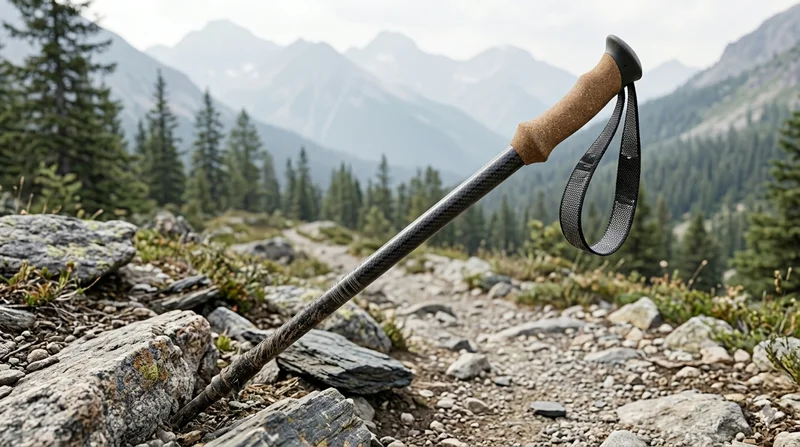
Carbon Fiber Trekking Pole
Lightweight carbon fiber trekking pole manufactured from high-grade carbon fiber tube. Weighs only 160g per pole while providing superior shock absorption and durability for hiking, trail running, and backpacking.

Round Carbon Fiber Tube — 3K Twill
Lightweight and ultra-stiff round tubes ideal for drone frames, robotics, and structural applications.