
A technical analysis of global carbon fiber supply, demand, and emerging applications for 2026, with demand shift data across aerospace, robotics, and drone sectors.
Introduction
Carbon fiber continues to reshape lightweight structural design across aerospace, industrial robotics, and emerging high-tech sectors. As of mid-2026, global installed carbon fiber capacity has surpassed 160,000 metric tons per annum. This article provides a technical overview of the current supply-demand landscape, key markets, and novel applications reshaping carbon fiber specifications.
Global Supply-Demand Overview (2024–2026)
| Year | Global Capacity (tons) | Global Demand (tons) | Utilization Rate | Avg Price IM7 (USD/kg) |
|---|---|---|---|---|
| 2024 | 128,000 | 112,000 | 87.5% | $42 |
| 2025 | 145,000 | 130,000 | 89.7% | $38 |
| 2026 est. | 163,000 | 152,000 | 93.3% | $35 |
The tightening utilization rate reflects capacity additions lagging behind demand growth, particularly in high-modulus grades (450 GPa+). Aerospace demand grew at 6–8% CAGR, while industrial segments expanded at 10–12% CAGR.
Key Markets: Aerospace, Robotics & Drones
Aerospace consumes approximately 28% of global output by revenue. Boeing 787 and Airbus A350 use over 50% carbon fiber by weight. Next-generation narrowbody programs are driving demand for high-tensile-strength fibers (≥5,500 MPa, 290 GPa) with improved toughness.
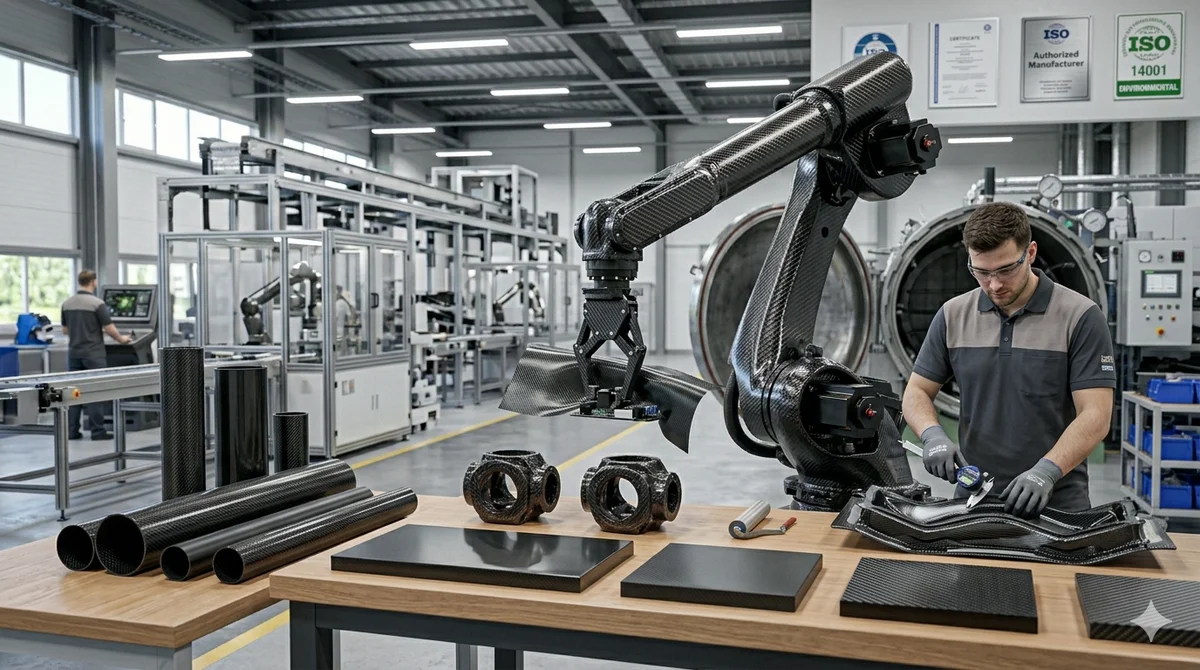
Industrial robotics requires high stiffness-to-weight ratios (≥130 GPa) to minimize deflection. Carbon fiber tubes replace steel arms, reducing moving mass by 40% and enabling faster cycle times. We supply precision pultruded tubes with ±0.1 mm tolerance for this application.
Drones and eVTOL represent a shift toward cost-sensitive, high-performance composites. Commercial drones use woven carbon fiber prepreg achieving specific modulus of 70–90 GPa/(g/cm³). T700-grade fibers (4,900 MPa) dominate automated layup processes for heavy-lift cargo drones.
Emerging Applications
- Satellite components: Near-zero CTE (~0.5 × 10⁻⁶/°C) and high specific stiffness make carbon fiber ideal for antenna reflectors and optical benches. Medium-modulus fibers (300 GPa) with cyanate ester resins are standard for low-outgassing space structures.
- Exoskeletons: Medical and military exoskeletons require lightweight, high-fatigue-life materials. Filament-wound carbon fiber tubes (5–15 mm diameter) in load-bearing frames reduce system weight to under 15 kg while supporting over 100 kg payload. Fatigue performance over 10⁶ cycles at 70% UTS has been validated.
- Hydrogen storage: Type IV pressure vessels with carbon fiber overwrap store compressed hydrogen at 70 MPa. T800-grade fiber (5,880 MPa tensile) achieves burst pressure safety factor of 2.25. Global demand for hydrogen storage carbon fiber is projected to reach 15,000 tons by 2027.
Frequently Asked Questions
What is the primary growth driver for carbon fiber in 2026?
Industrial segments — pressure vessel manufacturing for hydrogen storage and robotic system lightweighting — now account for over 35% of new capacity absorption. Cost reductions from enlarged PAN precursor supply have enabled wider adoption in price-sensitive sectors.
How does carbon fiber compare to aerospace aluminum (7075-T6)?
Standard modulus carbon fiber exhibits tensile strength of 3,500–4,900 MPa (vs. 570 MPa for 7075-T6) and modulus of 230–290 GPa (vs. 72 GPa). Density is 1.75 g/cm³ (vs. 2.81 g/cm³). Specific modulus is 130–160 GPa·cm³/g, roughly 4–5× higher than aluminum. However, carbon fiber is anisotropic and requires careful design for out-of-plane loads.
What are the main challenges in recycling carbon fiber?
Mechanical recycling produces short fibers with 40–60% retained strength. Pyrolysis (400–700°C) recovers fibers with ~80% retained modulus but 20–30% strength loss. Lack of standardized grades and limited cost competitiveness ($8–12/kg vs. $2–5/kg virgin) hamper adoption. Industry is shifting toward in-process scrap reuse.
Conclusion
The carbon fiber market in 2026 is defined by tightening supply of intermediate- and high-modulus fibers, with aerospace and hydrogen storage competing for precursor capacity. We provide custom tubes, plates, and machined parts for demanding applications. Browse our products or contact our engineers.
Part of topic
Related Articles
- Recycled Carbon Fiber Market Forecast 2030: Technology Maturity and Commercialization Path
- South Korea Carbon Fiber Market 2026: Hydrogen Economy and Shipbuilding Innovation
- Wind Turbine Blade Leading Edge Protection 2026: Polyurethane, Tape, and Metallic Shield Solutions
- China Carbon Fiber Overcapacity 2026: Price War Impact and Industry Consolidation
- India Carbon Fiber Market 2026: Wind Energy, Aerospace, and Defense Expansion
- PAN Precursor Market 2026: Acrylonitrile Supply and Carbon Fiber Cost Structure
Interested in Our Products?
Contact our team for competitive pricing and technical specifications.
Get a QuoteRelated Products
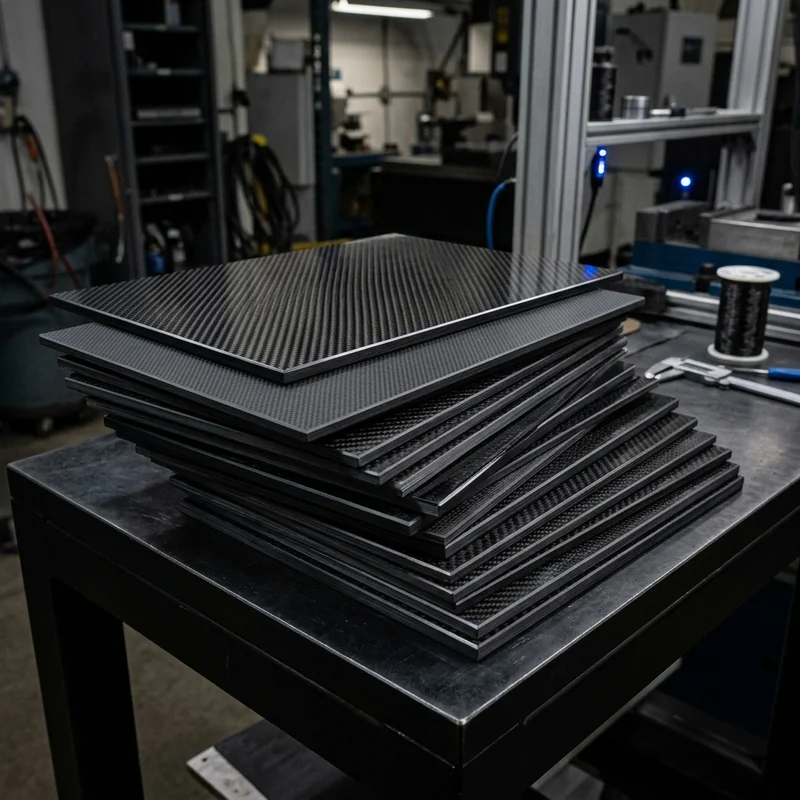
Carbon fiber standard plate-3k stripe
Lightweight, ultra-rigid standard sheets for drone fuselages, robot housings, facades and structural applications.

Carbon Fiber Plate — 3K Twill T700 1.5mm
Thin 1.5mm carbon fiber plate with 3K twill weave surface. Lightweight and stiff, commonly used for covers, panels, drone bodies, and applications requiring a premium aesthetic appearance.

Square Carbon Fiber Tube — 3K Twill T700
Square cross-section carbon fiber tube manufactured with 3K twill weave for torsional strength. Preferred for structural frames, trusses, and support columns where rectangular geometry offers design flexibility.

Carbon Fiber Plate — 3K Twill T700 3.0mm
Medium-thickness 3.0mm carbon fiber plate offering significantly higher load capacity while maintaining attractive 3K twill finish. Suitable for structural brackets, reinforcement plates, and load-bearing panels.
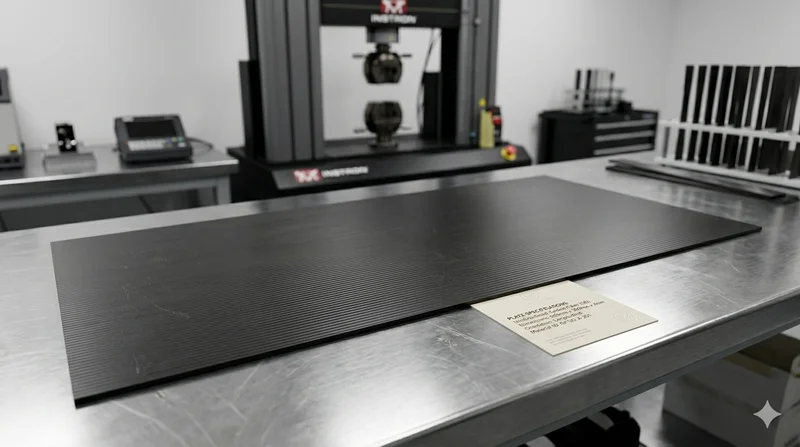
Carbon Fiber Plate — UD Unidirectional T700
Unidirectional carbon fiber plate with all fibers oriented in a single direction for maximum strength along the fiber axis. Essential for structural reinforcements, splints, and applications where load direction is predictable.