
Understanding carbon fiber custom parts cost structure is the difference between a realistic budget and a project that stalls at the quoting stage. Carbon fiber custom parts are manufactured in small batches for prototypes, racing programs and medical devices, and in high volumes for automotive, dro
Introduction
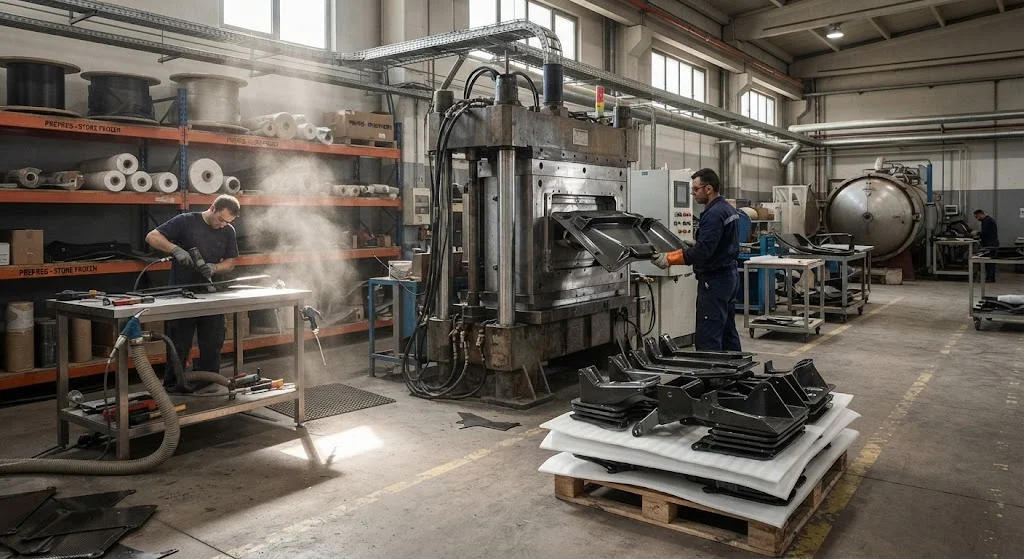
Understanding carbon fiber custom parts cost structure is the difference between a realistic budget and a project that stalls at the quoting stage. Carbon fiber custom parts are manufactured in small batches for prototypes, racing programs and medical devices, and in high volumes for automotive, drone and consumer products — and the cost per part changes by an order of magnitude across that range. The drivers are not mysterious: tooling amortization, process selection, labor content, material waste and inspection all scale differently with volume. This article breaks down where the money goes in carbon fiber custom parts manufacturing, compares small-batch and high-volume economics with worked numbers, and explains what information a supplier needs to produce an accurate quote.
Why Carbon Fiber Custom Parts Cost What They Cost
Every carbon fiber custom part carries five cost components, and each behaves differently as volume grows:
- Materials: carbon fiber prepreg or fabric, resin, consumables and waste. Prepreg costs 30-80 USD per kilogram at automotive grades and 80-200 USD for aerospace grades; net-shape cutting reduces but never eliminates waste.
- Tooling: molds, mandrels and fixtures. A hand-layup mold may cost 3,000-15,000 USD; an injection or compression tool 20,000-100,000 USD. Tooling is a fixed cost that shrinks per part only as volume grows.
- Labor: layup, bagging, trimming and assembly. Skilled layup labor dominates small-batch cost, typically 60-75 percent of unit price at low volume.
- Process and energy: autoclave, oven or press cycles. Autoclave cure cycles of 2-6 hours tie up expensive equipment and energy.
- Inspection: dimensional checks, ultrasonic or porosity testing, and documentation. Fixed per batch, but proportional to part complexity.
This structure explains the central rule of carbon fiber pricing: at low volume the part price is dominated by labor and tooling, while at high volume materials and automation take over.
Small Batch vs High Volume: Where the Cost Curve Breaks
The table below models a representative structural carbon fiber custom part — a 400 by 300 mm bracket — across three production scales. The numbers illustrate the shape of the cost curve, not a specific quote:
| Cost element | Prototype (1-10 pcs) | Medium batch (50-200 pcs) | High volume (1,000+ pcs) |
|---|---|---|---|
| Tooling cost per part | 1,500-5,000 USD | 150-500 USD | 20-100 USD |
| Material per part | 80-150 USD | 60-120 USD | 40-80 USD |
| Labor per part | 150-400 USD | 40-120 USD | 10-30 USD (automated) |
| Process per part | 50-150 USD | 30-80 USD | 15-40 USD |
| Inspection per part | 30-100 USD | 10-40 USD | 3-15 USD |
| Total per part | 1,800-5,700 USD | 290-860 USD | 88-265 USD |
Two conclusions follow. First, a part that costs several thousand dollars in prototype quantities can fall below 300 USD at a few hundred pieces — volume is the single largest pricing lever. Second, the break point between hand-layup and automated processes sits near 500-1,000 pieces per year; below that volume the automation investment does not pay back.
A third pattern deserves attention: the mid-volume trap. Many projects are priced once at prototype scale and once at target scale, but never at the transition volume of 200-500 pieces, where tooling is still being amortized and automation is not yet viable. Buyers who ask suppliers to price every volume step — 10, 100, 500 and 1,000 pieces — see the full curve and can schedule orders to land on the cheapest steps instead of the expensive middle. For most programs, the cheapest way to buy a part is to commit to a volume you can actually absorb, because every pricing step is built on utilization assumptions that vanish when orders arrive irregularly.
Process Choice: The Hidden Cost Driver in Custom CFRP Parts Cost
Custom CFRP parts cost is defined less by the fiber than by the manufacturing process, because each process trades tooling cost against cycle time and labor:
- Hand layup and autoclave: the most flexible, best surface quality, but 2-6 hour cycles and heavy labor. Ideal for 1-100 pieces and aerospace-grade properties.
- Compression molding: matched metal or composite tools press prepreg or sheet molding compound into net shape in 5-20 minute cycles. Tooling is expensive; unit cost drops steeply above 500 pieces.
- Resin transfer molding (RTM): dry preform plus injected resin; 10-30 minute cycles with good tolerances and Class A surfaces. Competitive from 200-2,000 pieces.
- Automated fiber placement (AFP): robotically laid tows; lowest labor content and waste, but million-dollar capital equipment. Economical above several thousand pieces.
For buyers, the practical takeaway is to state target volume honestly in the inquiry — quoting the wrong process for the real volume is the most common source of both overpaying and under-delivering.
Getting an Accurate Quote for Carbon Fiber Custom Parts
Bespoke carbon fiber pricing depends heavily on the information provided, and a custom composite parts quote is only as good as the inquiry behind it. Suppliers need eight inputs to price accurately:
- Full 3D CAD or drawings with tolerances and surface finish class.
- Annual volume and delivery schedule, not just total quantity.
- Mechanical requirements — stiffness, strength, fatigue or pressure values.
- Environmental exposure — temperature range, chemicals, UV and humidity.
- Attachment and joining constraints — inserts, fasteners, bonded interfaces.
- Visual quality requirements — cosmetic class, paint readiness, fiber pattern visibility.
- Certification needs — material data sheets, test reports, lot traceability.
- Target cost — a realistic band, so the supplier can select the process that hits it.
A supplier that responds with a process recommendation, a tooling plan and a cost breakdown rather than a single number is worth more than the cheapest quote, because the breakdown exposes where the money goes and what volume changes would save.
Suppliers also price risk into every quote: incomplete drawings, undefined tolerances and unstated cosmetic requirements all add contingency, so completing the inquiry before asking for numbers lowers both the price and the cycle time.
Frequently Asked Questions
Why is my one-off carbon fiber part so expensive compared to mass-produced carbon parts?
A one-off part carries the full cost of tooling, skilled labor and inspection on a single unit. The 1,800-5,700 USD prototype bracket in the table above is expensive not because carbon fiber is intrinsically costly but because every fixed cost lands on one part. Mass-produced carbon parts spread the same tooling across thousands of units and replace hand labor with automation. If you need one or two parts, consider standard stock shapes — tubes, plates and profiles — cut and machined to size, which reuse existing tooling and can cost a fraction of a custom mold.
At what volume does carbon fiber custom parts manufacturing become cost-effective?
Cost-effectiveness depends on the alternative. Against machined aluminum, carbon fiber parts typically break even at 500-2,000 pieces per year once weight savings deliver system benefits; against steel, the crossover is higher because the baseline is cheaper. Against a cheaper composite process, the crossover is defined by tooling cost and cycle time — compression molding overtakes hand layup around 500-1,000 pieces. The honest answer is that every process has a volume window, and the cheapest part comes from matching the process to the true annual volume rather than to the part's material alone.
What information do I need to prepare before requesting a carbon fiber quote?
Prepare the eight inputs listed above: CAD with tolerances, real annual volume, mechanical and environmental requirements, joining constraints, cosmetic class, certification needs and a target cost band. The most common quoting delay is vague volume — suppliers must guess the process, and a wrong guess produces either an uncompetitive price or an unproducible one. Providing a complete inquiry typically cuts the quoting cycle from weeks to days and produces more accurate numbers on the first pass.
Conclusion
Carbon fiber custom parts pricing follows a predictable structure: labor and tooling dominate at low volume, materials and automation at high volume, and the process choice — hand layup, compression molding, RTM or AFP — determines where the crossover points sit. A prototype bracket costing several thousand dollars per unit can fall below 300 USD at a few hundred pieces, which is why honest volume data is the most valuable input in the quoting process. Buyers who specify tolerances, volumes and requirements completely, and who evaluate quotes on the breakdown rather than the total, consistently pay less and receive more producible parts.
Explore our range of carbon fiber fabrics, prepregs and tows for custom parts programs, or contact our engineering team for process selection, quoting support and prototype-to-production guidance.
Part of topic
Related Articles
- Filament Wound Epoxy Tubes Cost: Materials, Process and Volume Pricing
- Microwave-Assisted Carbonization for Carbon Fiber: Energy Savings and Quality Improvement
- Carbon Fiber Laser Cutting and Trimming: Automation for High-Volume Production
- Pyrolysis Recycled Carbon Fiber: Mechanical Property Retention and Reuse Applications
- Carbon Fiber Bio-Composites: Natural Fiber Hybrid Reinforcement for Sustainable Applications
- RFID Tracking for Carbon Fiber Supply Chain: Traceability and Quality Assurance
Interested in Our Products?
Contact our team for competitive pricing and technical specifications.
Get a QuoteRelated Products
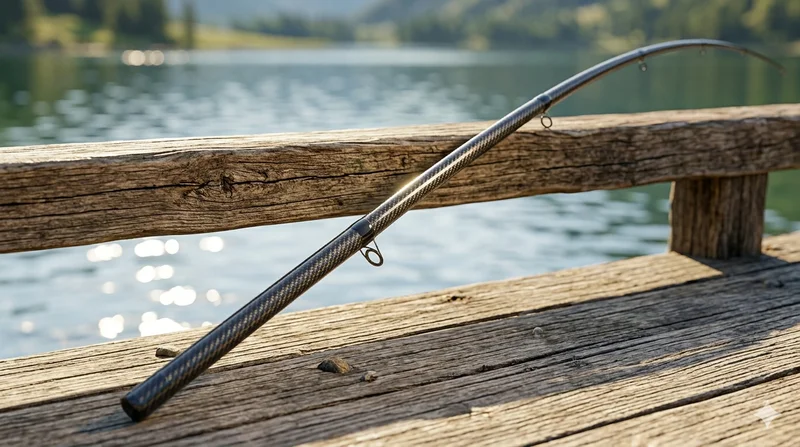
Carbon Fiber Fishing Rod Blank
High-quality carbon fiber fishing rod blank manufactured from multiple grades of Toray carbon fiber cloth. Available in a wide range of lengths, powers, and actions for freshwater and saltwater applications. Suitable for OEM rod building.
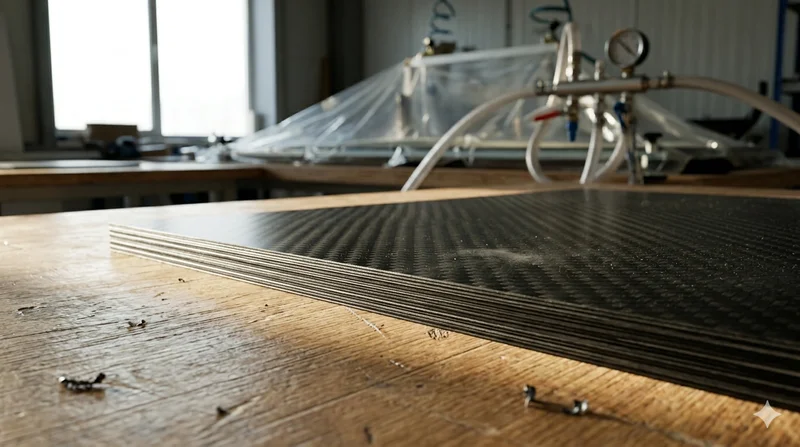
Carbon Fiber Plate — 3K Twill T700 3.0mm
Medium-thickness 3.0mm carbon fiber plate offering significantly higher load capacity while maintaining attractive 3K twill finish. Suitable for structural brackets, reinforcement plates, and load-bearing panels.
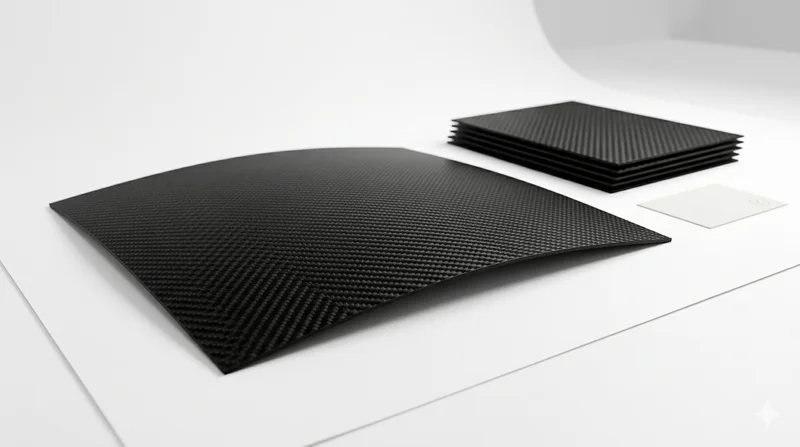
Carbon Fiber Plate — 3K Twill T700 1.5mm
Thin 1.5mm carbon fiber plate with 3K twill weave surface. Lightweight and stiff, commonly used for covers, panels, drone bodies, and applications requiring a premium aesthetic appearance.
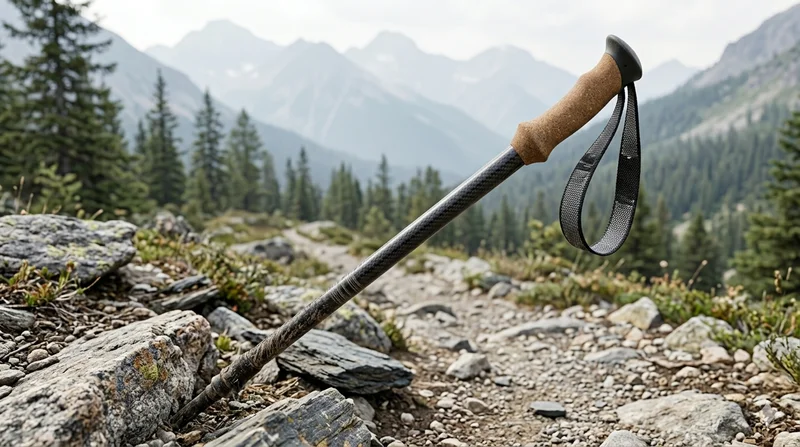
Carbon Fiber Trekking Pole
Lightweight carbon fiber trekking pole manufactured from high-grade carbon fiber tube. Weighs only 160g per pole while providing superior shock absorption and durability for hiking, trail running, and backpacking.
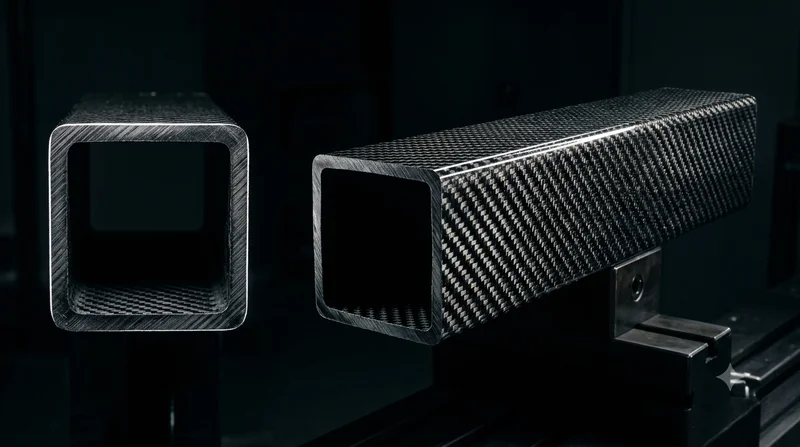
Square Carbon Fiber Tube — 3K Twill T700
Square cross-section carbon fiber tube manufactured with 3K twill weave for torsional strength. Preferred for structural frames, trusses, and support columns where rectangular geometry offers design flexibility.