
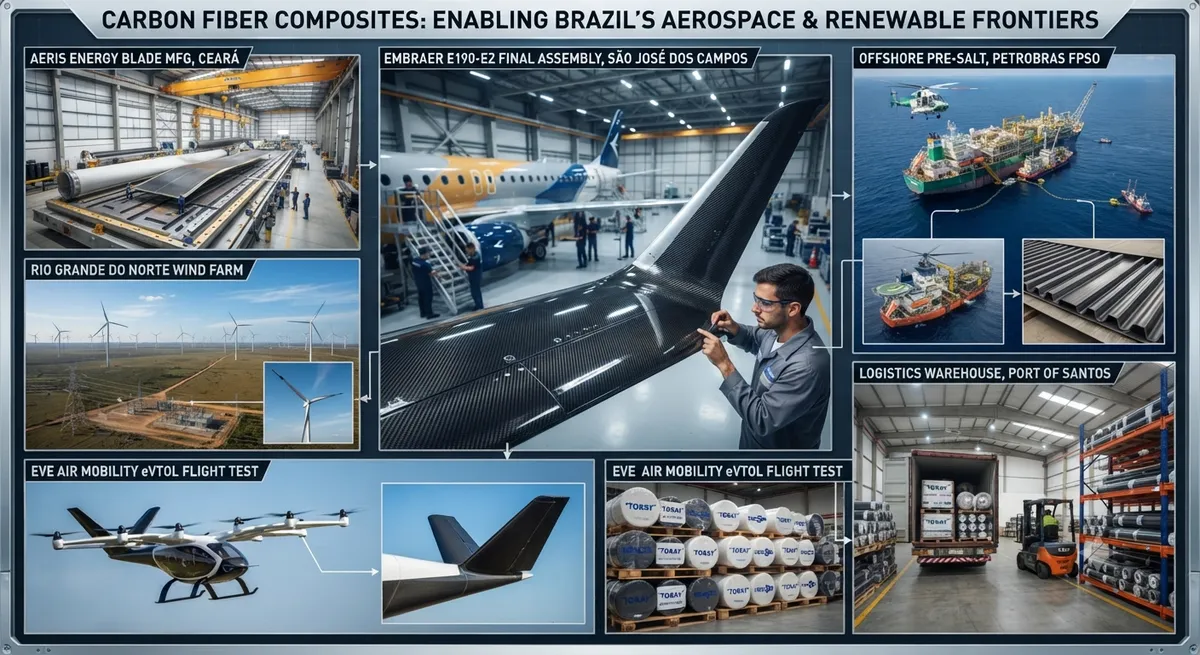
Analysis of Brazil's growing carbon fiber market driven by Embraer's aerospace production, wind energy expansion in the Northeast, and emerging oil & gas composite applications in pre-salt fields.
Brazil's carbon fiber market is undergoing a structural transformation in 2026, driven by three converging industrial forces: Embraer's expanding aerospace production, the accelerating build-out of onshore and offshore wind energy in the Northeast region, and the growing adoption of composite solutions in the oil and gas sector serving pre-salt fields. Together, these sectors are projected to consume over 4,800 metric tons of carbon fiber in 2026, representing a compound annual growth rate (CAGR) of 14.2% since 2021.
- Aerospace production: Embraer's E-Jets E2 family uses composites for 22% of structural weight; Eve eVTOL program expected to add 35–40% more CFRP consumption.
- Wind energy expansion: Northeast Brazil installed 3.2 GW of new capacity in 2025; blade length growth from 59 m to 85 m drives carbon fiber content from 1.8 to 4.2 tons per blade.
- Oil and gas adoption: Petrobras pre-salt fields increasingly deploy composite flexible risers and CFRP repair wraps for corrosion management.
- Infrastructure gap: Brazil has no domestic PAN precursor production; all carbon fiber is imported with 12–14% import duties adding $8–12/kg to landed costs.
Market Size and Segmentation
| Sector | 2025 Consumption (tons) | 2026E Consumption (tons) | Growth (%) | Key Driver |
|---|---|---|---|---|
| Aerospace (Embraer + MRO) | 1,240 | 1,420 | +14.5% | E2 backlog + Eve eVTOL |
| Wind energy (blades + nacelles) | 1,850 | 2,150 | +16.2% | NE onshore + offshore pilot |
| Oil & gas (risers, pipes, topside) | 580 | 680 | +17.2% | Pre-salt deepwater expansion |
| Automotive (racing + luxury) | 280 | 310 | +10.7% | Export-oriented hypercar OEMs |
| Sports & consumer goods | 150 | 170 | +13.3% | Surfing / cycling / fishing |
| Other (construction, medical) | 70 | 80 | +14.3% | Seismic retrofit + implants |
| Total | 4,170 | 4,810 | +15.3% |
Embraer's Aerospace Supply Chain
Embraer, the world's third-largest commercial aircraft manufacturer, is the anchor customer for carbon fiber composites in Brazil. The company's E-Jets E2 family — with a firm backlog of 298 aircraft as of Q1 2026 — uses composite materials for approximately 22% of its structural weight, including the empennage (horizontal and vertical stabilizers), winglets, nacelle components, and interior parts. The Eve Air Mobility eVTOL program, with 2,850 letter-of-intent orders, is expected to increase Embraer's CFRP consumption by a further 35–40% once series production begins (currently slated for late 2027). Embraer sources its carbon fiber primarily from Toray (via Toray do Brasil, its São Paulo-based distribution center) and Hexcel, with annual supply agreements totaling approximately 850 tons of prepreg and dry fiber. The company's local supply chain includes Oxiteno (resin systems) and a growing network of Tier 2 composite part suppliers in the São José dos Campos aerospace cluster.
Wind Energy: The Northeast Expansion
Brazil's wind energy sector installed 3.2 GW of new capacity in 2025, bringing total onshore installed capacity to 32 GW. The Northeast region — particularly Rio Grande do Norte, Bahia, and Ceará — accounts for over 80% of this capacity. Blade lengths have grown from the industry-standard 59 meters in 2020 to 72–85 meters in 2026, increasing carbon fiber content per blade from approximately 1.8 tons to 4.2 tons. Four new blade manufacturing facilities have been commissioned since 2023: Aeris Energy's fourth plant in Ceará (annual capacity: 900 blades), LM Wind Power's expansion in Suape (500 blades), and two GE Vernova facilities in Bahia serving the 6.0–7.5 MW turbine platform. Offshore wind pilot projects — including the 970 MW Asa Branca project off the coast of Rio de Janeiro and the 1.1 GW offshore cluster in the Northeast — are expected to begin construction in 2027, each requiring 30–45 tons of carbon fiber per GW for blades and structural components.
Oil and Gas Composite Applications
Petrobras' pre-salt fields, producing 3.4 million barrels of oil equivalent per day, are increasingly adopting carbon fiber composite solutions for corrosion resistance and weight reduction. Key applications include composite flexible risers (replacing steel CRA-lined risers with 45–55% weight reduction), CFRP repair wraps for aging pipelines (Petrobras has deployed over 12,000 meters of composite repair sleeves since 2019), and topside structural components for FPSO vessels. The carbon fiber content per FPSO projected for pre-salt duty is estimated at 18–25 tons for flexible risers and 5–8 tons for topside composite structures. Suppliers include TechnipFMC's composite flexible pipe division and Baker Hughes' CFRP spoolable pipe technology.
Frequently Asked Questions
Does Brazil have domestic carbon fiber production capacity?
As of 2026, Brazil does not have a domestic PAN-based carbon fiber precursor or conversion facility. All carbon fiber consumed domestically is imported, primarily from Japan (Toray, 38% market share), the United States (Hexcel, 22%), Europe (SGL Carbon, 15%), and China (Zhongfu Shenying, 12%). Import duties on carbon fiber remain at 12–14%, which adds approximately $8–12/kg to the landed cost compared to markets with local production. The Brazilian government's Plano de Ação para Biocombustíveis e Química Renovável (BIOQ) includes provisions for a national carbon fiber pilot plant, but no construction timeline has been announced.
How does Brazil's carbon fiber pricing compare to global benchmarks?
Carbon fiber import prices in Brazil average $38–52/kg for standard modulus (230 GPa) grade and $65–95/kg for intermediate modulus (290 GPa) grade, inclusive of import duties and logistics. This is 15–25% higher than US prices ($32–42/kg standard modulus) and 25–35% higher than Chinese domestic prices ($18–28/kg). The premium is driven by import duties, port handling fees at Santos and Rio de Janeiro, and warehousing costs. Large-volume offtake agreements with Toray do Brasil and Hexcel can reduce landed costs by 8–12% through volume rebates and consolidated shipping.
What are the main growth opportunities for carbon fiber suppliers in Brazil?
The three highest-growth opportunities are: (1) Wind energy blade manufacturing — the Northeast expansion will require 3,200–3,800 tons of carbon fiber annually by 2028 for blade production; (2) Embraer's eVTOL supply chain — Eve Air Mobility's series production will add 350–500 tons annual demand starting 2028; (3) Pre-salt composite riser replacement — Petrobras plans to replace 40% of its steel riser inventory (estimated 180 km) with composite alternatives by 2032, representing 2,500–3,200 tons of cumulative carbon fiber demand. Suppliers that can offer localized warehousing, technical support in Portuguese, and competitive pricing through reduced logistics overhead will have a significant advantage.
Part of topic
Related Articles
- Recycled Carbon Fiber Market Forecast 2030: Technology Maturity and Commercialization Path
- South Korea Carbon Fiber Market 2026: Hydrogen Economy and Shipbuilding Innovation
- Wind Turbine Blade Leading Edge Protection 2026: Polyurethane, Tape, and Metallic Shield Solutions
- China Carbon Fiber Overcapacity 2026: Price War Impact and Industry Consolidation
- India Carbon Fiber Market 2026: Wind Energy, Aerospace, and Defense Expansion
- PAN Precursor Market 2026: Acrylonitrile Supply and Carbon Fiber Cost Structure
Interested in Our Products?
Contact our team for competitive pricing and technical specifications.
Get a QuoteRelated Products
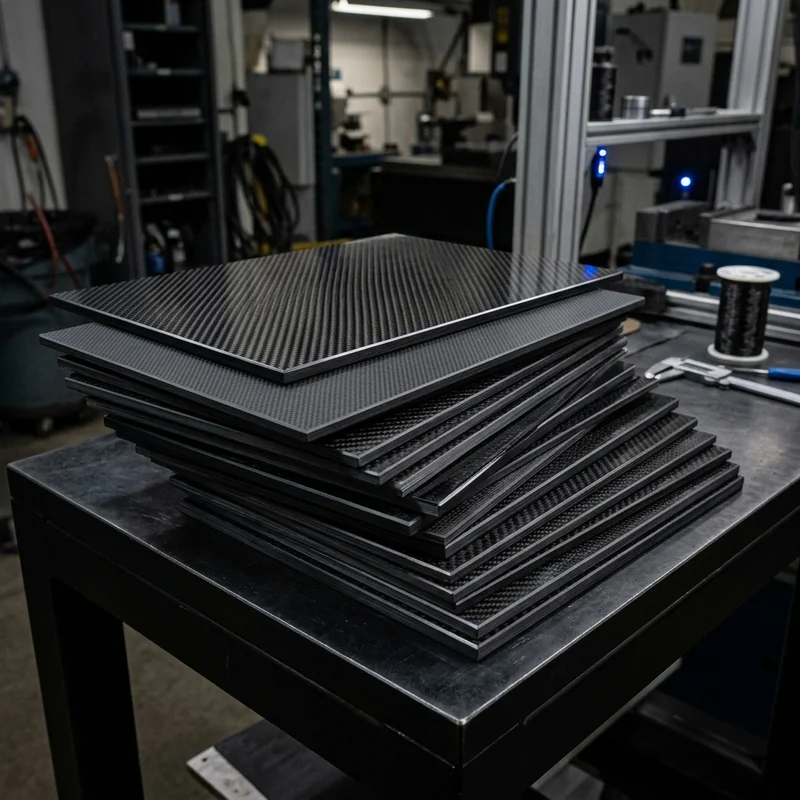
Carbon fiber standard plate-3k stripe
Lightweight, ultra-rigid standard sheets for drone fuselages, robot housings, facades and structural applications.

Carbon Fiber Plate — 3K Twill T700 3.0mm
Medium-thickness 3.0mm carbon fiber plate offering significantly higher load capacity while maintaining attractive 3K twill finish. Suitable for structural brackets, reinforcement plates, and load-bearing panels.

Carbon Fiber Plate — 3K Twill T700 1.5mm
Thin 1.5mm carbon fiber plate with 3K twill weave surface. Lightweight and stiff, commonly used for covers, panels, drone bodies, and applications requiring a premium aesthetic appearance.
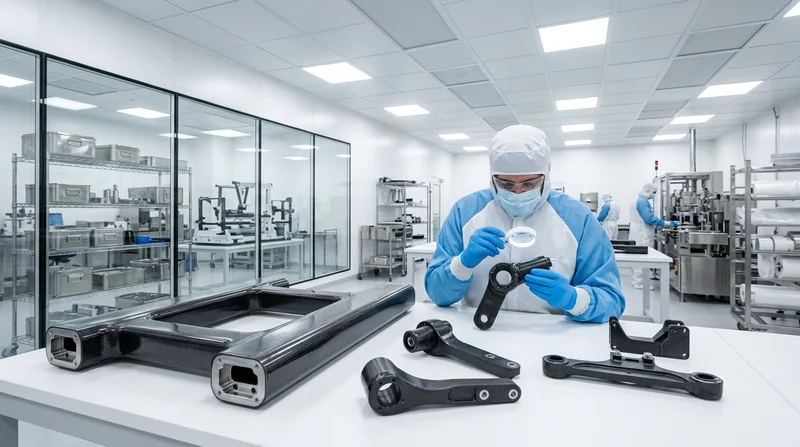
Custom Carbon Fiber Medical Device Components
Medical-grade carbon fiber components manufactured for imaging equipment, surgical instruments, and patient support systems. Carbon fiber's radiolucency (X-ray transparency) and high strength-to-weight ratio make it ideal for CT scanner beds, wheelchair frames, surgical robot arms, and MRI-compatible accessories. Biocompatible resin systems available.

Square Carbon Fiber Tube — 3K Twill T700
Square cross-section carbon fiber tube manufactured with 3K twill weave for torsional strength. Preferred for structural frames, trusses, and support columns where rectangular geometry offers design flexibility.