
The Philippines carbon fiber market is taking shape in 2026 as the country completes its transition from a remittance-driven economy to a regional hub for electronics assembly, aviation maintenance, and infrastructure construction. For decades the archipelago was known mainly as a sourc
Introduction
The Philippines carbon fiber market is taking shape in 2026 as the country completes its transition from a remittance-driven economy to a regional hub for electronics assembly, aviation maintenance, and infrastructure construction. For decades the archipelago was known mainly as a source of overseas workers and business-process outsourcing. Today its industrial belt — stretching from the Clark Freeport Zone north of Manila through the Laguna and Batangas corridors — is attracting manufacturers and service providers that need advanced structural materials. Carbon fiber demand is still small in absolute terms, but it is growing from three identifiable pillars.
The Philippine economy expanded by roughly 6% in 2025, and the Asian Development Bank projects growth above 5.5% through 2027. Manufacturing, electronics, and transport services now account for more than 40% of gross domestic product, while the government's "Build Better More" program allocates about 5-6% of GDP to public infrastructure every year. This article examines the electronics assembly, aerospace MRO, and infrastructure segments, and lays out a realistic sourcing strategy for carbon fiber buyers entering the market.
Electronics Assembly: The Established Demand Base
Electronics is the Philippines' largest and most mature manufacturing sector. Semiconductor and electronics products account for roughly 60% of merchandise exports — approximately $46 billion in 2025 — according to the Semiconductor and Electronics Industries in the Philippines Foundation (SEIPI). The industry clusters in the CALABARZON region (Laguna, Cavite, Batangas, Rizal, Quezon), Clark, Subic, and Cebu, where global firms operate assembly, testing, and packaging facilities. Growth in 2025-2026 is being driven by diversification of semiconductor back-end operations and the ongoing relocation of electronics assembly away from China.
This assembly base creates steady carbon fiber demand in precision categories:
- Semiconductor and precision equipment frames: Carbon fiber structural components for wafer handling robots, die attach machines, and test handlers — replacing aluminum for vibration damping and thermal stability.
- Automation and robotics: Pick-and-place gantry arms, end-effectors, and camera-mounting structures on electronics assembly lines, where carbon fiber's high specific stiffness shortens cycle times and improves positioning accuracy.
- Test and inspection tooling: Composite fixtures for AOI (automated optical inspection) and X-ray inspection stations that must hold micron-level tolerances across thermal cycles.
- Industrial drives and packaging: Lightweight carbon fiber housings, shafts, and guide rails for high-speed sorting and packaging equipment.
Electronics production has grown at an average of 8-9% per year over the past five years, and SEIPI expects export value to exceed $50 billion by 2027. Each wave of automation investment increases the share of precision-machined carbon fiber components in the bill of materials.
Aerospace MRO: The New Aviation Maintenance Hub
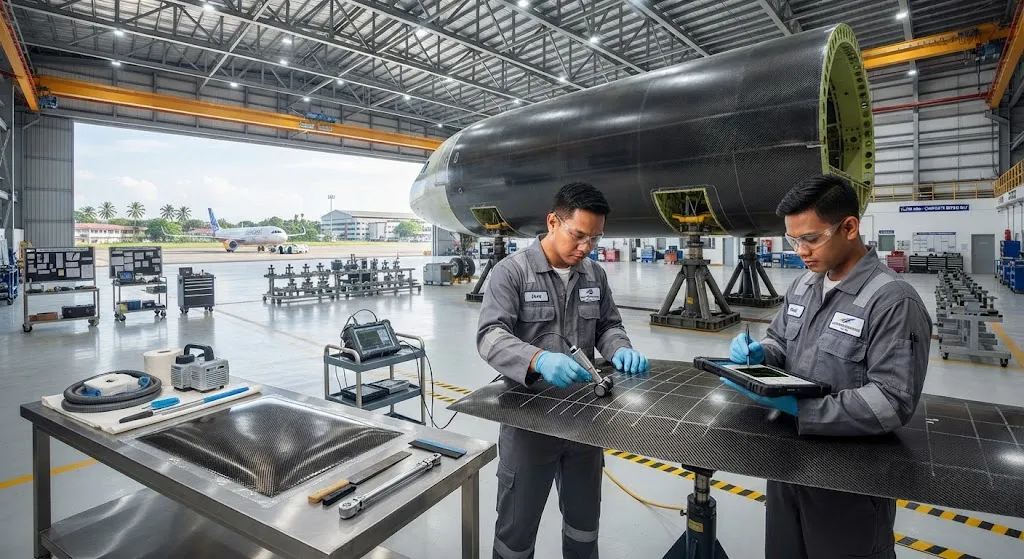
The Philippines has become one of Asia's fastest-growing aviation maintenance, repair, and overhaul (MRO) destinations. Lufthansa Technik Philippines operates its largest facility outside Germany at Clark — opened in 2019, with hangars able to service wide-body aircraft — while Philippine Airlines, Cebu Pacific, and international carriers route heavy maintenance through Manila, Clark, and Cebu. The local MRO industry is valued at roughly $1 billion and is projected to grow 8-10% annually as airlines extend the service life of composite-intensive fleets such as the Airbus A350 and Boeing 787.
Modern airframes are up to 50% composite by structural weight, which changes MRO economics. Certified composite repair now requires bonded patch tooling, autoclave-capable repair shops, and specialized inspection of carbon fiber structures. The resulting demand includes:
- Repair tooling and cure molds: Vacuum bag tooling, bonded repair fixtures, and cure tooling for composite patch repairs.
- Ground support equipment: Lightweight composite ramps, lifting fixtures, and cargo handling structures.
- Cabin interiors refurbishment: Carbon fiber galley structures, lavatory panels, and seat components for airline retrofit programs.
- Non-destructive inspection fixtures: Stable composite positioning frames for ultrasonic and thermographic scanning of large panels.
Because Philippine MRO providers are expanding capability rather than building it from scratch, much of the specialized tooling and composite repair materials are imported — an opening for overseas suppliers with FAA- or EASA-consistent quality systems.
Infrastructure: The Long-Dated Volume Driver
The "Build Better More" program commits the government to sustained public infrastructure spending of 5-6% of GDP through 2028. The flagship pipeline includes the Metro Manila Subway — the country's first underground rail line, financed with Japanese development assistance — the 147-kilometer North-South Commuter Railway, the new Manila International Airport in Bulacan, and a series of major bridges including the Panguil Bay and Guimaras links.
| Project Category | Scale (2026-2030) | Carbon Fiber Applications | Est. Composite Content (US$ M) |
|---|---|---|---|
| Metro Manila Subway | 33 km, 17 stations | Bogie frames, interior panels, cable trays | 40-70 |
| North-South Commuter Railway | 147 km, 35+ stations | Rolling stock interiors, platform doors, cladding | 60-110 |
| New Manila International Airport | Phase 1, 35M passengers/yr | Roof structures, facade panels, baggage handling | 25-50 |
| Bridges & marine works | 20+ major spans | CFRP rebar, stay cable ducts, formwork | 15-30 |
| Ports & logistics zones | 4 deep-water terminals | Crane components, equipment frames | 8-15 |
Two implications matter for carbon fiber suppliers. First, the railway program — modeled on Japanese rolling stock — will specify composite bogie components, interior panels, and platform systems that no Philippine manufacturer currently produces, sustaining import demand for years. Second, exposure to typhoon and seismic loads is pushing engineers toward corrosion-resistant, lightweight structural materials; CFRP rebar is being evaluated for bridge decks and coastal structures where chloride ingress shortens the service life of steel-reinforced concrete.
Supply Chain Structure and Import Dynamics
The Philippines has no domestic carbon fiber precursor, PAN fiber, or tow production. All carbon fiber is imported — primarily from Japan (Toray, Teijin, Mitsubishi), South Korea (Hyosung), Taiwan (Formosa Plastics), and increasingly China. Under the ASEAN Trade in Goods Agreement and the Philippines' RCEP membership, most carbon fiber raw materials enter at 0-5% duty, and JICA-financed infrastructure projects typically specify equipment and materials from partner countries, which favors Japanese and Korean suppliers.
The local conversion base is thin but growing. A handful of companies in the CALABARZON and Clark corridors perform prepreg layup, compression molding, and pultrusion at commercial scale, mainly for electronics tooling and industrial components. Specialized capacity — autoclave processing, automated fiber placement, and certified aerospace repair — does not yet exist domestically. Most B2B buyers therefore import finished carbon fiber components and perform local integration, secondary machining, and assembly.
Frequently Asked Questions
What are the key differences between importing carbon fiber into the Philippines versus Vietnam or China?
Tariffs and logistics favor the Philippines for certain buyers. Carbon fiber raw materials enter at 0-5% duty under ASEAN and RCEP preferential schemes, similar to Vietnam, and Manila's ports (Manila International Container Terminal, Subic) serve the CALABARZON electronics corridor within hours. The main differences are scale and support: Vietnam's electronics ecosystem is larger and its converter base more active, while the Philippines offers a smaller but less crowded market with strong aerospace MRO pull from Clark. Chinese buyers face higher duties and export-control documentation that Philippine importers do not.
Which carbon fiber applications will grow fastest in the Philippines over the next three years?
Three segments lead: aerospace MRO tooling and repair materials (driven by Lufthansa Technik Clark and the A350/787 fleet), precision components for electronics automation (growing 8-12% annually with semiconductor back-end expansion), and infrastructure products such as CFRP rebar and railway interior components (from the subway and commuter railway pipeline). MRO is the fastest-growing niche by value because of the certification barrier and the aging composite fleets being routed through Manila.
Can Philippine MRO providers perform certified repairs on composite airframes?
Yes, but with limits. Clark's Lufthansa Technik facility holds major international approvals and performs structural composite repairs on wide-body aircraft, including bonded patch repairs. Independent local providers are expanding ultrasonic and thermographic inspection capability. However, the country does not yet have an autoclave-capable repair ecosystem comparable to Singapore or Malaysia, so advanced repair materials, vacuum bag consumables, and tooling are imported. This creates a steady demand stream for overseas suppliers of certified composite repair products.
Conclusion
The Philippines carbon fiber market in 2026 is best described as a specialist, service-led market. Electronics assembly provides a stable base of precision component demand; the aerospace MRO hub at Clark adds high-value tooling and repair material consumption with a certification barrier that protects margins; and the "Build Better More" infrastructure pipeline — especially the Metro Manila Subway and North-South Commuter Railway — will keep specifying composite interiors and corrosion-resistant materials for years. With no domestic carbon fiber production, nearly every kilogram consumed is imported.
For buyers evaluating the Philippine market, the practical path combines imported carbon fiber materials with local secondary processing and assembly. Browse our carbon fiber product range to identify components suited to electronics, MRO, and infrastructure demand, or contact our engineering team for a market-entry assessment with pricing and lead-time projections for the Philippines.
Part of topic
Related Articles
- Carbon Fiber Rods for Sale: Bulk Pricing and Wholesale Distribution
- Carbon Fiber Sheet Amazon: What to Buy Online vs Direct from Manufacturer
- Carbon Fiber Rod for Sale: In-Stock Sizes and Custom Cutting Services
- Carbon Fiber Manufacturing Near Me: Finding Local Production Partners
- Carbon Fiber Tube Suppliers: Global Directory and Comparison
- Carbon Fiber Sheet for Sale: In-Stock Inventory and Custom Order Lead Times
Interested in Our Products?
Contact our team for competitive pricing and technical specifications.
Get a QuoteRelated Products
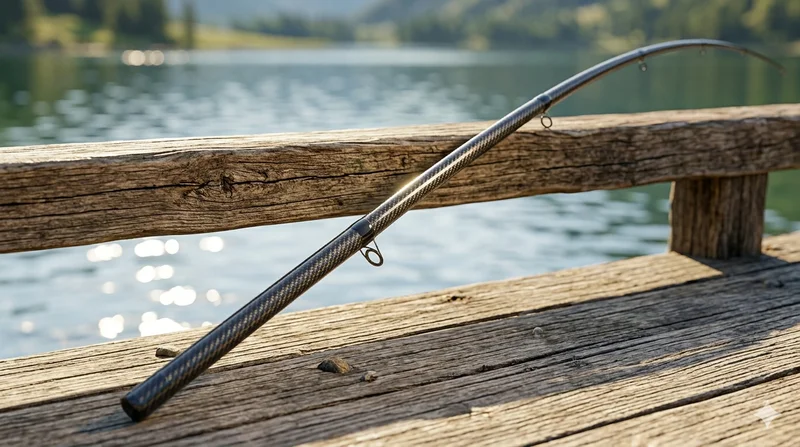
Carbon Fiber Fishing Rod Blank
High-quality carbon fiber fishing rod blank manufactured from multiple grades of Toray carbon fiber cloth. Available in a wide range of lengths, powers, and actions for freshwater and saltwater applications. Suitable for OEM rod building.

Carbon Fiber Plate — 3K Twill T700 1.5mm
Thin 1.5mm carbon fiber plate with 3K twill weave surface. Lightweight and stiff, commonly used for covers, panels, drone bodies, and applications requiring a premium aesthetic appearance.

Carbon Fiber Plate — 3K Twill T700 3.0mm
Medium-thickness 3.0mm carbon fiber plate offering significantly higher load capacity while maintaining attractive 3K twill finish. Suitable for structural brackets, reinforcement plates, and load-bearing panels.
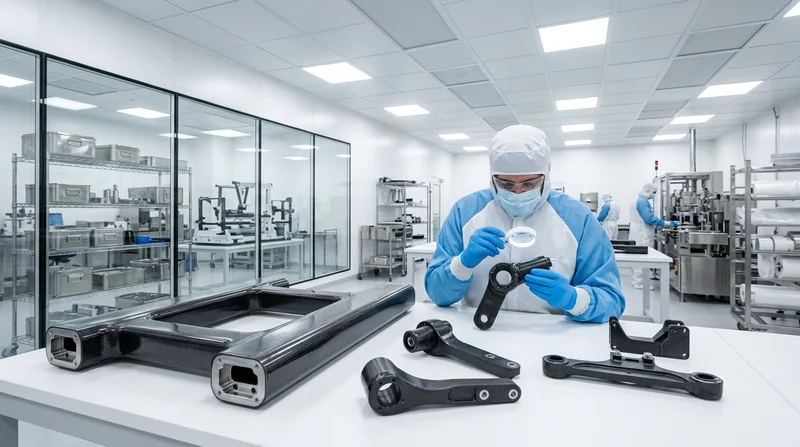
Custom Carbon Fiber Medical Device Components
Medical-grade carbon fiber components manufactured for imaging equipment, surgical instruments, and patient support systems. Carbon fiber's radiolucency (X-ray transparency) and high strength-to-weight ratio make it ideal for CT scanner beds, wheelchair frames, surgical robot arms, and MRI-compatible accessories. Biocompatible resin systems available.

Square Carbon Fiber Tube — 3K Twill T700
Square cross-section carbon fiber tube manufactured with 3K twill weave for torsional strength. Preferred for structural frames, trusses, and support columns where rectangular geometry offers design flexibility.