
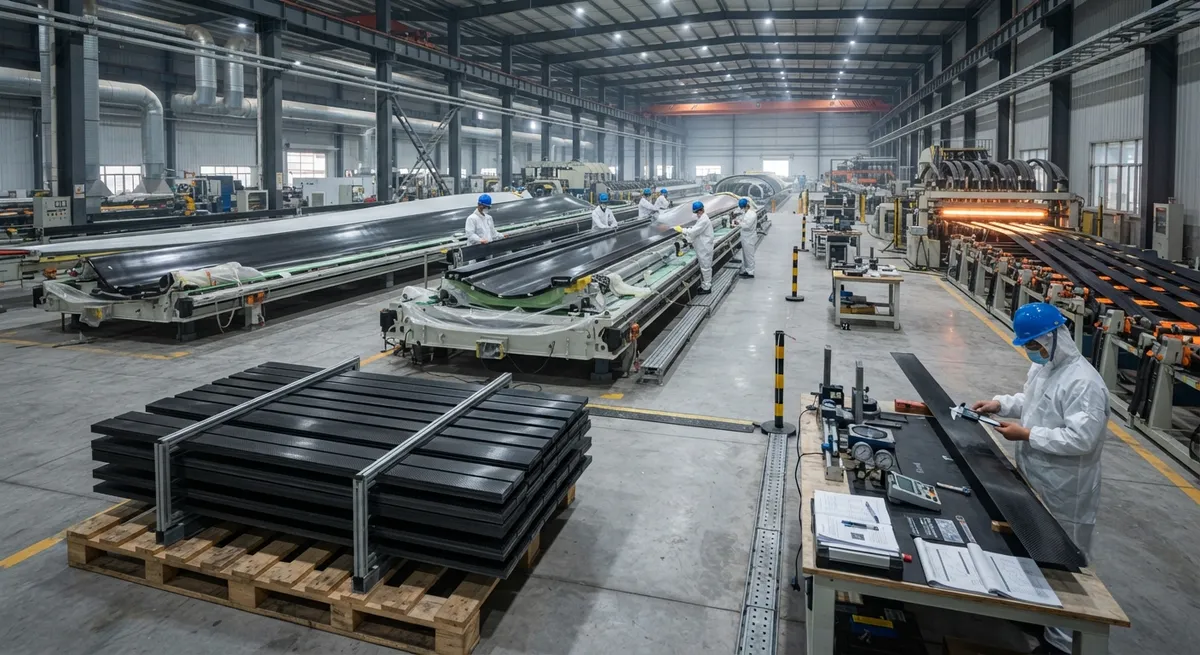
As wind turbine blades extend beyond 100 meters for offshore 15 MW+ platforms, spar cap design and manufacturing have become the critical bottleneck in blade production. The spar cap — the primary load-bearing structure running along the blade's length — must withstand extreme tensile and.
As wind turbine blades extend beyond 100 meters for offshore 15 MW+ platforms, spar cap design and manufacturing have become the critical bottleneck in blade production. The spar cap — the primary load-bearing structure running along the blade's length — must withstand extreme tensile and compressive fatigue cycles over 20+ year design lives. Two competing manufacturing approaches dominate the current landscape: pultruded carbon fiber planks (PCFP) and vacuum-assisted resin infusion (VARI). This analysis provides blade OEM engineers, procurement managers, and wind energy project developers with a data-driven comparison to inform process selection.
Process Fundamentals
Pultruded Carbon Fiber Plank (PCFP)
PCFP manufacturing is a continuous, automated process. Continuous carbon fiber tows are pulled through a resin bath (typically epoxy or polyurethane), then through a heated die that cures the composite into a constant cross-section plank. These planks — typically 50–150 mm wide and 3–10 mm thick — are cut to length and adhesively bonded into the blade mold as prefabricated spar cap elements. Leading suppliers include Owens Corning (Vectibrite), Exel Composites, and Toray Advanced Composites.
| Parameter | PCFP (Pultruded Plank) | VARI (Vacuum Infusion) |
|---|---|---|
| Fiber volume fraction | 65–72% | 50–58% |
| Longitudinal tensile modulus (GPa) | 140–170 | 100–130 |
| Longitudinal tensile strength (MPa) | 2,400–2,800 | 1,600–2,000 |
| Production rate (kg/hr per line) | 80–150 | 5–15 (per mold) |
| Labor content (hr/kg) | 0.02–0.05 | 0.15–0.40 |
| Material utilization | ~95% | ~75% |
| Capital investment (USD million) | 3–8 | 0.5–2 (per mold set) |
| Minimum production volume before breakeven | ~2,000 blades/year | ~500 blades/year |
Vacuum-Assisted Resin Infusion (VARI)
In the VARI process, dry carbon fiber fabrics (unidirectional, multiaxial, or non-crimp fabrics) are stacked in the blade mold, covered with a vacuum bag, and infused with low-viscosity resin under vacuum pressure. The infusion cures at ambient or mildly elevated temperature (40–80°C) over 4–12 hours. This is the incumbent process for blades up to 60–70 meters, used by LM Wind Power, Siemens Gamesa, and Vestas for established blade platforms.
Mechanical Performance Comparison
The higher fiber volume fraction achievable with pultrusion — 65–72% versus 50–58% for infusion — directly translates to superior mechanical properties. Pultruded planks deliver 30–40% higher tensile modulus and 40–50% higher tensile strength compared to variably infused laminates. This translates to measurable weight savings: a 70-meter blade using pultruded spar caps can reduce spar cap mass by 18–25% while maintaining equivalent stiffness.
Fatigue Performance
Fatigue life in the gigacycle regime (10⁸–10⁹ cycles, representing 20+ years of blade operation) differs substantially between the two processes:
- PCFP: Excellent fiber alignment yields minimal off-axis fiber content, reducing transverse crack initiation sites. S-N curves show fatigue run-out at 60–70% of ultimate tensile strength for 10⁷ cycles.
- VARI: Fabric crimp and fiber waviness intrinsic to textile reinforcement create local stress concentrations. Typical fatigue run-out occurs at 40–50% of ultimate tensile strength for 10⁷ cycles.
- Interlaminar shear: Pultruded interfaces show 15–20% higher apparent interlaminar shear strength (ILSS), but the adhesive bond between planks introduces a secondary bonding interface that requires careful quality control.
Production Economics
The total cost per spar cap depends critically on production volume, blade length, and regional labor rates. A 4 MW onshore blade (approximately 70 m length) serves as a useful baseline:
| Cost Component | PCFP (USD/blade) | VARI (USD/blade) |
|---|---|---|
| Carbon fiber raw material | 8,200–10,500 | 10,800–13,500 |
| Resin and consumables | 1,200–1,600 | 2,400–3,200 |
| Labor | 600–900 | 3,200–5,000 |
| Amortized capital | 1,800–2,400 | 400–800 |
| Quality assurance | 400–600 | 1,200–2,000 |
| Total | 12,200–16,000 | 18,000–24,500 |
At scale (≥2,000 blades/year), PCFP shows a 25–40% cost advantage per spar cap. However, at low volumes or for prototype runs, VARI benefits from lower capital entry cost and mold flexibility.
Quality Control and Defect Modes
Each process presents distinct quality challenges:
- PCFP issues: Die inlet clogging, uneven fiber tension causing width variation (±0.5 mm typical), inter-plank bond-line voids, and plank-to-shell adhesive thickness variation
- VARI issues: Dry spots from incomplete fiber wet-out, race-tracking along fabric edges, thickness tolerance (±1–2 mm typical), porosity from entrapped air, and long infusion times for thick (>30 mm) laminates
NDT methods differ accordingly: PCFP relies on ultrasonic C-scan of adhesive bond-lines plus dimensional gauging, while VARI demands full-field inspection via thermography or shearography for entire infused panels.
Industry Adoption Trends (2024–2026)
The shift toward pultruded spar caps accelerated significantly after 2023. Mingyang Smart Energy adopted pultruded carbon fiber planks for their MySE 16.0-242 offshore turbine, achieving a 22% spar cap weight reduction over infused designs. Vestas' V236-15.0 MW blade uses hybrid construction with pultruded caps in the root-to-midspan region and infused sections toward the tip. CSSC Haizhuang introduced H260-16.7 MW blades with full-length pultruded spar caps in 2025, citing 40% shorter layup time versus infusion.
Chinese OEMs have been particularly aggressive in adopting PCFP, driven by concentrated blade production hubs in Lianyungang and Yancheng that can achieve the volumes needed for process economics to favor pultrusion. European OEMs, while adopting PCFP for next-generation platforms, maintain VARI for legacy blade programs to avoid retooling costs.
FAQ
What is the minimum blade length where pultruded spar caps become cost-effective?
For blades under 50 meters, the adhesive and assembly costs of PCFP often outweigh the raw material savings. The crossover point is typically 55–65 meters (3–4 MW class), depending on local labor rates and production volume. Below this threshold, VARI remains the standard approach.
Can pultruded carbon fiber planks be repaired in the field?
Field repair of pultruded spar caps is possible but more complex than infused laminates. Scarf repairs following blade manufacturer specifications are recommended, using matched-modulus prepreg patches. The plank structure's high stiffness concentrates load at repair boundaries, requiring precise taper ratios (typically 30:1–50:1) to avoid secondary stress concentrations.
How do pultruded spar caps affect blade recycling at end of life?
The adhesive-bonded interface between pultruded planks and the shell creates a recycling challenge absent in monocoque infused blades. Thermal or chemical separation of bond-lines is required before material recovery. However, the unidirectional nature of pultruded planks makes them easier to segment for downcycling into construction materials. Current research at the National Renewable Energy Laboratory (NREL) focuses on separable adhesive formulations for PCFP joints.
Conclusion
For next-generation megawatt-class blades exceeding 80 meters, pultruded carbon fiber spar caps offer compelling advantages in mechanical performance, weight reduction, production rate, and total cost at scale. Vacuum infusion retains relevance for sub-60-meter blades, low-volume production, and OEMs with established infusion infrastructure. The optimal manufacturing strategy increasingly involves hybrid approaches — leveraging PCFP for straight root-to-midspan sections where unidirectional load dominates, and VARI for complex-curvature tip regions requiring tailored fiber orientation.
Blade OEMs evaluating process transitions should conduct site-specific total cost of ownership analyses factoring in local labor rates, existing mold inventory, blade design load envelopes, and projected annual production volumes. YongXian CarbonFiber supplies both pultruded unidirectional carbon fiber planks and engineered fabrics for infusion, enabling OEMs to evaluate both approaches with consistent fiber quality.
Part of topic
Related Articles
- Bio-Based Carbon Fiber Precursors: Lignin and Polyethylene for Low-Cost Production
- Large-Tow Carbon Fiber Cost Analysis: 48K vs 60K Price-Performance Comparison
- Carbon Fiber-Resin Interface Bonding: Surface Treatment and Coupling Agent Optimization
- Digital Twin for Carbon Fiber Manufacturing: Real-Time Process Monitoring and Defect Prevention
- Thermoplastic Carbon Fiber Welding for Automotive: Ultrasonic and Induction Welding Process Windows
- Large-Tow Carbon Fiber Wet Spinning: Process Optimization for 48K/60K Production Efficiency
Interested in Our Products?
Contact our team for competitive pricing and technical specifications.
Get a QuoteRelated Products
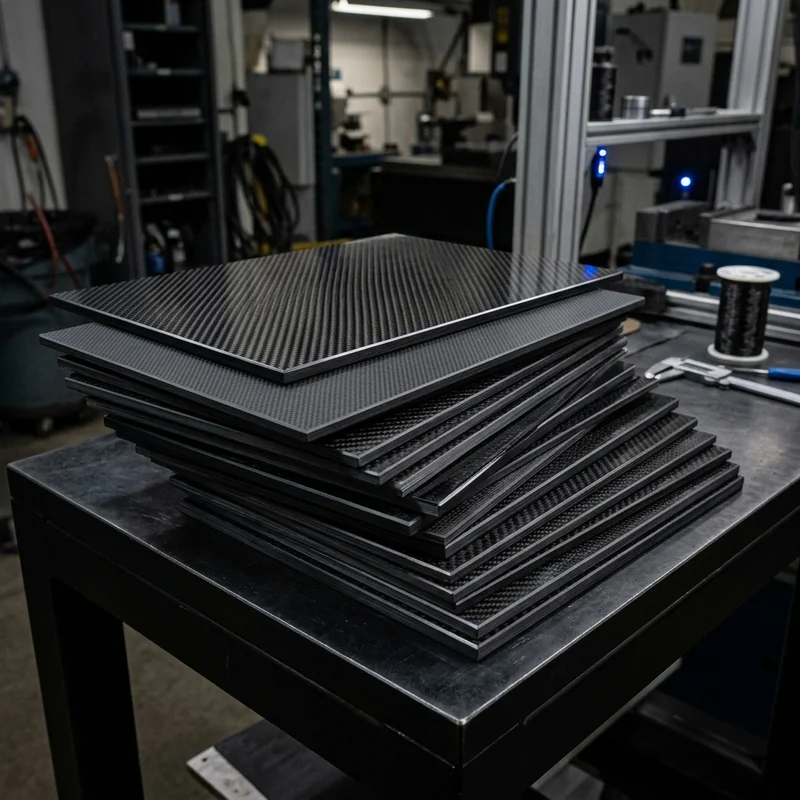
Carbon fiber standard plate-3k stripe
Lightweight, ultra-rigid standard sheets for drone fuselages, robot housings, facades and structural applications.

Carbon Fiber Plate — 3K Twill T700 3.0mm
Medium-thickness 3.0mm carbon fiber plate offering significantly higher load capacity while maintaining attractive 3K twill finish. Suitable for structural brackets, reinforcement plates, and load-bearing panels.

Carbon Fiber Plate — 3K Twill T700 1.5mm
Thin 1.5mm carbon fiber plate with 3K twill weave surface. Lightweight and stiff, commonly used for covers, panels, drone bodies, and applications requiring a premium aesthetic appearance.
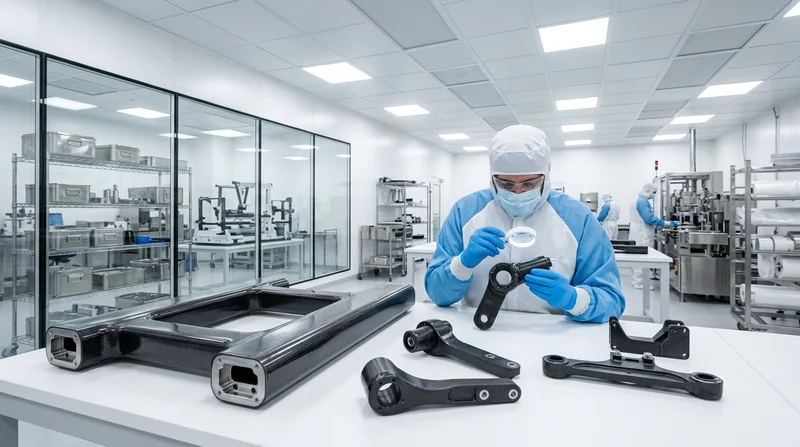
Custom Carbon Fiber Medical Device Components
Medical-grade carbon fiber components manufactured for imaging equipment, surgical instruments, and patient support systems. Carbon fiber's radiolucency (X-ray transparency) and high strength-to-weight ratio make it ideal for CT scanner beds, wheelchair frames, surgical robot arms, and MRI-compatible accessories. Biocompatible resin systems available.

Square Carbon Fiber Tube — 3K Twill T700
Square cross-section carbon fiber tube manufactured with 3K twill weave for torsional strength. Preferred for structural frames, trusses, and support columns where rectangular geometry offers design flexibility.