
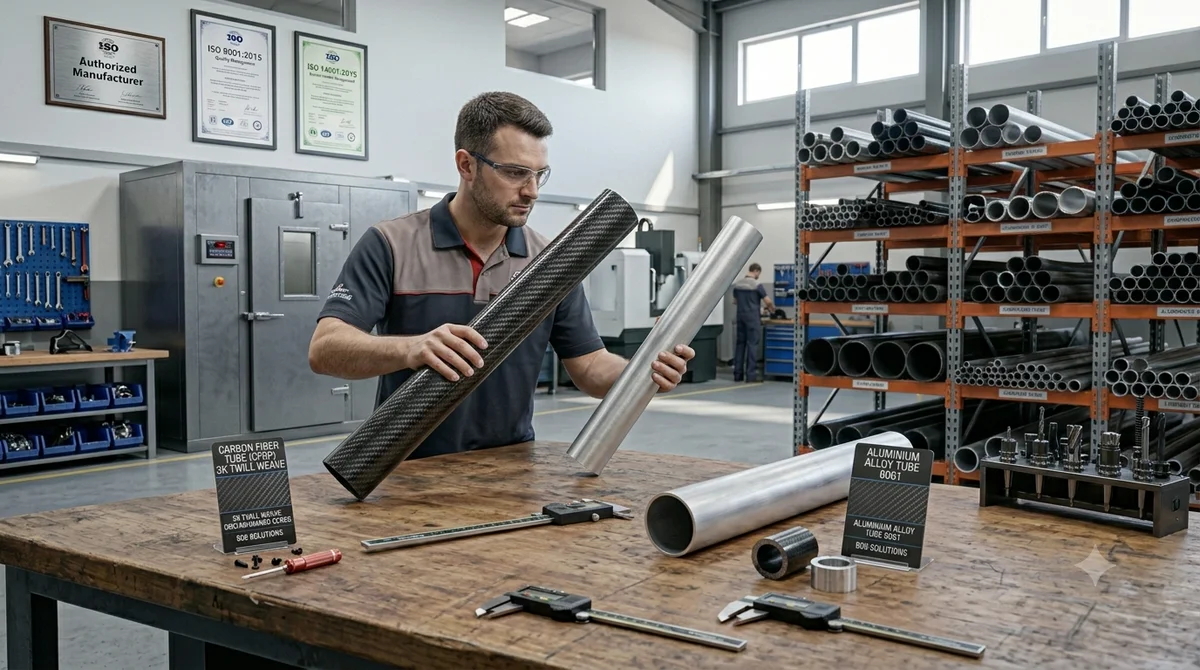
Technical comparison of carbon fiber tubes and metal tubes (aluminum, steel, titanium) covering density, strength, modulus, CTE, fatigue life, and cost for engineers selecting structural tubing.
Introduction
When specifying structural tubing for aerospace, robotics, automotive, or industrial applications, engineers face a fundamental material choice: carbon fiber reinforced polymer (CFRP) or traditional metals. Each brings distinct trade-offs in mechanical performance, weight, durability, and cost. This article provides an objective, data-driven comparison between carbon fiber tubes and their metal counterparts — aluminum (6061-T6), steel (4140), and titanium (Ti-6Al-4V) — to equip B2B buyers with the engineering facts needed for informed procurement decisions.
Carbon fiber tubes are manufactured by pultrusion or wrapping continuous fibers with epoxy resin, yielding unidirectional or quasi-isotropic properties. Metals offer isotropic grain structures with uniform mechanical behavior but higher density.
| Property | CFRP (T700/Epoxy) | Aluminum 6061-T6 | Steel 4140 | Titanium Ti-6Al-4V |
|---|---|---|---|---|
| Density (g/cm³) | 1.6 | 2.70 | 7.85 | 4.43 |
| Tensile Strength (MPa) | 2400–2800 | 310 | 1100 | 950 |
| Specific Strength (MPa/(g/cm³)) | 1500–1700 | 115 | 140 | 215 |
| Elastic Modulus (GPa) | 130–150 | 69 | 210 | 114 |
| Specific Stiffness (GPa/(g/cm³)) | 82–93 | 25 | 27 | 26 |
| CTE (10⁻⁶/K) axial | −0.3 to −0.5 | 23 | 12 | 8.6 |
| Fatigue Endurance (10⁷ cycles, %UTS) | 70–80% | ~30% | ~45% | ~55% |
| Raw Material Cost (USD/kg) | $25–$55 | $2.50–$5 | $1.50–$3 | $12–$30 |
| Fabrication Cost Index (Al=1.0) | 3.5–5.0 | 1.0 | 0.8–1.2 | 3.0–4.5 |
The decisive engineering advantages of carbon fiber tubes include: 40–80% weight reduction versus equivalent-strength metal tubes; 5–7× higher specific strength; no conventional fatigue limit with sustained loading at 70–80% UTS; near-zero axial CTE for dimensional stability across temperature ranges; inherent corrosion resistance eliminating coatings; and 5–10× higher vibration damping.
Weight-Specific Performance Comparison
For weight-critical applications such as drone arms, robotic manipulators, or aerospace struts, carbon fiber delivers up to 40% mass reduction versus aluminum and 70% versus steel for equivalent stiffness. In a typical robotic arm application, replacing a 6061-T6 aluminum tube (30 mm OD × 2 mm wall × 500 mm length, mass 250 g) with a CFRP tube of identical stiffness reduces mass to approximately 150 g — a 40% saving. At the component level, this reduction lowers actuator torque requirements by 20–35%, enabling smaller motors, lighter gearboxes, and extended battery life in mobile systems.
Fatigue and Longevity
Carbon fiber does not exhibit a conventional fatigue limit. CFRP tubes can sustain repeated loads at 70–80% of ultimate tensile strength without progressive damage, far surpassing aluminum (which typically fails around 10⁵ cycles at 30% UTS) and steel (which enters finite life below 45% UTS). In high-cycling applications exceeding 10⁶ cycles per year, CFRP eliminates fatigue-related inspection and replacement, reducing total lifecycle cost despite higher upfront material expense. For a high-speed pick-and-place robot operating at 120 cycles/minute, the annual savings from avoided tube replacements alone can exceed $3,000 per axis.
Frequently Asked Questions
In which applications do carbon fiber tubes clearly outperform metal?
Carbon fiber delivers greatest advantage in weight-critical sectors: aerospace (drone arms, satellite booms, fuselage struts), high-speed robotics (end-of-arm tooling, linear actuators), automotive (drive shafts, suspension links), and sporting goods. Where weight reduction yields fuel savings or speed gains, CFRP justifies its premium within 6–24 months of operation.
How does total cost of ownership compare over a 10-year life?
For a typical aerospace bracket using a 500 mm tube, CFRP TCO ≈ $110 versus aluminum ≈ $45 and steel ≈ $30. However, in rotating assemblies where weight savings reduce motor load by 15–25%, the break-even point is 18–30 months through reduced downtime and eliminated fatigue inspection costs. In marine environments, CFRP avoids corrosion-related recoating costs common with metals.
Are carbon fiber tubes more brittle than metal tubes?
Carbon fiber does not undergo plastic deformation like metals, but it is not inherently brittle. Impact resistance depends on fiber architecture: unidirectional tubes are weakest in transverse impact; braided or hybrid layups (carbon with aramid or glass outer layers) provide excellent impact absorption. For controlled-load applications like robot arms, a properly designed tube with ±45° fabric offers impact toughness comparable to 6061 aluminum.
Conclusion
Carbon fiber tubes deliver unmatched specific strength, stiffness, and fatigue performance. While upfront cost is 5–20× higher per kilogram, total system benefits — reduced weight, extended life, lower maintenance — make CFRP the optimal long-term choice for performance-critical applications. Browse our carbon fiber tube range or contact our engineering team for your specific requirements.
Part of topic
Related Articles
- Bio-Based Carbon Fiber Precursors: Lignin and Polyethylene for Low-Cost Production
- Large-Tow Carbon Fiber Cost Analysis: 48K vs 60K Price-Performance Comparison
- Carbon Fiber-Resin Interface Bonding: Surface Treatment and Coupling Agent Optimization
- Digital Twin for Carbon Fiber Manufacturing: Real-Time Process Monitoring and Defect Prevention
- Thermoplastic Carbon Fiber Welding for Automotive: Ultrasonic and Induction Welding Process Windows
- Large-Tow Carbon Fiber Wet Spinning: Process Optimization for 48K/60K Production Efficiency
Interested in Our Products?
Contact our team for competitive pricing and technical specifications.
Get a QuoteRelated Products
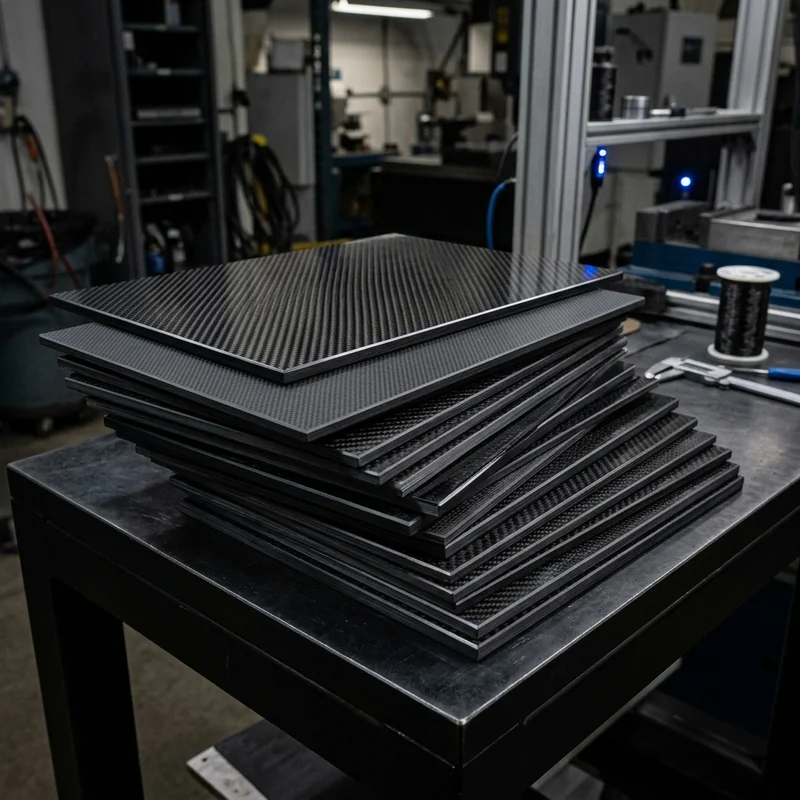
Carbon fiber standard plate-3k stripe
Lightweight, ultra-rigid standard sheets for drone fuselages, robot housings, facades and structural applications.

Carbon Fiber Plate — 3K Twill T700 1.5mm
Thin 1.5mm carbon fiber plate with 3K twill weave surface. Lightweight and stiff, commonly used for covers, panels, drone bodies, and applications requiring a premium aesthetic appearance.

Square Carbon Fiber Tube — 3K Twill T700
Square cross-section carbon fiber tube manufactured with 3K twill weave for torsional strength. Preferred for structural frames, trusses, and support columns where rectangular geometry offers design flexibility.

Carbon Fiber Plate — 3K Twill T700 3.0mm
Medium-thickness 3.0mm carbon fiber plate offering significantly higher load capacity while maintaining attractive 3K twill finish. Suitable for structural brackets, reinforcement plates, and load-bearing panels.
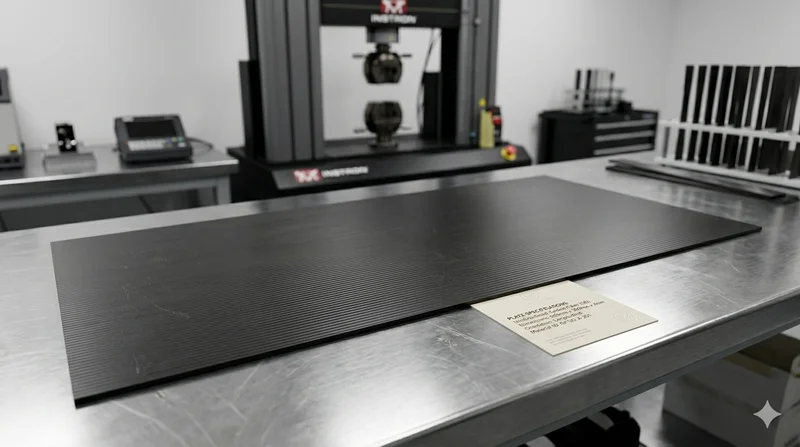
Carbon Fiber Plate — UD Unidirectional T700
Unidirectional carbon fiber plate with all fibers oriented in a single direction for maximum strength along the fiber axis. Essential for structural reinforcements, splints, and applications where load direction is predictable.