
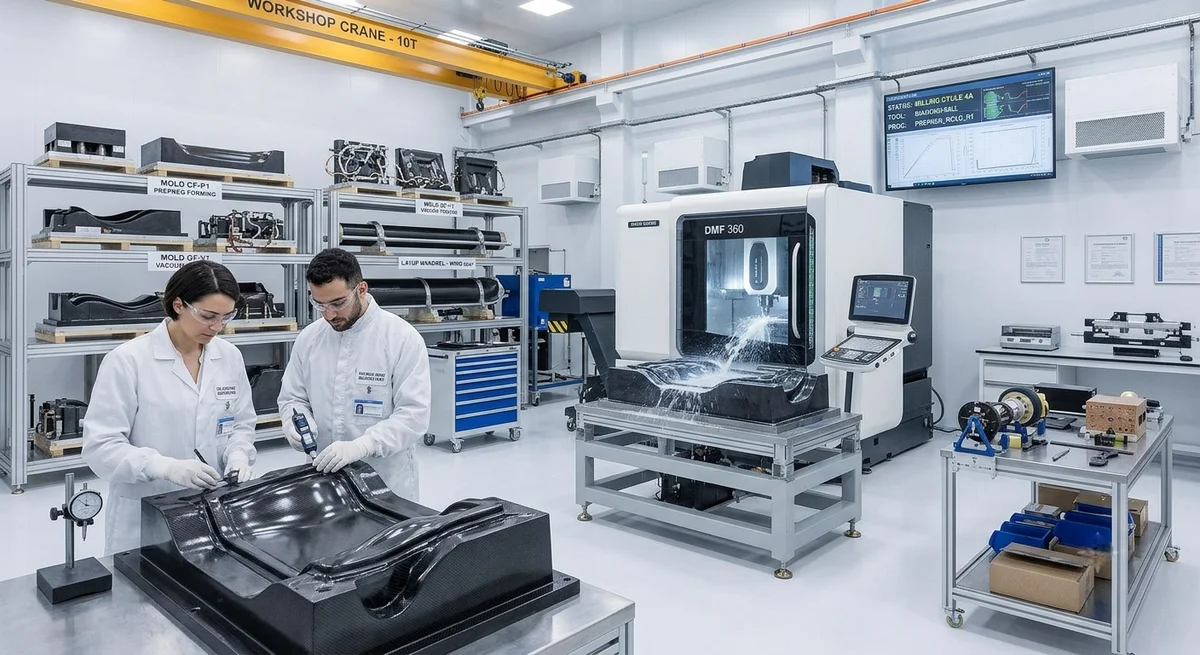
A technical comparison of carbon fiber tooling materials for composite manufacturing: epoxy tooling prepregs, BMI systems, nickel-shell faced tools, and additive manufactured tooling inserts. Covers CTE matching, thermal cycling durability, and cost analysis.
Introduction
In composite manufacturing, the quality of the finished part is directly determined by the quality of the tooling. Carbon fiber tooling materials have evolved significantly over the past decade, offering mold makers and composite manufacturers a range of options that balance thermal performance, dimensional stability, cost, and manufacturing cycle time.
This technical guide provides a comprehensive comparison of carbon fiber tooling materials used in aerospace, automotive, and industrial composite manufacturing. We examine five major tooling material categories: epoxy tooling prepregs, bismaleimide (BMI) systems, nickel-shell faced tools, carbon fiber-reinforced ceramic tools, and additively manufactured tooling inserts.
Tooling Material Comparison
| Tooling Material | Max Service Temp | CTE (×10⁻⁶/°C) | Thermal Cycles to Failure | Cost Index | Surface Finish (Ra) |
|---|---|---|---|---|---|
| Epoxy tooling prepreg | 180°C | 2–4 | 500–1,000 | 1.0 (baseline) | 0.4–0.8 μm |
| BMI tooling prepreg | 250°C | 1.5–3 | 1,000–2,000 | 1.8–2.5 | 0.4–0.8 μm |
| Nickel-shell faced tool | 350°C | 13–15 | 3,000–5,000 | 3.0–5.0 | 0.05–0.1 μm |
| Carbon-ceramic hybrid | 400°C | 1–2 | 2,000–3,000 | 2.5–4.0 | 0.2–0.5 μm |
| Additive tooling insert | 150–200°C | 8–15 | 100–300 | 0.5–1.2 | 1.0–3.0 μm |
Epoxy Tooling Prepregs
The most widely used carbon fiber tooling material. Epoxy tooling prepregs offer an excellent balance of cost and performance for parts cured up to 180°C. Key advantages include: low coefficient of thermal expansion matching carbon fiber parts (CTE 2–4 × 10⁻⁶/°C), good surface finish (Ra 0.4–0.8 μm with appropriate gel coat), and well-established processing parameters. Typical applications include aerospace interior panels, automotive body panels, and sporting goods molds. Process limitations include a maximum of 500–1,000 thermal cycles before microcracking appears, and the need for free-standing post-cure at 10–20°C above the intended service temperature.
BMI Tooling Systems
Bismaleimide (BMI) tooling prepregs extend the service temperature range to 250°C, making them suitable for high-temperature cure prepreg systems and resin transfer molding (RTM) processes. BMI tooling offers 2–4× the thermal cycle life of epoxy systems. CTE is slightly lower than epoxy systems (1.5–3 × 10⁻⁶/°C), providing better dimensional match with carbon fiber parts at elevated temperatures. Cost is 1.8–2.5× epoxy tooling. BMI systems require careful moisture control during layup (dew point below 4°C recommended) and higher post-cure temperatures (240–260°C).
Nickel-Shell Faced Tools
For applications requiring extreme surface finish and high thermal cycle life, nickel-shell faced tools combine an electroformed nickel face (1–3 mm) with a carbon fiber composite backup structure. The nickel face provides near-mirror surface finish (Ra 0.05–0.1 μm) and excellent durability (3,000–5,000 thermal cycles). The carbon fiber backup structure maintains low overall CTE. These tools are often specified for class A automotive body panels, medical device housings, and cosmetic aircraft interior components. Cost is 3–5× standard epoxy tooling. Lead time is also extended due to the electroforming process.
Additively Manufactured Tooling Inserts
Additive manufacturing (3D printing) is increasingly used for tooling inserts, particularly for complex internal features or conformal cooling channels. Fused filament fabrication (FFF) using carbon fiber-reinforced PEI (ULTEM) or PEEK filaments can produce tools for up to 150–200°C service. Powder bed fusion (PBF) of carbon fiber/nylon composites offers better surface finish and detail resolution. Additive tooling is cost-effective for low-volume production (1–50 parts) but has limited thermal cycle life and requires careful surface sealing. Print orientation must be optimized for the primary load direction during composite curing.
Selection Guide by Application
- Autoclave-cured aerospace structures: BMI tooling prepreg. CTE match critical. Budget: $15,000–$50,000 per mold.
- Automotive CFRP body panels (class A): Nickel-shell faced or epoxy-invar hybrid. Surface finish critical. Budget: $20,000–$80,000 per mold.
- Prototype and low-volume (1–50 parts): Additive manufactured (PEI-CF or PEEK-CF). Budget: $2,000–$8,000 per mold.
- Medium-volume (50–500 parts): Epoxy tooling prepreg. Best cost-performance balance. Budget: $8,000–$25,000 per mold.
- High-temperature RTM (>200°C): BMI or carbon-ceramic hybrid. Budget: $20,000–$60,000 per mold.
Cost Analysis
| Mold Size | Epoxy Tooling | BMI Tooling | Nickel-Shell | Additive (PEI-CF) |
|---|---|---|---|---|
| Small (0.5 × 0.5m) | $4,000–$8,000 | $7,000–$14,000 | $15,000–$25,000 | $2,000–$5,000 |
| Medium (1.0 × 1.0m) | $10,000–$20,000 | $18,000–$35,000 | $35,000–$60,000 | $5,000–$12,000 |
| Large (2.0 × 1.5m) | $25,000–$50,000 | $45,000–$90,000 | $80,000–$150,000 | $12,000–$30,000 |
| Lead time (weeks) | 4–8 | 6–12 | 8–16 | 1–3 |
FAQ
What is the most important factor in selecting a carbon fiber tooling material?
The coefficient of thermal expansion (CTE) match between tool and part is the most critical factor. A mismatch of more than 20% can cause dimensional non-conformance, spring-in/spring-out effects, and residual stresses in the cured composite part. For high-temperature cures, BMI or ceramic tooling is recommended to maintain CTE stability.
How many parts can I produce from a carbon fiber tool before replacement?
Epoxy tooling prepregs typically produce 200–500 parts before tool surface degradation requires rework or replacement. BMI tools produce 500–1,000+ parts. Nickel-shell tools can exceed 2,000 parts with proper maintenance. Additive tools are typically limited to 10–50 parts depending on the polymer matrix.
Can carbon fiber tools be repaired?
Yes, carbon fiber tools can be repaired using patch techniques similar to composite part repair. Surface damage can be filled with epoxy-based repair paste, and structural damage can be patched with prepreg plies cured in place using heat blankets. However, extensive repairs may affect dimensional accuracy. Total repair cost is typically 15–30% of new tool cost.
Related Articles
- Bio-Based Carbon Fiber Precursors: Lignin and Polyethylene for Low-Cost Production
- Large-Tow Carbon Fiber Cost Analysis: 48K vs 60K Price-Performance Comparison
- Carbon Fiber-Resin Interface Bonding: Surface Treatment and Coupling Agent Optimization
- Digital Twin for Carbon Fiber Manufacturing: Real-Time Process Monitoring and Defect Prevention
- Thermoplastic Carbon Fiber Welding for Automotive: Ultrasonic and Induction Welding Process Windows
- Large-Tow Carbon Fiber Wet Spinning: Process Optimization for 48K/60K Production Efficiency
Interested in Our Products?
Contact our team for competitive pricing and technical specifications.
Get a QuoteRelated Products
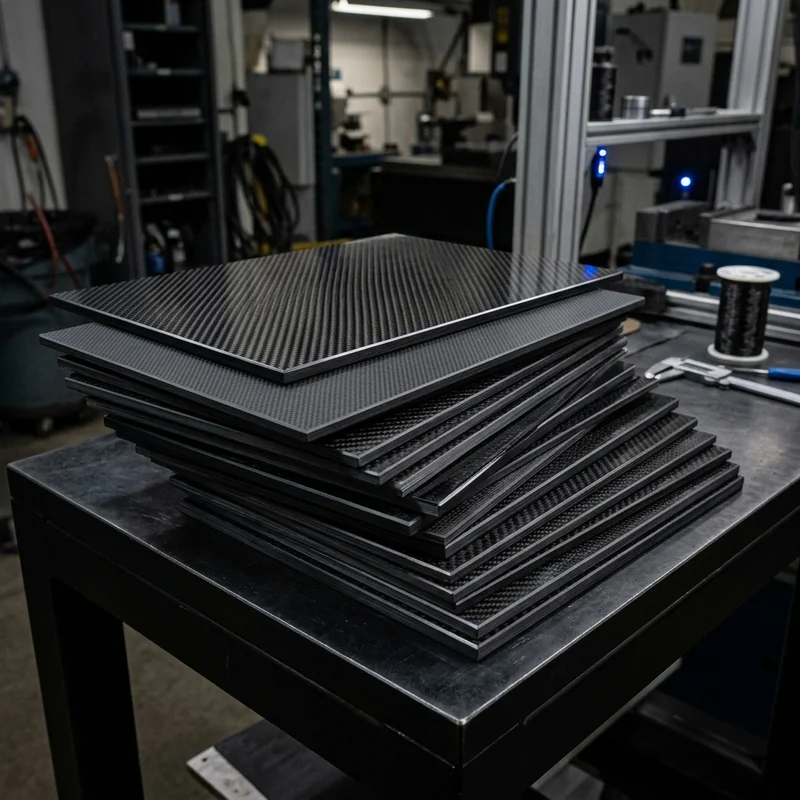
Carbon fiber standard plate-3k stripe
Lightweight, ultra-rigid standard sheets for drone fuselages, robot housings, facades and structural applications.

Carbon Fiber Plate — 3K Twill T700 1.5mm
Thin 1.5mm carbon fiber plate with 3K twill weave surface. Lightweight and stiff, commonly used for covers, panels, drone bodies, and applications requiring a premium aesthetic appearance.

Square Carbon Fiber Tube — 3K Twill T700
Square cross-section carbon fiber tube manufactured with 3K twill weave for torsional strength. Preferred for structural frames, trusses, and support columns where rectangular geometry offers design flexibility.

Carbon Fiber Plate — 3K Twill T700 3.0mm
Medium-thickness 3.0mm carbon fiber plate offering significantly higher load capacity while maintaining attractive 3K twill finish. Suitable for structural brackets, reinforcement plates, and load-bearing panels.
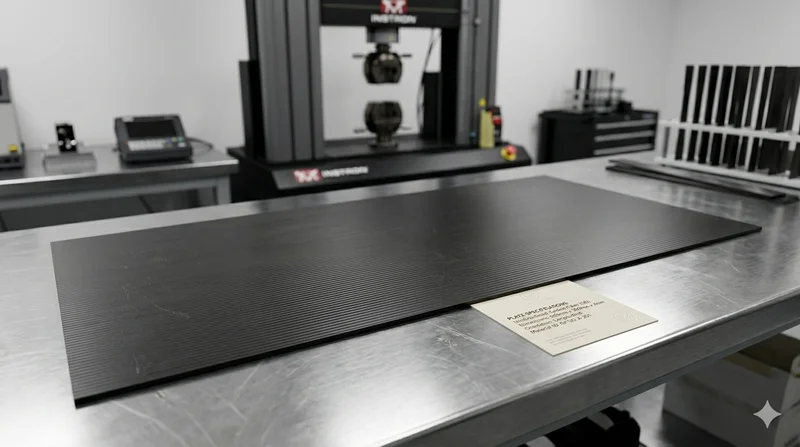
Carbon Fiber Plate — UD Unidirectional T700
Unidirectional carbon fiber plate with all fibers oriented in a single direction for maximum strength along the fiber axis. Essential for structural reinforcements, splints, and applications where load direction is predictable.