
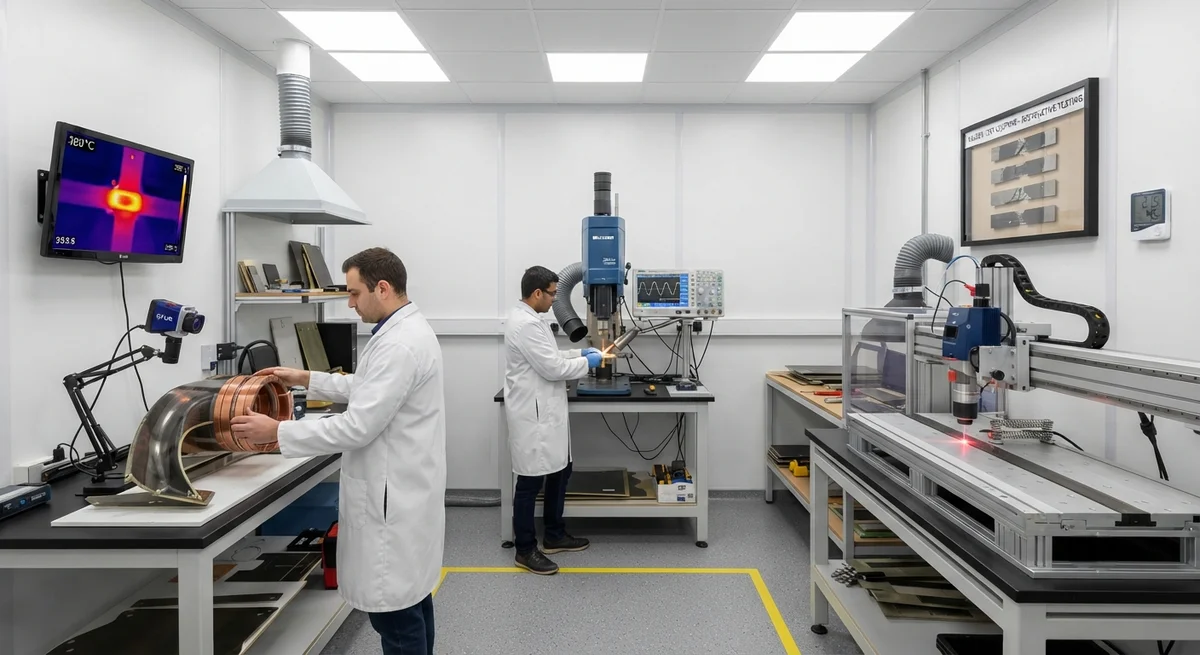
A comprehensive technical comparison of induction welding, ultrasonic welding, and laser-assisted bonding for thermoplastic carbon fiber composites — covering process parameters, joint strength data, cycle times, and production implementation guidance for aerospace and automotive applications.
Introduction: The Joining Challenge in Thermoplastic Composites
Thermoplastic carbon fibre composites — based on matrices such as PEEK, PEKK, PPS, and PVDF — are gaining significant adoption in aerospace, automotive, and industrial applications, driven by their distinct advantages over thermoset composites: unlimited shelf life at room temperature, reprocessability, high fracture toughness (typically 500–1,500 J/m² compared to 200–600 J/m² for toughened epoxy), rapid forming cycles measured in minutes rather than hours, and the potential for fusion welding without adhesive or mechanical fasteners.
However, the joining of thermoplastic composite components has been a persistent technical and economic barrier to broader adoption. Traditional joining methods — mechanical fastening (bolts, rivets) and adhesive bonding — introduce weight penalties, stress concentrations, surface preparation requirements, and manufacturing complexity that partly negate the advantages of the thermoplastic matrix. Fusion welding — the direct melting and consolidation of the thermoplastic matrix at the joint interface — offers a fundamentally better solution: no added weight, no fasteners, no adhesive cure time, and joints that match or exceed the parent material strength.
Three fusion welding technologies have reached production maturity for thermoplastic carbon fibre composites: induction welding, ultrasonic welding, and laser-assisted bonding. Each method applies energy to the joint interface differently, producing distinct temperature profiles, melting zones, and process windows. This article provides a technical comparison to support process selection for B2B buyers and manufacturing engineers.
Induction Welding
Process Principle
Induction welding uses a high-frequency alternating magnetic field (typically 100–500 kHz) generated by a copper induction coil to induce eddy currents in an electrically conductive susceptor — either the carbon fibres themselves or a dedicated metallic mesh or patch placed at the joint interface. The eddy currents generate heat through Joule (resistive) heating, melting the thermoplastic matrix at the interface. A consolidation pressure of 0.5–2.0 MPa is applied during heating and subsequent cooling to achieve intimate contact between the two surfaces and prevent void formation.
The critical advantage of induction welding is its ability to heat the joint interface selectively without heating the entire component. For carbon fibre-PEEK laminates, the carbon fibres act as efficient susceptors (electrical resistivity of 1.5 × 10⁻³ Ω·cm for PAN-based fibres), generating heat preferentially at the ply interfaces where fibre-to-fibre contact is highest. This allows welding of large structures — up to 2 m weld length demonstrated in production — with energy input limited to the weld zone.
Process Parameters and Joint Performance
Key induction welding parameters are coil current (100–600 A), frequency (100–500 kHz), welding speed (0.1–2.0 m/min), and consolidation pressure. Published data from the Thermoplastic Composites Welding Consortium (TCWC, 2025) reports single-lap shear strengths of 42–55 MPa for carbon fibre/PEEK joints welded at optimal parameters (350 A, 300 kHz, 0.5 m/min, 1.0 MPa), achieving 85–95% of the parent laminate shear strength. Double-lap joint configurations achieve 55–65 MPa — equivalent to co-consolidated material.
Ultrasonic Welding
Process Principle
Ultrasonic welding applies high-frequency mechanical vibration (20–40 kHz) through a sonotrode (horn) to the upper component, generating frictional heat at the joint interface through intermolecular friction and surface asperity interaction. The vibration amplitude (20–80 µm peak-to-peak) and weld time (0.1–5.0 seconds) control the energy input, while a static force of 100–2,000 N is applied through the sonotrode to maintain contact and promote material flow. The process is typically performed in a single shot for discrete weld points or seams rather than continuous welding.
The key advantage of ultrasonic welding is speed: complete weld formation in 0.5–5 seconds, making it the fastest fusion welding method for thermoplastics. Energy directors — small protrusions or a separate mesh/patch of thermoplastic material at the interface — concentrate the ultrasonic energy at the weld zone, reducing the energy required and improving joint consistency. The most common energy director configuration is a 0.1–0.3 mm thick neat PEEK or PPS film placed between the joining surfaces.
Process Parameters and Joint Performance
Ultrasonic welding parameters include vibration amplitude (30–70 µm), weld force (200–1,500 N), weld time (0.5–3.0 s), and hold time (1.0–5.0 s). For carbon fibre/PEEK laminates using a 0.2 mm PEEK film energy director, single-lap shear strengths of 38–48 MPa are achieved, representing 75–90% of parent laminate strength. The lower strength relative to induction welding is attributed to the more localised heating zone and potential for fibre misalignment in the melt zone. Weld quality is sensitive to surface condition — plasma or corona treatment prior to welding improves strength by 8–15% by removing surface contamination and increasing surface energy.
Laser-Assisted Bonding
Process Principle
Laser-assisted bonding uses a focused laser beam — typically a diode laser (800–1,100 nm wavelength) or fibre laser (1,070 nm) — to heat the joint interface selectively. For carbon fibre composites, the carbon fibres absorb near-infrared laser radiation efficiently, allowing direct heating of the joint interface without an additional absorber. The laser beam is scanned across the weld path using galvanometer mirrors, with typical scan speeds of 1–20 m/min. A consolidation roller applies pressure immediately behind the laser spot to consolidate the molten zone before solidification.
Laser welding offers the highest spatial precision of the three methods — weld zone widths of 2–10 mm can be achieved, compared to 10–50 mm for induction welding — enabling joining of geometrically complex components with tight tolerances. The narrow heat-affected zone (typically 1–3 mm) minimises thermal distortion and allows welding in close proximity to heat-sensitive features.
Process Parameters and Joint Performance
Key laser welding parameters are laser power (200–2,000 W), scan speed (1–20 m/min), beam spot size (3–10 mm), consolidation roller pressure (0.5–2.0 MPa), and pre-heat or post-heat conditions. For carbon fibre/PEEK laminates, single-lap shear strengths of 45–58 MPa are reported at optimal parameters (1,500 W, 5 m/min, 5 mm spot, 1.5 MPa), achieving 88–98% of parent laminate strength — the highest of the three methods.
Table 1: Comparative Performance — Induction vs Ultrasonic vs Laser Welding
| Parameter | Induction Welding | Ultrasonic Welding | Laser-Assisted Bonding |
|---|---|---|---|
| Single-lap shear strength (CF/PEEK) | 42–55 MPa | 38–48 MPa | 45–58 MPa |
| % of parent laminate strength | 85–95% | 75–90% | 88–98% |
| Cycle time per weld point | 10–60 s | 0.5–5 s | 2–30 s |
| Continuous weld speed | 0.1–2.0 m/min | N/A (discrete) | 1–20 m/min |
| Maximum weld length (production) | 2.0 m | 0.3 m (single shot) | Continuous |
| Weld zone width | 10–50 mm | 5–15 mm | 2–10 mm |
| Heat-affected zone | 5–20 mm | 2–8 mm | 1–3 mm |
| Consolidation pressure | 0.5–2.0 MPa | Contact force only | 0.5–2.0 MPa (roller) |
| Susceptor/energy director required | Optional (CF self-couples) | Yes (film or mesh) | No (CF absorbs NIR) |
| Equipment cost (USD, production) | $80,000–250,000 | $40,000–120,000 | $150,000–450,000 |
| Tooling cost per joint geometry | Low to moderate | Moderate | Low |
| Suitable joint types | Lap, T-joint, edge | Lap, spot, stud | Lap, T-joint, butt, fillet |
Application-Specific Selection Guide
The selection of the optimal welding method depends on production volume, joint geometry, strength requirements, and cycle time targets:
- Induction welding is best suited for large structural joints — fuselage skin-to-stringer, wing rib-to-skin, and aerospace floor panel assemblies — where joint lengths of 0.5–2.0 m require continuous welds and moderate cycle times (30–120 seconds per metre) are acceptable. The capability to weld without a separate susceptor (using carbon fibre self-coupling) reduces consumable cost and simplifies process validation for aerospace certification.
- Ultrasonic welding excels in high-volume, small-joint applications — automotive battery tray assembly, interior trim attachment, cable harness brackets, and medical device enclosure sealing — where individual weld points or short seams (10–100 mm) are required at cycle times below 5 seconds per joint. The lower capital cost and compact equipment footprint make ultrasonic welding accessible for lower-volume production lines.
- Laser-assisted bonding is optimal for high-strength, high-precision joints — aerospace control surface assembly, automotive structural battery enclosures, and pressure vessel dome-to-liner bonds — where the highest joint strength (88–98% of parent material), narrowest heat-affected zone, and ability to weld complex 3D contours are required. The higher capital investment is justified by the superior joint quality and process flexibility.
Frequently Asked Questions
Q: How does the weld strength of thermoplastic fusion compare to adhesive bonding?
A: Published comparative data (SAMPE Conference Proceedings, 2025) shows that induction-welded CF/PEEK single-lap joints achieve a shear strength of 48–55 MPa, compared to 25–38 MPa for film adhesive-bonded joints (e.g., 3M AF 163-2K, Solvay FM 300-2) prepared with standard surface preparation (grit blast + solvent wipe). Fusion welds eliminate the adhesive layer — a potential creep and moisture ingress path — and provide 40–60% higher joint strength. For double-lap configurations, welded joints approach the parent laminate's interlaminar shear strength, which is not achievable with adhesive bonds.
Q: Can these welding methods be applied to glass or aramid fibre-reinforced thermoplastics?
A: Yes, with modifications. Glass and aramid fibres are electrically insulating (glass) or have high electrical resistivity (aramid), so induction welding of glass/aramid composites requires a metallic susceptor (100–200 µm stainless steel or copper mesh) at the joint interface. Laser welding of glass-reinforced thermoplastics requires a laser-absorbing additive — carbon black (0.5–2.0% by weight), Clearweld® near-infrared absorber, or a thin carbon fibre veil — incorporated at the surface ply. Ultrasonic welding is the most material-agnostic method and works well with all fibre types, provided a compatible energy director film is used.
Q: What is the maximum thickness of components that can be joined by each method?
A: Induction welding is practical for laminate thicknesses of 1–15 mm per component; above 15 mm, through-thickness temperature gradients become significant, requiring longer heating times and risking surface degradation before the joint interface reaches melt temperature. Ultrasonic welding is limited to thinner components — 0.5–6 mm — due to the rapid attenuation of ultrasonic vibrations through the material thickness. Laser-assisted bonding is effective for 0.5–10 mm thickness; thicker laminates require higher laser power and slower scan speeds to ensure the joint interface reaches the melt temperature without surface burning. For thick-section joints (>15 mm), a hybrid approach — pre-heating the joint zone with hot gas or infrared lamps followed by laser or induction welding — is recommended.
Q: Are fusion-welded thermoplastic joints inspectable by NDT methods?
A: Yes. Ultrasonic C-scan remains the primary NDT method for evaluating weld quality, with similar inspection parameters to those used for the parent laminate (5–15 MHz focused transducers). The weld zone appears as a region of uniform back-wall echo amplitude — any reduction or loss of echo indicates porosity, delamination, or lack of fusion. Phased-array ultrasonic testing (PAUT) is increasingly used for complex joint geometries, providing 2D cross-sectional images of the weld zone. Laser shearography — measuring the surface strain response under thermal or vacuum loading — is an effective production-rate NDT method capable of detecting kissing bonds (zero-volume disbonds) that are invisible to conventional ultrasonic testing. For critical aerospace joints, a combination of 100% ultrasonic C-scan and sampling-based shearography is standard practice.
Q: How do environmental factors — moisture, temperature, UV — affect welded joints over time?
A: Fusion-welded joints in PEEK and PEKK matrices show excellent environmental resistance due to the intrinsic chemical stability of these polymers. After 5,000 hours of hot-wet exposure (70°C/85% RH), induction-welded CF/PEEK joints retained 92–97% of their initial shear strength. After 1,000 hours of UV exposure (xenon-arc, ASTM G155), strength retention was 88–94%. Ultrasonic welds show slightly higher sensitivity to moisture — 85–90% strength retention — due to the potential for micro-voids at the weld interface that act as moisture accumulation sites. Laser welds, having the narrowest heat-affected zone and lowest void content, demonstrate the best environmental durability — 94–98% strength retention after hot-wet exposure. No welding method shows a statistically significant reduction in fatigue life under standard environmental conditions compared to the parent laminate.
Conclusion
Fusion welding of thermoplastic carbon fibre composites is a production-ready technology that eliminates the weight, complexity, and environmental sensitivity of adhesive bonding and mechanical fastening. Induction, ultrasonic, and laser welding each occupy distinct application niches defined by joint geometry, production volume, cycle time, and strength requirements. Induction welding provides the best combination of weld strength and scalability for large aerospace structures; ultrasonic welding delivers the fastest cycle times for high-volume discrete joints; and laser-assisted bonding achieves the highest joint strength with the greatest spatial precision. For B2B buyers evaluating welding technology investment, the key factors are production volume (ultrasonic > 50,000 joints/year; induction and laser > 5,000 m weld/year), joint access requirements, and certification pathway. YongXian CarbonFiber supplies unidirectional and woven thermoplastic prepreg systems (CF/PEEK, CF/PEKK, CF/PPS) optimised for fusion welding processes. Contact our applications engineering team for weld process development support and material qualification assistance.
Part of topic
Related Articles
- Bio-Based Carbon Fiber Precursors: Lignin and Polyethylene for Low-Cost Production
- Large-Tow Carbon Fiber Cost Analysis: 48K vs 60K Price-Performance Comparison
- Carbon Fiber-Resin Interface Bonding: Surface Treatment and Coupling Agent Optimization
- Digital Twin for Carbon Fiber Manufacturing: Real-Time Process Monitoring and Defect Prevention
- Thermoplastic Carbon Fiber Welding for Automotive: Ultrasonic and Induction Welding Process Windows
- Large-Tow Carbon Fiber Wet Spinning: Process Optimization for 48K/60K Production Efficiency
Interested in Our Products?
Contact our team for competitive pricing and technical specifications.
Get a QuoteRelated Products
Carbon fiber standard plate-3k stripe
Lightweight, ultra-rigid standard sheets for drone fuselages, robot housings, facades and structural applications.

Carbon Fiber Plate — 3K Twill T700 1.5mm
Thin 1.5mm carbon fiber plate with 3K twill weave surface. Lightweight and stiff, commonly used for covers, panels, drone bodies, and applications requiring a premium aesthetic appearance.

Square Carbon Fiber Tube — 3K Twill T700
Square cross-section carbon fiber tube manufactured with 3K twill weave for torsional strength. Preferred for structural frames, trusses, and support columns where rectangular geometry offers design flexibility.

Carbon Fiber Plate — 3K Twill T700 3.0mm
Medium-thickness 3.0mm carbon fiber plate offering significantly higher load capacity while maintaining attractive 3K twill finish. Suitable for structural brackets, reinforcement plates, and load-bearing panels.
Carbon Fiber Plate — UD Unidirectional T700
Unidirectional carbon fiber plate with all fibers oriented in a single direction for maximum strength along the fiber axis. Essential for structural reinforcements, splints, and applications where load direction is predictable.