
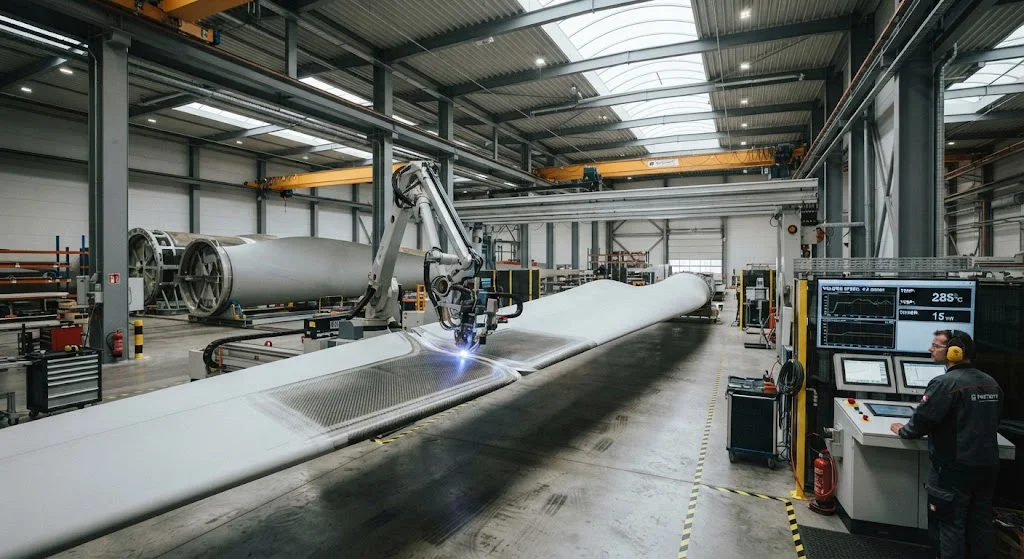
Wind turbine blade assembly has traditionally relied on structural adhesive bonding to join blade shells to spar caps and shear webs — a process that requires 8-24 hours of cure time per blade, demands precise surface preparation, and creates permanent joints that cannot be disassembled
Introduction
Wind turbine blade assembly has traditionally relied on structural adhesive bonding to join blade shells to spar caps and shear webs — a process that requires 8-24 hours of cure time per blade, demands precise surface preparation, and creates permanent joints that cannot be disassembled for repair or recycling. As blade lengths exceed 100 meters and production rates increase to meet global wind energy targets, adhesive bonding is becoming a bottleneck in blade manufacturing throughput and a constraint on end-of-life blade management.
Thermoplastic blade welding offers a fundamentally different approach: joining blade components using heat and pressure rather than chemical adhesives, producing bonds that can be reheated and reformed for repair, disassembly, or recycling. The shift from thermoset (epoxy or polyester) to thermoplastic (polypropylene, polyamide, or polyethersulfone) blade materials enables welding-based assembly with cycle times of 10-30 minutes versus 8-24 hours for adhesive cure. This article examines the welding technologies — induction, infrared, and resistance welding — being developed for large thermoplastic blade assembly, quantifies the manufacturing and lifecycle advantages, and reviews the quality assurance approaches needed for production-scale implementation.
Why Thermoplastic Materials for Blades
The transition from thermoset to thermoplastic blade materials is driven by three manufacturing and lifecycle advantages:
- Weldability: Thermoplastic matrices soften when heated above their melting point (typically 150-260°C depending on polymer), enabling fusion bonding through heat and pressure application. This contrasts with thermoset resins that cure irreversibly — once bonded, thermoset joints cannot be reheated for repair or disassembly without damaging the parent material.
- Recyclability: Thermoplastic composites can be remelted and reprocessed at end of life, enabling material recycling pathways that are unavailable for thermoset composites. As blade lengths increase and the first generation of large blades approaches end of life (2030-2035), recyclability is becoming a regulatory and economic requirement rather than a nice-to-have feature.
- Faster processing: Thermoplastic welding eliminates the multi-hour adhesive cure step, enabling continuous production flow rather than batch processing. Cycle time reduction from 12-24 hours (adhesive cure) to 10-30 minutes (welding) increases blade factory throughput by 2-4x without additional factory floor space.
Current thermoplastic blade materials include glass fiber-reinforced polypropylene (GF-PP) for shear webs and spar caps, glass fiber-reinforced polyamide (GF-PA) for blade shells, and carbon fiber-reinforced polyethersulfone (CF-PESU) for high-load structural elements. These materials offer mechanical properties comparable to thermoset composites (tensile strength 400-800 MPa, elastic modulus 20-40 GPa) while enabling the welding-based manufacturing approach.
Welding Technologies for Large Blade Assembly
Three welding technologies are being developed and tested for joining large thermoplastic blade components, each with distinct advantages for different blade sections and production scenarios:
| Technology | Heating Mechanism | Typical Joint Width | Cycle Time | Best Application |
|---|---|---|---|---|
| Induction welding | Electromagnetic induction in conductive susceptors | 50-200mm | 10-20 minutes | Spar cap to web joints |
| Infrared welding | Radiant heat from IR emitters | 100-500mm | 15-30 minutes | Shell-to-shell bonds |
| Resistance welding | Joule heating from resistive elements | 20-100mm | 8-15 minutes | Structural reinforcement joints |
| Hot gas welding | Convective heat from hot air | 10-50mm | 20-45 minutes | Repair and small joints |
Induction welding is the most advanced technology for blade assembly, using alternating magnetic fields to heat conductive susceptors (carbon fiber layers, metal meshes, or carbon nanotube coatings) embedded in the thermoplastic matrix. The susceptor absorbs electromagnetic energy and converts it to heat, melting the surrounding thermoplastic matrix to form a fusion bond. Induction welding advantages include rapid, localized heating (temperature uniformity ±5°C across the weld zone), non-contact energy delivery, and scalability to large blade dimensions. Production systems from companies like Vestas and Carbon Rotors use induction welding for spar cap-to-web joints on blades exceeding 80 meters.
Infrared welding uses banks of IR emitters (tungsten, quartz, or ceramic elements) to radiantly heat thermoplastic surfaces before pressing them together under controlled pressure. IR welding is suited to large-area bonds such as shell-to-shell joints, where the broad heating zone provides uniform temperature distribution across wide bond areas. The process requires careful thermal management to prevent surface degradation — thermoplastic surfaces exposed to excessive IR radiation can develop surface oxidation or molecular weight reduction that compromises weld strength.
Resistance welding embeds resistive heating elements (carbon fiber fabrics, metallic meshes, or printed conductive tracks) at the bond interface, passing electrical current through the elements to generate localized Joule heating. This approach provides excellent temperature control (±3°C uniformity) and is particularly suited to high-stress structural joints where precise thermal profiles are critical for weld quality. Resistance welding cycle times of 8-15 minutes are the fastest of the three technologies, but the requirement for embedded heating elements adds material cost and complexity.
Process Parameters and Quality Control
Thermoplastic welding quality depends on three interdependent process parameters that must be precisely controlled for each blade section:
- Temperature: The thermoplastic matrix must reach its melting temperature (not degradation temperature) to achieve molecular interdiffusion across the bond interface. Typical processing windows are 190-230°C for polypropylene, 250-290°C for polyamide, and 340-380°C for polyethersulfone. Temperature uniformity across the weld zone must be maintained within ±5-10°C to prevent local overheating (degradation) or underheating (incomplete fusion).
- Pressure: Welding pressure (0.5-2.0 MPa typical) ensures intimate contact between mating surfaces and facilitates molecular interdiffusion. Insufficient pressure produces void formation and reduced bond strength; excessive pressure squeezes molten matrix from the weld zone, creating resin-starved areas with poor mechanical properties.
- Time: Weld dwell time (the duration at welding temperature and pressure) determines the extent of molecular interdiffusion across the bond interface. Insufficient dwell time produces weak bonds with low interfacial strength; excessive dwell time wastes energy and may cause thermal degradation of the matrix adjacent to the weld zone.
Process monitoring systems for production welding use embedded thermocouples, infrared temperature sensors, and ultrasonic thickness measurement to verify temperature, pressure, and time parameters during each weld cycle. Post-weld quality assurance includes ultrasonic inspection of bond integrity, destructive testing of witness coupons (small sample pieces welded simultaneously with the blade), and mechanical testing (lap shear, peel, and flexural tests) on a statistical sampling basis.
Manufacturing Throughput and Cost Analysis
The shift from adhesive bonding to thermoplastic welding transforms blade factory economics in three dimensions:
- Throughput increase: Eliminating 8-24 hours of adhesive cure time per blade increases factory output from 1-2 blades per production line per day to 3-5 blades per day, depending on blade size and welding complexity. For a factory producing 500 blades per year, welding-based assembly can increase capacity to 1,000-1,500 blades per year without additional factory floor space.
- Fixture simplification: Adhesive bonding requires complex blade molds and clamping fixtures to maintain bonding pressure during cure. Welding fixtures are simpler — typically heated platens or induction coils that apply pressure only during the weld cycle — reducing fixture capital cost by 30-50% and changeover time between blade variants by 60-80%.
- Labor reduction: Adhesive bonding requires skilled surface preparation (plasma treatment, primer application) and adhesive dispensing. Automated welding systems reduce direct labor by 40-60% while improving process consistency — a critical factor as blade production scales to meet 100+ GW annual global installations.
- Material cost impact: Thermoplastic resin costs ($2-4/kg) are comparable to or slightly higher than thermoset resins ($1.5-3/kg), but the elimination of adhesive ($15-30/kg for structural blade adhesives), primer, and surface treatment chemicals provides net material cost reduction of 10-20% per blade.
Repair and Recyclability Advantages
Thermoplastic welding provides unique lifecycle advantages that thermoset adhesive bonding cannot offer:
- In-field repair: Damaged blade sections can be repaired by local reheating and re-welding, rather than the complex patch-and-adhesive repair procedures required for thermoset blades. Repair time reduces from 12-48 hours (thermoset) to 2-8 hours (thermoplastic), and repair quality approaches original manufacturing strength when proper welding procedures are followed.
- Disassembly for recycling: At end of life, thermoplastic blade components can be separated by selective reheating, enabling material recycling of blade shells, spar caps, and shear webs individually. Thermoset blades cannot be economically disassembled — current end-of-life options are limited to shredding for cement kiln co-processing or landfill disposal.
- Remanufacturing potential: Blade components damaged during transportation or installation can be reprocessed rather than scrapped, reducing material waste and warranty costs. This capability is particularly valuable for 100m+ blades where transportation damage risk increases significantly.
Frequently Asked Questions
How does weld strength compare to adhesive bond strength in blade applications?
Properly executed thermoplastic welds achieve 80-95% of the parent material strength, compared to 60-85% for structural adhesive bonds. The higher weld strength results from molecular interdiffusion across the bond interface — the thermoplastic matrix flows and entangles across the joint, creating a continuous material structure rather than the discrete adhesive layer characteristic of bonded joints. Lap shear strength of welded polypropylene joints typically reaches 15-25 MPa, compared to 12-20 MPa for structural adhesive bonds in equivalent geometry. The practical implication is that welded joints can be designed with smaller bond areas or fewer weld passes, partially offsetting the additional welding equipment cost.
What are the main challenges for scaling thermoplastic welding to 100m+ blades?
Three challenges dominate. First, maintaining temperature uniformity across weld zones exceeding 5 meters in length requires sophisticated multi-zone heating systems and real-time thermal monitoring — non-uniform temperature produces variable weld quality along the joint. Second, welding fixtures for 100m+ blades must handle blade weights exceeding 30 tonnes while maintaining precise alignment — the capital cost and complexity of these fixtures represent a significant fraction of factory investment. Third, welding process qualification and certification standards for blade structural joints are still under development — blade certification bodies (DNV, GL) are developing guidelines but production-scale qualification programs are ongoing. These challenges explain why thermoplastic welding is currently adopted first for blade sub-component assembly (spar cap to web) rather than complete blade shell bonding.
Can existing thermoset blade factories be converted to thermoplastic welding?
Partial conversion is feasible but complete transformation requires substantial investment. Existing blade molds cannot be used for thermoplastic blades (different thermal expansion, different material handling). However, factory infrastructure — cranes, climate control, quality inspection systems — can be repurposed. The primary investment requirement is welding equipment (induction generators, IR emitter banks, or resistance welding power supplies) and blade handling fixtures designed for thermoplastic welding pressure and temperature requirements. A realistic conversion timeline is 18-24 months for a factory producing blades in the 60-80m class, with total conversion cost estimated at 40-60% of a greenfield thermoplastic blade factory.
Conclusion
Thermoplastic blade welding is transitioning from experimental development to production-scale implementation, driven by the need for faster blade assembly, recyclable blade materials, and repair-friendly blade designs. Induction, infrared, and resistance welding technologies each offer distinct advantages for different blade joint types, with cycle times of 10-30 minutes replacing 8-24 hour adhesive cure processes. The manufacturing throughput gains of 2-4x, combined with end-of-life recyclability and in-field repair capability, make thermoplastic welding a strategic technology for the next generation of 100m+ wind turbine blades. As welding process standards mature and blade certification bodies establish qualification guidelines, thermoplastic welding will become the preferred assembly method for high-production-rate blade factories.
For wind turbine blade manufacturers evaluating thermoplastic welding technology, the practical considerations are welding process selection for specific blade joints, fixture design for large blade handling, and qualification testing programs for certification. Explore our thermoplastic carbon fiber materials, including welding-grade prepregs and susceptor materials for induction welding applications, or contact our engineering team to discuss thermoplastic blade welding requirements for your manufacturing program.
Part of topic
Related Articles
- Bio-Based Carbon Fiber Precursors: Lignin and Polyethylene for Low-Cost Production
- Large-Tow Carbon Fiber Cost Analysis: 48K vs 60K Price-Performance Comparison
- Carbon Fiber-Resin Interface Bonding: Surface Treatment and Coupling Agent Optimization
- Digital Twin for Carbon Fiber Manufacturing: Real-Time Process Monitoring and Defect Prevention
- Thermoplastic Carbon Fiber Welding for Automotive: Ultrasonic and Induction Welding Process Windows
- Large-Tow Carbon Fiber Wet Spinning: Process Optimization for 48K/60K Production Efficiency
Interested in Custom Carbon Fiber Products?
Contact our team for competitive pricing and technical specifications.
Get a QuoteRelated Products
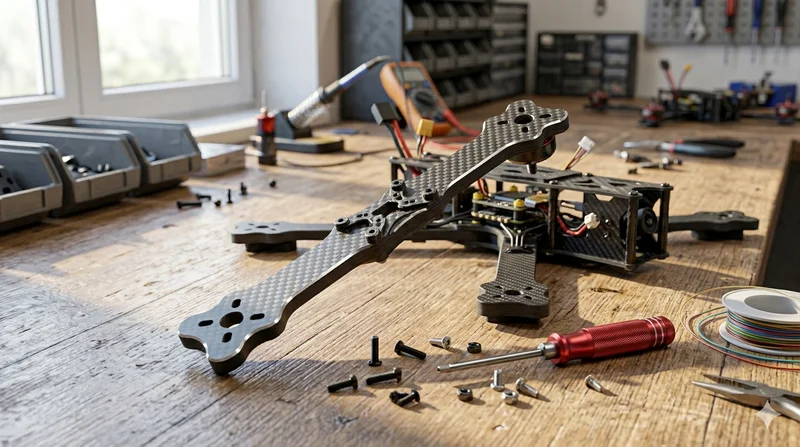
Carbon Fiber Drone Arm
Precision-molded carbon fiber drone arm combining unidirectional fiber for stiffness and woven layers for torsional strength. Designed for FPV, photography, and industrial drone platforms. Each arm is CNC-machined to exact specifications.
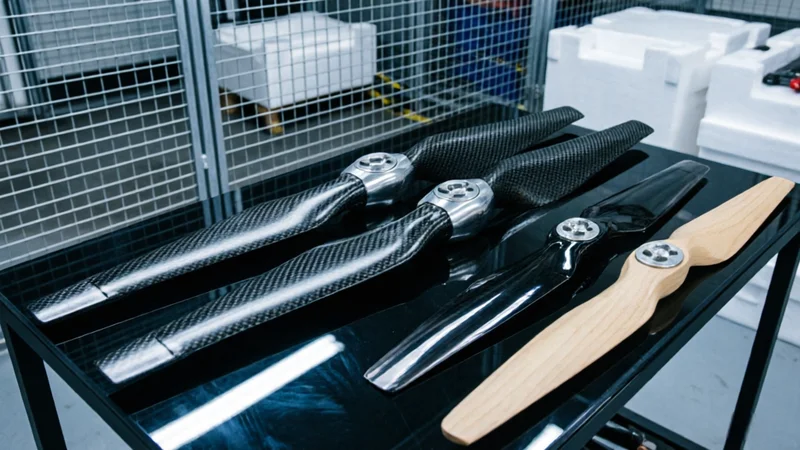
Carbon Fiber Drone Propeller — High-Performance Prepreg Molded
Prepreg-molded carbon fiber propellers for industrial and racing drones. Optimized airfoil design with balanced blade geometry for maximum thrust efficiency. 3-5× stiffer than nylon/plastic props, reducing blade flutter and improving flight stability. Available in common sizes or custom diameter/pitch.