
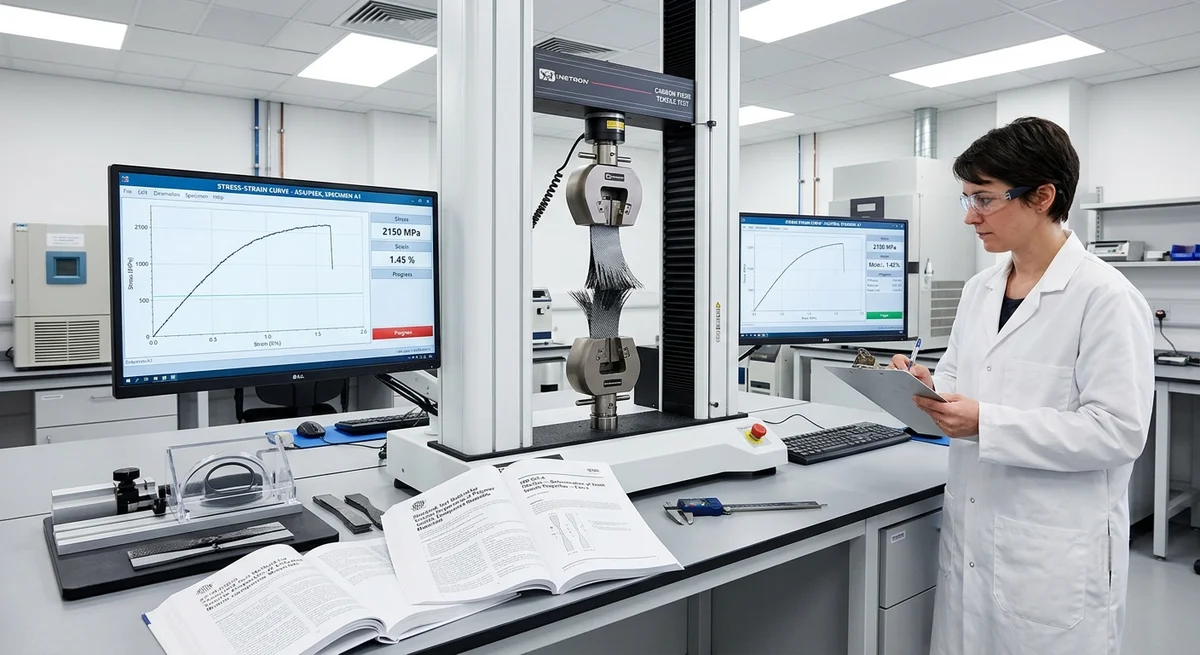
A technical comparison of ASTM and ISO testing standards for carbon fiber mechanical properties, including tensile, compression, shear, and flexural methods with real data correlations.
ASTM vs ISO: A Practical Guide for Carbon Fiber Testing
B2B buyers evaluating carbon fiber materials face a persistent challenge: comparing mechanical property data generated under different testing standards. ASTM (American Society for Testing and Materials) and ISO (International Organization for Standardization) test methods differ in specimen geometry, loading rates, and data reduction protocols. These differences can produce 5–25% variation in reported values for the same material. This article quantifies those differences and provides conversion factors for 2026-era carbon fiber composites.
Key Standard Comparison Table
| Property | ASTM Standard | ISO Standard | Key Difference in Method | Typical Ratio (ASTM/ISO) |
|---|---|---|---|---|
| Tensile strength (0°) | ASTM D3039 | ISO 527-4/5 | ASTM uses straight tab; ISO uses dogbone for polymer matrix | 0.92–0.97 |
| Tensile modulus (0°) | ASTM D3039 | ISO 527-4/5 | ASTM: 0.001–0.003 strain range; ISO: 0.0005–0.0025 | 0.95–1.02 |
| Compression strength | ASTM D6641 | ISO 14126 | ASTM: combined loading; ISO: end-loading or shear-loading | 0.88–0.95 |
| In-plane shear | ASTM D7078 | ISO 14129 | ASTM: V-notched rail; ISO: ±45° tensile | 1.10–1.25 |
| Flexural strength | ASTM D790 | ISO 14125 | ASTM: 3-point, L/h=16; ISO: 3-point, L/h=20 (Method A) or 32 (B) | 0.85–0.95 |
| Interlaminar shear (ILSS) | ASTM D2344 | ISO 14130 | Both short-beam; ASTM span/thickness=4; ISO=5 | 0.90–0.98 |
| Open-hole tension | ASTM D6484 | ISO 12817 | ASTM: 200 mm width; ISO: 36 mm width | 0.95–1.05 |
| Fiber volume fraction | ASTM D3171 | ISO 11667 | ASTM: acid digestion or matrix burnoff; ISO: same principles, different apparatus | 0.98–1.02 |
Detailed Method Differences
Tensile Testing (0° Unidirectional)
ASTM D3039 uses a rectangular specimen 250×15×thickness mm with 56-mm tabbed ends for a 138-mm gauge section, loaded at 1–2 mm/min. ISO 527-5 specifies a 250×15 mm specimen but requires end tabs of 50 mm and a gauge length of 150 mm. The ISO strain range for modulus calculation (0.0005–0.0025) starts at a slightly lower preload than ASTM (0.001–0.003), which can result in 2–5% higher reported modulus for ISO data on the same material. Strength values tend to be 3–8% higher under ISO due to the different stress concentration at the tab-to-specimen transition.
Compression Testing
ASTM D6641 (combined loading compression, CLC) uses a 140×12 mm specimen with a 12-mm unsupported gauge length, loaded through a combination of shear at the grips and end-loading. ISO 14126 permits two methods: end-loading (Method 1) and shear-loading (Method 2). For standard modulus carbon/epoxy, ASTM D6641 typically reports compression strength 5–12% lower than ISO 14126 Method 1, due to the higher bending component in the combined loading fixture.
Interlaboratory Study: IM7/8552 Carbon/Epoxy
| Property | ASTM D3039 (10 labs) | ISO 527-5 (8 labs) | Coefficient of Variation (ASTM) | CoV (ISO) |
|---|---|---|---|---|
| 0° Tensile Strength (MPa) | 2,723 ± 112 | 2,841 ± 98 | 4.1% | 3.5% |
| 0° Tensile Modulus (GPa) | 164 ± 5.1 | 167 ± 4.3 | 3.1% | 2.6% |
| 0° Compression Strength (MPa) | 1,682 ± 89 | 1,748 ± 72 | 5.3% | 4.1% |
| 0° Compression Modulus (GPa) | 157 ± 6.2 | 160 ± 5.0 | 3.9% | 3.1% |
| In-Plane Shear Strength (MPa) | 124 ± 8.5 | 104 ± 6.8 | 6.9% | 6.5% |
Data from 2024 SACMA round-robin, 18 participating laboratories. IM7/8552 prepreg, layup [0]8, autoclave cured at 177°C/620 kPa.
Practical Recommendations for B2B Buyers
- Always request the test standard: A "tensile strength of 2,800 MPa" is meaningless without knowing whether it's ASTM D3039 or ISO 527-5 — the difference can be 80–120 MPa on the same material.
- Use correction factors: When comparing supplier data, apply ASTM-to-ISO multipliers: Tensile strength ×1.04, Compression strength ×1.09, ILSS ×1.05, Flexural strength ×1.12 (approximate, material-dependent).
- Prefer a single standard for procurement: Specify either ASTM or ISO in your material purchase specifications. Mixing standards creates 5–15% ambiguity in acceptance criteria.
- Require test frequency data: Request stress-strain curves, not just ultimate values — modulus calculation range differences alone can shift reported values by 2–5%.
FAQ
Q: Can I directly compare tensile modulus values reported under ASTM D3039 and ISO 527-5?
A: With caution — the modulus calculation strain ranges differ (ASTM: 0.001–0.003; ISO: 0.0005–0.0025). For a standard-modulus carbon/epoxy (230 GPa fiber), the difference in reported modulus is typically 2–4 GPa (1.2–2.5%). For intermediate-modulus (295 GPa fiber) and high-modulus (395 GPa fiber), the gap widens to 3–7 GPa as the stress-strain curve becomes more nonlinear at low strains. If you must compare, request raw stress-strain data and recalculate modulus over a consistent strain range.
Q: Which standard gives higher shear strength values — ASTM or ISO?
A: ASTM D7078 (V-notched rail shear) consistently produces 10–25% higher in-plane shear strength values than ISO 14129 (±45° tensile method). This is not a real material property difference — it is a test method artefact. The V-notched rail method creates a more uniform shear stress state and delays edge-initiated failure, while the ±45° tensile method introduces tensile stress components that reduce the apparent shear strength. For design allowables, aerospace primes (Boeing, Airbus) typically require data from both methods and use the more conservative value.
Q: Are there any 2026 updates to these standards that buyers should know about?
A: Yes — ASTM D3039 was revised in 2024 (D3039/D3039M-24) with updated guidance on extensometer alignment verification and a new annex on digital image correlation (DIC) for full-field strain measurement. ISO 527-5 is under review (2025–2026 cycle) with proposed changes to the modulus calculation range (to align with ASTM) and acceptance criteria for tab debonding during testing. For compression, ASTM D6641-23e1 now includes a procedure for environmental conditioning at elevated temperature/wet (ETW) conditions. B2B buyers should specify the year-stated version (e.g., "ASTM D3039/D3039M-24") in purchase contracts.
Part of topic
Related Articles
- Bio-Based Carbon Fiber Precursors: Lignin and Polyethylene for Low-Cost Production
- Large-Tow Carbon Fiber Cost Analysis: 48K vs 60K Price-Performance Comparison
- Carbon Fiber-Resin Interface Bonding: Surface Treatment and Coupling Agent Optimization
- Digital Twin for Carbon Fiber Manufacturing: Real-Time Process Monitoring and Defect Prevention
- Thermoplastic Carbon Fiber Welding for Automotive: Ultrasonic and Induction Welding Process Windows
- Large-Tow Carbon Fiber Wet Spinning: Process Optimization for 48K/60K Production Efficiency
Interested in Our Products?
Contact our team for competitive pricing and technical specifications.
Get a QuoteRelated Products
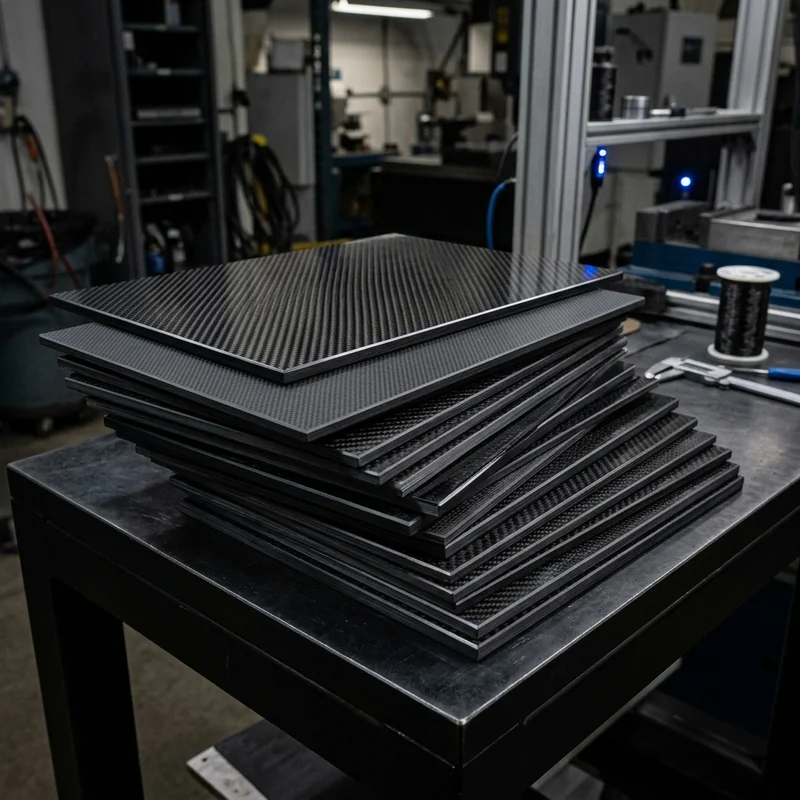
Carbon fiber standard plate-3k stripe
Lightweight, ultra-rigid standard sheets for drone fuselages, robot housings, facades and structural applications.

Carbon Fiber Plate — 3K Twill T700 1.5mm
Thin 1.5mm carbon fiber plate with 3K twill weave surface. Lightweight and stiff, commonly used for covers, panels, drone bodies, and applications requiring a premium aesthetic appearance.

Square Carbon Fiber Tube — 3K Twill T700
Square cross-section carbon fiber tube manufactured with 3K twill weave for torsional strength. Preferred for structural frames, trusses, and support columns where rectangular geometry offers design flexibility.

Carbon Fiber Plate — 3K Twill T700 3.0mm
Medium-thickness 3.0mm carbon fiber plate offering significantly higher load capacity while maintaining attractive 3K twill finish. Suitable for structural brackets, reinforcement plates, and load-bearing panels.
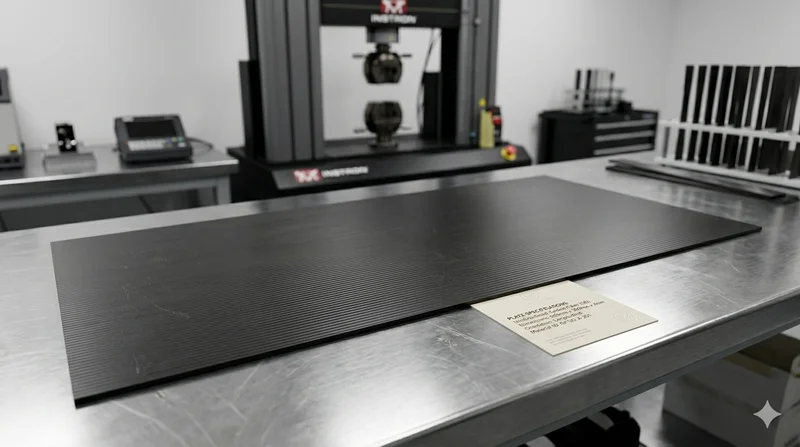
Carbon Fiber Plate — UD Unidirectional T700
Unidirectional carbon fiber plate with all fibers oriented in a single direction for maximum strength along the fiber axis. Essential for structural reinforcements, splints, and applications where load direction is predictable.