
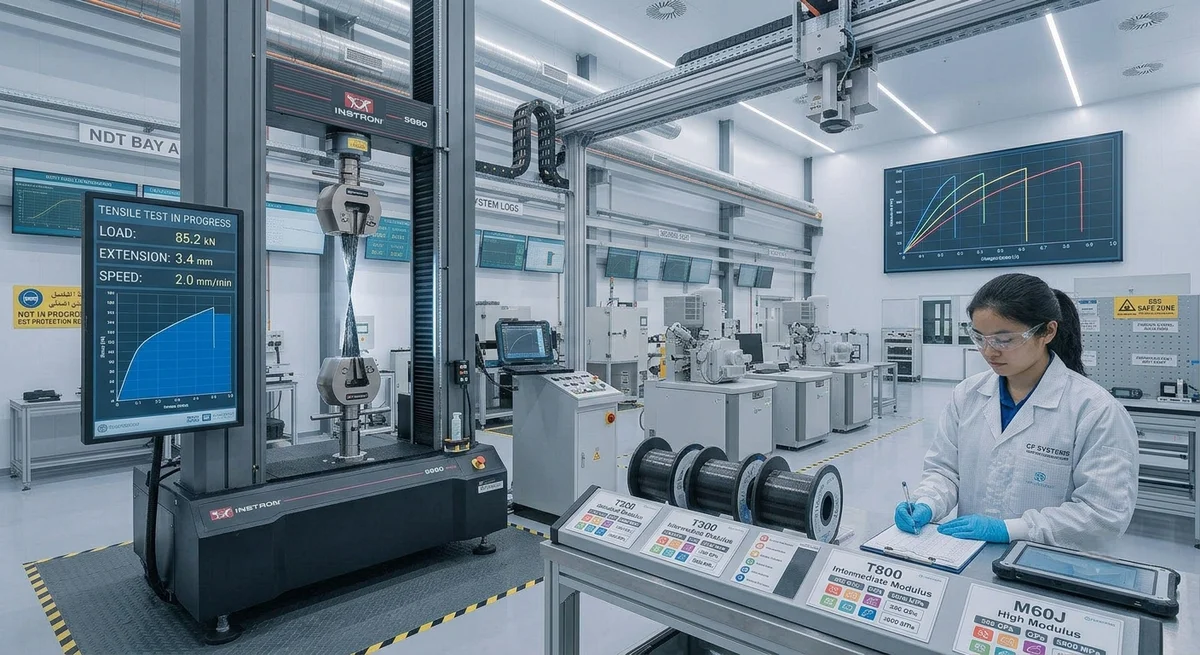
Tensile modulus and tensile strength are the two most critical mechanical properties in carbon fiber specification, yet they are frequently misunderstood by engineers new to composites. This technical guide explains the fundamental relationship between modulus and strength across standard, intermediate, and high-modulus fiber grades, with practical guidance for material selection in structural applications.
When specifying carbon fiber for a structural composite, engineers must navigate a complex trade-off between tensile modulus and tensile strength — two properties that, contrary to intuition, do not correlate linearly. Understanding this relationship is essential for material selection because choosing the wrong fibre grade can lead to overdesigned (and overpriced) laminates or, worse, premature failure in service. This guide provides a systematic framework for matching fibre mechanical properties to application requirements.
Carbon fiber tensile modulus — a measure of stiffness, or resistance to elastic deformation — is determined primarily by the degree of graphitic crystallite orientation along the fibre axis. Higher graphitisation temperatures (1800–3000 °C) during processing produce more aligned carbon layer planes, yielding fibres with moduli exceeding 800 GPa. However, this increased order comes at a cost: the high-temperature treatment reduces the number of structural defects that serve as energy-dissipation sites during fracture, making the fibre more brittle. Consequently, tensile strength — the maximum stress the fibre can withstand before breaking — typically peaks at intermediate modulus levels and declines in ultra-high-modulus grades.
The practical implication is that modulus and strength follow a bell-shaped relationship within the PAN-based carbon fibre family. Standard modulus fibres (220–250 GPa) offer moderate stiffness with high strength (3500–4800 MPa), making them the workhorse for general structural applications. Intermediate modulus fibres (280–350 GPa) achieve the highest strength values — up to 5500–7000 MPa in aerospace-grade fibres like Toray T1100G or HexTow HM63 — because the graphitic structure is sufficiently aligned for stiffness while retaining enough turbostratic disorder for toughness. High modulus fibres (350–600 GPa) show declining strength (2500–4000 MPa) as brittleness increases, while ultra-high-modulus fibres (600–900 GPa) exhibit the lowest strength (1500–2500 MPa) despite extreme stiffness.
For practical engineering, the selection decision hinges on the dominant load condition. Stiffness-critical applications — such as satellite booms, precision instrument frames, or wind turbine blade spars — benefit from high-modulus fibres that minimise deflection under load, even at the expense of strength. Strength-critical applications — pressure vessels, impact-prone automotive structures, or aerospace primary structures — require intermediate-modulus fibres that maximise fracture resistance. Cost-sensitive applications typically default to standard-modulus fibres, which offer the best balance of mechanical performance and price (USD 20–40/kg versus USD 80–200/kg for high-modulus grades).
| Fiber Grade | Tensile Modulus (GPa) | Tensile Strength (MPa) | Elongation at Break (%) | Typical Cost (USD/kg) | Primary Applications |
|---|---|---|---|---|---|
| Standard Modulus (e.g., T300, AS4) | 230 | 3,530 | 1.5 | 20–35 | General structural, automotive, sports equipment |
| Intermediate Modulus (e.g., T800, IMT) | 294 | 5,490 | 1.9 | 50–80 | Aerospace primary structure, pressure vessels |
| High Modulus (e.g., M40J, HR40) | 377 | 4,410 | 1.2 | 80–120 | Satellite structures, precision instruments |
| Ultra-High Modulus (e.g., M60J, YS-90A) | 588 | 3,920 | 0.7 | 150–200 | Space booms, optical benches, thermal management |
| Pitch-Based (e.g., K13D, YSH-70A) | 790 | 2,600 | 0.3 | 300–600 | Heat spreaders, thermal management, space radiators |
- Modulus is dictated by graphitisation temperature — higher temperature → higher crystallite alignment → higher stiffness, but also higher brittleness and lower strength
- Strength peaks in intermediate-modulus fibres (280–350 GPa), where the structure balances crystallite alignment with retained turbostratic disorder for toughness
- The elongation at break decreases consistently with increasing modulus — from 1.5–2.0% for standard-modulus fibres to 0.3–0.5% for ultra-high-modulus grades — affecting drapability and design strain limits
- Cost scales nonlinearly with modulus: high-modulus fibres cost 3–10× more than standard grades due to extended high-temperature processing and lower production yields
- Hybrid laminates combining standard and high-modulus fibres in different plies can optimise the stiffness/cost trade-off by placing stiffer fibres in outer plies where bending moment is highest
FAQ
Q: Why does carbon fiber strength decrease at very high modulus levels?
A: The high graphitisation temperatures (2500–3000 °C) required to achieve extreme crystallite alignment also anneal out microstructural defects that act as crack-arresting sites. With fewer energy-dissipation mechanisms, cracks propagate more easily, reducing the ultimate tensile strength. This is a fundamental materials science constraint, not a manufacturing limitation.
Q: Can I mix different modulus fibres in the same laminate?
A: Yes — this is called a hybrid laminate and is widely used to optimise performance. However, careful attention must be paid to strain compatibility. High-modulus fibres fail at lower strains (0.3–0.7%) than standard-modulus fibres (1.5–2.0%). If they are mixed in the same ply or orientation, the high-modulus fibres may fracture first, creating stress concentrations that trigger premature failure of the standard-modulus fibres.
Q: What is the most commonly used carbon fibre grade for aerospace?
A: Intermediate-modulus fibres dominate aerospace primary structures. Toray T800S (294 GPa modulus, 5,880 MPa strength) and Hexcel IM7 (276 GPa, 5,170 MPa) are the most widely specified grades for commercial aircraft, used in Boeing 787 and Airbus A350 wing and fuselage structures.
Q: How should I select fibre grade for a pressure vessel?
A: Pressure vessels (Type III and Type IV) are strength-critical rather than stiffness-critical. Choose intermediate-modulus fibres with the highest tensile strength — typically 5500–7000 MPa — as the burst pressure is limited by fibre fracture. T700S (230 GPa, 4900 MPa) is a cost-effective choice for industrial CNG tanks, while T1100G (324 GPa, 7000 MPa) is preferred for high-performance hydrogen storage.
Q: What testing standard should I use to verify fibre mechanical properties?
A: The most widely accepted standards are ASTM D4018 (tensile properties of continuous fibre) and ISO 10618 (carbon fibre — determination of tensile properties of resin-impregnated yarn). Always verify that supplier data sheets reference these standards, as non-standard test methods can produce significantly different results.
The relationship between tensile modulus and tensile strength in carbon fibre is a classic engineering trade-off governed by the degree of graphitic crystallinity. No single fibre grade excels in both properties simultaneously. Standard-modulus fibres offer the best value for general use, intermediate-modulus fibres deliver peak strength for demanding structural roles, and high/ultra-high-modulus fibres provide unmatched stiffness for precision applications. Understanding where your application falls on the modulus–strength curve is the first and most important step in material selection. YongXian CarbonFiber supplies a full range of PAN-based and pitch-based carbon fibres spanning 230–900 GPa modulus, with full mechanical test data traceable to ASTM D4018 and ISO 10618 standards.
Part of topic
Related Articles
- Bio-Based Carbon Fiber Precursors: Lignin and Polyethylene for Low-Cost Production
- Large-Tow Carbon Fiber Cost Analysis: 48K vs 60K Price-Performance Comparison
- Carbon Fiber-Resin Interface Bonding: Surface Treatment and Coupling Agent Optimization
- Digital Twin for Carbon Fiber Manufacturing: Real-Time Process Monitoring and Defect Prevention
- Thermoplastic Carbon Fiber Welding for Automotive: Ultrasonic and Induction Welding Process Windows
- Large-Tow Carbon Fiber Wet Spinning: Process Optimization for 48K/60K Production Efficiency
Interested in Our Products?
Contact our team for competitive pricing and technical specifications.
Get a QuoteRelated Products
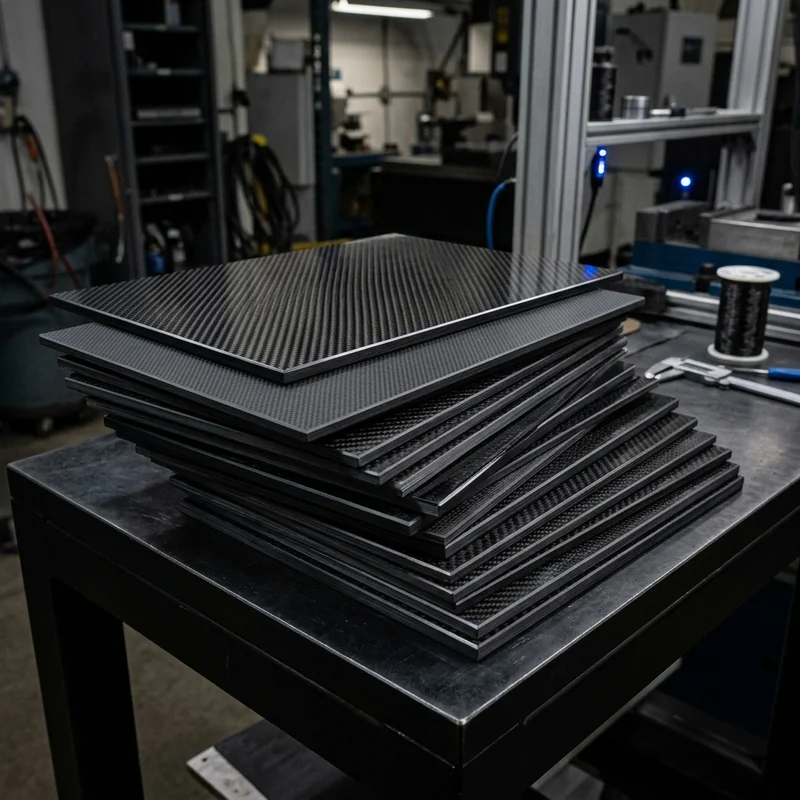
Carbon fiber standard plate-3k stripe
Lightweight, ultra-rigid standard sheets for drone fuselages, robot housings, facades and structural applications.

Carbon Fiber Plate — 3K Twill T700 1.5mm
Thin 1.5mm carbon fiber plate with 3K twill weave surface. Lightweight and stiff, commonly used for covers, panels, drone bodies, and applications requiring a premium aesthetic appearance.

Square Carbon Fiber Tube — 3K Twill T700
Square cross-section carbon fiber tube manufactured with 3K twill weave for torsional strength. Preferred for structural frames, trusses, and support columns where rectangular geometry offers design flexibility.

Carbon Fiber Plate — 3K Twill T700 3.0mm
Medium-thickness 3.0mm carbon fiber plate offering significantly higher load capacity while maintaining attractive 3K twill finish. Suitable for structural brackets, reinforcement plates, and load-bearing panels.
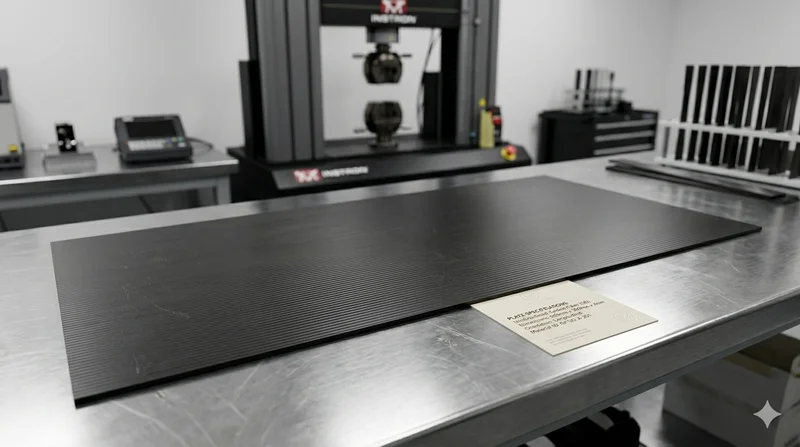
Carbon Fiber Plate — UD Unidirectional T700
Unidirectional carbon fiber plate with all fibers oriented in a single direction for maximum strength along the fiber axis. Essential for structural reinforcements, splints, and applications where load direction is predictable.