The qualification of high-performance carbon fiber for wind turbine spar caps represents one of the most demanding fatigue validation challenges in the renewable energy sector. Spar caps bear the primary structural load of wind turbine blades, experiencing billions of stress cycles over
Introduction
The qualification of high-performance carbon fiber for wind turbine spar caps represents one of the most demanding fatigue validation challenges in the renewable energy sector. Spar caps bear the primary structural load of wind turbine blades, experiencing billions of stress cycles over a 20-30 year service life. When Zhongfu Shenying's SYT80 fiber, classified as T1200 modulus, achieved batch installation in 4-16MW offshore wind blades within just 5 months, it demonstrated that accelerated qualification methodologies can compress what traditionally required 18-24 months of testing into a dramatically shorter timeline without compromising safety margins.
This rapid qualification represents a paradigm shift for the wind energy industry, where carbon fiber adoption has historically been constrained by lengthy material qualification processes. The 5-month cycle encompassed coupon-level fatigue testing, sub-component validation, full-scale blade testing, and production process qualification — an integrated approach that leverages modern fatigue analysis methods, advanced testing protocols, and digital fatigue life prediction tools. This article examines the qualification methodology, fatigue performance characteristics, and implications for offshore wind blade manufacturing.
SYT80/T1200 Material Characteristics
SYT80 carbon fiber belongs to the T1200 modulus class, positioned between standard modulus (T300/T700) and intermediate modulus (T800/T1000) fibers commonly used in wind energy applications. The material properties that make it attractive for spar cap applications include:
- Tensile modulus: 294 GPa (vs. 230 GPa for T700, 294 GPa for T800), providing the stiffness required for spar cap structural performance.
- Tensile strength: 5,880 MPa, offering sufficient margin for ultimate load cases while maintaining fatigue resistance.
- Strain to failure: 2.0%, balancing stiffness with damage tolerance for cyclic loading environments.
- Fatigue S-N characteristics: Superior fatigue exponent compared to standard modulus fibers, enabling thinner spar cap designs with equivalent fatigue life.
The fiber's surface treatment and sizing system are optimized for epoxy resin compatibility, achieving fiber volume fractions of 58-62% in unidirectional spar cap laminates. This fiber volume fraction range represents the practical maximum for vacuum infusion processes while maintaining adequate resin wet-out for long-term durability.
5-Month Rapid Qualification Methodology
The accelerated qualification pathway compressed the traditional 18-24 month timeline through several strategic innovations that maintained statistical confidence while reducing calendar time:
| Qualification Phase | Traditional Timeline | Rapid Timeline | Key Acceleration Factor |
|---|---|---|---|
| Coupon fatigue testing | 6-8 months | 8 weeks | High-frequency pulsation testing (100 Hz) |
| Sub-component validation | 4-6 months | 6 weeks | Parallel testing with coupon phase |
| Full-scale blade testing | 4-6 months | 8 weeks | Combined static/dynamic test protocol |
| Production process qualification | 2-4 months | 2 weeks | In-line process monitoring from first production |
| Total | 16-24 months | 20 weeks (5 months) | — |
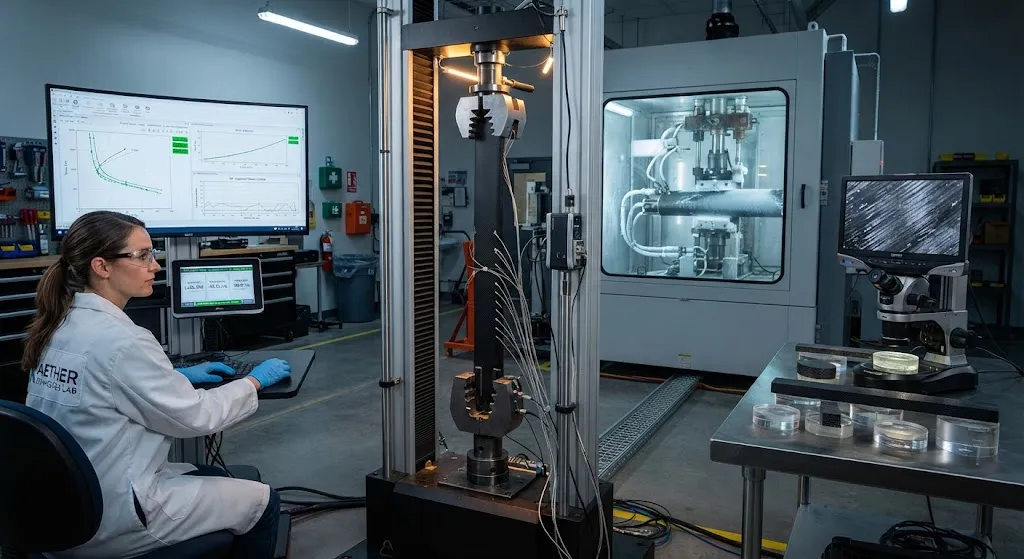
The coupon testing phase utilized resonance-based pulsation testing at 100 Hz rather than the conventional servo-hydraulic testing at 1-5 Hz. This approach reduces testing time by a factor of 20-100 while maintaining equivalent stress amplitude control. Statistical confidence was achieved through larger sample sizes (30+ specimens per load level vs. 6-8 in traditional testing), leveraging the speed of high-frequency testing to gather more data in less time.
Fatigue Performance Data
The fatigue validation generated comprehensive S-N data across the stress range relevant to spar cap applications. The following table summarizes key fatigue parameters for SYT80/T1200 unidirectional laminates at 60% fiber volume fraction:
| Fatigue Parameter | SYT80/T1200 | T700SC (Reference) | Improvement |
|---|---|---|---|
| S-N exponent (m) | 14.2 | 10.8 | +31% |
| Characteristic fatigue strength at 10^7 cycles (MPa) | 1,420 | 1,180 | +20% |
| Fatigue scatter factor (k) | 3.2 | 3.8 | -16% |
| Residual strength after 10^6 cycles (% of static) | 78% | 72% | +6% |
| Crack initiation site | Fiber/matrix interface | Fiber/matrix interface | — |
The higher S-N exponent of 14.2 compared to 10.8 for T700 translates directly to longer fatigue life at the same stress amplitude. For a spar cap experiencing 1,000 MPa alternating stress, SYT80 achieves approximately 3x the fatigue life of T700 at the same stress level — a margin that enables thinner, lighter spar cap designs while meeting 20-year fatigue life requirements.
Production Process Integration
The rapid qualification extended beyond material testing to include production process validation from the first batch. Key process parameters monitored during qualification included:
- Fiber placement tension: 12-15 N/tow for unidirectional tape, verified by inline tension sensors with statistical process control limits.
- Resin infusion flow front: Monitored using distributed temperature sensing along the spar cap length, ensuring complete wet-out before gel time.
- Cure cycle compliance: Real-time exotherm monitoring during oven cure, with peak temperature limits set at 180°C ± 5°C to prevent thermal degradation of the fiber-matrix interface.
- Void content: Target <1.5% by volume, verified by ultrasonic testing at 100% coverage on spar cap sections.
Production process data from the first 50 spar cap sets was analyzed using control chart methodology to establish process capability indices (Cpk > 1.33) for all critical parameters. This statistical evidence of process stability supported the decision to proceed with full production without extended pilot runs.
Frequently Asked Questions
How does the 5-month qualification timeline compare to industry standards for wind energy materials?
The 5-month timeline is significantly shorter than the 18-24 months typically required for new material qualification in wind energy. Traditional qualification follows a sequential path: coupon testing completes before sub-component testing begins, which completes before full-scale blade testing. The rapid approach overlaps these phases, runs coupon tests at much higher frequencies, and leverages digital fatigue life prediction to reduce the number of physical test specimens required. This methodology is gaining acceptance as fatigue analysis tools and material databases mature, but it requires strong statistical foundations and transparent data sharing with certification bodies. The approach is most applicable to材料 that have established fatigue performance databases — SYT80 benefits from extensive T700/T800 qualification data that reduces the uncertainty in accelerated testing.
What are the risks of accelerated fatigue qualification for spar cap applications?
Accelerated qualification carries several risks that must be managed through robust statistical methods. High-frequency testing may not capture rate-dependent effects that occur at lower frequencies in service, though this concern is mitigated by the predominantly elastic behavior of carbon fiber composites under fatigue loading. Larger sample sizes partially compensate for the reduced testing duration, but the approach assumes that the manufacturing process producing test specimens is representative of production — a critical assumption that requires rigorous process control. Additionally, accelerated qualification relies on the validity of S-N curve extrapolation to the 10^7-10^8 cycle range typical of 20-year blade service. This extrapolation is well-established for carbon fiber composites but requires material-specific validation. For SYT80, the risk is mitigated by the fiber's position in the T1200 class, where extensive qualification data from aerospace applications provides confidence in the extrapolation methodology.
Conclusion
The 5-month rapid qualification of SYT80/T1200 carbon fiber for wind turbine spar caps demonstrates that accelerated testing methodologies can dramatically reduce material qualification timelines while maintaining the statistical confidence required for safety-critical structural applications. The key enablers — high-frequency fatigue testing, parallel test phase execution, integrated production process monitoring, and digital fatigue life prediction — represent a maturation of wind energy material qualification practices that will accelerate carbon fiber adoption in offshore wind blades.
For blade manufacturers and wind farm developers, the implications are significant: faster qualification cycles translate directly to shorter time-to-market for next-generation blade designs, enabling the industry to meet aggressive offshore wind deployment targets. The SYT80 qualification data provides a reference methodology for other high-performance fiber systems seeking rapid qualification pathways. Explore our wind energy carbon fiber range, including T1200-class fibers qualified for spar cap applications, or contact our wind energy engineering team to discuss material qualification support for your blade programs.
Part of topic
Related Articles
- Bio-Based Carbon Fiber Precursors: Lignin and Polyethylene for Low-Cost Production
- Large-Tow Carbon Fiber Cost Analysis: 48K vs 60K Price-Performance Comparison
- Carbon Fiber-Resin Interface Bonding: Surface Treatment and Coupling Agent Optimization
- Digital Twin for Carbon Fiber Manufacturing: Real-Time Process Monitoring and Defect Prevention
- Thermoplastic Carbon Fiber Welding for Automotive: Ultrasonic and Induction Welding Process Windows
- Large-Tow Carbon Fiber Wet Spinning: Process Optimization for 48K/60K Production Efficiency
Interested in Custom Carbon Fiber Products?
Contact our team for competitive pricing and technical specifications.
Get a Quote