
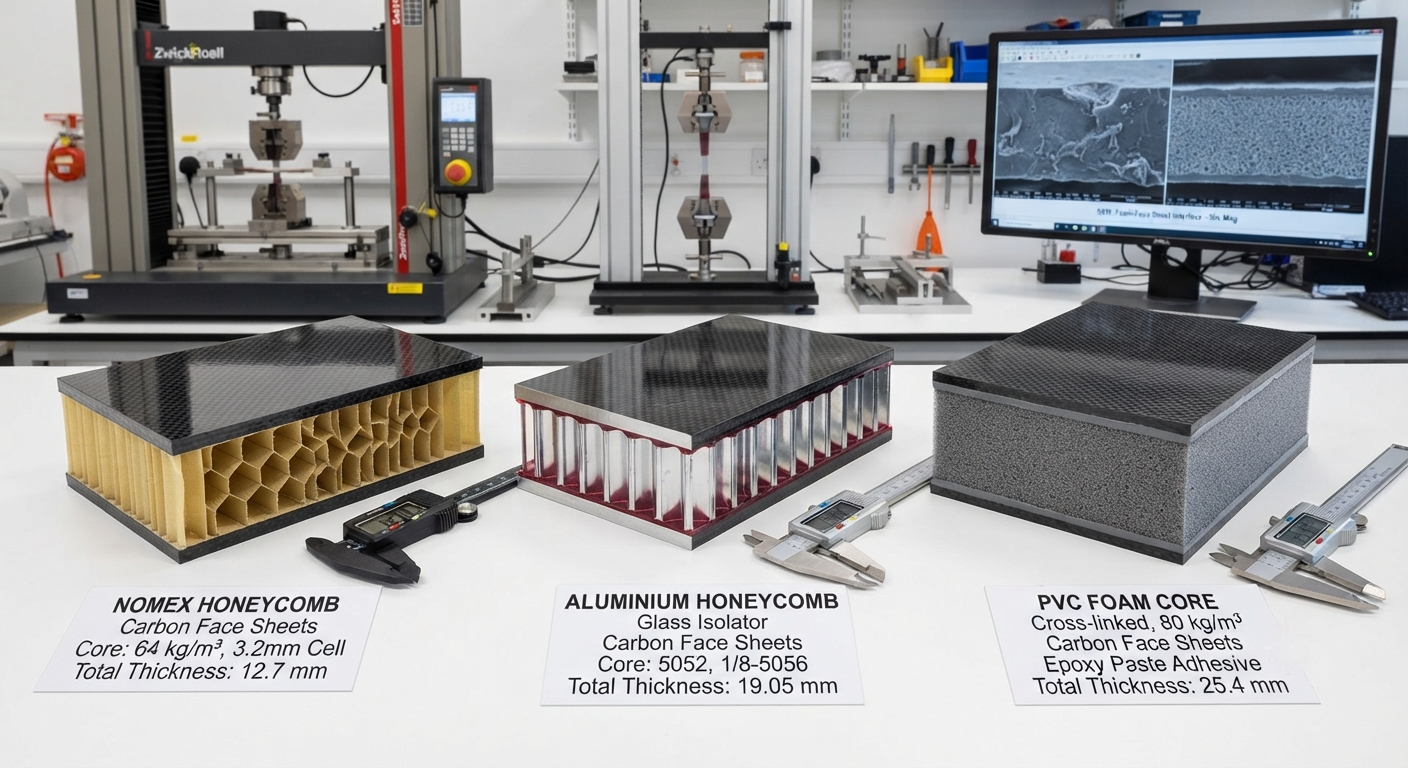
Comprehensive B2B technical comparison of carbon fiber sandwich panel core materials. Detailed analysis of Nomex honeycomb, aluminum honeycomb, cross-linked PVC foam, PET foam, and PMI foam with a 10-row comparative property table (density, compressive strength, shear strength/modulus, temperature limits, thermal conductivity, FST performance, galvanic compatibility, cost index). Sector-specific recommendations with a 7-row application recommendation table for aerospace interiors, aerospace floors, marine hull/deck, railway, wind blade shear webs, and industrial panels. Includes adhesive system selection guidance, environmental durability analysis (moisture, thermal cycling, FST), cost analysis ($130-$500/m² total panel cost by core type), repairability comparison, and 2026 recyclability trends with PET foam market growth data (14% CAGR).
Introduction to Carbon Fiber Sandwich Core Materials for Structural Panels
Carbon fiber sandwich panels are a class of advanced composite structures consisting of two thin, high-strength carbon fiber face sheets bonded to a lightweight core material. This construction principle — analogous to an I-beam, where the face sheets carry bending loads as flanges and the core acts as the shear web — achieves exceptional stiffness-to-weight and strength-to-weight ratios that are unattainable with monolithic carbon fibre laminates of equivalent mass. For B2B buyers in aerospace, marine, transportation, and industrial sectors, selecting the optimal core material for a carbon fiber sandwich panel application requires a systematic comparison of mechanical properties, environmental resistance, manufacturing compatibility, and cost.
The global market for carbon fiber sandwich panel core materials was valued at approximately $1.2 billion in 2025, with demand projected to reach $1.9 billion by 2031 at a CAGR of 8.1%. Three core material families dominate the market: Nomex (aramid fibre) honeycomb (38% share), aluminium honeycomb (32%), and structural polymer foams (25%), with balsa wood and specialised materials accounting for the remaining 5%. Each material family offers distinct performance characteristics that make it suitable for specific end-use applications, and the selection decision must be grounded in quantitative engineering data rather than generalised assumptions.
Core Material Families: Composition and Manufacturing
Nomex (Aramid Fibre) Honeycomb
Nomex honeycomb is manufactured from meta-aramid fibre paper (DuPont™ Nomex® or equivalent) that is dip-coated in phenolic resin, expanded into a hexagonal cell geometry, and heat-cured to set the cell structure. The resulting core material combines low density (29–128 kg/m³), excellent fire-smoke-toxicity (FST) performance, superior dielectric properties (transparent to radio frequencies), and high specific shear strength. Nomex honeycomb is the preferred core material for aerospace interior panels, radomes, and secondary structures where FST compliance (FAR 25.853, Airbus ABD0031, Boeing BMS 8-124) is mandatory. Cell sizes typically range from 1.6 mm (1/16 in) to 9.5 mm (3/8 in), with larger cells offering lower density at the expense of core crush strength and face sheet waviness (telegraphing).
Aluminium Honeycomb
Aluminium honeycomb is manufactured by adhesive bonding of thin aluminium foil sheets (typically AA 5052, AA 5056, or AA 3000 series, 25–100 µm foil thickness) into a stack, which is then expanded into a hexagonal cellular structure. Aluminium honeycomb offers the highest absolute shear strength and compressive strength among common core materials at equivalent density, combined with excellent thermal conductivity (170–210 W/m·K), which can be advantageous for heat-dissipating applications. However, it is susceptible to galvanic corrosion when in contact with carbon fiber face sheets (requiring a glass fibre isolation layer), has relatively poor FST performance compared to Nomex, and is electrically conductive, which may be undesirable for certain aerospace and electronics applications.
Structural Polymer Foams (PVC, PET, PMI, and SAN)
Structural polymer foams are closed-cell rigid foams manufactured through various polymerisation and blowing processes. The four primary foam types for carbon fiber sandwich applications are: (a) PVC (polyvinyl chloride) foam — the most widely used structural foam, offering good strength-to-weight ratio, excellent toughness, and broad chemical resistance. Cross-linked PVC foams (e.g., Divinycell H series from Diab) provide higher temperature capability (up to 90°C continuous) compared to linear PVC. (b) PET (polyethylene terephthalate) foam — a recyclable thermoplastic foam with good FST properties, increasingly specified in transportation and marine applications where recyclability is a procurement requirement. (c) PMI (polymethacrylimide) foam — the highest-performance structural foam, with continuous service temperature up to 180°C, excellent compressive creep resistance, and compatibility with autoclave cure cycles. Rohacell® (Evonik) is the dominant PMI foam brand, primarily used in aerospace primary structures. (d) SAN (styrene-acrylonitrile) foam — offers intermediate performance between PVC and PET, with good toughness and the ability to be thermoformed into complex 3D shapes.
| Property | Nomex Honeycomb | Aluminium Honeycomb | PVC Foam (Cross-linked) | PET Foam | PMI Foam |
|---|---|---|---|---|---|
| Core Density Range (kg/m³) | 29–128 | 32–130 | 40–250 | 70–250 | 32–200 |
| Typical Density for Panels (kg/m³) | 64 (3.2 mm cell) | 83 (3.2 mm cell) | 80 (H80 grade) | 100 (A100 grade) | 51 (IG 51 grade) |
| Compressive Strength (MPa) at 80 kg/m³ | 2.8 (L direction), 1.5 (W) | 5.2 (L), 3.1 (W) | 1.45 | 1.2 | 1.5 |
| Shear Strength (MPa) at 80 kg/m³ | 1.6 (L), 0.9 (W) | 3.1 (L), 1.8 (W) | 1.1 | 0.9 | 1.3 |
| Shear Modulus (MPa) at 80 kg/m³ | 110 (L), 55 (W) | 380 (L), 190 (W) | 35 | 30 | 42 |
| Max Continuous Service Temp (°C) | 180 (phenolic dip) | 200 (alloy dependent) | 80 (standard), 90 (cross-linked) | 100 | 180 |
| Thermal Conductivity (W/m·K) | 0.08–0.15 | 0.5–2.0 (through-thickness) | 0.03–0.05 | 0.04–0.06 | 0.03–0.05 |
| FST Performance (UL 94 / FAR 25.853) | V-0 / Self-extinguishing | Non-combustible (melt only) | V-0 to HB (grade dependent) | V-0 (with additives) | V-0 |
| Galvanic Compatibility with CFRP | Compatible (non-conductive) | Requires GFRP isolation layer | Compatible (non-conductive) | Compatible | Compatible |
| Relative Cost Index (per m³) | 1.8–2.5 | 1.0 (baseline) | 1.2–1.6 | 0.8–1.1 | 3.0–5.0 |
Selection Criteria for B2B Panel Applications
The selection of an appropriate core material must consider multiple interconnected factors. The following decision framework is structured by application sector, with quantitative comparison of core performance relevant to each use case:
Aerospace Interior and Secondary Structures
Aerospace applications — including cabin paneling, overhead stowage bins, galley structures, lavatory modules, and cargo liners — impose the most demanding FST requirements in the composites industry. Nomex honeycomb is the near-universal choice for these applications, driven by its compliance with FAR 25.853 (12-second vertical burn test, heat release ≤ 65 kW/m² per FAR 25.853(d), smoke density ≤ 200 per FAR 25.853(c)). The phenolic resin dip coating of Nomex paper provides inherent flame resistance, and the aramid fibre structure does not melt or drip. Key specifications for aerospace sandwich panels include: (a) Core density: typically 48–80 kg/m³ Nomex honeycomb with 3.2 mm (1/8 in) cell size; (b) Face sheets: 2–4 plies of woven carbon fiber prepreg (e.g., 3K plain weave or 2x2 twill, 0.25 mm cured ply thickness per ply); (c) Adhesive: epoxy film adhesive (e.g., Solvay FM 73, Hexcel Redux 312) at 200–400 g/m² areal weight. PMI foam (Rohacell) is used in aerospace floor panels and control surfaces where higher compressive strength in thin-gauge panels (< 10 mm total thickness) is required, accepting the 3–5× cost premium over Nomex.
Marine Structural Panels
Marine applications — including hull structures, decks, bulkheads, and superstructures for high-speed vessels, workboats, and luxury yachts — require core materials with excellent moisture resistance, impact toughness, and compatibility with wet layup or infusion manufacturing processes. Cross-linked PVC foam (Divinycell H series) is the predominant choice, offering a proven track record spanning more than 40 years of marine construction. Key specifications: (a) Core density: 60–100 kg/m³ for primary structures (deck, hull bottom); 80–130 kg/m³ for high-load areas (keel, engine mounts, appendage attachments); (b) Face sheets: carbon fiber/epoxy laminate (typically 600–1,200 g/m² areal weight per face) manufactured by vacuum infusion or prepreg; (c) Core thickness: 15–40 mm for hull panels; 10–25 mm for decks and bulkheads. PET foam (e.g., Diab Divinycell P series) is gaining adoption in marine applications where recyclability is a procurement requirement, driven by IMO regulations on end-of-life vessel recycling and the EU Ship Recycling Regulation. PET foam offers 30–50% lower cost than cross-linked PVC, with approximately 15–25% lower mechanical properties at equivalent density.
Transportation and Railway
Railway and mass transit vehicles require core materials that meet EN 45545-2 fire safety classification (HL1, HL2, HL3 depending on vehicle category). PET foam with fire-retardant additives (e.g., Diab Divinycell PX series, Gurit Corecell T-series) is increasingly preferred in European rail applications due to its combination of FST compliance, recyclability, and cost-effectiveness. Aluminium honeycomb with non-woven glass fibre scrim is used in high-traffic floor panels where compressive strength and wear resistance are critical. PMI foam is specified for roof panels and driver's cabin structures requiring higher temperature resistance. Key considerations for railway panels include: (a) EN 45545-2 compliance for smoke density (Ds(4) ≤ 150) and heat release rate (MARHE ≤ 60 kW/m²); (b) Core density typically 80–130 kg/m³ for floor panels; (c) Impact resistance to EN 1263-2 and EN 13155 for panel structural integrity under dynamic loading.
Wind Energy and Industrial Applications
Wind turbine blade shear webs and nacelle covers increasingly use PET foam and cross-linked PVC foam cored sandwich panels. PET foam is the dominant choice for blade shear webs due to its compatibility with vacuum-assisted resin transfer moulding (VARTM) processing and the increasing emphasis on blade recyclability. Balsa wood — historically used in blade cores — is being phased out in favour of synthetic foams due to variability in mechanical properties, moisture sensitivity, and limited availability of certified marine-grade balsa. Industrial applications — including automotive body panels, truck trailer sidewalls, material handling equipment, and construction panels — typically select PET foam or linear PVC foam based on cost optimisation. For these applications, the core material decision is driven by cost per unit stiffness (Pa·m³/€) rather than absolute mechanical performance.
| Application Sector | Recommended Core Material | Key Driver | Typical Density (kg/m³) | Core Thickness (mm) | Face Sheet Architecture | Manufacturing Process |
|---|---|---|---|---|---|---|
| Aerospace interiors | Nomex honeycomb | FST compliance (FAR 25.853) | 48–80 | 6–20 | 2–4 plies woven CF prepreg | Autoclave / press cure |
| Aerospace floors | PMI foam (Rohacell) | Compressive strength at thin gauge | 51–110 | 8–16 | 2–4 plies woven CF prepreg | Autoclave |
| Marine hull/deck | Cross-linked PVC foam | Moisture resistance, toughness | 60–100 | 15–40 | 600–1,200 g/m² CF laminate | Vacuum infusion / prepreg |
| Marine (recyclable) | PET foam | Recyclability (EU regulation) | 80–130 | 15–30 | 600–1,200 g/m² CF laminate | Vacuum infusion |
| Railway floor | Al honeycomb / PET foam | Compressive strength / FST | 80–130 | 15–30 | CF or glass/epoxy | Press / vacuum bag |
| Wind blade shear web | PET foam | VARTM compatibility, cost | 60–100 | 10–25 | Biaxial CF fabric / infusion | VARTM |
| Industrial panels | PET / linear PVC foam | Cost per unit stiffness | 80–150 | 8–20 | CF or hybrid CF/glass | Press / infusion |
Core-to-Face Sheet Bonding: Adhesive Systems and Considerations
The interface between the carbon fiber face sheet and the core material is the most critical bond line in a sandwich panel. Failure at this interface — disbonding — is the most common failure mode in sandwich structures and can lead to catastrophic panel collapse. The selection of the adhesive system and bonding process must account for core material type, face sheet material, manufacturing process, and service environment:
- Film adhesives for honeycomb cores: Nomex and aluminium honeycomb cores are typically bonded to carbon fiber face sheets using epoxy or phenolic film adhesives with a carrier scrim (nylon or polyester non-woven fabric, 40–120 g/m²). The adhesive film is placed between the core and face sheet during layup; during cure, the adhesive flows to form a fillet at the cell wall-to-face sheet junction. The fillet geometry (height of 1–3 mm, radius of 0.5–1.5 mm) is critical for peel strength. Peel strength testing per ASTM D1781 or climbing drum peel test per ASTM D3167 is used to qualify adhesive bond performance. Minimum peel values for aerospace sandwich panels are typically 15–25 N·mm/mm of width for 3.2 mm cell honeycomb.
- Syntactic paste and film adhesives for foam cores: Polymer foam cores are bonded using either: (a) Epoxy film adhesive (same as honeycomb bonding) for prepreg face sheets cured in autoclave or hot press; (b) Two-part epoxy paste adhesive for co-bonding with wet-layup or infusion face sheets. The advantage of paste adhesive is its ability to fill minor surface irregularities in foam core (typical foam surface roughness Ra = 50–150 µm). Key quality parameters include: adhesive thickness (target 0.15–0.30 mm for film; 0.5–1.5 mm for paste), void content (< 2% by area per micrographic examination), and adhesion strength verified by flatwise tensile testing per ASTM C297.
- Co-curing vs. secondary bonding: Co-curing (curing the face sheet prepreg and adhesive simultaneously) reduces manufacturing steps and improves bond quality through chemical cross-linking between the prepreg resin and adhesive. However, foam cores with limited temperature capability (< 90°C continuous) cannot survive autoclave cure cycles (120–180°C, 3–7 bar). For these systems, secondary bonding using room-temperature or low-temperature (60–80°C) curing adhesives is required, accepting a 15–25% reduction in peel strength compared to co-cured bonds.
Durability and Environmental Resistance
Sandwich panel durability depends critically on the core material's resistance to environmental degradation mechanisms:
- Moisture ingress: Water intrusion into sandwich panels is a primary failure mechanism, particularly in marine and aerospace applications. Nomex honeycomb is inherently hygroscopic (equilibrium moisture content at 50% RH = 4–6% by weight) and can experience significant strength reduction when saturated (up to 30% reduction in shear strength at 90% RH). Aluminium honeycomb is not hygroscopic but can suffer from corrosion at cell walls in the presence of moisture, particularly at galvanic cells formed with carbon fiber face sheets. PVC and PET foams have closed-cell structures with low water absorption (< 2% by weight for PVC; < 1.5% for PET after 24-hour immersion per ASTM D2842). PMI foam has the lowest water absorption (< 1%). Mitigation measures include: edge sealing of panels with polysulphide or polyurethane sealants, use of moisture-barrier films, and periodic inspection using ultrasonic C-scan or thermography to detect moisture accumulation.
- Thermal cycling and fatigue: Differential thermal expansion between the carbon fiber face sheet (CTE ≈ 0–2 ppm/°C in-plane) and the core material creates thermal stresses during service temperature excursions. For Nomex honeycomb (CTE ≈ 20–30 ppm/°C in-plane), the CTE mismatch with CFRP is significant, requiring careful design of edge closures and core splice joints. Aluminium honeycomb (CTE ≈ 23 ppm/°C) presents a similar mismatch. Foam cores (CTE ≈ 60–90 ppm/°C for PVC; 50–80 ppm/°C for PET) have even larger CTE mismatch, but the lower modulus of the foam (E ≈ 30–100 MPa) results in lower induced stresses. Fatigue performance of sandwich panels is dominated by the face sheet-to-core bond line; well-designed panels can sustain 10⁷ fatigue cycles at 30–50% of static ultimate load without disbond propagation. Boeing BSS 7364 and Airbus AITM 1-0010 provide standardised fatigue testing protocols for aerospace sandwich panels.
- Fire, smoke, and toxicity (FST): FST performance is the most consequential selection criterion for aerospace and rail applications. Nomex honeycomb with phenolic dip coating provides the best FST performance, meeting FAR 25.853 and OSU heat release ≤ 65/65 kW·min/m² for aerospace interiors. Aluminium honeycomb — while non-combustible as a material — can conduct heat along cell walls, potentially spreading fire through a panel. Foam cores require fire-retardant additives to meet FST requirements; cross-linked PVC achieves V-0 rating (UL 94) with flame-retardant formulations, while PET foam requires brominated or phosphorus-based FR additives (5–15% by weight) to achieve V-0. PMI foam achieves V-0 without additives up to 110 kg/m³ density, with OSU heat release < 50/50 kW·min/m² (Rohacell Airstar grade).
Frequently Asked Questions
What is the maximum service temperature for PVC-foam-cored carbon fiber sandwich panels?
Standard cross-linked PVC foams (e.g., Diab Divinycell H series, Gurit Corecell M series) have a maximum continuous service temperature of approximately 80°C, with short-term excursions (≤ 1 hour) acceptable up to 100°C. High-temperature cross-linked PVC grades (e.g., Divinycell HT series) extend continuous service to 95°C and short-term excursions to 120°C. These temperature limits are determined by the glass transition temperature (Tg) of the PVC polymer (typically 125–135°C for cross-linked grades). For applications requiring service temperatures above 100°C — such as engine-bay enclosures, aerospace flight surfaces, or near-hot-structure areas — PMI foam (Rohacell, 180°C continuous) is required. It should be noted that the epoxy adhesive used for face sheet bonding typically has a lower service temperature (80–120°C for standard structural adhesives; 150–200°C for high-temperature aerospace adhesives) and may be the limiting factor in the sandwich panel's overall temperature capability.
How do I prevent galvanic corrosion between aluminium honeycomb core and carbon fiber face sheets?
Galvanic corrosion occurs when aluminium (anode) is in electrical contact with carbon fiber (cathode) in the presence of an electrolyte (moisture). The potential difference between CFRP (0.3–0.5 V vs. SCE) and aluminium (-0.8 to -0.9 V vs. SCE) drives a galvanic current that corrodes the aluminium core at the cell wall-to-face sheet interface. Prevention requires: (a) A glass fiber isolation layer — a single ply of 0.1–0.2 mm E-glass or S-glass prepreg (or woven fabric in wet layup) must be placed between the carbon fiber face sheet and the aluminium honeycomb core, serving as an electrical insulator. The GFRP layer must extend across the entire core-bonding interface without gaps or breaks. (b) Full encapsulation — the aluminium core must be completely sealed from moisture ingress using edge seals, with no exposed cell walls at panel edges, cutouts, or fastener holes. (c) Corrosion-inhibiting primer (e.g., MIL-PRF-23377 epoxy primer with strontium chromate) applied to aluminium foil surfaces before honeycomb manufacture, although this is typically done at the honeycomb supplier level. (d) Stainless steel or titanium fittings for mechanical attachments — never use aluminium fasteners in CFRP/aluminium honeycomb panels. If galvanic isolation cannot be guaranteed, Nomex honeycomb or foam cores should be selected instead of aluminium honeycomb for CFRP-faced panels.
What are the cost differences between core materials for a typical 1 m² carbon fiber sandwich panel?
For a 1 m² carbon fiber sandwich panel with 15 mm core thickness and 80 kg/m³ core density — representative of a marine deck panel or industrial panel application — the core material cost breakdown is as follows (2026 pricing, approximate USD): Cross-linked PVC foam (Divinycell H80): $28–$45 per m². PET foam (Divinycell PX100): $22–$38 per m². Aluminium honeycomb (3.2 mm cell, 83 kg/m³): $35–$55 per m². Nomex honeycomb (3.2 mm cell, 64 kg/m³): $65–$95 per m². PMI foam (Rohacell 51 IG): $110–$180 per m². The total sandwich panel cost includes additional materials (carbon fiber face sheets: 600 g/m² each face = 1,200 g/m² total × $30–$45/kg = $36–$54 per m²; epoxy resin system for infusion: $8–$15 per m²; adhesive film: $5–$12 per m²) plus manufacturing costs (layup labour: $30–$60 per m²; consumables (vacuum bag, peel ply, breather): $10–$20 per m²; oven/autoclave cycle: $15–$40 per m²). The total manufactured panel cost ranges from approximately $130 per m² (PET foam, infusion process) to $360 per m² (Nomex honeycomb, autoclave process). PMI-foam aerospace panels with autoclave-cured prepreg face sheets range from $280 to $500 per m².
Can carbon fiber sandwich panels be repaired, and how does core material choice affect repairability?
Yes, sandwich panels can be repaired, and the core material significantly influences repair feasibility and procedure. For foam-cored panels: (a) Damage is removed by routing or grinding a stepped scarf in the face sheet and core, using a 20:1 to 30:1 scarf ratio. (b) The core is replaced by fitting a precisely machined foam plug (or Nomex plug for foam cores) bonded with paste adhesive. (c) The face sheet is rebuilt using prepreg or wet layup patches (same fibre architecture as original) cured at room temperature for 24 hours or at 80°C for 2 hours using portable heating blankets. For honeycomb-cored panels, repair is more complex because: (a) Moisture trapped in the honeycomb cells must be removed by drilling weep holes and drying (4–24 hours at 70–90°C), known as the dry-out process. (b) Potting compound (epoxy filled with microballoons, 0.5–1.2 g/cm³ density) is injected into damaged cells to create a solid substrate for patch bonding. (c) The cured potting compound must be machined flush with the core surface before patch application. Sandwich panel repairs can typically restore 75–90% of original static strength and 60–80% of original fatigue life. Nomex honeycomb panels are generally considered more repairable than aluminium honeycomb, because Nomex core can be machined and potted more easily. Foam cores offer the simplest repair process because foam plugs can be shaped to match the removed core without requiring potting or dry-out steps.
How do I specify a Nomex honeycomb core for an aerospace carbon fiber sandwich panel?
An aerospace Nomex honeycomb core specification should include: (1) Core material: specify Nomex (meta-aramid) paper, phenolic resin dip-coated. Acceptable commercial grades include DuPont Nomex (all grades), Hexcel HRH-10, Euro-Composites ECA-48, or equivalent. (2) Density: specify nominal density in kg/m³ (typically 48, 64, 80, or 128 kg/m³) with tolerance per ASTM D6576 (± 5% at the time of manufacture). (3) Cell size: specify hexagonal cell dimension (mm or fractions of inch). Common sizes: 1.6 mm (1/16 in) for thin/curved panels; 3.2 mm (1/8 in) for general interiors; 4.8 mm (3/16 in) for flat panels with moderate loading; 6.4 mm (1/4 in) for non-structural fairings. (4) Bare compressive strength (ASTM D7336) and plate shear strength (ASTM C273) at the specified density — these are material property values provided by the manufacturer and should be verified via incoming inspection on a per-lot basis. (5) Non-standard requirements: (a) Stabilised compressive strength after exposure to 95% RH at 50°C for 30 days per ASTM D6576; (b) Core flatness tolerance (typically ≤ 0.5 mm variation over 300 mm span for aerospace interiors); (c) Surface preparation — core may be specified as unsliced (solid block, user slices) or pre-sliced to thickness with specified tolerance (± 0.13 mm for precision panels). (6) Procurement certification: supplier must provide ASTM D6576 compliance certification, batch-specific mechanical test data, and material traceability documentation meeting AS9100D requirements.
What is the trend toward recyclable core materials in 2026, and how does it affect material selection?
The trend toward recyclable core materials is accelerating in 2026, driven by three forces: (a) EU regulatory framework — the European Union's End-of-Life Vehicles Directive (2000/53/EC) and the Ship Recycling Regulation (1257/2013) impose recycling and recovery rates of 85–95% by weight for vehicles and vessels, driving the specification of thermoplastic (recyclable) core materials. (b) OEM sustainability pledges — major aerospace (Airbus, Boeing), automotive (BMW, Volvo), and wind energy (Vestas, Siemens Gamesa) OEMs have published 2030–2040 sustainability roadmaps that include recyclable material content targets of 25–50% by 2030. (c) Thermoplastic foam availability — advances in PET foam manufacturing have improved the mechanical property consistency and temperature capability (now up to 100°C continuous service) of recyclable PET foams to within 15–25% of cross-linked PVC foam properties at equivalent density. PET foam is the primary beneficiary of the recyclability trend, with global PET foam demand growing at 14% CAGR (versus 6% for cross-linked PVC and 4% for Nomex honeycomb in non-aerospace applications). Balsa wood — a natural, renewable core — is experiencing renewed interest as a bio-based core for low-temperature (≤ 80°C) industrial panels, but its inherent property variability (± 20–30% in mechanical properties across shipments) and moisture sensitivity remain significant drawbacks. For B2B buyers developing new products in 2026–2027, specifying PET foam as the default core material with provision for upgrading to cross-linked PVC or Nomex honeycomb only where temperature, FST, or specific mechanical requirements cannot be met by PET represents the most forward-looking core material strategy.
Part of topic
Related Articles
- Bio-Based Carbon Fiber Precursors: Lignin and Polyethylene for Low-Cost Production
- Large-Tow Carbon Fiber Cost Analysis: 48K vs 60K Price-Performance Comparison
- Carbon Fiber-Resin Interface Bonding: Surface Treatment and Coupling Agent Optimization
- Digital Twin for Carbon Fiber Manufacturing: Real-Time Process Monitoring and Defect Prevention
- Thermoplastic Carbon Fiber Welding for Automotive: Ultrasonic and Induction Welding Process Windows
- Large-Tow Carbon Fiber Wet Spinning: Process Optimization for 48K/60K Production Efficiency
Interested in Our Products?
Contact our team for competitive pricing and technical specifications.
Get a QuoteRelated Products
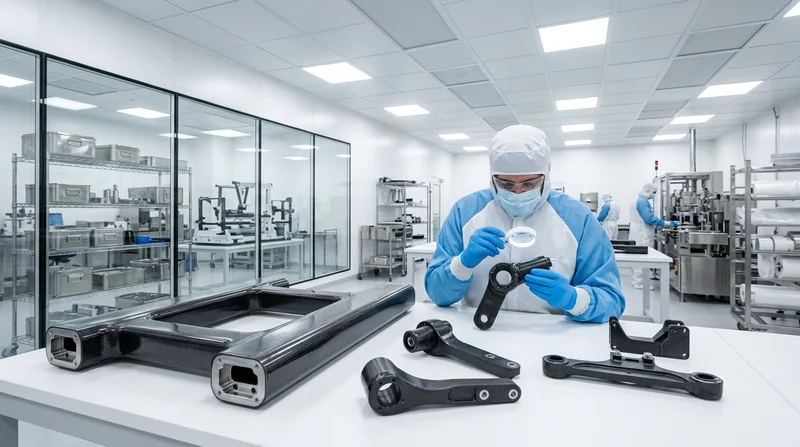
Custom Carbon Fiber Medical Device Components
Medical-grade carbon fiber components manufactured for imaging equipment, surgical instruments, and patient support systems. Carbon fiber's radiolucency (X-ray transparency) and high strength-to-weight ratio make it ideal for CT scanner beds, wheelchair frames, surgical robot arms, and MRI-compatible accessories. Biocompatible resin systems available.
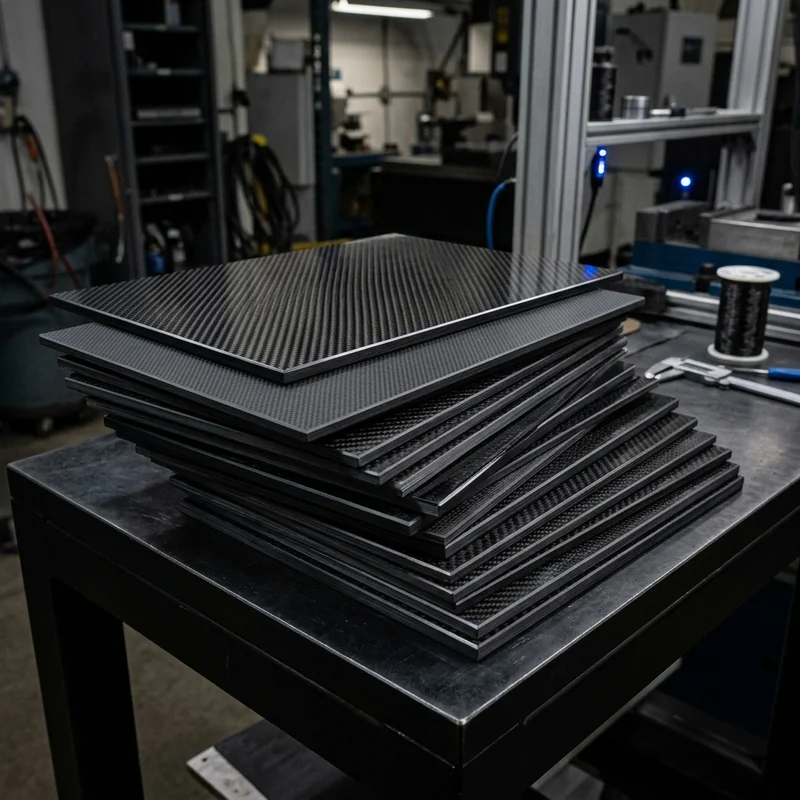
Carbon fiber standard plate-3k stripe
Lightweight, ultra-rigid standard sheets for drone fuselages, robot housings, facades and structural applications.

Square Carbon Fiber Tube — 3K Twill T700
Square cross-section carbon fiber tube manufactured with 3K twill weave for torsional strength. Preferred for structural frames, trusses, and support columns where rectangular geometry offers design flexibility.

Carbon Fiber Plate — 3K Twill T700 3.0mm
Medium-thickness 3.0mm carbon fiber plate offering significantly higher load capacity while maintaining attractive 3K twill finish. Suitable for structural brackets, reinforcement plates, and load-bearing panels.

Carbon Fiber Plate — 3K Twill T700 1.5mm
Thin 1.5mm carbon fiber plate with 3K twill weave surface. Lightweight and stiff, commonly used for covers, panels, drone bodies, and applications requiring a premium aesthetic appearance.